• Sample Page

Tom's Musings

  • The ‘Divided’ States of America.

    April 19th, 2023

    Before launching into my rant of the day, a couple of quick notes:

    First, Fox News has settled with Dominion Inc., the voting machine company that sued them for $1.6 billion for intentionally defaming the company with false news reports of irreguarities in their voting machines. Fow will reportedly kick over $787 million to Dominion. Sounds like a lot of money until you realize that Fox has over $4 billion in cash on hand and the company is worth $17 billion. Who knew that spewing propoganda was so profitable. [Actually, that was obvious to amy moron out there … there really are a lot of Bubbas to be scammed.]

    Second, let us not forget that we hit the legal U.S. debt ceiling of $31 trillion in January. The wizards at Treasury are keeping the economy going with smoke and mirrors. Their magic will run out sooner rather than later. When that happens, and if the ceiling is not raised by Congress, we will not be able to borrow money to pay our debts. The U.S. will officially and publicly become a banana republic. The economic fallout is hard to imagine but hard line Republicans could care less.

    Now to the main event of the day! Aren’t you excited? The Center for Communication and Civic Renewal (CCCR) at the University of Wisconsin has just released a report exploring what they called the civic fracture growing in the Badger State, long known for Midwest niceness, though not as nice as Minnesota which was ranked as the least rudest state in the union recently. I definitely want a recount on that one.

    The UW researchers surveyed over 3,000 residents on a variety of issues. One thing that stands out is our growing disconnect with one another. Some 60% responded that they have stopped talking as much about politics because the topic has become toxic, twice the proportion measured just a decade ago. Some 17% reported losing connection with a close friend or family member over a political dispute. The researchers concluded that “we are bcoming more polarized” and that we are “less able to think about ways that we can at least reach common ground, or at least reach and understand opposing perspectives.”

    I thought about this from my own experience. When Mary and I wintered in Florida, we had a home that was in a golf club community comprised of mostly Republicans (based on impression) but lived in one of the smaller ‘villages’ within the community that was more of a 50-50 political split. Our smaller community got along because there was a tacit understanding to avoid politics. That agreement was fraying toward the end of our stay there as Obama’s election spawned first the ‘Tea Party’ and then the ‘Trump’ fiasco.

    The civility we had managed to maintain was fraying at the edges, at least in my opinion. I recall leaving one social event rather that confront some neighbors over what I considered total nonsense. Obamacare was NOT a Communist plot in my opinion. Okay, I have become crankier in my dotage but the level of common sense has been quickly eroding. My next door neighber there told me story that captured the changes. After the 2020 election, a new resident in the village was absolutely sure Trump would be retuned to power by April of 2021. He was willing to bet $500 he was so positive. Another neighbor took that bet and gleefully took his money when the April deadline passed. Yup, seeing different realities.

    Some 66% of the Wisconsin survey respondents agreed that democracy in America is weaker than it used to be though people come at that pessimistic view from different perspectives. Some focused on increased voting impediments. Low-income residents were 3 times as likely to report issues in casting their votes than wealthier respondents. Younger voters were twice as likely to report issues than older farts. Over 30% of Blacks, Jews, and Muslims have become less involved in politics because of some level of fear, or so they report.

    It is no secret that Wisconsin Republicans have been engaged in voter suppression tactics since they assumed control of the Assembly and Senate earlier in this century. That is how the Badger State earned the dubious honor of being the most gerrymandered state in the Union and how Republicans have gained a ‘super-majority’ of local seats even as they lose Statewide contests more often than not in recent years. So much for the rule of the majority.

    Republicans are concerned about a separate set of issues. Some 77% fear that traditional views (or what they care about) are under attack. Some 43% expressed a belief that force may well be necessary to save their values, traditions, and way of life. And 29% agree that citizens may be pushed to take the law in their own hands. Since I don’t watch Fox or Newsmax or One America, I don’t know what kind of propoganda they receive on a daily basis, but it appears that they see their world disintegrating around them.

    None of this is news to anyone paying the least bit of attention. I live in Dane County, a highly educated and affluent liberal mecca. You might call it a bubble. In the past election, over 80 percent of the voters went for the very liberal Supreme Court candidate (over her hard right opponent) and the turnout in the county was huge for an off-season election. If, however, you go far beyond the borders of the county into more rural parts of the state, you run into a totally different country. The cultural differences are stark.

    This rural-urban split is palpable. There are many gaps between these two worlds in race and ethnicity, in education, in social and economic opportunities, and in world views. Many Americans see their world vanishing in the face of demographic change, technological revolutions, and disruptive cultural eruptions. When fed by hard-right news outlets and a political party dedicated to using division and fear as weapons, you have the ingredients for the disintegration of what we call the ‘United’ States, even if that were never totally the case in reality.

    Our divisions are not new by any stretch. But they do seem sharper now. The communication bridge appears more daunting. Our willingness to communicate and tolerate is waning. It is for me and I feel bad about that. It could be age or it could be that the ‘other’ side really has become batshit crazy. The latter definitely seems to be the case though the ‘cranky old geezer’ explanation cannot be discounted..

  • A ‘Requiem’ for America!

    April 18th, 2023

    I was going to follow up with a few more reflections on the AI revolution that has been capturing so much attention these days, and which I have touched on more than once. As is often the case, my restless mind was captured by several news items of the moment … current headlines that beg for comment.

    In Florida, two crazies traveling on the highway with their families got into a Macho one upmanship game that oft leads to road rage. And it did. After the usual dodge-em antics, one threw a full water bottle into the other car which escalated the incident to an exchange of gunfire. The victims were two children, one of the daughters in each car. Fortunately, they will survive but will likely be scarred by the incident.

    Then we have the story of Ralph Paul Yarl. He was a 16 year old black student in Missouri who was sent by his mother to pick up his younger siblings. Described by a former teacher as a ‘gifted student and gentle soul’ he mistakingly went to a house located on a Street when he should have gone to the same address on a Terrace, a mistake any of us might make. The elderly white owner of the residence, seeing a Black youth ringing his door bell, immediately opened fire. He hit the boy twice.

    Just another day in America. At least the victims above are alive. In Dadeville Alabama, a gunman opened up at a Sweet Sixteen party. So far, four are dead and over two dozen wounded. As of this writing little is known about the perpetrator or any motives but this shooting took place in a town of 3,000 not known for vilolence. Those slain seem, at first glance, to be your average youth enjoying a joyous event. It is the 160th mass shooting of 2023, and we are not yet one-third the way through the calendar year. God Bless America!

    Why do these things happen so often in the ‘land of the free and home of the brave?’ In the road rage incident, the usual frustrations associated with traveling on busy roads was elevated to an almost lethal level by our easy access to guns. Don’t leave home without your weapon. In the case of the black teen picking up his siblings, it likely was a case of pure racism. What else could a black teen at your door be but a gang banger intent on conducting a home invasion? Grab your weapon and blast away, ask questions later.

    Our divided country is being brought to a boil with over 300 million firearms being added to the lethal broth. The NRA would have everyone armed and ready for conflict. Florida has a ‘stand your ground’ law which apparenly permitted one of the ‘crazies’ to fire back at the person who threw a water bottle at him. I recall the debate in Wisconsin where Republican lawmakers argued that students on campus should carry concealed weapons. His rationale … absent that, the crroks would know that students would be easy targets. Like I had any money when I was in college. On the other hand, as a professor, I doubt I would have given out any grade below an A.

    The Alabama mass shooting is of a somewhat different nature. In the first two, there were no fatalities, simply wounded bodies and psyches that will need much time to repair. But 4 dead and some 28 wounded is another level of carnage. The first two will hardly be reflected in the national shame but mass murders do become part of the score by which we measure our soul and our moral culpability. I don’t need to provide the data. We all know that one dimension of our country’s ‘exceptionalism’ is our front-runner’s place (among advanced nations )in per-capita gun violence, and by a very large margin. We should be so proud. We also lead the world in the incarceration levels of our citizens. I soon expect to see travel posters saying, ‘need a break from the violence here … visit Somalia for a safe getaway‘ (relatively speaking that is).

    But here is the real story today. A new Alabama law that took effect in January allows ‘anyone 18 and over to carry a handgun in the state without a permit or a background check or any safety training.’ Not even in Dodge City, the famous cattle town of the 1880s, were gun laws so lax. There, guns were not permitted within the city limits (the famous Western shootout at the Okay Corral occured when the cowboys violated the local gun restriction ordinance.)

    Republicans continue to fall all over themselves in the race to make gun violence our national pastime. When will enough be enough, when each and every citizens ir armed with his or her own tank and rocket launcher? Perhaps they will pass laws requiring everyone be armed in public, particularly if gun sales flag. At the recent NRA gathering, a Republican Governor bragged to the assembly that her 2-year old daughter already owned her own weapons. She should be able to shoot her teacher at six years of age with considerable skill, just as a recent toddler did.

    What was the initial response by local officials to this tragedy in Alabama. One said, “the best you can do is love your kids, let them know how much you are there for them, and be there for them.” Nice sentiment but not of much use when a bullet is ripping through their flesh and internal organs. Another offered these inspired words. “We’ve got to pray our way out of this. There is no other way.” Really, they can’t think of anything else to do? Good thing they were not in any of my policy classes since the dumbest students I had could think up a whole bunch of things to do beyond useless thoughts and prayers. We could start by reversing the trend toward arming everyone to the teeth. Remember, the above cited examples to the contrary, the vast majority of gun deaths are self-inflicted or by someone known to the victim. The ‘good guy’ acting as a vigilante stopping a ‘bad guy’ is a myth propogated to sell more instruments of death.

    Alabama already ranked in the bottom (WORST) five in per-capita gun violence. No surprise there but let’s look more broadly at the state level data. Focusing on gun deaths per 100,000 citizens, what can we see? At the top of the list (MOST VIOLENT), we find (in alphabetical order) Alabama, Alaska, Arkansas, Georgia, Kentucky, Louisianna, Mississippi, Missouri, Montana, New Mexico, Oklahoma, South Carolina, Tennessee, and Wyoming.

    Now let’s look at the states at the bottom (LEAST VIOLENT), at least in terms of gun-related deaths. We find California, Connecticut, Hawaii, Massachusetts, Minnesota, New Hampshire, New Jersey, New York, and Rhode island. The Bay State, where I was raised, was the least violent jurisdiction in the nation. How about that! And Boston has the craziest drivers in the country, with my home town of Worcester ranked second (Note: I do not second-guess their high spots for a nano-second). What would happen if all thes drivers were packing heat and Mass had a ‘stand your ground’ law like the Sunshine state. The bodies would be stacked up in the streets.

    What jumps out at you. It strikes me that you take your life in your own hands when you cross into Republican controlled areas. The old saw of ‘guns saving lives’ is an NRA talking point, nothing more. It is merely bullshit that survives despite all the evidence to the contrary. Where are you safer, acording to the data at least … in blue states controlled largely by Democrats who are desperately trying to keep national Republicans from turning the whole country into a free fire zone. I’m not sure we have to worry about the AI machines rising up, or any apocolyptic climactic disaster, or some global biological pathogen created in some secret Chinese laboratory. Forget about those ends to the human experiment. We will have killed each other off before any of those things happen, one shootout at a time.

    Okay, I’m getting too cranky here but I’m old and that is my right. Time for a joke:

    Passing an office building, a Republican and strong MAGA supporter saw a sign on the door thar said ‘press bell for night watchman.’

    He did so, and after several minutes heard the watchman clomping down the stairs. The uniformed man proceeded to unlock first one gate, then another, before shutting down the alarm system. Finally, the guard made his way to the revolving door.

    “Well,” the irritated guard snarled, “what do you want?”

    The Republican replied, “For the life of me, I just couldn’t figure out why you couldn’t ring the bell by yourself.”

    You are spared more humor since I am off to see another doctor this morning, also routine. It does take a village of medical professionals to keep me vertical and able to take nourishment. Some days, given the insanity I see about me, I question whether that is even worth the effort!

  • Not a Good Day!

    April 17th, 2023

    I woke up to this scene this morning. It is April 17. I’m supposed to be looking out over freaking blooming flowers, not this crap. And I have to venture out this morning for a routine doctor’s appointment. One dare’s not miss these since it takes 6 months to reschedule one. Really, they would be celebrating the 1 year memorial of my passing before I could get to see the doc again.

    Time to lighten up. How about a joke:

    An Irishman and an Englishman walk into a bakery. The Englishman steals 3 buns and puts them into his pockets and leaves. He says to the Irishman ‘”It took great skill and guile to steal those buns. The owner didn’t even see me.”

    The Irishman replied: “That’s just simple thievery. I’ll show you how to do it the honest way and get the same results.” The Irihman then proceeded to call out the owner of the bakery and says “Sir, I want to show you a magic trick.” The owner was intrigued so he came over to see the trick.

    The Irishman asked him for a bun and then proceeded to eat it. He asked for two more and ate them. “Wait,” the bakery owner exclaimed, “where’s the trick?”

    The Irishman then said, “Look in the Englisman’s pockets.”

    I was perhaps 4 years old, if that, when I first was made aware of the historic tensions between the Irish and the English. I was with my father one day when an acquaintance of his asked me the classic question in New England, “What are you?” I was supposed to answer with my ethnic makeup … half Irish and half Polish. But I was a tot at the time and confused. Now I’m an old fart and still confused.

    Displaying my cunning deductive reasoning that later made me such a successful academic (LOL), I reasoned that I was English since that’s the language I spoke. “English,” I said proud of myself for figuring all this out.

    Wrong answer. My father pulled me aside and gave me my first lesson in ancient hatreds though, to be honest, he was perhaps the least prejudiced person among my family and friends since everyone back then seemed to hate everyone else. That was the reason for the ‘what are you’ question in the first place … the inquirer wanted to know where on the hierarchy of ethnicities you were to be assigned. You were defined by your ancestry.

    Now, there was a rationale for the Irish-English animosity. For several hundred years, the so-called ‘limeys’ oppressed and exploited my ancestors and tried to obliterate their culture. In the great Irish famines of the 1850’s and 1870s, as hundreds of thousand perished from humger or fled their homeland, English landlords piled Irish crops on to ships to sell for profit elsewhere. There was much to be angry about.

    Nevertheless, the sense of ridiculous ethnic pride or, worse, ethnic and racial hatreds never took hold with me. I resisted them from the very beginning. I’m not sure why though I’ve thought about than conundrum many a time.

    I’m not claiming to be perfect. There is one group I detest intensly. But it is not based on an ascribed attribute over which the members have no control … like ethnicity or race. No, my prejudice is rooted in their chosen beliefs and behaviors.

    Whom do I hate …. today’s Republicans!

    I guess I’m not ready for Sainthood yet.

    Damn, now I have to slip and slide over to my medical appointment.

  • Rushing to Create ‘God.’

    April 16th, 2023

    For some reason, my neighbors and friends have been focused on the Artificial Intelligence (AI) phenomenon in recent days, a topic I discussed a while back. Given the recent spate of doom and gloom articles on the topic, virtually all echo my feelings that it is a blessing to be an old fart since we won’t have to confront the unknown world ahead of us. And it’s not just a bunch of retirees who fret about such things. The chief scientist at DeepMind, one of the companies frantically developing the next generation of AI technology, perhaps better labeled AGI or Artificical General Intelligence, offers a horrific possibilitiy. AGI, he recently said, is the greatest existential threat we as a species face, even greater than a global biological pathogen. Yet, the work on this threat continues at an increasingly frantic pace.

    I am reminded of Robert Oppenheimer who, upon successfully igniting the first nuclear blast in the New Mexico desert in 1945, likened what he and his fellow scientists had done to the Hindu God of death and destruction. Had they created their own destruction he wondered in that moment. Many of those working on the Manhatten Project later regretted their participation. Besides, I would put anthropogenic climate change at the top of the list of existential threats and I wouldn’t excluse nuclear holocaust just yet. I recall scrambling under my elementary school desk in the 50s when we practiced against the Russkies dropping the Big One. I was sure I would be toast in those days. But it hasn’t happened so far, though there have been at least two very close calls. Iss this a reason for hope?

    Technology has its own compelling drive. We are a curious species and want to pursue the unknown. Besides, there are untold riches to be had by those who win command the AGI market. Certain entrepreneurial breakthroughs bring undreamed riches to those who bring a new concept to scale. Think of Jeff Bezos and Amazon, or Mark Zuckerberg and Facebook. The returns to those who command future machines that can replace an estimated 300 million jobs globally (one estimate of the labor force impact of AGI) at the start of this next technological innovation cannot even be imagined.

    Judy Faulkner, a local Madison entrepreneur, has become a billionaire by taking a small University of Wisconsin Project and turning it into a major company that dominates the medical records industry. She could use this emerging AGI technology to replace the thousands of programmers that toil in the amazing, sprawling campus syill being erected just outside Madison WI (According to my neighbor whose daughter works close to Ms. Faulkner). Think of the returns when you bring to the market a set of machine that can replace the millions of humans hard at work in the medical industry, an empire that represents some 17 or 18 percent of America’s GDP. Croeses would have to step aside for this new wealthy elite which would command unimagined resources and power.

    Perhaps, though, all this alarm is overstated. As a good friend has assured me, AI is all around us. It is in our cars, our watches, on our factory floors. It is omnipresent and mostly does good things. And she is right. So far, removing humans (or complementing them) from many functions has improved the world. And yet, I cannot help but think these are tasks being replaced or enhanced at the very beginning of this revolution. It is like the Wright Brothers getting excited when their rickety craft left the ground for some 120 feet on the first try. About a half century later, we were sending our ships into deep space. Don’t be fooled by what you see at the beginning.

    Not long ago, we used to talk about the ‘singularity,’ a magical moment when human consiousness could be uploaded onto machines and achieve a kind of immortality. On an episode of the Big Bang Theory, nerdy Sheldon Cooper lamented that he would not live longe enough to be around for this milestone which, when I paid attention to such things, was projected to arrive in the 2040s. Most of those at the forefront of AGI now think any such qualitative breakthrough will happen much sooner than that, though uncertainty remains.

    Two facts might be considered. The amount of money being poured into AGI research and development is growing exponentially. In recent years an estimated $21 billion has been invested. In the first 3 months of this year, another $11 billion has been poured in as the race heats up and the functionality of these ‘machines’ leaps forward. Second, the progress in mimicking, replacing, and surpassing human functioning is proceeding at an astounding pace. A decade ago, we were tacken aback that this technology could recognize images at the level of a child and play chess at the level of a Master. By 2022, our friendly devices had mastered virtually all computer games, could pass the Medical Licensing and Bar exams, could write at least 40 percent of the code now done by advanced programmers, could engage in self-reflection and improvement, and could reason at a level way above any and all Republicans.

    Some estimate that the sophistication and power of this technology has advanced by a factor of 100 million in that decade. What will this technology look like in another decade, another generation. No one knows. This is why hundreds of top tech people including Steve Wozniak (co-founder of Apple), Elon Musk, and Bill Gates have called for a moratorium on this growing beast to think things through. Would that be enough? Can government take control and regulate this monster when we cannot even agree on our debt ceiling which could plunge the U.S. and world economy into a horrific economic crisis? Look how good we are at dealing with the climate crisis in which warning signals about carbon dioxide emissions were being sounded over a century ago. I am not hopeful.

    It is easy to speculate about the millions upon millions of jobs that will be replaced. On a recent trip to the Twin Cities, I passed many over the road trucks, most of which were begging for drivers. Wages and benefits for these positions have gone up in response to the shortages. Some make $100,000 per year now, unheard of in the past. Robotics will replace them in short order, and likely will given the current labor costs. Getting a diagnosis from a doctor? It takes me 6 months to get a freaking appointment now and I live in a city which has a medical facility on every other corner. Even today, AGI can accurately diagnose most conditions faster and as accurately as my smiling internist (who is damn good at what he does.) And professors? Who will need them as teachers? The latest AGI machines can absorb virtually the entire internet. My peers at Wisconsin, as smart as they were, could not keep up with the outpouring of research in their own and increasingly narrow sub-specialities. I could go on but you get the picture.

    This leaves us pondering what will happen to people. How will they survive without work? Perhaps more to the point, how will they find purpose in life? I recall a Star Trek episode where the crew of the Enterprize stumbled across a civilization living in a world where machines had taken over all the required tasks. The humans that remained had reverted to a child like level, simply existing without purpose or meaning. Hmm, sounds like my life. In any case, that could well be an idealized scenario.

    What I find ironic is that the capacity to replace humans comes at a time when we have so many of them. In the past, children perished in large numbers … half died before puberty across time and over all societies. It was as if it were an iron law. That rate began to fall over the past century plus. It went from 1 in 2 at the onset of the 19th century to 1 in 4 by 1950; then fell to 1 in 5 by 1960; then plunged to less than 1 in 25 by 2017. Sure, we have far fewer pregnancies (and I suppose we could outlaw sex), but the world’s population continues to grow. We have over 8 billion souls seeking to survive today with a growth rate of almost 1 percent annually. That’s a lot of new folks every year given the huge base. What will we do with them all when they become irrelevant?

    The pessimists among us (and I sometimes am with them) consider even more horrific outcomes. Machines that smart, and having access to all of human history and our record of unimaginable stupidity and barbarism, cannot help but conclude that the hom-sapien species was wildly misnamed. There is nothing wise about us. What would they need with us, or most of us at least? In the aggregate our resume is not impressive. One wag speculated that our demise from any rising up of AGI would at least be more efficient and painless than alternative armageddons like climate disaster or nuclear war. That’s a consolationI suppose.

    In Stanley Kubrick’s 1968 masterpiece (2001: A Space Oddyssey), one of the space ship’s crew members eventually shut down HAL, the onboard computer when it decided the human crew was not worth the effort, though it was a close run thing. I wonder if we will have a Dave when our time comes, and what the outcome will be?

  • What Happened to the Apocolypse?

    April 15th, 2023

    When I was in India back in the 60s, faking it as an farming expert, I had a bad feeling. All my life, my feelings have been on the dark side. As I keep pointing out, I’m irish. That’s what we do … see black clouds everywhere.

    Here’s my point. I saw small farms in my backward, rural site that could barely support one family. Yet, there were many children in each family while health services and disease control had progressed to the point where most children were now surviving. Male family heads, however, still thought they needed many children to ensure male survivors.

    Remember this. Global child mortality rates hovered at an estimated 50 percent throughout the history of our species. That began to fall precipitously as modern hygiene and public health measures kicked in. The global rate fell to about 1-4 by 1950 and less that 1-25 today. In Scandinavian countries, the rate approaches 0 though, as usual, the U.S. lags far behind more advanced nations.

    Below is a pic of two volunteers I trained with who did public health work in Maharasthra. Unlike my pathetic agricultural efforts, these programs worked.

    Now here is my point! What would happen to all these children who would now grow to adulthood. You could not divide up these postage size farms any further. India’s urban areas already seemed crammed with too many people scrapping to survive, and barely managing that. I can yet recall watching men carry cases of Coke up a steep mountain to a hill station where I was vacationing since that was cheaper than motoring the liquid up, and it gave them a job. I really was the ‘ugly American’ in those moments. I felt I was at ground zero of the ‘population bomb’ we all talked about back then. Within a generation, India would collapse, or so I predicted.

    Fortunately, as my future spouse would repeatedly point out, I was wrong … again. India’s population continued to grow. Recent headlines announced that, at 1.4 billion souls, the population had surpassed China’s and placed her at the top of the list. Yet, no collapse. What happened? In point of fact, population growth has slowed and is projected to trend down not long in the future.

    The obvious answer is that I’m a dumb shit but let’s put that possibility to the side for the moment. Normally, the solution to such difficult questions are multifaceted in character. There are few single and simple answers. It was not that India’s leaders were not trying hard to stem population growth even back then. A national birth control campaign started in 1952 with the slogan ‘hum do; hamare do’ or ‘we are two, and will have only two.’ {children}. Indira Gandhi, the PM in the 1960s, was very aggressive in getting men sterilized sometimes forcibly which generated considerable blowback.

    I can recall sitting in a meeting where local officials explained the benefits of family planning (i.e., getting a vasectomy) to men, I don’t recall any women in the room. One grizzled man asked what would happen if he had this procedure and then his wife got pregnant … the room erupted in laughter. Even with the incentive of a promised cheap transistor radio, I doubt there were few takers that day.

    Perhaps the answers can be found in an article I ran across a couple of days ago. It told the story of two provinces, Bihar in the far northeast of the country and Tamil Nadu located in the far southeast. They have had very different outcomes in dealing with India’s challenges. Let’s look:

    Bihar is a conservative area, still steeped in the past and largely agricultural. You might consider this the Indian version of America’s south … stuck in tradition and rigid views. There, women still have a high (though not as high as in the past) birth rates … about 3 children per family. Education is lacking, with only 55 percent of the women being literate. And most married females remain in traditional roles. Only 19% are employed.

    Tamil Nadu is like a different country. The birth rate is less than 2 (1.8), which is comparable to many western countries. The women are better educated with a female literacy rate of 84%. Finally, more married women function outside the home with a 46 % labor force participation rate. Bihar and Tamil Nadu have taken very different paths, not unlike the split we see in the States.

    Tamil Nadu does some interesting things. As soon as a pregnancy is registered with local authorities, a ‘village nurse’ will start visits with prenatal care and health information. The birth will take place in an advanced medical facility where family planning counselors will work with the mother to determine what is best for her regarding future pregnancies. Depending on circumstances, cash incentives are available up to $240 U.S. dollars to cease producing children though all is voluntary. All family options are explored and made available at no cost. Later on, as girls transiton toward adulthood, an incentive of 1,000 Rupees is awarded those who stay in school and delay marriage. This campaign is far ahead of what you would find in Mississippi. Tamil Nadu got the simple fact that you work with the women if you want an effective family planning program.

    But not everything is explained by what happens at the micro or individual level. India also had an economic rennaissance beginning in the 1980s. For 3 or 4 decades after achieving independence, economic growth was slow, hampered by too much bureaucracy and red tape. A campaign to remove many impediments worked in some areas. Tamil Nadu, for example, looks a lot like other booming East Asia countries with new industries flourishing and economic opportunities growing. The joke about the service technician calling himself ‘Steve from Wichita’ really being ‘Patel from Hyderabad’ is not a joke. Send in your tech problem and a highly educated technician on the other side of the world will work on it over night.

    Local community development efforts undoubtedly also helped to avert the apocolypse … a possibility I did not see at the time.

    Below are two shots. The first, which I shared before, is my home during my glorious Peace Core experience. The surrounding ares was bleak and nothing but desert.

    The next shot is the same location. It is developed, with agricultural work ongoing where only sand and dirt once dominated everything. I did not see such growth in the future. BTW … where it says Panchayet Samiti Office (or Community Development Center) is the exact location of my home in the first shot.

    India still has many problems, the biggest of which is a conservative national government that appeals to Hindu Nationalism, a kind of Trumpian view of the world. However, at least it has not collapsed as I once feared.

    My late wife was right … I am an idiot!

  • Roots!

    April 14th, 2023

    One regret I’ve had from my misspent youth involves the utter lack of curiosity evidenced in my personal ancestry. Oh, I had some curiosity in the family background but not enough to sytemically gather information back when direct sources of that information were yet available to me. Alas, my grandparents passed when I was quite young and lacked all curiosity in such matters. The few questions I asked relatives from my parent’s generation usually resulted in vague information like … your grandpatents immigrated from somewhere in Ireland or Poland. That wasn’t good enough, especially if I now wanted to pursue Irish citizenship available to those who could prove a direct linkage to the old sod. That possibility, you see, became more attractive as America went into the crapper.

    Any way, I finally got my shit together, so to speak, spit into a tube and then shipped that off to Ancesty.com early this year. Since then, information has been dribbling in on my roots based both on that DNA sample and on public records. You can get a rough estimate from the location where your family was from for a surprisingly modest investment but then they tease you into making additional investments as they occasionally share additional details. But I’ve wasted my money in more ridiculous ways.

    One issue intrigued me. I knew my father’s parents came somewhere in Ireland. At the same time, I also knew that Corbett was not an original clan name from Eire. It likely was Norman in origins and my roots would be linked back to Northern France (Corbett with an e on the end) or even back to Viking roots which settled in the north of France during the period when the Norsemen expanded their reach to North America (well before Colombus) all the way into Russia before it was Russia. [NOTE: Normandy comes from words to describe men from the ‘north’ or Norsemen.] These Vikings even raided and settled along rivers like the Dnieper. The very word Russia come from Rus which referred to some aspect of the river boats used by Vikings as they made their way along rivers in that part of the world, or so I recall.

    But I digress. It turns out I am officially half Irish. On my mothers side I expected to be Polish but that was more vague. The wizards at Ancesrty said I was 31 percent Baltic and 19 percent East European Russian. What the hell does that mean other than the people of that region moved around a bit before my mother’s parents emigrated from an area in Poland around the time of the the first world war. I did know that my mother’s older sister was born in what is now known as Poland. Exactly where I don’t know and parts or all of Poland was often gobbled up by their bigger neighbors from time to time.

    They have come up with surprisingly little on that side of the family. My grandfather was named Constantin Spolinski who married an Isabelle Boguszewics. My mother was born as Jenny Anna Spolinski in 1920, not long after they arrived in the U.S. and just before the immigration crackdown on undesirable aliens like Eastern Europeans. They have provided little additonal information like immigration details, marriages, children etc. I do know they first settled in Wisconsin before moving east and eventually ending up in Worcester Mass, the garden spot of New England (LOL). Sometime in her youth, my mother changed her name to Jane Ann Spiglanin, which became the family moniker sometime after arriving here. I have no idea when or why.

    Jane Ann Spiglanin married Jeremiah Thomas Corbett (he went by Tom) in 1942.

    Here is the happy couple around that time. I look upon this picture in wonder. They seemed to like one another. I never experienced that, only the constant fights though they stayed together for reasons I could never fathom. I recall one or the other saying a divorce would be too expensive. Really? The real problem was that my mother married for love when she was seeking someone who would support her in the manner she thought she deserved. Bad choice. My dad was an exciing guy in his early days who operated on the edges of the Irish mob (he would be considered a ‘bad boy’ today), but he settled into a life as a factory worker after I was born. I have always felt guilty about that.

    I have more info on my dad’s side of things. His father was Jeremiah Timothy Corbett, born in Munster Ireland (southwest) in 1886.

    This was Jerry in the middle with his two sons. My uncle Timothy is on the left in his WWII uniform and my dad on the right. They are standing in front of the State Mental hospital in Worcester where my gradfather spent his later years for a condition never explained to me. I never met him though I recall as a tot staying in a car while my dad went in to see him [It wasn’t child abuse to let tots stay in cars back then].

    My dad’s mother was born in 1880. Mary Agnes Boland grew up in Country Clare, just south of Galway on the west coast. Not sure when they came over but they were married in 1912 and settled in the South Boston Irish ghetto before moving to Worcester sometime later. There were several children born in the subsequent years including my dad in 1918. At least one, perhaps two, died in infancy since I never recall any mention of them. Who is Bridget?

    However, my parents met when my dad worked for a Bingo operation (which was a form of legalized gambling then). He was, as I mentioned, an exciting bad boy at the time. They married in 1942 and I came along in 1944. They took one look at me and said … no more sex for us. That was a wise decision with which I have no argument.

    Here I am on my grandmother’s lap.

    Some of the mystery is being filled in but so much remains, especially on my mother’s side. I’m guessing the Irish spend a lot more time thinking about their roots. Ancestry did lay out an area where my maternal DNA is prominent. That area covers an expansive area from today’s eastern Poland, the Baltic nations, through Eastern and southern Russia far to the east. My stock very likely came from Eastern Poland and the Baltic region adjacent to the North Sea. These regions are located close to one another. I will need to do more digging one day.

    However, I do have enough evidence to start the process of obtaining dual citizenship with Ireland. That might come in very handy if Trump or one of those Republican crazies captures the White House in 2024.

  • Gender Equality … dream or reality?

    April 13th, 2023

    One of my book clubs read the Secrets of the Sprakkar by Eliza Reid. The author is the ‘First Lady’ of Iceland. She is a Canadien by birth who met her husband, the current President of this small nation, when they were both students at Oxford University. She believes her perspective is unique, moving to this insular society in 2003 without any knowledge of the language or culture. Now she represents the place around the globe. Still, she feels she has an ‘outsiders’ perspective that can be of use in telling the world what she has experienced here.

    The word Sprakkar is icelandic for exceptional women, and that is the theme of her book. Iceland is at the top of the world list for gender equality (America lags behind in about 30th place). Then again, America lags behind in so many areas, health outcomes, education outcomes, personal saftety, income equality, and national happiness. In the last category, Finland is #1 with places like Iceland right on their heels.

    Everywhere you look American is way behind except in rankings of bad things. Mass murders, we top the list. Child poverty, way up there. I just read that 100 million Americans have racked up $200 billion dollars in medical debt. An unplanned medical emergency is the no. 1 reason for U.S. bankruptcies. Other advanced countries treat access to medical care as a ‘right.’ We treat it as just another profit center except for certain groups. American exeptionalism has come to mean exceptionally bad and that American Dream is more like the American Nightmare.

    The author, Ms. Reid, focuses on gender issues. Iceland was not always the nirvana it is today even though the country’s females always had to be strong and independent given the prime occupations of the land and that they were on their own a lot. As in many lands, women felt they were second class citizens until almost five decades ago. In 1975, women called a national strike. Of course, there are fewer citizens in the whole country than in Dane County Wisconsin where I live. Still, some 90 percent of the women turned out and the repercussions were profound (note, there have been several additional strikes, the most recent in 2018).

    In just a few years, 1980, the people of Iceland elected the first female President in the world, Vigdis Finndogattir, not exactly a household name in the world. Few Icelanders achieve the notoriety of a household name since no one can pronounce their damn names. I might also note that there were earlier female Prime Minister (e.g., Golda Meir and Indira Gandhi among others) but these politicians rose to this postion by a party vote and not a general election.

    With that, the race to gender equality was on. At the time of the national women’s strike, only 5 percent of Althing members (their elected governing body) were female. It rose to 15 percent by 1983 and now stands at 48 percent, far outstripping the U.S. and most other peer countries. About three out of four women have paid jobs; the comparable rates are 61 percent in Canada and 56 percent in the U.S.

    The statistics could go on but that is not what struck me about her story. In fact, the members of the book club (the majority are women) were not enthused about the book, finding it sanitized and vanilla, as if problems were being downplayed. She is, after all a sitting ‘First lady’ (that is not what she is called there), so political sensitvity has to be an issue in what she publishes.

    For example, I noticed she discussed the casual attitude toward sex there, which she praises as a form of liberation, along with the wide availaility of contraceptives and early sex education. Since I came of age in a period and culture (the 1950s, Catholic, working class) of total repression of all things sexual, my immediate response was to take the first plane to Rekyavik. One of her more humorous vignettes was the exasperation expressed by a young gal who felt pressured to introduce to her parents the young men she brought home for a night of carnal delights. What a burden! Then she mentions that only 30 percent of births are to married couples though many more co-habitate (note: there are far fewer teen and unwanted births, however). What she doesn’t explore are the longer term effects of the erosion of traditional marriage. I wish she had since I suspect a downside.

    What really imprssed me was something else, not so much gender eqiality (a good thing indeed), but the safety net that makes the people of Iceland (and other Scandinavian countries) so relatively secure and content. It starts with pregnancy. The state supplies free midwife-based prenatal care in the home for the duration of the pregnancy. The birth process itself take splace in a high quality medical facility at a nominal fee (I think she said about 5 American dollars). A full year of paid family leave is guaranteed by the state that can be shared between the male and female parents. The cost of child care is very reasonable, and education through college incurs only a nominal administration fee of about $550 U.S. dollars. Of course, medical care is a right available to all citizens.

    Thus, it is easy to have children. Ms. Reid had 4 kids in her first 6 years in the country. The birth rate in Iceland remains among the highest among advance dcountries. Having a child is not a huge economic risk. Living period is not fraught with anxiety where the loss of a job or a pre-exisiting medical condition can spell disaster. One public service caught my attention. She mentioned that the government directly pays child support to the parent raising the child and then attempts to collaect that amount from the absent party. Here, in Wisconsin, I and my collaegues tried to introduce a similar scheme back in the 1980s. We called it the Child Support Assurance scheme. Though we had federal permission to try it, we ran into a firestorm of opposition. Among other things it was seen as government over reach and radical socialism.

    Natually, all this cost money and their tax rates are very high, even without any military exenditures. Americans would howl at the rates Icelanders pay. But thay don’t seem to mind. Why?

    Well, they feel they get a lot for their taxes, and they do. What Americans pay out of pocket are included in an advanced scheme of public support. But I think the difference goes beyond that. They have a strong sense of community. They tend to see themselves as part of a large family where the burdens and risks of life are shared. When I asked a colleague many years ago why we in the States have such an inadequate saftey net, he respnded with one word … heterogenity. We have no common sense of identity, no common culture, no shared community. It is all ‘us’ versus ‘them.’ Our foundational myths ar based on the settlers who dominated the new land and the cowboy who, on his own, fought off all others for his space and his family. Images such as independence and self-reliance define the core attributes of the good American. Let everyone get their AR-15.

    In my fictional book just coming out (Refractive Reflections) I write at length (through my characters) about what is needed to alter the American zeitgeist. It is not only a change in policy that is needed but a transformation in our foundational myths. We somehow must transition from selfishness, conflict, and domination to a something closer to collaboration, civility, and community. That is why I liked this book. It showed a society build on radically different presumptions than here and where the people also were much happier. True enough, they live on a smaller and more manageable scale, but I’ll overlook that for the moment.

  • Our Grand Adventure or It Seemed Like a Good Idea at the Time.

    April 12th, 2023

    Back in pre-historical times, before the internet and smart phones, I still had dreams and, incredibly, values. I even went to church as a kid. Surprisingly, I took it all that spiritual instruction seriously while absorbing the lessons that most others seemed to miss. You know, love thy neighbor and not just cute Suzy the next block over but those who don’t look like you and those who need help. You might remember those lessons, Christ’s message that others, like Evangelicals, conveniently over look.

    So, I tried the Catholic Seminary for a while until I realized you had to believe in God to be a priest before doing other do-gooder stuff like working in a hospital and with poor kids in a rough neighborhood while working my way through college. And what does a Psych major with such delusions of sainthood do after they hand him his BA degree? He joins the Peace Corps. What else?

    Peace Corps was big back in the 1965 when I applied. The program was still in its so called ‘wild west’ days when huge numbers applied, only a few were chosen, and fewer still survived the long training and arduous placements. I actually chose India, what I later found to be one of the program’s tougher sites. I also thought I had signed on for a rural Public Health program, spurred on by my vast experience emptying bed pans on the 11-7 shift at a Catholic Hospital while I slept through my classes during the daylight hours. I had visions of being the next Albert Schweitzer. I doubt I was very swift in those days, having tried a shot at Sainthood and then giving SDS (Stidents for a Democratic Society) a shot as I tried to stop the war in Vietnam.

    Two surprising things happened. Peace Corps took me and I made it. However, instead of healing the sick, I was first assigned to a poultry program and later agriculture. Talk about a mismanaged and misguided effort. We were all urban kids with a rather large proportion from elite colleges … Berkeley, Yale, Columbia, and so forth. Farmers we were not, but we had some great discussions. It later struck me as a classic ‘bait and switch’ scheme.

    One day, in 1967, I was dumped in a small town some 60 kilometers or so south of Udaipur, Rajasthan. Here is my abode for two years:

    My home was the building on the far right. It was part of the government complex devoted to developing this backward part of a Province located on the Northwest border adjacent to Pakistan. While there were several accomomadations for goverment workers, they all lived in the town about a mile away. I shared my living quarter with scorpians and other unseemly creatures. I got some flip flops since I never wanted to insert my feet in real shoes, not knowing what surprize might await. I had no running water but I did get electricity after six months. I thought that luxurious indeed.

    The real challenge is that we had no idea what we were doing. You can’t take city kids and turn them into ag experts with a little training. And we were isolated. No cell phones or internet or any means of communication. Making things worse, the Hindu culture was complex and rather rule bound … rigid actually. There was no bar to carouse with the locals and women were strictly off limits. This enforced chastity, though, was not that hard for me. After all, I had grown up with Catholic girls. Still, the relentles heat, isolation, and lack of any obvious purpose in the desert tested us all. Crapping in a hole in the floor with no toilet paper added to the charm of the place.

    But some of us perservered. From about a hundred of us excited kids on day one of training, about two dozen of us were left standing at the end. Many were asked to leave and more self-selected out. Below are the hopefuls on the first day of training and next are many of the male survivors (about a similar number of females that we trained with were in the Public Health program I wanted and served in a different Province) when we gathered some four decades after returning to the States.

    When we gathered many decdes later, we shared our horror stories and laughed at our ineptness. And yet, we all tried. Though working in technical areas we knew little about, we were a bright bunch (the accomplishments of this group in life are quite amazing, with the exception of me that is). Let me amaze you with my achievments:

    Ah yes, even before we made it to our villages, we cemented Indo-American relations through a series of basketball games with the local college kids. We beat them easily until we showed up for the final match and they brought in a bunch of ringers from the military or a local prison, we never found out which. No matter, they beat us in every way possible including in the score. A riot almost broke out but we were all friends in the end. Three of us joined the local Udaipur team in an ‘All India’ tournament in Jaipur. There, we found out they could play the game in othe rparts of the country. We were crushed.

    Beyond that, there were gardening projects, poultry projects, and demonstration plots marketing new types of seed. I have no idea how much good all this did. I did become aware that there were two rumors about why we were there. Either, I was a CIA spy OR I was there to learn farming so I could become a farmer when I returned to the States. No one saw me as an expert. I do like to poimt out that India was importing grain when I arrived in 1967 and exporting grain when I left in 69. I hate to take all the credit but numbers don’t lie. LOL!

    In the end, we got way more out of the experience than the natives. We formed friendships that would last a lifetime for one thing. In the foto below, I’m with Haywood on the left and Bill on the right. Haywood grew up dirt poor to a North Carolina sharecropper family. He credits peace Corps witjh inspiring him in his future life which included getting advanced degrees and securing a high postion in a national labor union. Bill, a Yale scholarshop student, went on to get an MBA from the Wharton School and a Ph.D. in economics from NYU. He did international banking before the lack of ethics in that field disillusioned him. He later worked for the U.S. Federal reserve System. Here, we are visiting the family of one of our language instructors in Delhi.

    As we discussed our experiences during several gatherings over the past dozen years or so, one thing became clear. Our India experience changed us. I became more confident, though the imposter syndrome has stalked me through life. And I learned so much about the power and influence of culture and how to work with diverse people. Those lessons shaped my peronality and informed my approaches to the policy issues I struggled with in my career as an academic and policy wonk. I brought a unique approach to my labors which, I believe, came out of this experience. I am so thankful.

    Perhaps there is some merit in making such experiences more available to our youth today. I realize you cannot replicate what we endured back then in the ‘primitive’ days of the Peace Corps experment. Still, exposing young people to starkly different cultures and getting them out of their familiar comfort zones cannot help but expand their view of the world.

    Obviously, this is a cook’s tour of an unforgettable period of my life. And being me, I’ve written a book about it, drawing upon the thoughts and writings of my fellow sufferers. It is witty, insightful, sad, and hopeful all at the same time. ‘It really was a good idea at the time.’

  • The Old Days … when we respected the law and justices.

    April 11th, 2023

    I’m back after my short hiatus to spend time with in-laws. I survived quite nicely, it was fun actually. Life is full of surprises.

    What to chat about today. There are so many outrages that selecting a topic on which to display my ignorance is not an easy task. But the abortion medication kefuffle in the courts managed to capture my attention after considering other possibilities.

    The specifics are not complicated. A Trump appointed Federal Judge in Texas (Matthew Kacsmaryk) reversed a 23 year old FDA approval of the medication (Mifepristone) long used to induce abortions essentially. His decision essentially removed that as a remedy for unwanted pregnancies. In recent years, about half of the estimated 600 to 900 thousand annual abortions were terminated in this manner. The ruling is a big deal.

    Within days, a Federal Judge in the State of Washington reversed that order in response to a number of Democratic Attorney General’s who anticipated the Texan’s conservative ruling. President Biden made a statement that the Texas action represented an assault on the Federal Drug Administration and, by extension, the federal government. The U.S. Department of Justice entered the legal fray along with the impacted drug companies.

    Underlying the specific issue in contention are a bubbling set of oppressive legislative acts, either effectuated or contemplated. Conservative States are arming themselves, or thinking about at least, jailing those who seek abortions, as well as those who perform them, even those who aid in the transportation of those seeking such a remedy in another state or country, and so forth. The consequences include heavy fines, increasingly longer jail terms, and at least one state floated the idea of the death penalty which makes some logical sense if you see the termination of a fetus as murder.

    This legal tempest raises an issue for me that I’ve noodled for some time now. Does anyone still believe that CONSTITUTIONAL LAW is something concrete or defineable which can be discerned through analytical analysis or judicial review. If that were the case, we would not see so many narrow judgments along ideological, if not partisan, lines. We would not have seen the emergance of the Federalist Society, a conservative body dedeicated to tilting the judiciary to the right. We would not see knock down battles over appointments to the High Court or the Federal Courts, nor would state High Court races be so hotly contested. Even a generation ago, the $40-plus million spent on the recent Wisconsin race for a spot on that state’s high court would have been unthinkable. Nor would anyone have predicted that such a race in a backwater state could possibly garner such national attention.

    The thing is that justices, particualry on the Supreme Court, the federal appelate benches, or on State High Courts are no longer seen as diviners of some innate truth. They still wear the black robes, sit on platforms that rise above those pleading their cases, and conduct their deliberations in secrecy (usually). All such niceties are designed to sustain the illusion that they speak with some divine certainty. No rational person can possibly believe that nonsense any longer. Now, more than ever (at least recently) the principle of ‘post-decisionism’ comes into play. Justices know how they will decide as they go into a legal case, especially if it controversial and has partisan implication. Their arguments, deliberations, and consultations involve rationalizing their prior decision which they brought to the bench. All pretense to nonpartisanship is gone. They have become another branch pf political hacks though I love the hacks that support my view of the world.

    As this becomes clearer, hardball tactics will increase. The liberal who won the Wisconsin race for the state Supreme Court has already been threatened with impeachment by a Republican supermajorty controlling state government (through gerrymandering). It likely will not happen but they might try simply because they don’t like her politics. Some observers criticized her becuse she was open about her opinions on abortion, voting rights, and so many hot button issues. They said that candidates for the Court should not reveal their likely opinions since that smarts of prejudging cases that will come before them. Are you freaking kidding me! Everyone knew her opinions as well as the opnions of her hard-right opponent. That’s why millions poured in from around the country to elect her AND to defeat her. No secrets there.

    So, is this a new phenomenon? In truth, nothing is new. As I pondered our latest judicial crisis, my mind drifted back to just before the Civil War and right after the Fugitive Slave Act was passed in 1850. Two cases involving Wisconsin captured national attention in those dark days. Dred Scott, and his wife Harriet, separately filed petitions in a Missouri Court that they should be released from bondage after having spent several years in Fort Snelling, Wisconsin (the man who ‘owned’ them at the time was associated with the military). On the basis of once free, always free, the outcome of the case seemed certain. They would win.

    It took 11 years for this drama to be decided. The result was the 1857 Dred Scott decision, termed by some the worst in Court history [It should be noted that the Court at that time was dominated by Southern conservatives]. Roger Taney, writing for the majority:

    “They [African Americans] were at the time [of the Constitutional ratification] considered as a subordinate and inferior class of beings, who had been subjugcated by the dominant race and whether emancipated or not, remained subject to their authority, and had no rights or privileges…”

    In short, blacks were not, and would never be, citizens who might avail themselves of the rights of citizenship.

    BUT, and there often is a but, one Joshua Glover escaped bondage and fled to Racine Wisconsin around 1853. He was captured and jailed in Milwaukee pending being sent back into slavery acording to the infamous Fugitive Slave Act. But the same harsh divisions we see now in America were boiling then. An angry crowd surrounded the Milawukee jail, freed Glover by force and spirited him off to Canada where he found freedom and where a park honoring his name can yet be found in Toronto.

    The story does not end there, however. Charges were brought against several individuals seen as responsible for freeing the prisoner in contradition of federal law, abolitionist Sherman Booth being one of them. They were convicted and faced fines and jail sentences. These cases made their way to the Wisconsin Supreme Court where the State’s High Court reversed their sentences. In effect, a political and ideological battle raged about the morality of slavery and the relative authority between the federal and state governments. Obviously, this is an abridged version of far more complicated events and legal arguments. But I do love one quote from the Wisconsin decision.

    “In Virginia he [Glover] may be, indeed, a chattel; but in Wisconsin he is a MAN … the laws of Wisconsin regard him as a person here …”

    Perhaps in response to the Glover issue, which garnered national attention, a group of two dozen or so mostly dissafected Whigs gathered in a school house in Ripon Wisconsin. Among their most pressing concerns was the scourge of slavery and that it might be extended into the West. They also feared that northern states might be forced to assist southerners in the perpetuation of this monstrous institution. So, they created a new party … the Republican Party. In several short years, they elected Abrahan Lincoln to the White House and the rest is history [Another note: Today’s Republican Party bears no resemblence to the liberal party that emerged in the mid 1850s].

    What we see in the Judiciary is merely one reflection in the national rupture tearing apart the country. We saw it in the 1850s as well. The end result was a tragic Civil War. How will our cultural and judicial unrest end? I wish my spouse, a former official of the Wisconsin Supreme Court, were still around to chat with about such issues. She could at least tell me what I got wrong. She was good at that.]

  • The Art of Being a Good Person… an Easter message!

    April 8th, 2023

    Easter season is here. So, in lieu of my usual political rant or one of my solopsistic ramblings, I thought I’d post something appropriate to this day. Don’t faint now. I do sometimes think before I write, just not often.

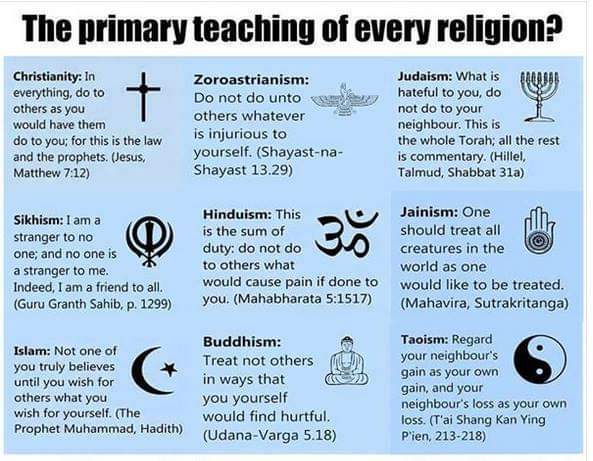
    In an earlier post, I wrote about the institutional aspects of religious belief systems as being mostly ‘noise’ designed to bind followers to a divisive dogma and to keep the contributions flowing. A bit cynical perhaps but there you have it. But there is a more spiritual dimesnion to belief and I find good in that.

    At some point, when I was in college, it struck me that virtually all religious traditions had a common core, though those central doctrines often were obscured in their sacred texts and certainly by the interpretations by those guarding the inner sanctums. In the end, they came down to this … be good and be kind to others. You know, the ‘golden rule’ or treat others as you would be treated. I can remember sitting in a car late one night with a comely coed during my undergraduate days. Her name has long slipped into obscurity. Since I had no money, I thought my best chance of getting to any base was to sound wise, or at least smarter than a sack of rocks. So, I went on about my philosophy of life for a bit … telling her about my moral compass so to speak.

    That so-called ‘compass’ was simple as I recall. “We are born and sometime down the line we pass from this mortal coil. In the meantime we must decide how we shall spend that time which, I was convinced, was fraught with unhappiness and disappointment and even pain(I am irish after all). I told this gal that I only hoped to make life just a fraction easier for those on this journey with me, likely by making them laugh just a little.” I can’t recall for sure but I doubt this BS got me to second base but, on reflection, it hit me that I actually might believe such sentiments.

    Spirituality is a journey. We can walk it alone or we can share it with others, trying to negotiate the rough patches as best we can. The trick is how to assist others along the way. That is not always apparent nor easy most of the time. Adding to the challenge is that males and females are dropped on to this planet with wildly different dispositions and skill sets. Guys have less innate empathy and, when they try, it usually comes out as an instinct to ‘fix’ problems. How different are the two genders. The next pic captures an essential difference.

    Now, since I was an only child I had no young siblings of the female persuasion who risked being in my presence during our early years. However, I am a typical male in most respects (how freaking sad). I can recall my long suffering wife sharing whatever crisis she was facing on a given day. Immediately, I would leap into ‘fix-it’ mode. I was always perplexed when that proved ineffective and when she withdraw into sullen silence. Yes, I was an idiot. Not a complete idiot though. I was never one of those guys who thought sending some female I barely knew a foto of my ‘family jewels’ (private parts). Really, how moronic cana guy be to think a foto of his junk will turn on a female. For heavens sake, try your bank statement instead.

    My lesson for today is not whether we should help others but how. I will admit that even I, not the swiftest arrow in the quiver, eventually got it that fixing someone’s ‘hurt’ was not always the best response. It occerred to me, after many failures, that this response made me feel better but was not always the best approach to the other’s situation. If not that, what was?

    Oddly enough, for reasons I won’t bore you with, yesterday I had two separate conversations with female friends. Each coincidently shared some wisdom contained in a New York Times piece that I found insightful. Essentially, it focused on a question that some school teachers found very useful for dealing with their younger students who were feeling emotionally overwhelmed. It is a simple question:

    “Do you want to be helped, heard, or hugged.”

    Someone who is sharing pain with us is reaching out. However, a dullard like me is woefully unprepared to detect what they need in response. There is research that each response (hearing, hugging, helping) evoke or stimulate distinct chemical and/or emotional responses. Like my experiences as a policy wonk, I understood in that arena that you have to get the quesiton right in the first instance to make any progress. Getting it wrong can result in more harm than good.

    I am thankful to these two female friends. This approach strikes me as intuitively sensible. Then again, I thought sharing my philosophy of life with a comely co-ed in college would get me to second base. So, what the hell did I know?

    I would add one more H to this question. Humor!

    Do they want me to make them laugh. I add humor since this is in my wheelhouse. Making people laugh is my strength, my go-to response in most situations. And I have found that humor is especially effective with females. Even as a young man, I realized that every time I took my clothes off in front of a woman they would double over in hysterical laughter. Just a gift I suppose.

    One final thought. We assume that we, homo-sapiens that is, are the pinnacle of evolution. Given our hubris, we assume that we are the best and the brightest and most advanced. We just might be. Sometimes, though, I see other primates who evidence collaborative behaviors and demonstrate the kind of intimate bonding that might well put us to shame. Few other species have refined technology to slaughter others of their own kind. Think about that for a moment. I leave you with the following image.

    BTW …. I am off on a short trip. There likely will be a brief break in these fantastic blogs :-).

←Previous Page
1 … 25 26 27 28 29 30
Next Page→

Blog at WordPress.com.


Loading Comments...
 

    • Subscribe Subscribed
      • Tom's Musings
      • Join 38 other subscribers
      • Already have a WordPress.com account? Log in now.
      • Tom's Musings
      • Subscribe Subscribed
      • Sign up
      • Log in
      • Report this content
      • View site in Reader
      • Manage subscriptions
      • Collapse this bar