• Sample Page

Tom's Musings

  • Milestones 😞

    May 21st, 2023

    Recently, I have completed my 79th journey around the sun. I find this more palatable than stating my actual age. In fact, it has been some time since that disgusting number has proven to be an acceptable utterance. Rather, my age has morphed into a kind of burden bordering on the horrific. Sure, we joke that being alive is better than the alternative but really? When people ask how I’m doing, I reply ‘I’m still vertical and taking nourishment’ or ‘ I’m still on the right side of the turf.’ In truth, that is bull shit.

    Lets face it. There comes a time when we start looking back with mixed emotions rather than looking forward with anticipation, if not anxiety. Before I continue, let me hasten to add that, in some respects, I’m not sad being old. Recently, I chatted with a friend where we both agreed that we were lucky to have lived in the times that we did. Moreover, we feel damn fortunate not to be coming of age in the current era. As bad as things were in the 50’s and 60’s, and we did have major problems then, there was a sense of hope in the future. Now, kids look forward with apprehension and anxiety. Depression and suicidal thoughts appear endemic in today’s youth. How sad is that!

    Of course, I cannot get inside their heads today. Nor can I feel confident in recalling my early perceptions and feelings with any accuracy. It might well be that I’m glossing over my authentic reactions of what it was like back in the day, coloring them with today’s gloomy perspectives on the world.

    In fact, I can vividly recall periods of doubt when I was just a kid. I feared that I had nothing to offer the world and could not imagine who would hire me or how I would survive on my own. I resolved such anxieties with the thought that I could always join the Army. They would take anyone, even a hopeless sad sack like me. How relieved I was to find out that I could manage life quite well without having any demonstrable skills whatsoever. Nevertheless, I am sticking with the hypothesis that we were the lucky generation and today’s poor bastards don’t have it as well as we did. That’s my story and I’m sticking with it.

    I guess I base this view on the fact (opinion?) that we had a more equal society in the post-World War II period. The great depression had discredited the old and previously dominant laissez-faire attitude toward the economy while a global war interjected a broad community-like feeling that we were all in this together. There was a kind of leveling for a while that led to the emergence of many ‘rights’ revolutions over the next two to three decades. While the process of change was turbulant and even violent on occasion, we thought the end would bring a better society for all. And things did get better. Poverty and income inequality fell steadily, de-jure discrimination and oppression on many fronts were beaten back, and opportunities for all were exapanded. Your position at the starting line of life was not cast in cement. Even a talentless schmuck like myself could rise from the working class streets of Worcester to a world class university and into the rooms where national policies were made. As my cousin’s husband would always say, ‘is this a great country or what.’

    Now, of course, we would use the past tense I fear … this was a great country. The elite never forgave Franklin Delano Roosevelt for betraying ‘his class.’ The embedded roots of virulent authoritarianism had never disappeared and waited for an opportunity to make a comeback. Never forget that many people back in the day thought that government putting fluoride in our water supply was a Communist plot and that even Dwight Eisenhower, our Republican President and the five-star general who beat the Nazis, was really a Communist sympathizer. I yet recall that many in Texas cheered when JFK was slain, believing him to be a traitor. The hard right was always there, they just were in temporary hiding.

    We know realize that they were merely planning and plotting for their comeback to a position of dominance. Aided by buckets of money and new technologies, they broke through in national politics with Reagan. As the internet and cyberspace increased our capacity to split apart as a coherent society, the hard right steadily increased in size and power. They drove out any and all moderate members from the Republican party (does anyone think Eisenhower would have a chance today) and have made their part in a virtual cult embracing every aspect of 1930s totalitarianism. I despised Romney’s policies but he was the last sane Republican. I fear how all this will play out but am rather glad I might not be here to see the end game.

    Oddly enough, I was going to write about something else …. I digress a lot as you know by now … but this is what ‘musing’ is all about. Anyway, I suppose that my most recent milestone was beginning my 80th sojourn around our own star … the sun. If it means anything, it would be the gratefulness that I have lived when I did and that I had all these opportunities that fell into my lap. In all honesty. I cannot say that I worked all that hard for them. I was fortunate and blessed with (or inherited) a vast supply of BS.

    But what about some of the other, and earliier, milestones.

    16 … Turning 16 was special. I recall doing all the driver training stuff before my b-day so I could go for my exam on that day. I was apprehensive since I learned almost all the others in my training class had flunked their first time around. Somehow, I passed and was ecstatic. I was now free to roam the world. All I needed was a car of my own which never materialized for many years. Oh well, it is the symbol of independence represented by a license that counts.

    21 … Another milestone. On that day, you become an adult. Now that is freedom! Yoy can legally get drunk, you can sign contracts though I had none to sign, and you were legally liable for your debts. So, this was a mixed bag of benefits and responsibilities including a free pass to killing yourself with cirrhosis of the liver which I came perilously close to doing in future years. On that day, I do recall my father taking me to his favorite bar … talk about a rite of passage. I tried to keep up with him as he downed his normal allotment of daily beer while thinking this might not end well. I was so relieved when he said it was time to go. When I stood, I said a prayer that I would make it out the door before falling over. I didn’t want to disappoint my dad in front of his friends. I did make it but it was a close-run thing.

    26 … Today, it might not mean anything but it meant a lot for the males in my generation. It was the birthday on which you escaped being pursued by the Selective Service Draft. If they managed to snare you in their tentacles, it could mean a one way trip to sunny Vietnam. Most every male I knew spent eight years scheming and plotting to evade the draft. I finally got around to being called for my physical after returning from India, perhaps I had made it to 25 by this time. That was a memorable day including being interrogated by three members of military intelligence (a story for another blog) to determine if I was a bad-ass or able to serve in our military. Eventually, they decided I could. I also thought seriously about fleeing to Canada (which I now regret not doing) and trying to make a case as a Conscientious Objector. By this time, the lottery was in effect which told you which month you would be called up. My 26th birthday was in May and my lottery number suggested I could be called up the same month. To make a long story short, May came and went without me being called, though I sweated a lot during this time. I had my life back.

    30 … This is only significant symbolically. Nothing really happens except you feel that you are finally an adult. In truth, I didn’t feel like an adult for many years hence and acted accordingly in several ways. But to the outside world, I was one of thse responsible folk with a home, a wife, a real job, and all that conventional crap. It also made me laugh. In the wild 60s, a favorite mantra on the left was ‘never trust anyone over thirty.’ Now I finally knew what they meant.

    55 … This may seen like an odd milestone date but it was the first year both my wife and I could retire and get a pension and join AARP and become eligible for a number of benefits specified for old farts. In fact, my spouse did retire as Deputy Director of the Wisconsin Court System on her 55th birthday. She worked directly for the State Supreme Court justices and witnessed the early decline of that body into fractious partisan disputes. She wanted nothing to do with a court that cared not one whit for justice but mostly for some ideological agenda. A couple of years later, I partially retired from teaching and administration (which meant I was not tied to the campus) but kept doing project and consulting work until my early 70s. However, we could escape to Florida in the winters now which helped my spouse’s Reynauds condition. In effect, it was another kind of freedom milestone.

    65 … I cannot say this milestone had much personal meaning for me. However, it is when government declares that you are an old fart. You start getting Social Security (the full benefit) and Medicare. I guess symbolically at least, one enters their dotage but it doesn’t feel that way.

    80 … If one gets this far, you are indeed a certified elder. Unlike in many cultures, it is not as if anyone listens to your accumulated wisdom. In fact, whenever you have trouble with all the damn new-fangled technology, you are always looking about for a teenager to bail you out. More than that, you finally feel old. The body definitely is slower and creekier. You can no longer fool yourself that you really are a 50 year old whose birthday listed on their driver’s license is an error. You see your colleagues and acquaintances passing day by day. When you get together with friends, you discuss recent medical adventures and future doctor visits which you dread since the lab results are likely to reveal something awful. Worst of all, everyone gives you the same advice for continuing on. Watch your diet, drink plenty of water, and exercise daily. Shit, that’s all you got for me … continuing on only if I torture myself.

    Hey, I rather like my fat, excuse me flat, body. Oh well, I’m still vertical and taking nourishment, perhaps too much nourishment.

  • A Modest Suggestion.

    May 20th, 2023

    I understand some of you are not getting email notices when I publish a blog. Well, neither am I any longer. Until I figure that out, just check http://www.toms-musings.com on occasion. BTW … I am cutting back on blogging to get some balance back in my life.

    H. L. Mencken was one of the most astute observers of American life and politics in the early 20th century, perhaps only rivaled by Will Rogers. Still, it took almost a century for him to get the above prediction totally right, though he came close with Chief Executive Officers such as Coolidge, Reagan, and George W. Bush. I recall the chatter after Reagan visited the U.K. during Margaret Thatcher’s run as P.M. Apparently, she shared the opinion within her circle that, while she loved Ronnie’s values and perspectives, he surely wasn’t smart enough to even hold a portfolio in her cabinet. Calvin Coolidge was a total nonentity who felt that the best government was none at all. He preferred long daily naps to, you know, managing the affairs of the ship of state. Business leaders could do that in his stead. And W. was the perfect class dunce that could easily be manipulated by Rove, Cheney, and others from the ‘dark side.’

    What is it about our political apparatus that we can spend so much money and effort in selecting our top national leaders and yet come up with such losers, as least intellectually. Sure, we also have elected leaders of highly questionable moral turpitude on occasion. Still, my questions about a candidates values would not necessarily preclude him or her from the position. Nixon comes to mund here. No one, however, ever questioned his intelligence. I’m not talking about electing Nobel prize candidates but about people whom you would walk away from at a cocktail party because they simply were way too dumb to be interesting. I’m not talking about a high bar here.

    In most democratic nations, the Presidency (sometimes the Monarchy), is a symbolic office with limited powers at best. The members of Parliament (or whatever the governing body is called) choose the Chief Executive Officer from among the elected party in power at the time. You may not like the person or agree with their values but, as far as I can see, those chosen are always bright. Just compare Germany’s Angela Merkel (a scientist before going into politics) with Donald Trump (a moronic conman). Argument over. Just think about the British Prime Minister getting up in Parliament and anwering the withering questions from the opposition, which they do on a regular basis. Doing that effectively takes an amazingly quick wit and excellent debating skills. Here, the closest thing we have to this is the occasional White House press conference which are highly stage managed, if they occur at all.

    Obviously, even our so-called Founding Fathers had doubts about whom might be elected to high office. That’s why they established all these checks and balances in our system and definitely why they instituted the electoral college. It is also why they limited voting rights to propertied males for the most part. While they wanted a democracy, they feared a mature democracy with more or less universal suffrage. The men who developed our constitution were the elite of the time and were quite suspicious of the ‘rabble.’ They were especially fearful that a broad voting public would drift toward a different form of tyranny, one based on passion and self-interest and not on reason and the long view. Horrors, if the rabble rose to power, they might vote to cancel their debts to the propertied classes.

    For the first several administrations, the elite ran things. There was Washington, Adams, Jefferson, Monroe, Madison, a second Adams, etc. These were men the founding fathers envisioned running the show, highly educated and urbane and with patrician qualities. That turned around with Andrew Jackson, a racist populist from the backwoods who really should not adorn our $20 bill. His campaign of genocide against Native Americans was unconsionable. After that, we had a series of forgettable Presidents with a few, like Lincoln and Garfield and Teddy Roosevelt and a flawed Wilson, who were principled and saw a higher duty for the office.

    Arguably, FDR was the onset of the modern Presidency. The Global Depression and World War II demanded that the powers of the Chief Executive be expanded and that a larger bureacracy be created for the enhanced role of the federal government. The U.S. was now a global power and had taken responsibility for ensuring the welfare of more and more Americans. An active administrator and administration was required. No longer could a President fritter away his days taking naps or playing poker with his friends. He had to run things and in a big way.

    Thus, the President had to have a skill set that would enable him to run the biggest coporation in the world. Wow! Yet, with a 24/7 and 365 day year round campaign for high office, we more often than not get highly suspect candidates. Worse, even when presented with one decent person, chances are the populace will chose the loser among those offered. When FDR first ran, he gave so little thought to his running mate that he chose John Nance Garner for the spot, the man who would have risen to the top spot if something happened to Roosevelt. Garner was a racist, southern conservative with an approach to economics that rivaled the Republicans at the time … totally wrong for the times.

    So what, you say? Roosevelt probably felt the same way. But even before being sworn in, an assassin took several shots at FDR from close range during a rally in Miami. Fortunately, the shooter’s arm was jostled as he shot, resulting in FDR being spared while at least one bullet struck the Mayor of Chicago who was leaning in to congratulate the President-elect at that very moment. Mayor Cermak died soon after. Garner would have been an absolute disaster in the White House at the very moment we needed a person of exceptional qualities. History might have been very different.

    Since then, only Harry Truman served in the presidency without at least a college degree but he made up for that with uncommon common sense, decent cognitive abilities, and a strong moral center. Others, like Lyndon Johnson and Ronald Reagan had college degrees but from lesser institutions. Still, looking at many who have held our highest offices recently, few might be considered exceptional from a credential point of view. And while Kennedy, Nixon, Carter, Clinton, Eisenhower, and Obama were above average in intelligence, Reagan, Bush Jr., and Trump (to name a few) were almost too dumb to tie their own shoes.

    I’ve thought on this many times over the years. Were the Founding Fathers right. Do we need to put a check on our ability to elect any old moron who excites the base? They thought the electoral college might perform this role if someone unfit won an election. The Electors would be the last line of defense against an idiot taking charge. Now, it is merely a formal function, not a substantive one.

    At the same time, I wish we had some way of ensuring that candidates met some minimal level of competence. After all, most job seekers for professional positions must first pass one or more hurdles before even being considered by hiring supervisors. They must meet minimal educational and experience qualifications or be vetted by a civil service panel before getting to their actual hiring interviews. I was for my first government position (and I made it through somehow) which demonstrates that the system is not perfect.

    Now, a President must have several qualities with intellegence being only one of them. Still, I do wish we had some way of screening out the dullards and the cognitively deficient before they secured the highest office in the land. We see the State or U.S. Bar Association often putting out statements or assessments of the candidates fitness for the Courts before an election. These are advisory only but a way of (not always successfully) weeding out those with no business being on the Bench. In Parliamentary systems, the candidate’s Peers do the vetting and are unlikely to select a total loser. If they do, the governing party is likely to fall from a ‘no-confidence’ vote. In a full democracy, we have no such assurances or ‘fail safe’ mechanism.

    The election of Trump proved that anyone, and I mean anyone, can be President. Think about that. Would you want a plumber doing open heart surgery on you? Would you choose someone who failed arithmatic to be your accountant. How about your butcher being in the cockpit of a jumbo-jet that was taking you to Europe or Asia. Even your barber must be licensed. We expect minimal levels of competence for ordinary jobs, should we expect more from the person chosen to lead the most powerful (for now) nation on earth? I believe so.

    In my dream world, I would like to see some process for vetting candidates before they are permitted to run. Do they psooses the minimal skills to do the freaking job? Do they know jack-shit about government and governing (Trump did not). Can they connect the basic dots in policy matters to pass one of my Policy courses (Trump would not). I desperately wish we had some form of screening system by a non-partisan body to at least guarantee that a person had the minimal qualifications and skills for the position. I had to go through such a vetting process for a low-level public service position. Can’t we be ingenious enough to do the same for the position on which our futures depend?

    Just a thought!

  • A Great read from an old PC colleague.

    May 18th, 2023

    I hope you can read the blog below. Jerry was in Peace Corp with me. He remains active in the fight for a better America.

    https://open.substack.com/pub/jerryweiss?utm_source=share&utm_medium=android

  • Perspective.

    May 17th, 2023

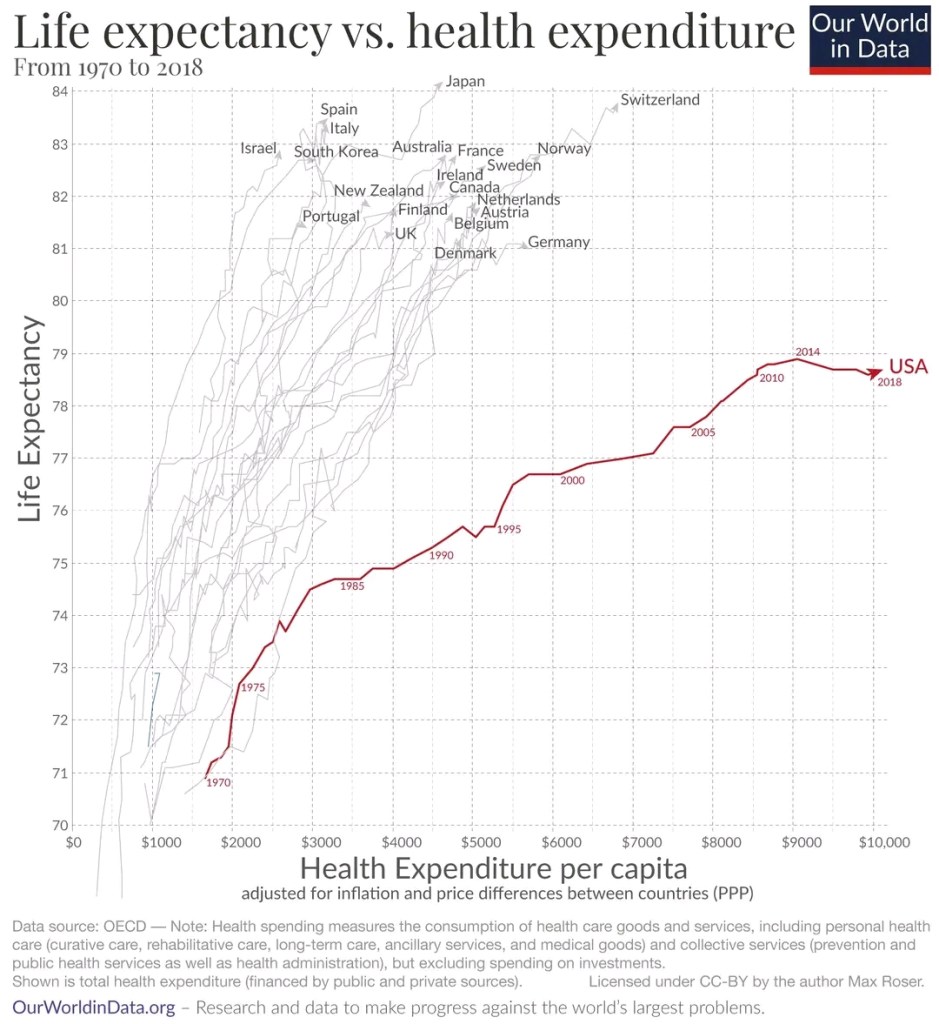
    This will be short today. In fact, I was going to skip today until a news item cought my attention. Then again, many do. The Washington Post reported on some recent research that, among other findings, suggested that America has suffered some 1.6 million ‘excess’ deaths in the Black Community over the past two decades. I believe they use the term ‘excess’ for what I would call ‘amenable’ deaths, those that could have been delayed (since we all die eventually) if they had acccess to the kind of medical care and other resources generally available to all in other advanced countries. That is, there would have been 1.6 million fewer deaths among Blacks if the mortality rates between the races were equal.

    They place the blame for this at the hands of unconsionable levels of inequality, partly structural in character, that we traditionally find in America. One domension of American exceptionalism is extremely high levels of inequality. As income and wealth and opportunity disparities have soared since the beginning of the 1980s, so have certain social outcomes associated with the differential ability to secure what is needed to thrive.

    Inequality covers many sins but let us focus on one. Too many individuals cannot get health care, or cannot afford decent care, or skip and delay care due to copays and other costs, or fail to take any or all their prescribe dmedications due to inflated prices. Many become sick when they did not have to, or sicker than they have to, or die when they might have lived. Sick and unproductive workers, let us not forget, cost money and weaken productivity.

    A second study determined the price society pays for failing to achieve a level playing field (e.g., health equity) that facilitates the premature passing of African Americans was $238 billion in 2018 alone. The notion of inequality (as suggested) covers many dimensions of American life … access to good schools, to social networks, to better jobs, and so forth. Some historical lessons are sharp and obvious. Domestic workers and farm laborers were excluded from the 1935 Social security Act because they were mostly black workers. For decades, redlining steered minorities into specific geographic areas that were less desirable. When the researchers expanded their analysis to a broader population the fiscal cost soars. The failure to achieve equity in America, primarily health equity, cost the nation $1 trillion dollars. Now we are talking real money.

    You would think that some 60,000 preventable deaths every year would raise alarms in society. But then, we have tens of thousands of gun related deaths every year without any action being taken. And therein lies my conundrum. Why do we look upon what ought to be a national calamity with such indifference? How can we not respond to such outrages? Are we that callous a country?

    I watch a lot of what I call ‘brain rot’ shows. Mostly, these are true crime semi-documentaries where some grisly murder takes place and the authorities successfuly track down the miscreant or miscreants. Given the number of series devoted to such themes, Americans apparently find blood and mayhem quite amusing or at least distracting. Often they are wrapped up in seductive titles … Snapped (usually women who kill their spouses) or Killer Siblings (family members who go off on a murderous crime spree) or The Murders of Atlanta or New York (or wherever). I’m not criticizing since I am one of the faithful vieweres.

    Here is my point. In these shows, the authorities (and sometimes whole communities) devote incredible energy and expend enormous resources to identify and capture the guilty party and then seek justice for their criminal acts. The investigations and pursuit for such crimes can take years and cover many states or even countries. The costs involved can be extraordinary, suggesting that the search for resolution and justice is passionate, admirable, and even moving. Moreover, there typically is a sense of finality and completion when a satisfactory ending is achieved. In many cases, justice involves not only determining who did the crime but finding the victim (or the few bones that remain) who might have been dumped in lake, buried in a secret grave somewhere, or stashed in some unused freezer or locker somewhere. The subsequent finding of guilt in a courtroom and the incarceration or execution of those responsible (we hope they got the right person) leads to palpable relief on the part of all concerned, often entire communities, amidst tears of relief and even joy.

    That is all well and good. We breath more easily when justice is served. But this usually involves the death of one person or, in extreme cases, less than a handful. While every death can be viewed as tragic, how can we ignore the preventable deaths of thousands while being so concerned for a single violent act? Why so little public outcry when many perish? Why no calls for justice? Why are not those responsible brought to justice. Really, when was the last time you saw CEO’s or lawyers for tobacco companies, the NRA, pharmaceutical firms that overcharge, or politicians who refuse to expand access to health care brought to justice? Arguable, they are responsible for unknown numbers of deaths. And yet, they earn 6 to 8 figure salaries and enjoy the lifestyle of potentates.

    I can easily think of several reasons why we treat these deaths differently. A conventional murderer often selects a specific victim and the manner of dispatching that unfortunate is up close and personal. We can draw a direct line from one person to another. Institutional slaughter is less personal, less visceral, and carried out within respectable boundaries … the seeking of corporate profits to please shareholders or satisfying one’s political base to remain in power. Then again, Mafia murders were done for similar reasons.

    I understand all that. Yet, I cannot escape one reality. On the one hand we may have one death for which the state might spend millions in the search for and punishment of the guilty. On the other, there will be thousand upon thousands of unecessary deaths where those responsible will remain pillars of society. They eventually will retire to their villas in Tuscany or their mansions in Naples Florida. Where is the justice in that?

    Something strikes me as being out of whack here.

  • A Good, If Unplanned, Life.

    May 16th, 2023

    How many forks along the road of life do we confront? Do we think hard about each one, calculating the cost-benefits of every binary (or more complicated) choice confronted? Do we then fret and worry that a wrong decision had been made, that we had taken the poorer path and had forfeited some better alternative? Do we even have a freaking idea where we are going?

    Not having any children of my own, which I’ve discussed earlier, my conclusions about how people confront life comes from the students I taught and my own pathetic existence. I could add that my close friends have helped but I don’t have any, other than the good people that ‘rent-a-friend’ sends over from time to time. No, my information sources remain sparse.

    My students at the University of Wisconsin encompassed the period from the 1980s to early in this century. While I taught undergrad classes, my better sources of data came from the Social Work graduate students I taught in the 2nd year Practicum course for those interested in doing Policy work as a career. This course was small, roughly 8 to 15 students, and I had them for two whole semesters. From many conversations with them over the years, I absorbed the unpleasant truth that their world increasingly was dominated by anxiety and uncertainty. Many were in deep debt and worried about their futures. They focused much on job prospects and the bleak options they felt were in front of them. Many struck me as desperate.

    I don’t blame them for this somewhat myopic and dismal perspective on their futures … this obsession with securing professional and financial success. The adult world they faced was far different from what I confronted in the 1960s when I was coming of age. In the most general sense, options for them seemed to be narrowing while the climb to financial security appeared to be a more difficult ascent. You needed more credentials, and of the correct kind, just to get into the ground floor while the stairway up was steep and filled with competitors. In the 1960s, a plurality of college age resondents said that developing a sound philosophy of life was extremely important to them. A generation or two later, securing financial security had risen to the top.

    We all knew that inequality in both outcomes and opportuities became more pronounced in recent decades. In 1979, less than 10 percent of all income went to the top one-percent of families. That figure doubled in the years after Reagan took office and would continue to rise until it approached 25 percent. Such unequal outcomes had last been seen just before the great crash of 1929. This trend represents a tectonic change and a radical shift in the distribution of society’s goodies. A few were getting a lot while the rest of us were left scrambling for crumbs.

    It was so different when I was in college. Sure, the competition was tough, it always is. At the same time, the prospects before us seemed open and unlimited. I became a Psychology major at Clark University mostly because it was the best department in the University. The American Psychological Association (APA) had been founded there and this was the place Sigmund Freud came to give his only lectures in America. After all, I had no idea what I wanted to do when I grew up. In truth, the thought of being a counselor of some sort repelled me … listening to other people bitch all day! I’d probably whack them after a half hour session and tell them to ‘suck it up.’

    I might have been thinking about an academic career. That prospect dimmed quickly enough. Academic Psychology was abandoned after I spent a summer doing research on a National Science Foundation grant for promising young scholars. (How in the world was I chosen?) At the end of that summer, I realized I had to kill all my rodent subjects, one of whom peed right into my face as I jabbed a needle into his stomach. Thus ended my career as a research psychologist.

    I did get as far as asking my advisor where I might consider going for a graduate degree. He didn’t blink as he rattled off Harvard, Yale, and Stanford. I almost laughed in his face. I was still a working class kid wondering how they had not yet discovered I was a fraud and kicked me out of Clark. It was not until many years later when I realized my colleagues were from these very institutions that I finally realized my advisor was not on drugs.

    ME CONTEMPLATING MY FUTURE IN 1966!

    When I drifted out of college, I went the Peace Corps direction. I had been atrracted to that ever since Kennedy announced it in 1961. It fit my do-gooder sensibilities and appeared likely to be one hell of an experience. It was, though, a much more challenging trial than I had anticipated. Today, students might worry that two years out of their lives would put them behind in the competition up the ladder of success. How would potential employers look upon this kind of escapade? Perhaps some would see it in a positive light but could one take the chance. My sense is that, for recent generations of young people, every decision is approached in light of future payoffs.

    Such considerations never entered my mind. I took courses in school because they interested me. I went the Corps route because it intrigued me. After India, I wandered back into graduate school in Urban Affairs at the University of Wiscosnin-Milwaukee since it spoke to my desire to help save society and I had heard about it while training there. That it might embellish my credentials was of secondary importance. In my world, one had faith in the future and that things would work out … somehow.

    I remember once, when I was involved in the anti-war movement, a young man (though older than me) from my old neighborhood suggested that my activities might threaten my future plans. A file in some government agency might torpedo what little chance I had in life. He had recently joined the FBI and he was sincere in his comments. I thought on his advice for a moment and rejected it out of hand. I could not turn my back on what I believed for mere expediency. Perhaps more importantly, I never believed my future was in doubt or that I would find something ineresting to do. Even if he were correct, I was determined to do the right thing, not the safe thing. You could think like that back then.

    For me, in the end, meandering through life worked out fine. Go fgure! After India, I returned to Milwaukee for a masters degree mostly because, as I mentioned, I had heard good things about the Urban Affairs program when I trained for the Peace Corps there. Good enough I thought. I was into social problems and this degree sounded vague enough to keep all my options open. Really, if I had studied accounting I would likely have to be an accountant. That sounded like prison to me. Shoot me now.

    I had a great time in Milwaukee but that eventually ended, as all good times do. For the first time, I thought about gettng a real job, as much as the prospect pained me. I looked around for something to do in a desultory fashion when a professor I had worked with asked me to join him on a trip to Madison. He was working with with some State officials on a long forgotten project. During lunch, the topic of my unemployment came up and one official suggested I consider State Service. I immediately lied and said that had always been my dream while wondering silently what the hell State Service might entail. Before heading back to Milwaukee he secured some paperwork for me to fill out, which I did and sent back. Then I immediately put that incident out of my mind.

    Then, my aimless life took another turn. This professor called one evening and said I had a job interview the next day in Madison. ‘What job?’ I asked but all he had was a building, a room number, and a time. I trekked down to the Capital City, found the room and walked in. It was as civil service interview panel for the position of Research Analyst-Social Services. Well, I thought, This should be quick since I knew little about research and less about social services. But, with very modest expectations, I tried to enjoy the experience before heading back to Beer City while hoping to forget all about what I considered a wasted day.

    Sometime later, I get another call. I have an actual job interview with the hiring supervisor in the Department of Health and Social Services. It turned out I had made it to the 3rd position in the hiring queue after another candidate dropped out (only the top 3 could be interviewed for the position). I went through this next step again assuming one of the two more qualified individuals would get the position. Then, mirabili dictu, I got a call and was offered this real job. The hiring supoervisor said she found the 2nd candidate better than the 1st and I was better than the other two. I told her it was a damn good thing she did not get to the next person on the list. Go figure!

    I enjoyed life as as a State employee, this was back in the days when they were valued and Wisconsin was doing exciting things. Then, after about four years, lightening struck again. My supervisor told me to work with a Social Work Professor on a Research Grant he was preparing, a grant application to a federal agency that had to have the support of the state agency. Why not! I helped him out and forgot about it once my collaborative work was complete. Once again, I get a call. This academic said he got the grant and would I consider moving to the University to help him run this large and very complicated project. Giving up a civil servic eposition was risky. So I gave this matter great thought, about six seconds, before saying … sure, why not!

    Now I’m at the university but as low as you can go. But I figure, this is better than working for a living. As the project was winding down, I realized I needed the ‘union card’ (a Ph.D.) to have any career here. So, I started in the doctoral program in Social Welfare (while working under some of the best poverty researchers in the country). I was a terrible student since I spent little time at it. With my state contacts, I was able to forge critical linkages between the scholars at the University’s Institute for Research on Poverty (IRP) and the agencies responsible for social programs and welfare. I was busy working on the hot topics of the day when I should have been studying. Still, this state-university marriage was a natural match that paid dividends for many years on both sides.

    Other idiosyncratic choices came about. One day, the Institute Director sent out a memo asking if anyone wanted to spend time working in the Office of the Assistant Secretary of Planning and Evaluation (ASPE). This entity did overall planning for the U.S. Department of Health and Human Services (DHHS) and aslo provided IRP with much of its federal funding as the designated site for poverty related research. I crumpled the memo up and threw it in the wastebasket. But I kept thinking about it during the day. This was at the beginning of Clinton’s administration and welfare reform would be high on the agenda. So, I retrieved the crumpled paper, and brought it home to discuss with my spouse. What would she think if I spent a year in D.C.? (She was Deputy Director of the state Court System by this time and would stay in Madison.) Her only response was to take out my suitcases and start packing for me. Hmmm?

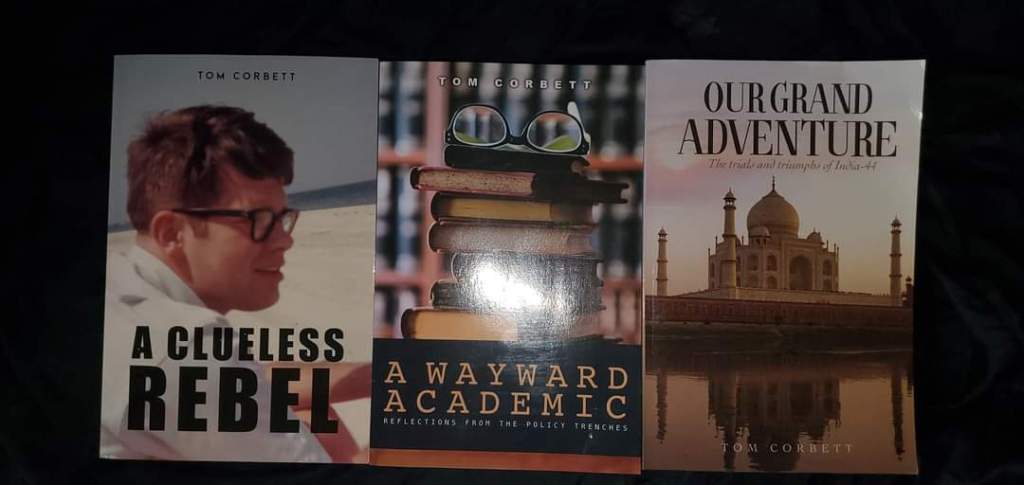
    By the time I returned, I was well established in Washington as a policy guru, I was in a leadership position at the Institute for Research on Poverty, I was a popuular teacher, and I was in demand to give talks and to consult with states and local around the country on welfare and human services issues. In short, I was what was called a ‘player.’ Somehow, without any plan whatsoever, and with zero direction in life, I wound up enjoying a rewarding career. Again, if you read my book titled A Wayward Academic: Reflections from the policy trenches, you will see how the substance of my career was dictated by random phone calls.

    My wife had a similar life trajectory. While she was a more diligent student than I (we met while I was in m Master’s program), she also had no direction as to a career. Yet, once in State Service (she started as a limited term employee heading a research project), she quickly rose through the ranks in several agencies to end up as Deputy Director of the Wisconsin Supreme Court. Only then did she take a sabbatical and go back for her Law Degree. As my cousin’s spouse always said, ‘is this a great country or what.’

    By this time, you are asleep or asking what my point might be. As my late wife and I came of age, it seemed as if the world was open before us. The American dream, if you will, remained alive and well. You could work your way through school without help from wealthy parents (she also came from a family of modest means). You didn’t have to start worrying about which courses to take in grammar school. You didn’t need to do all kind sof extra activities and grind away in AP classes on the chance of making it to an Ivy League school. You were not a failure if you got a B in a class. If you were smart and imaginitive and a risk taker in my day, opportunities seemed to present themselves to you.

    Bottom line, I feel so lucky to have lived when I did. In college (and in my masters program), I spent countless hours debating with my peers about the issues of the day. Sure, I also did just enough in my classes to keep future options open but that is not where my real education was obtained. It was in the crucible of argument and the confronting of the issues of the day … war and peace, civil rights, social opportunites for all. That is where I learned how to think things through and sort out complex issues. When I was in my doctoral program I learned more from staffing a legislatively mandated welfare study than from my classes (in which I had several incompletes at one point).

    My cognitive abilities were sharpened in these continuing debates about real world issues. My enduring values were perfected as I tried to work on actual policy conundrums, not going through the usual lock-step process expected on students. It was there that my liberal education became a reality, not liberal in any political sense, but in the pursuit of a free inquiry to determine what constitutes a just society and a fruitful future in life. Hell, when I was on the MSW admissions committee in the School of Social Work, I realized my college GPA wasn’t good enough to get past the Committee on which I now served.

    I feel sad kids today. With all the goodies now being distributed to the favored few, the rest of them must scramble for what is left. Even so, I watch Republicans in Wisconsin and elsewhere (Florida) try to turn our colleges into high level technical skills. They wish to destroy the kind of free an unfettered inquiry that directs minds toward creative ends. They fear that thinking students will not buy what they are peddling. My neighbor, whose father was a professor, told me he once asked an iconic scholar at UW what the benefit of a liberal arts education might be. The scholar’s response stayed with him all these years … ‘so it will be harder to fool you.’

    I hope they never succeed in destroying a place of free inquiry like the University of Wisconsin. I had it so good.

  • Monday’s Memories!

    May 15th, 2023

    I ran across this foto and paused. It was taken in 1967, almost certainly in Udaipur India where we were getting our final training before heading out to our sites for two long years. Now that was a journey marked by frustration and fultility though interspersed with occasional moments of triumph or, more accurately, small successes. It is difficult to discern what we were thinking in that moment. Perhaps it was hitting us that we knew shit about what we were being asked to do. It had been a long and arduous training but, let’s face it, you cannot turn city kids into farm experts in a few weeks. It is even more impossible when the technical training was in another field altogether (chicken farming or poultry raising) for the first half of our preparation.

    Not long after this shot was taken, three of us would be loaded on the back of a truck with all our worldly possessions stuffed into a standard Peace Corps trunk and sent on a perilous journey down out of the Adravilli Hills to our hot desert homes some 50 or so miles (kilometers) south of the enchanting city of Udaipur. Randy (not pictures above) and I were assigned to Salumbar, a real town and the headquarters for local community development efforts. Poor Steve (the Black fellow whose face can just be seen in the 4th position from the right) was sent even further south to some hamlet long forgotten. He was a great guy, but his assignment was impossible. It was too remote and the place simply too backward. The locals talked a dialect (Mewari) in which we had no training, and it took him one day on India’s cruel form of torture (rural buses) to reach us and another day to get to Udaipur. He gave up after a few weeks. I’m surprised he lasted that long.

    Many of these faces bring back memories, though not all. I cannot recall the name of the fellow on the far left. He did not come to any of the reuninions that we began having in 2009, the 40th anniversary of our return to the States in 1969. But I do recall the last time I saw him. Three of us were standing in St. Peter’s Square, the center of Vatican City and the Catholic Church. While gawking at our surroundings, we heard a familiar voice. It was he (who cannot be named). We chatted amiably about all we had seen and then went our separate ways. Perhaps I would have treasured the moment more if I had realized our paths would never cross again.

    Next to him was Jerry. He was a thoughtful and serious fellow that I did not get to know very well. Then again, it did nor help that he married one of the gals from the public health group we trained with and who then served in Maharasthra to our south. Thus, he did not hang much with us during our occasional escapes to Udaipur for R&R. I believe his new wife became ill (several in my group became seriously ill though I escaped any real trouble). They both returned to the States after about a year. That marriage did not last but I do see his blogs from time to time. He remains immersed in leftish politics and in fighting the good fight. He has retained his spirit while mine might be lost somewhere under the couch.

    Gary, the slightly dishevelled gentleman to the right of Jerry, was a favorite of all of us. He seemed very talented and extremely bright. He played a marvelous violin and had such a unique and idiosyncratic take on things. He saw things in an oblique but unique manner. He was one of two in our group to extend for a third year in India. Sadly, he never adjusted well after returning to the States. He wound up surviving on earning from playing his violin on street corners and from a small trust fund left by his parents. To our dismay, we discovered that he ended it all by jumping off a building in San Francisco. Damn, he was such an original.

    Haywood was another of what I would call one of my closer friends. We all loved him. He had grown up dirt poor as part of a sharecropper’s family in North Carolina but always said the one thing they had in abundance was love for one another. Later, he would insist that Peace Corps changed the course of his life. On numerous occasions, he noted that some of us motivated him to go on to do graduate work which, in turn, led to a career as a top official in a national union. He probably looked at me and said, if this klutz can do well, then anyone can. Yes, I’ve been an inspiration to many. To use an old cliche, he did light up any room he entered. I can still hear his infectious laugh, feel his kind heart, and recall his humorous stories. He passed way too early several years back and is missed by all.

    Tom M, [not to be confused with Tom C (me)] is next in line. While Tom has a soft look about him, that hid a tough, focused interior. He had strong values and was always looking for ways to make a difference. After getting his master’s in government from Harvard, Tom eventually went on to work with the United Nations. During his career, he was assigned to a number of the world’s hottest spots while working with refugees and others caught up in struggles and conflicts we’ve never been able to completely avoid. As happened in the Balkans during their post-Tito ethnic and nationalistic coflagration of the early 1990s, he found himself trapped on the front lines. That was far from the only time he was in danger. An exciting life indeed. Another vilounteer (not pictured) spent his career in the U.S. Foreign service. he had roatated out of the embassy in Iran not long before the Khomeini inspired student takeover in 1979.

    Me! Then there is me, tall and lean and with a full head of hair. Sigh! But you know about me so I’ll only share one story. Some time back, I took this picture and showed it to a number of acquaintances and colleagues. Which one of these characters is me? I would ask. Each would study the picture, look at me, study the picture again, look at me a second time, and then make a selection. Invariably, they would pick the wrong guy, usually a selection I found perplexing or even insulting. I suggested to several they seek help from an opthamologist.

    Bob is next to me. He is a bit of an enigma. I don’t recall much of him from our days in India. He might actually have worked hard at his job. Then, he passed before we started getting together about a dozen or so years ago.

    Bill comes next. Like Haywood, he is someone I got to know somewhat better than many of the others. He was a scholarship student at Yale, coming from a large working class Catholic family. We were in the same language class during training, which was somehow based on aptitude though my making it in proved that the selection process was flawed. He, however, was smart indeed. He and I travelled back together through Europe at the end of our tour enjoying several enjoyable, if futile, efforts at seducing young ladies who were unfortunate enough to cross our paths. Then he went on to to get a Business degree from the Wharton School at the University of Pennsylvania and a Doctorate in economics from NYU. He did everything from working in international banking in Paris to working at the Federal Reserve. He always had a strong ethical side to him and spent part of his early retirement focused on climate change, writing a scholarly book on the topic. A fascinating guy.

    Below is a pic of Haywood, myself, and Bill while we visited the family of one of our language instructors in Delhi.

    Next we have an instructor from the local university about wjom I know absolutely nothing.

    Roger is next. He was one of several volunteers who had attended the University of California-Berkely as an undergraduate. With a few exceptions, most India-44 volunteers (the one’s who lasted that is), came from the east and west coasts. Many attended prestigious schools though not all. This was back in the day when the Corps had many more applcants than they could select or use. Not surpisingly, many then failed to make it into the program, or through training, or either to be assigned to a site nor complete their two years of service. Many were called but few chosen and fewer survived to the end. India was considered one of the toughest sites back then for a varety of reasons, something we learned about through painful experience. Enough of a digression. I recall Roger being a serious volunteer with a love of cycling. He somehow used the crappy Superman bikes we were given and cycled all over Rajasthan. Years later, we met at his home in the Bay area. His wife was also into Indian culture and dance. His Peace Corps tour clearly had stayed with him.

    David L is next … the tall young man with the short beard. He left at the end of our in-country training but still managed to leave me with a strong impression of him. He was from Virginia, retained a distinct southern accent, and was deeply committed to social justice and civil rights. During our stateside training we spent a week in Houston Texas. It was 1966, and we northerners were totally innocent. When we heard that a black volunteer was denied entrance to a ‘private club’ that was open to any white person who would pay the entrance fee, we had to protest. That led to a kerfuffle at the entrance. David, when he was grabbed by a couple of rednecks immediately went limp. It was the ‘non-violent response’ he had learned in civil rights protests. I will never forget what came next. As tensions mounted, I saw a police car coming down the street and waved them over. I told the officer that a violation of the civil rights law had just occured. He looked at me as if I had just dropped out of a space ship, told me he didn’t give a f%$k about civil rights, and then rolled up his window as he continued on his way. We somehow made our escape and filed some kind of action the next day with a federal agency (forget which) that I’m sure was discarded the moment we left. I wish David had stayed with us.

    A Peace Corps technical instructor is next. All I recall is that he was from some midwestern state and had the impossible task of turning us into farmers ina few weeks.

    Steve is the head of the black guy barely visible. I think he was from Tennessee. Poor Steve was assigned to an impossible site south of my town, probably near the freaking border of Gujarat. I have no idea what Peace Corps was thinking with some of these placements. From the inception of the program to when we were placed, a lot of time had passed and the original situation may have changed. Moreover, the presumption that any American kid could make a technical contribution, even if they knew jack-shit about what they were doing, was wildly optimistic. Steve was a wonderful guy and tried hard. But no one could have lasted where he was. One has to remember, that we were really isolated back then … no cell phones or other means of communication. You were really on your own in the freaking Rajasthani desert where it was hot, disease ridden, isolated, and lonely. Beside that, you could not get a beer (or any alcohol)at a local bar and even looking at women was discouraged.

    David D. was an interesting character. He also was an Ivy league scholarship student … Columbia University. Perhaps because he had to fight for all he had achieved, he had a bit of a chip on his shoulder. He was smart though perhaps not the best fit for Peace Corps. Something happened about halfway through our tour and he was sent home early. Still, he remained attached to the group and came to a couple of our reunions. He never lost his interest in India, going on to get his Doctorate in South Asian Studies at Columbia. When we did reunite, I found him to be mellower and at peace with himself. He was mch more self-aware as well. We all grew in our own ways.

    Mike is the next in line, thin with a beard. Well we were all thin then but he was extra thin. I liked Mike a lot. He also had grown up in a relatively poor ethnic family. Many of us later talked about how easy it was then to go to college. The California public system was dirt cheap (he attended San Francisco State University). There is one reason Mike remains a favorite of mine. Later in life, he wrote a hilarious manuscript about his misadventures with members of the fair sex after his divorce. In his writings he referenced some of his earlier failures with women, one involving the final party we had before leaving India. He was having a medical issue at the time and might have skipped the party in any case. But what he wrote was that he decided not to go since he despaired competing with guys like me for the favor of the ladies since I was ‘tall, dark, and had the rugged good looks of someone who could adorn the cover of a romance novel.’ Then again, his medical issue turned out to be a detaching retina and he was flown to the Military base in Germany for immediate eye surgery. Obviously, he could not see clearly. Bill and I visite him there on our way home. Mike also went on to get a graduate degree and ran a non-profit that upgraded the computer capabilities of libraries in New England. I last saw Mike on his 75th birthday when he, Bill, and familes had rented a party boat for a trip up the Hudson River. Mike is an original.

    Hap completes the lineup. He also served out the two years. He was inevitably upbeat and had a smile on his face. While I never got to know him very well, it was always nice to be around him. He made us all laugh and feel good about ourselves. He also was from California and would return there to become a lawyer. At the end of our tour he started back hime with Bill and I through Europe. I think he made it to Rome before heading directly back to the States. Bill and I went on to Switzerland and Paris, from where he headed home since a girl was waiting for him. I had to visit Ireland, my irish roots were calling me, before heading back to reality. You can only avoid life for so long. Sigh!

    This is a small taste of what was a seminal experience in my life, in all our lives. As you can tell, only a small prtion of all who started out on this adventure endured to the very end. Many didn’t make it to India and the caualty rate of those who did remained high. It was a tough experience but one that left us all changed, hopefully for the better. You really understood the power of culture after being immersed in a version of one that tested your strengths and endurance.

    I am amazed at how much our small group (many of which were not included in the picture) contributed to the world later in life. Many went on to advanced degrees from top universities and to successful careers. Perhaps they had been picked by Peace Corps because they were special to begin with. Or perhaps they (we) were transformed by this compelling and unique experience. We cannot know.

    Of all my experiences in life, three stand out … my days at Clark University, my Peace Corps experiences, and my days in Milwaukie right after returning from India. I don’t recall much else, nor much about the people at least, during my life before Clark nor during my later doctoral studies. Perhaps these moments stand out only because they occured at a special time in the trajectory of my life. Either that, and I don’t discount this, there was something magical about these moments in time that I was priveleged to experience.

    If you want to experience more, pick up the volume below:

  • Aaaaaargh! Oh, I am also baffled.

    May 14th, 2023

    First, let me wish a happy mother’s day to all those mothers out there. In my misspent youth, I tried hard to get pregnant but had no luck. I never did figure out why.

    In truth, the thought of having a child petrified me. I did many things in my life but successfully raising an offspring seemed well beyond my skill set and certainly beyond my pay level. Therefore, I got a vasectomy early on to make sure that didn’t happen. However, I do salute all of you who were braver than I. We do need people though I generally find humans over rated. I still shudder at the thought I might have brought someone or something into the world that took after me. Yikes! You can thank me later.

    Second, I am cringing at my last post. In my haste to get to my appointment for another Covid booster shot, I hit publish well before it was ready to go. Sorry about that. I would say it won’t happen again but that’s silly. Of course it will. I am who I am and can be no other.

    Third, I believe one remedy to error-filled posts is to step back from a blog-a-day. While I have an infinite amount of BS to share, that is a demanding schedule. Perhaps if I could figure out how to edit out the many existing errors in my prior posts, I would keep up the pace. Then, I could occasionally take a full day and clean everything up so I don’t come across as a blithering idiot. On the other hand, why try to fool people. I am a blithering idiot.

    Fourth, there might be a more compelling reason to scale back my blogging pace. It is clear I need more balance in my pathetic existence. Writing and napping (with an occasional book club thrown in) is not exactly a full and exciting life. I really should (gasp!) exercise more. Let’s be honest here, I should finally get off my fat ass and exercise just a little. And (aaargh!), I should clean up my hovel or what I call home. It is not good when the EPA declares your residence a toxic waste hazard. Time to bring in a Bobcat and begin excavating some of the debris … the first several layers at least.

    Finally, I need some help. How is that for stating the obvious. Let us start with help in this one area. Can someone explain to me how MAGA types think, or whether they are capable of any cognitive activity at all? I used to be understanding of others. As a policy wonk I had conservative colleagues with whom I could work with even if I disagreed with them. As a teacher, the few conservative social work students studying at Wisconsin would thank me for being so balanced and accepting even when other social work faculty apparently were not. Then again, I felt my role was to teach them how to think and not what to think.

    However, I am now a grumpy old man. Perhaps it is a function of age … we just get crabby as we enter our dotage, a threshold I passed over some time ago. Or, perhaps those on the other side of the ideological divide have gotten worse in recent years. After all, I can recall when Republicans represented sober and clean government, even if they favored the business classes. In my youth, Southern Democrats were the suspect types even as Northern Dems were my tribe as an ethnic working-class kid.

    For a variety of reasons, all the whack jobs and nut cases have migrated to the current Republican Party. This has been a migration of several decades in the making but is now complete. Those intellectual conservatives I had worked with in earlier decades (the ones I still have contact with) have abandoned the party. More to the point, the Party has left them. As one former colleague who had worked on the Hill before migrating to the Brookings Institution said to me, ‘they (Republicans) have lost their way.’

    That is putting in mildly. Conservative Republicans (and the clear majority now lean to the hard-right) could not find reality with an AAA Trip map, GPS, and a guide dog. When my late wife and I wintered in Florida, we would leave our liberal Madison bubble as Winter approached to live among a politically diverse group of neighbors until Spring returned. There were topics one stayed away from during our annual hibernation but that is virtually impossible now. Today, I would rather face frigid Winters but at least my blood pressure will remain controlled. My wife’s family used to be quite close and routinely have large gatherings of the clan. In recent years, they have splintered with the ideologically separate groups unfriending themselves on Facebook while those big gatherings are a thing of the past. The cultural gap is too wide, communication too difficult.

    In my more conventional liberal youth, I usually could find some way to understand those on the other side of the divide, most of them at least. I would read what conservative thinkers had to say and seek out the logic of their positions. While I might continue to disagree (and usually did, but not always), I could see some logic in their positions. Those days are gone. Now, I look across the divide in total disbelief. It is as if I am looking upon an alien species whose brains are wired in a totally incomprehensible fashion. I cannot legitimately call them homo-sapiens, the sapien part appears missing.

    How could anyone think that Donald Trump is the highest expression of Christian values and that Jimmy Carter is the opposite. How could anyone conclude that Barak Obama was a divisive force whose administration brought ruin to America while Trump’s was a glorious reign that brought us together. Or how could they cling to the fiction that Trump won the 2020 election or that voter suppression and gerrymandering somehow strengthen what remains of our democracy? How could any sensible person deny science and reason and facts in the face of overwhelming evidence of anthropogenic climate change? Or how could they argue that more guns will make us safer as America becomes the international poster boy for gun-relate carnage? I could go on and on but you get the picture.

    George Orwell was spot on in his depiction of a future world where all was upside down … up would be down, black would be white, war would be peace, freedom would be slavery. That man was so prescient. He did get one thing wrong, however. The title of his classic work should not have been 1984 (though that is about when our descent into madness began) but 2016 (when our madness was fully expressed). That was the moment when we finally lost any touch with decency and with our national sanity.

    If anyone can make sense of what is happening, please let me know for I am at a total loss.

    I know I am not the brightest bulb on the marquee, the sharpest knife in the drawer, nor the swiftest arrow in the quiver. However, I have tried hard to understand the way today’s Repubicans think. I mean, I have tried very hard. But I am baffled at their total lack of logic. Even if rural America or working class folk feel threatened by economic challenges or changing demographics, why would they flock to a political party that clearly doesn’t have their interests at heart? Why would they cling to candidates that only serve the interests of a small economic elite … a group that has seen their situation overwhelmingly improve at the expense of the rest of us. Cannot they connect the most transparent or obvious of dots? Yup, I am totally baffled.

    Please enlighten me.

  • Roads Not Taken!

    May 13th, 2023

    When you are about to enter your 8th decade, a week away for me, you reflect more on what might have been. Were there moments back in the fog in one’s early years where, while poised in a fork in the road, you went one way and not the other. What might have happened had you made a different choice? Would your life now be better or worse? Would you be more fulfilled or bitter at the decision then made? Would things be different at all?

    Like my most recent prior blog, this is an exercise in counterfactuals, possibilities we cannot know with any certainty unless, of course, there are an infinite number of universes out there as some Physicists suggest. Even if they are all these worlds available to us, there remains the issue of whether we can somehow experience these parallel worlds. All that strikes me as quite improbable.

    I have remarkably few regrets in my life. I means, really, for a working class kid who showed no demonstrable skills and struggled even in elementary school, I managed to fool the world quite easily. I faked it as an academic and policy guru. Still, I’ve never escaped the thought that my success in the academy and (more to the point) in the public policy arena was all done with ‘smoke and mirrors.‘

    I will engage in a bit of self-promotion here. The Provost at the University of Wisconsin is leaving to assume the Presidency of the University of Oregon. He and I have traded friendly insults for three decades now. He wrote the following to me recently as he prepared for his departure: “I truly loathe putting this in writing, but you are among a small number of my favorite people in the world. I learned a lot from observing the way you navigate life and professional relationships (Now I must add the the throwaway line, as it provided great guidance on what not to do … but that’s not true and not even funny!). I admire your writing and ‘public intellectual’ efforts and, darn it, you’re a wonderful human being.” This is from one of the few sensible economists (and fellow policy wonks) I know.

    In truth, I never had a conventional career. I was lucky enough to somehow play at being a ‘faux‘ academic while doing what I most loved to do … stuggle with impossible conundrums and challenges. At the same time, I could spend time with students and help shape their lives as possible future change agents in the world. I recall sharing the following piece of wisdom when they threw me an impressive retirement party (they wanted to make sure I really laft): “I had the best freaking job in the world. I got to fly around the country to work with incredibly smart people on some of the (at the time) most pressing public domestic issues facing us … welfare reform, poverty amelioration, and the redesign of human service systems.”

    What I didn’t say to the audience that day is my position as Associate Director of a major national academic research entity (The Institute for Research on Poverty or IRP) gave me instant credibility on the national stage and opened all kinds of doors to me. All these benefits, and I was barely able to squeek by my high school algebra class. That’s a neat trick if you can pull it off.

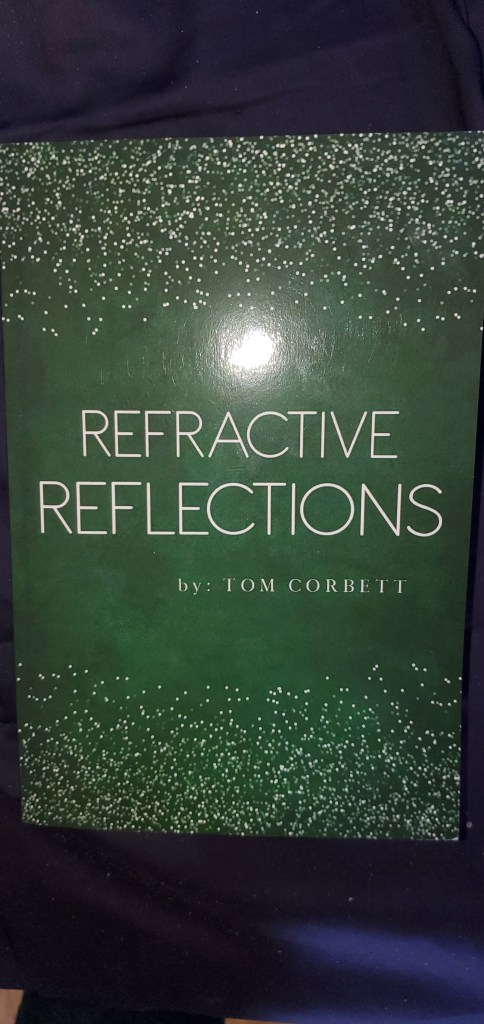
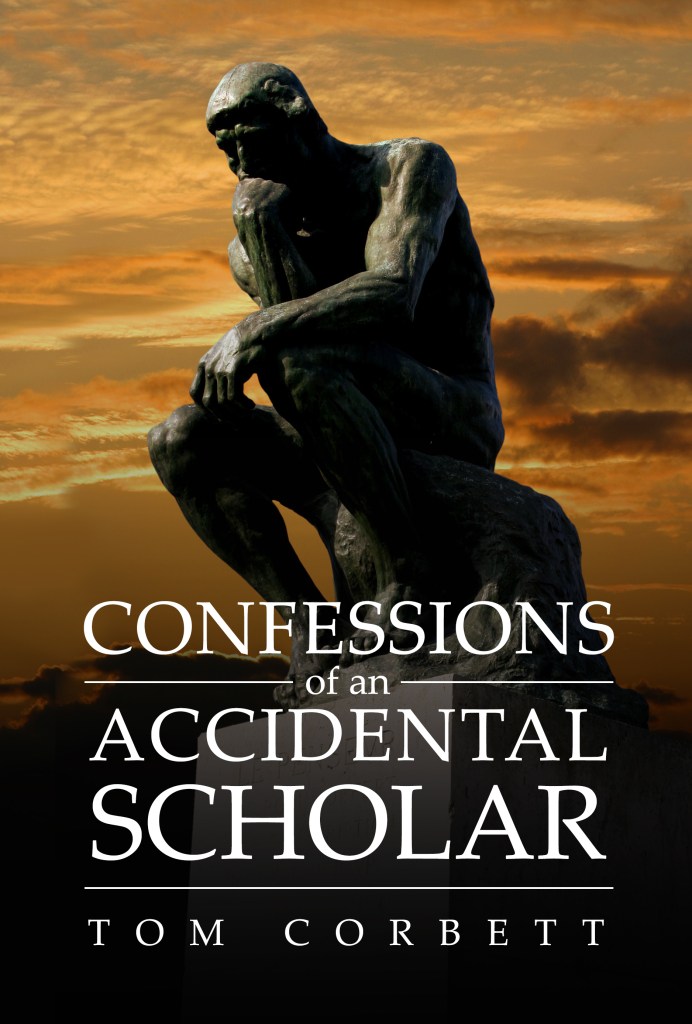
    And yet, I’m not totally sure this is the life I was meant to lead. I suppose I’m reflecting on this question because my latest book is finally making it on to the Amazon site though it has been on Barnes and Noble for several weeks now (You can see the cover below). It is the latest in a series of works that take the reader on a multi-level journey through complex relational, political, and conceptual labyrinths as three familes intersect around momentous challenges in four countries (America, Canada, England, and Afghanistan). Best you check out my web site for details (www.booksbytomcorbett.com).

    To my mind, these non-academic books represent a realization of a long deferred fantasy. As a kid, as my neighborhood friends dreamed of being cowboys or soldiers (post WWII) or athletes, I wanted to be an author. I have no real idea where this ambition came from other than the fact my father had a set of Reader’s Digest Condensed Books and almost all of the Perry Mason series authored by Earle Stanley Gardner. Perhaps that, and my library card, were all that was needed to light the spark. Once, I came across a newspaper article about my dad (after his death). It had been written when he was in High School and a member of the basketball team. When asked his future plans, he said he wanted to be a journalist. For a poor depression era Irish kid, that was a pipe dream and he wound up doing factory work. Yet perhaps there was some kind or literary gene within his makeup. After all, he was a great story teller. Who knows?

    However, I was an indifferent student until I arrived at Clark University after an ill-conceived stop at a Catholic Seminary. It was there that my mind expanded, if not exploded, with curiosity and into a more encompassing world perspective. My time at Clark also rekindled my suppressed dream of being a writer. I majored in Psychology since that was the best department in the school. In truth, I had absolutely no plan in life, I went with the flow as was easy to do back then. One day, I was in a cafeteria line standing next to my English Lit professor. I loved such classes since they did not involve numbers. Since he was trapped, I mentioned that I harbored this hope of being a writer someday, expecting him to break out laughing. But he was kind and only asked me one question … Can you tell a good story?

    I had no idea in the moment. There were moments in my young life when I sparkled a bit by revealing a tiny bit of talent. At the risk of repeating more old stories, I recall the time when we were asked to write a short story in high school. Such an assignment, not involving math, was in my wheelhouse. I let loose my imagination and, when volunteers were solicited in class, my hand shot up. The Brother in charge (a Catholic institution) looked at me in dismay. I could see it in his demeanor… not that dolt! Then, as I stood, all my hubris drained away. Would I would once again make a fool of myself?

    Nevertheless, I read my story as it played out in my head and, when finished, looked up expectantly but decidedly anxiously. I expected a sea of smirking faces. But I was stunned. My classmates had been rather transfixed and impressed. This was likely a genuine reaction since this was many years before drugs were prevalent in schools. Even the Xaverian Brother, whose ename I now forget, looked amazed. Perhaps I could tell a good story. But it would take another five decades or so before I had a firm answer on that.

    One thing was clear to me even as I approached adulthood and independence. It never dawned on me that writing could pay the bills. And, as much of a rebel as I was (in my own way), I did want to eat well and have a roof over my head. Much later in life, I was an FB friend (whom I never actually met) with an author who had some actual literary success. One of her books was selected by Oprah and rushed to the top of the best seller list. Several years later, from her posts, it was clear she had financial struggles. That was nothing I had to worry about in life though my career had its own form of debilitating stresses. Try getting involved in an issue like welfare reform. My favorite mantra was ‘I knew I was approaching the truth when absolutely no one agreed with me.’ That is a lonely place to be.

    As some proof of my story-telling skills, I offer the the above series of compelling literary masterpieces. Perhaps, again with some likely undeserved hubris, the aggregate Amazon reader reviews are in the 4.6 out of 5 star range. That is as good as anyone gets. The feedback from those who share their reactions with me personally are very uplifting. This is critical. Let me be realistic. I might get sales in the hundreds of books, perhaps close to a thousand, but I will never reach a real audience, nor make any money with this avocation. The satisfaction has to come from within and perhaps the knowledge that you are touching a few others.

    Even during my so-called academic career, it was clear that my written skill set was where my strength might be found. My academic home was in Social Work where I taught several policy courses. But mostly I hung around with the economists at Wisconsin and with those practitioners of the dismal science affililiated with IRP from Universities across the country. Economists, with a few exceptions, are a hard and difficult lot. Praise does not come easily to them. However, I noticed many would go out of their way to comment positively on my written works. That was not to be dismissed lightly.

    For example, Robert Lampman was the economist often credited with writing a chapter for JFK’s economic report to the President that later inspired Lyndon Johnson’s War On Poverty. He stopped me one day early in my career at IRP to lavishly praise one of my first written pieces at IRP. I recall standing there thinking here is a man who is a virtual icon in poverty studies praising a schmuck like me. What is going on?

    Much later, I wrote a piece called Child Poverty: Progress or Paralysis for IRP’s FOCUS, an outlet widely read in both the academic and policy communities. It came out just before I left to spend a year in D.C. to work on Clinton’s welfare reform legislation. When I got to D.C. I found it was a rage among the policy set. I later found out the GAO would hand it out whenever Congressional staff wanted information on poverty and welfare issues. It probably was one of the least academic pieces ever in FOCUS but, on the other hand, was insightful and written in an accessible and even humorous style. You don’t have to be dull to have an impact.

    As you can see in the above insert, I have also published several memoirs and one recent co-authored academic work. The memoirs cover my early life, my policy career, and an hilarious remembering of my Peace Corps days in India-44. If, as several sages have pointed out, a life unexamined is a life not worth living, my life has been well worth living. I still wonder if my life has been as humorous as I make it out to be in my retelling of the story. Most likely, it was that fall-down funny since people have always referred to me as one big joke.

    However, my professional life was a 24/7 obsession. Life at a research university, and as a player in the national public policy arena, doesn’t leave much room for a personal life. Surely, there was no time to indulge in that chidlish dream of being a writer. That would have to wait. It wasn’t until I went to the one and only reunion I ever attended, my old Peace Corps group some 40 years after we returned to the States, that circumstances gently led me back to my early dream. At the reunion, we decided to put together an edited volume of our experiences (Note: we eventually published two … The Other Side of the World and Return to the Other Side of the World.) Working on these was all it took (along with my spouses failing health which diminished our ability to travel) to motivate my literary fires once again.

    Over the past decade or so, I’ve written a host of works, rewritten and republished many, and have had a marvelous time in the process. I’ve given up most other retiremement preoccupations like golf (at which I sucked anyways) and workouts at the gym (which was little more than self-abuse). I realized at some point that I really loved writing, and still do. It was always within me, sublimated in the academic and policy writing that occupied me for decades but there nonetheless. And so, many a day I would ponder … Did I make a mistake all those years ago by taking the safe route of getting a real job? Had I sold out on my real dream by ignoring my inner muse?

    Who knows? After all, I experienced great joy as a policy wonk and as a university teacher, and was pretty good at raising money and keeping an important research entity aflout during some trying times. It was not exactly a life wasted by any means. But I’ve never quite been able to shake that sense of taking the wrong road early on. When I think on such matters, that early dream usually involves sitting around in Provincetown on Cape Cod having great discussions with Eugene O’Neill and exchanging corrspondance with William Faulkner. But that was in a time now lost to us … a moment when literature was less a business and more of an art form. It just might be impossible to ‘go home again.’

    Nope, I will simply be grateful to have had two marvelous careers, for me at least since I cannot speak to any possible contributions to the world. One career was a paid vocation in the real world and the other, in retirement, has been mostly in the interior terrain of my imagination. While I cannot speak to what others experience in their private worlds, I have come to appreciate how rich and varied are the stories inside me. I can let myself relax and narratives and dialogues simply flow through my head. Or, I sit down to a morning blog, write one sentence, and the rest flows. I’ve often been frustrated that my fingers cannot work as fast as my mind. (That partially explains my many spelling and grammar errors.) It has always been such.

    Bottom line, no regrets. After all, I might have gotten a real job and actually worked for a living simply to make money. Heaven help me if I had taken that road. I surely would have ended it all many decades ago. But, as of today, I still have things to say on paper and worlds to explore inside my head. How freaking marvelous is that!

    By the way … I am motivate to keep blogging by the thought of organizing my daily mental masturbation into book form. But before that, I may rework another earlier work which I’m not satisfied with (after all, I write for myself and am my own judge and jury). See below for this next project that will involve substantial revisions to an earlier work.

    Watch out world! Lock up the women and children.

  • Counterfactuals!

    May 11th, 2023

    Since I have no life, I belong to two book clubs. One met last night and the other meets this afternoon. Last night’s gathering discussed The Daughters of Yalta while my other group today will be discussing Lenin on the Train. The first book explored the final conference between Stalin, Roosevelt, and Churchill held at the end of the war in Europe. Since the Nazi’s were virtually defeated at this time, the focus of this momentous meeting was to discuss the post war European world … whether a United Nations was feasible, what would be the fate of Poland and other East European countries, and whether Russia would join the war against Japan.

    The literary focus was on the role three daughters (of Roosevelt, Churchill, and Averill Harriman who was U.S. Ambassador to Moscow) played at the conference. Each accompanied their fathers at the conference for various and different reasons but all played important roles. Anna Churchill, for example, worked hard to keep her dad alive through the grueling conference. This well written work, however, managed to shed considerable light on this momentous moment in history.

    The second book focused on the decade leading up to the Bolshevik revolution in 1917. That November, the Provisional Government established after the fall of the Czar was in turn thrown out by a minority of hard-left Communists. Again, this moment in history was approached from a slightly oblique angle … the cynical decision of the German high command to help Vladimir Lenin get from his exile in Switzerland back to Russia. The Germans hoped he would, as in fact happened, topple the first post-Czarist government and get Russia out of the conflict.

    I suspect even they were surprised when this wild scheme worked. After all, the German brain-trust also tried to foment an uprising in Ireland (the 1916 Easter uprising which ended quickly and tragically) and an uprising in India (which went nowhere). But their Lenin crackpot scheme, against all odds, worked and altered himan history. At the time. they thought, if this cock-a-mamie scheme worked, they could easily dispatch of Lenin and his crowd after victory in the West. It seemed like a good idea at the time.

    I also watched an older movie over the weekend called Darkest Hour. This excellent flic focused on the darkest days in Britain when Churchill replaced Chamberlain as PM and the Nazis invaded the low Countries and France in early 1940. It involved an agonizing debate over whether England would sue for peace with Hitler. Remember, the situation of the Brits as France crumbled. They had no major allies at the moment and (in just a matter of days), their forces would be huddled around the port of Dunkirk waiting to be annihilated or captured. Without an army and what seemed like an inadequate air force, there odds of survival appeared impossible despite having the best navy in the world. There was a huge sentiment in Parliament to recognize reality and settle for the best terms possible. George VI was on the verge of seeking exile in Canada and U.S. Ambassador Joseph Kennedy (father of JFK) was an aggresive proponent of appeasement. Though he wavered, Winston Churchill held firm and gave his famous ‘We Shell Never Surrender’ speech to parliament. It seemed like national suicide at the time.

    All this got me thinking about how fragile history is, how much depends on idiosyncratic events that might have gone another way. At Yalta, for example, FDR was dying. It was never admitted, of course, but all who observed him could plainly see this was the fact. Worse, his closest aide (Harry Hopkins) was also dying. Hopkins had been joined at the hip to FDR, enjoying such a close relationship that he lived in the White House for a number of years.

    One cannot say for sure, but perhaps the course of events at Yalta and beyond might have been different had America been led by someone not in such severely compromised health. In those critical moments, FDR pushed away Hopkins, Churchill, and his Soviet Ambassador Harriman in the vain belief he could establish a special relationship with Stalin. All these advisors had a more realistic view of ths Soviet leader, but had little opportunity to alter FDR’s opinion or approach. He had to know this man’s history, a sociopath and sadist who killed off millions including virtually all of his close comrades in fits of paranioa and in the lust for total power. Would a healthy man have committed such an obvious blunder?

    Or consider the German High Command during WWI. As the conflict seemed never ending they became desperate. America was about to enter the war. They needed Russia to leave the field of battle. But the Lenin card was such a long shot. Why expend resources on this guy along with the political capital that came with initiating a scheme to get him (and a number of his associates) across Germany and through Sweden and Finland to St. Petersburg. His party, the Bolsheviks, were thought by many as a bunch of kooks with no chance to assume power. The Mensheviks were the overwhelming majority among the socialist left. Unfortunately, this dominant wing of the left felt a moral obligation to respect the promises they had made to their allies. They supported continuing a fultile war that bled Russia dry. Lenin brought with him a fierce focus and an unbending and obsessive will. By the Fall of of 1917, he has seized power.

    But there had been so many times when Lenin might have been stopped. The German’s might have scrapped this hairbrained scheme (or so many thought at the time). Lenin could have been stopped at the Russian border, when he was halted and almost refused entrance until permission to allow him in was secured from the Provisional Government (P.G.). Kerensky, the leader of the P.G., finally granted him permission to enter thinking him a marginal actor and no real threat. After realizing that was an error of judgment, Kerensky might have come to his senses and gotten Russia out of the war, an act that might have saved his government which started out with condiserable popular support.

    Instead, he launched another ill-fated advance which resulted in another slaughter of Russian troops which, in turn, incited mutiny among the soldiers and insurrection in the streets. It all might have been so different. Perhaps the world would have been spared some seven decades of Communist threats. Kerensky ultimately escaped to the United States and continued to attack the Bolsheviks as he regretted the choices he had made.

    Or what if FDR had been well enough to think clearly at this point. Why did he ignore his closest advisors to pursue a ‘relationship’ with a paranoid dictator who had never honored a commitment in his life. Hopkins, Harriman, and surely Churchill never had illusions about what would happen to Poland and other Eastern European countries at the end of the war. But, with FDR’s acceptance of Stalin’s assurances, they left Yalta with vague language and illusory promises including free elections in Poland that were doomed from ths start. All they had to look at was Stalin’s recent behaviors such as when he signalled the Polish underground movement in Warsaw to rise up while suggesting that nearby Soviet Troops would help them. Then he ordered his forces to halt on the outskirts of the city as some 200,000 Polish freedom fighters were slaughtered by Nazi troops. Stalin wanted any and all possible resistance to Communist control eliminated. That is what the police would call ‘a clue.’

    But let us think back to other moments when history hung in the balance. Churchill being appointed PM at this critical moment was not a sure thing. The King did not want him. Prime Miinister Chamberlain, who was on his way out, preferred Lord Halifax as his successor … a strong supporter of negotiating a peace with Hitler. Halifax turned down the office, most likely on the assumption that Churchill would fail miserably and he (Halifax) could ride in to save the day with less damage to his own reputation.

    That turned out to be a massive miscalculation. At the time, though, it was a sensible decision. After all, who could anticipate the RAF could hold out against the Luftwaffe, or that Hitler was dumb enough to start a two-front war before securing his western flank, or that Hitler would declare war on U.S. after the Japanese attack on Pearl Harbor when he didn’t have to. By all odds, Chrchill’s reign as PM shuld have been short and forgettable. Few gave England any chance of holding out against what looked like an invincible force at the time.

    Or let’s go back to the period after Roosevelt was elected. While giving a speech in Miami in February of 1933, some 17 days before his inauguration, a crazed gunman (Guiseppe Zangara) started shooting at the President-elect. The wife of a local physician grabbed the would-be assassin’s arm as he began shooting. As a result, the Mayor of Chicago who was greeting FDR at the moment was hit by one of the bullets and died days layer.

    But think of this, candidates picked their running mates only on political grounds at the time. No thought was given to the suitability of the man to lead the country. John Nance Garner would have succeeded to the Presidency. He was a southerner by temperment, a die hard racist, a fiscally conservative politician utterly incapable of leading the nation during the depths of the depression. This would have been a disaster of unknown, but not unexpected, proportions.

    Or let’s look at Hitler in his early days. Theoretically, he could have been shot for treason, or at least sentenced to a long prison term, after his treasonous act of leading the Munich Beer Hall Putsch in 1923. This insurrection was put down rather easily but only after a number of deaths. But Hitler was treated leniently by the courts, only spending about 2 years of a soft incarceration during which he was permitted to receive visitors and wrote his manifesto … Mein Kampf. Would the Nazi’s have risen to power had he been treated more harshly? More importantly, is there a lesson to be learned for how Trump has been treated after the january 6 insurrection on the American Capitol? Or what about the apocryphal story about a seminal moment in WWI. A British soldier purportedly had a clear shot at Hitler and chose not to take it for reasons no one knows. Would 50 million plus lives have been sapred if he had? Not likely but one never knows.

    One could go on with the ‘what-ifs’ of history. I mean, really, what if James Comer hadn’t made the bone-head move of releasing the news that the FBI was looking into Hillary’s emails just days before the 2016 Presdiential election. Would we have been spared the agony of a Trump admnistration if he had waited a week? Oh, what might have been!

    When you don’t have a real life, these are the things you think about as you avoid doing anything actually productive. Perhaps tomorrow I’ll go out and get a real life.

    But don’t count on it!

  • Golden Years My Ass!

    May 10th, 2023

    In less than two weeks I will enter my 80th decade. Let me put a better spin on that, I will be 79 years old. No matter how you phrase it, I will be ancient. And those cute jokes in the above meme … all too true! Really, how many more years (months, weeks?) before I will be buying Depends, surviving on Ensure, or picking out walkers from the geriatric selection on Amazon.com. After all, I’ll need a top notch walker to chase the nurses around my nursing home. How did that happen? How did that happen so fast?

    Sometimes I look back and think, it was a long life. My early images usually come to me in black and white, slightly whiter at the edges. That’s probably because my extent photos of those early years look like that … monochrome and faded. It is almost as if they were from someone else’s existence, another person or not me at least, who lived in some exotic world long lost to us. It was a world without the internet, where you looked up things in an encyclopedia or in a library card file cabinet, where you talked to your friends face to face, where you used your phone only if someone else on your ‘party line’ wasn’t using it, where the milk man and ice man and coal man made regular deliveries, and where you played outside and unsupervised without concern about being kidnapped or abused. My parents encouraged me to play outside and in the traffic but that is another story.

    I can recall being thrilled to be assigned as the ink well filler at my local Grade School. Yes, we had ink wells in those days. They were essential to refilling of our pens as we were instructed in how to write in the cursive style. I think quill pens had been discarded only a couple of years before I arrived. Yes, penmanship was taught in those pre-historic days, as well as diagramming sentences, and spelling correctly. Okay, I had trouble in all three areas but at least these skills were taught. Another honor I received was being assigned to walk a group of the younger kids home. I even got to wear a white thingy defining my elevated status. I don’t think more than a dozen of those insufferable little brats were lost on my watch.

    There is another ‘sense’ I have about my dotage. I don’t feel this old. I still think about myself as a sexy guy with a trim body and a full head of hair. I put a pic on my Blog profile from that era just to remind me of those glory days, not that any of that helped me with the lasses. Nothing helped with members of the feminine tribe! Sigh! Once, perhaps about a decade ago if that, I was carded while buying something that required proof of age. When I laughed out loud at the at the clerk and revealed to him that I had been a schoolmate of Abe Lincoln, he adopted a look of incredulity … ‘well, you don’t look old.’ Really, I thought they had to pass a drug test before getting these jobs.

    Then, of course, comes my daily reality test. It is a bitter test indeed, one of pain and suffering. I have to get up each and every morning. The groaning and muttering and complaining about a body that doesn’t work very well is followed by a horrific realization of the long distance to the male throne room. That moment is best not decribed. Such scenes are not suitable for women and children. And now I have this damn Fitbit watch, a device created by the Devil him or herself ostensibly to get me into shape. That evil thing sets down in irrefutable ways just how inert I have become. ‘What do you mean I only walked 174 steps today?’

    I hate people to know this, but I once went to the gym regularly, and walked around the golf course (no cart). Back in high school and college I walked to school, long walks of several miles in all kinds of weather. Now, when the phone rings on the other side of the room, I debate whether the long trip is worth it. That crisis has been resolved by my new technology. The number now shows up on my watch and helps me ignore the calls from scammers promising to make me a literary star. In those, and many other moments, I know I am beyond ancient. OMG! Remember when we had to walk over to the TV to turn the tuner (i.e. pre-remote controls). How did we survive? While that health and fitness watch has come in handy in some ways, it did me no favors when it assigned me a personal nickname … lard ass.

    There is one blessing for which I am grateful. I have all the financial resources I need to live in comfort and without worry. Even the enormous costs associated with having my spouse cared for in a memory care facility as she declined with Alzheimers was easily covered because we could pay for a good long-term insurance policy that was available and affordable back in the old days. I thought about all of this, and my good financial fortune, when I ran across a few statistics a couple of days ago:

    Just before the pandemic hit, half of all American households had no retirement savings, none at all. While shocking, it has long been known that American’s are relatively poor savers (compared to Asian families for example). Further, it was estimated that only one-quarter of working households had defined benefit plans [pensions], down from at least one half as recently as 1989. But those that had contemporary retirement accounts haven’t saved much. Less than a third of all those houesholds held $100,000 or more in savings, hardly enough to enjoy a comfortable retirment. At ages 55-59, the prime pre-retirement years, the median household had $25,000 in retirement accounts, $5,000 in checking and savings, $40,000 in financial assets, and an overall net worth of $180,000 dollars. With such low levels of private resources, many elderly will rely substantially upon Social Security benefits. The average household benefit from that program today is about $22,000 … hardly enough to escape poverty. And this system will come under increasing pressure in future years.

    If you were to travel through Sun City in Arizona or the Villages in Florida, you will see thousands of happy retirees enjoying their Golden Years. They will whip around in their golf carts, enjoy daily rounds of golf, drinks with neighbors in the late afternoon, followed by a meal at a fine restaurant. They might even enjoy the occasional cruise or trip to exotic locations like Las Vegas. Life seems good for our retirees. I recall driving through the villages and seeing all those smiling faces on people waving at us. They seemed so friendly until I remembered they voted for Trump in large numbers. Ugh!

    Two things to keep in mind when looking upon these fortunate ones. They represent only a portion of all retirees and, because they congregate in highly visible communities, are easily confused as representing the norm for all of the elderly. Those struggling to survive day to day tend to be scattered and less visible. But there is another way to look on this matter. What we see before us usually is what is most obvious. There is a silent tragedy unfolding, hidden by the curtain of time and our typically myopic point of view.

    Many observers have talked about the hollowing out of the middle class, something that happened gradually as a consequence of the Reagan revolution and the redistribution of income and wealth to the elite. Well, think about this. It is this vaunted American middle-class from a prior era that filled up all those modest ranch style homes in retirement communities. Most of the current inhabitants of these homes, or filling up the golf courses, were fortunate enough to work during the golden era that preceded the ‘war on working America’ that began when the newer tribe of Republicans seized control in the 1980s.

    My wife and I can be counted upon as memebrs of a more fortunate generation. We came of age in a blessed period when the American Dream was alive and well. We both came from working class families of limited means. Still we were easily able to work our way through school to higher degrees from top universities (a Ph.D. for me and an honors Law Degree for her). And we worked in an era where defined pensions were commonplace, good job opportunities were available, and reasonable compensation packages were the norm. I taught at the college level and, day after day, saw the anxious looks of students who were burdened by crushing debt at the start of their careers and frightened by receding prospects in their futures. These were college students. I understand that the despair and anxiety among today’s high school youth are palpable and disturbing.

    My point is that our economic sins of today won’t be fully expressed until sometime down the line. Untold numbers of future aging Americans will hit their golden years without adequate resources to get them through to the end. That is a sad prospect. The old saying is that we measure a society by how it treats its most vulnerable members … the young and the old. We have always sucked (comparatively speaking) in supporting our young. We have done somewhat better with our edlerly (they vote after all). But I fear even our limited successes with that population are about to end.

    In the future, America may fail to protect neither its young nor its old. Pathetic indeed. So, perhaps I should not moan so much about my crumbling body and receding hairline. At least I have enough to eat well, too well in fact, and have a decent roof over my head. Hell, I can even buy a hi-tech fitness watch I’ll never use without worrying about the cost. Oh joy!

←Previous Page
1 … 22 23 24 25 26 … 30
Next Page→

Blog at WordPress.com.


Loading Comments...
 

    • Subscribe Subscribed
      • Tom's Musings
      • Join 38 other subscribers
      • Already have a WordPress.com account? Log in now.
      • Tom's Musings
      • Subscribe Subscribed
      • Sign up
      • Log in
      • Report this content
      • View site in Reader
      • Manage subscriptions
      • Collapse this bar