• Sample Page

Tom's Musings

  • Then, and now.

    October 10th, 2024

    It is commonly lamented in these days that we are a divided country. It is alleged that our politics are more divisive than they have ever been. Many stress the seemingly obvious fact that the partisan gap has congealed into a kind of normative rigidity seldom seen in our republic. There is, of course, much hyperbole in such assertions. We conveniently forget that the Shay’s Rebellion of Western Massachusetts took place at the very beginning of our independence as a nation. Even before we had a functioning constitution and government, internal tensions were pulling us apart. Clearly, our national unity was never more tenuous than in the years leading up to the Civil War.

    In point of fact, we have been divided as a people since the earliest days of our self-governance. The issue of slavery was an obvious and glaring sticking point. It has always been difficult to square away the high sounding principles of equality borrowed from John Locke and other philosophers of the enlightenment who inspired American revolutionaries by arguing for the equality of all with a crass justification of keeping some humans in bondage.

    Another deep divide crept into the fabric of our republic almost from the onset. Our so-called Founding Fathers hoped that some comity might exist among those in government once the Constitution was accepted. There were concerns, of course, even at the start of the American experiment. After all, there were few existing examples of peaceful self management to lend support for this American imnovation in self-governance. The British had waged a bitter Civil War in the mid-17th century while France devolved into violence and anarchy around the time that the Colonies were integrating themselves into this experiment called the United States.

    The framers of the Constitution were conflicted. They wanted to avoid any type of monarchy or totalitarian rule. At the same time, they feared giving too much control to the ‘people’ whom they viewed with some distrust. The men who created the mechanics of this new government were educated leaders with considerable property. They were the elite of those times. What was to prevent the unwashed mob from simply voting to redistribute wealth from those that had it to those that didn’t. Given this concern, the democratic protocols in our early days enacted were decidedly undemocratic. Voting rights were extremely limited to propertied males and an electoral college was created to hopefully control the masses from putting unacceptable persons in charge of the national government.

    The desire for a mature democracy, and the simultaneous fear of it, has been at the core of our political tensions ever since. However, the subsequent twists and turns have been convoluted and hard to follow. I try to follow one simplistic thread below.

    George Washington was more or less appointed the first President than elected to that office. Until he exercised authority, not many understood the role of a chief executive other than that his powers were to be limited. Many states had their own legislative bodies designate their members to the electoral college, no popular vote was permitted. George was an easy pick no matter the method employed. He was thought to be the embodiment of the Platonic ideal of a wise and benign authority figure, exercising influence through wisdom and restraint.

    The hope was that educated and wise men of property and propriety would continue to govern sensibly. That hope was premised on the exclusion of the common man, anyone non-white, or poor, and certainly all females. In an 1805 judicial case, Martin vs. Massachusetts, it was ruled that the idea of liberty could not possibly mean the destruction of men’s patriarchal authority by extending to women any role in the political process. White, male, Christian rule was assumed.

    Life, however, is messy. Almost immediately, the factions feared by the Founding Fathers began to form. On one side were those who remembered well the failures of the original Articles of Confederation, which only weakly united the 13 colonies in an unworkable association. The focus of this group was largely advocated by Washington, Adams, and Hamilton. These men wanted a stronger executive, closer ties with England, and unifying institutions such as a national bank. They also favored, in general at least, a more pro-active government to address common problems. They would evolve into a political party that went through several iterations … the Federalists, the Whigs, and finally an upstart Republican Party.

    The other side organized themselves around Thomas Jefferson, James Madison, and later Andrew Jackson. They were generally known early on as Jeffersonian Democrats or Democratic-Republicans. Like all the early political parties, they suffered from internal tensions, but they differed from their opponents in several key ways. They tended toward a support for limited government, toward a devotion to agrarian and rural ideals, and toward embracing at least the rhetoric of the French Revolution. Especially, with the ascension of Andrew Jackson to the White House, those Democratic-Republicans who remained devoted to Jeffersonian ideals stressed the equality of the common man as long as he was male and neither Black nor a Native American. As Democrats, they increasingly became the party supporting national expansion, state and local control over national hegemony, and pro-slavery sentiments.

    Those retaining a belief in a stronger central government, in national investments in infrastructure and later education, and free labor (anti-slavery) eventually drifted to the Whig Party which also picked up disaffected members of the old Democratic-Republican group.

    By the 1850s, however, the slavery issue dominated American politics. The successful expansion of America’s manifest destiny under Democratic President James K. Polk to the Pacific Ocean (war with Mexico and treaty with England) radically elevated the question of slavery to a crisis level. How would these new lands be organized? Would slavery be permitted or not, and how would this critical decision be determined? On such matters would the uneasy truce between North and South be maintained.

    As the tensions that existed from the very beginning of our Republic were heightened by territorial expansion, it became clear to some that a new political organization was needed. Drawing upon members of the dying Whig Party and disaffected members of the old Democratic-Republican coalition originally developed by Jefferson-Jackson, a new and invigorated political initiative was launched in 1854. According to disputed legend, it was all started in a white schoolhouse in Ripon Wisconsin … a humble origin story indeed.

    This invigorated political organization separated itself from their Democratic counterparts along several dimensions. In today’s political climate, the new Republican Party would be considered the progressives of that era. They opposed slavery, encouraged innovation and change, and were willing to invest national resources to expand opportunities for all. For example, Vermont Republican Representative Justin Smith Morrill argued for an early form of progressive income taxation … ‘Nothing upon each man an equal amount, but a tax proportionate to his ability to pay.’ Republican John B. Hale, a Republican Senator from New Hampshire, argued Americans wanted to be taxed so that issues related to the common good might be addressed. That’s right. Republicans were the pro-tax party.

    In the early 1860s, Republicans passed the first income tax (replacing in part regressive tariffs), the Homestead Act (distributing land to common people), the Land-Grant Act (expanding higher educational opportunities), the Dept. Of Agriculture (a federal department devoted to economic development), and the Pacific Railway Act (a large scale infrastructure investment that anticipated another Republican initiative, the National Highway Act, by almost a century). The new Republican Party also committed itself to promoting a stronger commitment to democracy, a belief in progress, and a rough equality of all (at least within the limits of that era).

    The existing Democratic Party had a far different perspective on the ‘good society.’ They had an extremely hierarchical and rigid notion of the world. There were distinct classes of people designed by Providence to play certain roles in life, a view not far removed from the rigid caste system in South Asia. In 1858, Democratic Senator James Henry Hammond of South Carolina posed his mudsill theory in Congress. He argued that most people are designed and ordained to perform ‘menial duties’ because they have ‘a low order of intellect’ and ‘little skill.’ Slaves and impoverished whites fit this class of folk. Only a few in society were born to ‘that other class which leads to progress, civilization, and refinement.’ Of course, that would include the plantation owners that dominated Southern Politics and, to a remarkable degree, the nation as a whole.

    In fact, wealthy Southerners were a tiny minority of the U S. Population. By 1860, the North had some 22 million of the nation’s 31 million people. Of the 9 million souls who lived in the South, 4 million were enslaved. While elite Caucasians (those with more than 20 slaves) made up 4 percent of the entire Southern population and 0.6 percent of the national population, they managed to control much of the national government (along with its key institutions like the Supreme Court and the Executive Office) at least up to the election of Abe Lincoln and this new Republican Party. Consider the infamous 1857 Dred Scott decision handed down by the U.S. Supreme Court that legitimized the 2nd class status of Black Americans.

    We tend to view today’s political parties as representing core normative and ideological positions that each has held in perpetuity. Nothing can be further from the truth. In fact, with these two political factions firmly established by the 1860 election, we continued to see twists and turns over the next century and a half. The Republican Party tied themselves increasingly to the moneyed interests of the northeast in the latter decades of the 19th century while their Democratic opponents embraced fully the racist sentiments of a defeated post civil war South. Northern Democrats moved to the left during the Great Depression as Republicans, now fully wedded to laissez faire orthodoxy, lost their zeal for pro-active governance. The great political realignment of the 1960s and 70s rooted out the extraordinary historical tensions existing within and between the two parties.

    Basically, Southern racists and conservatives left the Democratic Party to become Republicans while Republican progressives and moderates (mostly from blue states) were systemically purged from their party, a process that was not fully completed until the Trump takeover about a decade ago. At long last, we had two parties that reflected more or less coherent values and positions. For one thing, we had a Republican Party that emphasized limited government, individual freedom at the expense of collaborative progress, and a hierarchical view of society with overtones of authoritarian or strongman rule. In short, today’s Republicans are the Democrats of the 1850s.

    The Democrats, on the other hand, now are the Republicans of that upstart Party that was initiated in the dynamics of the pre-Civil War era. They favor a more centralized government, are suspicious of any extreme laissez faire approach to economics, favor pro-active public responses to society’s challenges, and retain faith in a fully mature democracy. This last point clearly separates the two contemporary parties. Republicans seek to limit voting and generally constrain the exercise of public input into the electing of political leaders. They retain much of the suspicions about Democracy harbored by the Founding Fathers. Conversly, Democrats generally feel that a strong faith in the public is warranted and essential to preserving the American vision.

    Hopefully, this brief discourse on politics in America has not been too confusing. 😬 I may go back and fill in important blanks in future blogs. For now, though, I wanted to get across a simple point … Our political tensions have a long and convoluted history. In fact, the major parties have exchanged positions on some of our core and salient historical disputes. However, these basic friction points never disappear even as they evolve and switch from one party to the other. In the end, they endure, going back to the very origins of our nation. Some even tap the original doubts about whether a Republic so conceived could last.

    Perhaps that is why the 2024 election seems so important. On the agenda is a question seldom addressed with honesty. Can a nation of the people, by the people, and for the people endure. The Founding Fathers were not so sure. When Ben Franklin was asked at the end of the constitutional convention about what kind of government was being proposed. His alleged response was … a Republic, if you can keep it. It was almost lost in the past, certainly in the aftermath of Abe Lincoln’s election. It still might be lost on November 5. Even if the worst does not come to pass in the next election, we must acknowledge that some 40 percent or more of the American electorate appear willing to abandon democracy for some form of autocratic rule. The fate of the Republic will remain uncertain for some time.

  • Hyperbole or Not.

    October 4th, 2024

    People of my age, those who read at least, are familiar with George Orwell’s iconic work … 1984. He created a fictional and very frightening world where the rules of conduct had largely been constrained, twisted, or even reversed. Human behavior and individual freedom were highly restricted by a form of universal authoritarian oversight while thought was manipulated through systemic gaslighting (manipulating reality in ways that disorient observers. Nowhere was the oppressive mechanisms of control more transparent than in the corruption of language. In Orwell’s dystopia, freedom meant slavery, lies became truth, and black was white. Nothing was quite what it seemed, so an unquestioned authority was essential to keeping all things from flying apart. Only blind obedience could assuage the disorientation and paranoia intrinsic to this destabilizing reality.

    Orwell, of course, lived and wrote during the height of what appeared to be an apocalyptic contest between seemingly irreconcilable views of the good society. On one side were authoritarian models (Fascist and Communist) while a range of Democratic models (including those mildly socialistic) posed an alternative, though these more reasonable alternatives did not always offer promising futures for a world seemingly bent on self- destruction at times. During his formative years, Orwell fought on the Republican or leftist side against Franco’s Fascists during the vicious Spanish Civil War of the 1930s. He was an idealist, driven by a vision of humans being able to develop in freedom and self-determination and thus capable of fully expressing themselves. It must have been disheartening to him when his own side engaged in destructive and nihilistic infighting over who was right and who would be in charge should they prevail in the end. The issue became moot when they were crushed. No wonder he became a master of portraying society in a most negative light. There were few models of enlightened leadership in his world.

    Yet, both 1984 and his other iconic work, Animal Farm, have withstood the test of time. They have remained eloquent testimonials to the ever present dangers that overshadow our efforts to develop or sustain participitory methods of self-governance. Can we really perfect, as much as feasible, a democratic model of government, or will we inevitably succumb to the baser instincts embedded in the human animal. While we have a veneer of sophistication and self-congratulatory successes, doubts are ever present. That remains particularly true of the American experiment in democracy.

    Humans, after all, are animals not all that advanced over their earlier frightened and vulnerable ancestors, those befuddled predecessors who huddled in small tribes for protection and mere survival. Look around, and you will still see residual evidence of instinctive primal fears that we cannot completely escape. Many of us still react irrationality to those who look, believe, and behave differently from the tribe with which we identify. That primal instinct embedded from eons of successful survival tactics has led to the rise of right-wing movements even in our oldest, most democratic nations. Attack the ‘other’ while circling the wagons around ones own people. It remains our go-to or default response. Above all, look to a strong man for succor and leadership.

    And so, I’m sitting here pondering whether Orwell’s warning to future generations yet has currency. Should we still look to him as a prophet or were his futuristic visions merely exercises in imaginative hyperbole? Did he overstate his case for literary notoriety or did he, in fact, predict the threats we now face with uncanny prescience?

    Obviously, we are in the midst of our quadrennial exercise in national self-abuse called our Presidential election. I’ve been living through these for almost seven decades (the 1956 election is the first I recall with any clarity). I can say without exaggeration that the last three contests have been qualitatively exceptional, with the stakes dramatically elevated. While it was oft heard that each election was THE most important ever, it just might be true now. The current contest arguably is the most important since 1800 when John Adams, after realizing that the electoral college voted to replace him as President with his arch political enemy Thomas Jefferson, merely got in his carriage and headed back to Boston. That election proved that the Constitution could work. Until that moment, the principles embodied in that document were merely words on paper.

    For something like a decade now, the foundational premises of our government have been under increasing threat. Yes, the ‘movement’ conservative initiative launched some seven decades ago (the starting point is open to debate) now exercises control over one of our two major parties. Virtually all moderates have been purged from the Republican party as traitorous RINOs. With the success of the Trump phenomenon, they are ready to push the for the final denoument of a long-held dream … replacing a government of and by the people with the institution of a so-called unitary executive supporting a vision backed by a kleptocracy of super-wealthy, white males. Once firmly in power, all remaining substantive protocols supporting a functional democracy would cease to exist.

    Is this nightmare a product of delusional hyperbole? Perhaps, but that has never been my style. I’ve never been a conspiracy oriented type, at least not until recently. Besides, many other sober observers are raising similar alarms. Just yesterday, Former Republican Congress person Liz Cheney, daughter of Vice President Dick Cheney, spoke with Kamala Harris in Ripon Wisconsin … the birthplace of the modern Republican Party back in 1854. In her remarks, she asserted that “… Trump attempted to stay in power by unraveling the foundations of our republic.” As the audience shouted ‘thank you Liz,‘ she added the following warning. “We cannot turn away from this truth.”

    It is convenient to think that the existential threat to American democracy was confined to January 6, 2021, the day that exiting President Donald Trump encouraged HIS people to storm the Capitol to forcibly stop the electoral college from carrying out their routine Constitutional function. In a recently released legal brief, it was revealed that aides rushed in to tell Trump that his Vice President was in physical danger and might need to be rescued. His response was two terse words, ‘so what.’ The President was willing for his second in command to be hung by a rabid mob rather than lift a finger to help. If his naked ambition blinded him to the immediate plight of his second-in-command, what thought would get give to mere words on a document, even one that has purportedly guided the republic for nearly 250 years.

    By this moment in time (1-6-21), Trump and his minions had long been engaged in thwarting the ‘foundations of our Republic’ to repeat Cheney’s words. Trump thought that the Presidency put him above the law. With increasing rasfness and a disregard for legal niceties, he began to refashion his administration into a semi-dictatorship. He told increasingly bold lies. He purged his administration of those not sufficiently loyal to him as opposed to their professional duties. He hired an acolyte to oversee federal hiring (John McCentee) and initiated a plan to change tens of thousands of civil servants to ‘schedule F’ positions. That would make loyalty to Trump the sole basis for keeping ones positions. Trump went after those functionaries in his own administration who might thwart his exercise of unchecked power (Attorney General Jeff Sessions, James Comey, several departmental level Inspector Generals etc.). He had his administration transparently issue what they called ‘alternative facts.’ Nothing foretold the dawn of Orwell’s dystopia more clearly than this disturbing fact. Finally, as reelection time approached, Trump nakedly sought to influence foreign leaders to help him stay in power, which led to his impeachment but not conviction (on party lines). This act was seen as so egregiously dangerous to the republic that it was outlawed by the Logan Act of 1799.

    All of the above have been fully documented in court cases and legal briefs, Congressional hearings, and books and articles written by insiders who often witnessed such events. While the past is disturbing, the possible future is, to draw upon my most dire descriptor, downright Orwellian. Though Trump may be mentally declining, even he (and certainly those in his inner circle) recognize the mistakes they made last time around. Early in their administration, they appointed too many individuals who, while conservative, yet believed in their oaths of office and in the Constitution. They ascribed to the rule of law and to the limits on executive power. Many were purged because of their fidelity to these principles, but not soon enough to remain in power despite the last elections indisputable outcome. While Trump exercised a ferocious end game to stay in power, it proved not quite enough.

    Next time around, if there is one, the same mistakes will not be repeated. Trump’s minions have already drawn up plans to eviscerate the independent civil service that goes back to the reforms of the 1880s. They will finish the job of bringing the levers of power into line including the judiciary, the military, the justice department, and those overseeing elections. Pay heed to the words of Trump himself when he promised Evangelicals that one more vote for him and they won’t have to worry about voting anymore. That is not an idle threat. That is the plan.

    The blueprint for America’s future is laid out in Project 2025. It is a full agenda for replacing our participatory form of governance with an oligarchic model based on this neutral sounding term of unitary executive. Make no mistake about what that means … the introduction of a dictatorship. It would be the end of the American experiment as we have known it, and for which so many have sacrificed so much.

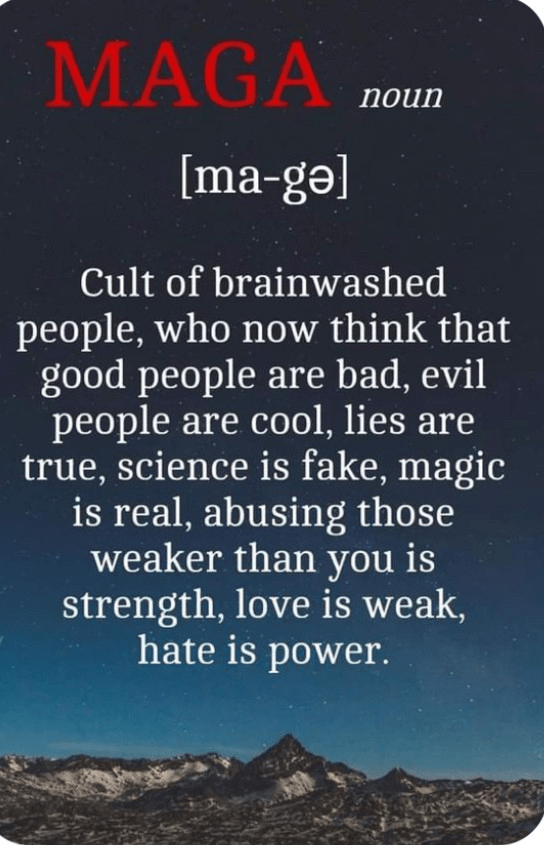
    I would like to argue that, assuming a good outcome in November, the threat of an Orwellian dystopia is over. But no, V.P. candidate Vance stands ready to pick up the banner. He is smarter than Trump, far more educated, and equally as bankupt morally. He has already demonstrated that he can lie with Donald’s aplomb and stir up divisive hate by stoking fear of alleged immigrant hordes. More disturbingly, the tens of millions of MAGA conservatives won’t go away, nor will the billionaires with their limitless resources ready to create a society they can control for their own nefarious purposes. It is not over by a long shot.

    George Orwell’s nightmare is not at an end. It has only just begun.

  • Tribalism

    October 1st, 2024

    I can yet recall the political wars of my youth. They could be virulent and hard fought, but they seemed genteel in the light of today’s almost apocalyptic contests. Today, our politics seem more like the end days battles between good and evil, darkness and the light. We are not talking about minor disputes over the appropriate levels of taxation or seeking the correct balance between investments in private versus public goods. Those were the reasonable debates among principled combatants in the old days. No, today we struggle for the continued existence of a democratic Republic and the sustaining of our national unity while the world looks on in growing horror.

    We’ve always had venomous anger in our politics. The sectional rage to preserve racial hegemony and apartheid, the rights movements of the 1960s (including deep frustrations and communal outbursts), and the anger vented by the young toward state-sponsored institutional violence in Southeast Asia and elsewhere as indigenous peoples sought their own forms of sovereignty are examples. At the core of governance, however, a certain set of common understandings prevailed. Enough decent people in government debated details within accepted frameworks of negotiation and compromise. We all accepted a Keynsian framework within which government would steer the ship of state. Extremes were avoided.

    In many respects, politics today are different … visceral and raw. Disputes are based on emotion and premised on radically different views of reality. Even as late as the early 1990s, I can remember working with those of a Republican persuasion to work out compromises on welfare and human services issues. Sure, normative differences existed. But the dialogue was, for the most part, between sensible adults who referenced logic and evidence to advance differing opinions and perspectives. The Gingrich revolution of 1994 was a shot across the bow against that sensible world. For Newt, any compromise with the other side was treason. The reasonable Republicans from those days now just shake their heads in dismay … wondering what happened to their party.

    The hyper-partisanship and polarization of today has many roots. The political realignment in the post Brown vs. The Board of Education world divided the political world into more homogeneous political entities. The Democratic Party drifted to the left and the Republican Party to the right (and then to the Hard Right). The GOP eventually purged almost all moderates from their ranks, though it took some time to achieve that goal. The political and normative divide gradually took on a geographic or spatial character. Conservatives reigned in southern states and the more rural states in the Western part of the country. The so-called progressives tended to be in highly populated, coastal areas. The areas of contention were reduced to several so-called swing states. Our antiquated electoral college (a residue of the Founding Fathers distrust of an untried concept of democracy and persistent fear of mob rule) shifted political battles away from a pure majority rule for deciding national elections. For over three decades, the Republican Party has garnered a national majority vote only in 2004.

    I live in one of those swing states … Wisconsin. The spatial and cultural character of the political divide plays out here in a very clear way. The progressive vote is found in the more densely populated areas, while the MAGA vote is concentrated in the more rural and sparsely populated areas.

    For example, if I were to drive around the State Capital, Madison, I would see a sea of signs like the one above. On the west side of the city, where I reside, nary a single Trump sign is found. Who lives in Madison? Well, it is a rapidly growing metropolis (about 300,000 in the city and 600,000 in the county) comprised of highly educated, professional types. The economic growth has been fueled by the prestigious University of Wisconsin and the spin-offs from the intellectual ferment of this bastion of research. Growing companies include such examples as Epic Systems (which controls the majority of medical data systems nationally and even abroad) and Exact Sciences and many other like hi-tech firms. They employ technically sophisticated people who think logically and function based on data and empirical research.

    When you get out to the countryside, you see signs like the one below. Recently, my female friend and I drove up to her retreat on Green Lake about 75 miles northeast of Madison. As we drove though the bucolic countryside replete with dairy farms and corn crops, the dominant political preference was undeniable. All one could see were Trump signs, often large in size and brassy in their message.

    Only when we drove through the smaller towns did we see sights like the one below … supporters of Harris. This was in Ripon Wisconsin, a town of less than 8,000 souls. Ripon happens to be the birthplace of the Republican Party (in 1854) when it was the upstart liberal entity replacing a dying Whig party. The new Republicans were the liberals … opposed to slavery and supportive of a stronger central government and more public investments in the common good.

    The spatial dimension of our current political and cultural divide could not be clearer. The Dems really dominate in those areas where the population is educated and more sophisticated. My neighbors in west Madison are, almost universally, professionals with advanced degrees from the best universities. They had professional careers as doctors, engineers, lawyers, and academics. They lived in worlds defined by numbers and clear thinking. It is not surprising that the last Republican Governor (Scott Walker) went after the University of Wisconsin. He reduced state support, attacked University governance, and even tried to eliminate the iconic Wisconsin Idea where the University would work to solve social issues. Now, Wisconsin ranks 43rd among all states in their financial support of higher education. Only aggressive solicitation of other sources af extramural resources (something I did when there) has sustained the University as a first-class R-1 research university on the global stage.

    The Republicans really dominate in rural communities. These are almost universally white and culturally homogeneous worlds. Anything or anyone that is different is viewed with suspicion. One of my favorite stories involves my late wife. Many decades ago (the 1970s), she was in charge of a study of the role of women in state service. While doing interviews of public officials throughout the state, she was driving toward the courthouse in a somewhat rural county. She was pulled over by the police. The officer started interrogating her. Exasperated, she asked what she had done wrong. Nothing, the officer replied. But I saw your ‘support the equal rights amendment (for women)’ sticker on your bumper and knew you were not from around here. In these areas, threat and danger are found everywhere.

    These two worlds (urban and rural) operate within very different universes. Frankly, I cannot even fathom how those out in our lovely Wisconsin countryside see the world. Theorists posit that these folks are driven by rural, white rage or perhaps it is a sense of lost cultural identity and a sense of diminished societal hegemony. A fear and resentment seems to stalk the countryside but, frankly, I know too little about that world to make sense of it. Apparently, they want a strongman to come along and make things right again which, I fear, means doing something vengeful to folk like me (though I’m too old to care). I fear that a similar set of resentments led the Germans to accept Hitler in the early 1930s.

    When we were up at my female friends retreat on the lake, she had to stop by the business of the mechanic who winterized one of her boats. Knowing that I had a Harris-Walz sticker on my car, she suggested I park a distance away where he would not see it. While a good mechanic, his understanding of the broader world hardly exceeds that of a child. According to her, he really believes that a Communist government would be instituted if the Dems prevail in the upcoming election. No amount of reasoning with him is possible, she informed me. Unfortunately, he is not alone in his paranoid views..

    I fear that our tribal bubbles are congealing, the surfaces that separate us are becoming less permeable. After all, we have our own individual sources of information and input. There no longer is a Walter Cronkite to bring us common news. We mostly talk to people who agree with our views. And our instantaneous access to the world’s information enables us to cherry pick that which reflects and supports our priors. We are, in short, retreating into our own insular tribes. I fear this is a very bad thing. The consequences of this degree of separation can hardly be imagined, but it will not be positive by any means.

  • Dad and Me.

    September 24th, 2024

    This is 1944, probably in the Fall given how we are all dressed. I am the little shit squeezed between my father, Jeremiah Thomas Corbett, and my mother, Jane Ann (Spiglanin) Corbett. It was considered a mixed marriage in those days … the joining together of members from the Polish and Irish tribes in Worcester Mass. They probably still liked each other in these early days, their youth and hopes had yet to be dashed by a harsh reality and lost dreams. That would come later, as did the bitterness.

    I cannot imagine that my presence in their lives was anything else than a serious inconvenience. They were players in their youth, lovers of gambling and night-clubs, and of drinking with friends. I would be pawned off on my grandmother who lived in the 3rd floor tenement while we occupied the first floor flat of the ubiquitous three story residential buildings that populated Worcester Mass. I liked my grandmother. She was straight out of central casting, plump and gey haired and matronly. Besides, she made the best eggnoggs imaginable.

    I was also schlepped to the nearby tenements of two aunts who would be stuck taking care of yours truly. Such a joy I was 😊. In any case, I would be amused later in life by the arguments in the family about who really raised me … my mother’s sister or my dad’s sister. It was inconceivable to me that rational adults wanted to take credit for such a questionable accomplishment πŸ˜…. But there you have it.

    When no one could be persuaded to look after me, I do recall being taken (reluctantly) to the homes or apartments of friends where my folks and their friends would gather for evenings of good cheer and poker. The drinks would flow among the adults, the laughter was abundant, yet I never had trouble falling asleep among the coats that had been piled on a spare bed. To this day, I can nap amidst total chaos. Napping is my personal strength.

    One image survives from my earliest memories. Each morning, I would find mom sitting in her robe while smoking a cigarette and drinking a beer as she argued with one of her sisters on the phone. (Note: she mostly worked evenings serving drinks in taverns and night clubs.) She loved her siblings, but they fought like cats and dogs. I cannot imagine my mother denying herself cigarettes and beer during her pregnancy with me, even if the dangers were known in the early 1940s. How I was not born severely damaged is a mystery. Then again, perhaps I was … which would explain a lot about how I turned out.

    Mostly, like all children of that era, I was left to my own devices. I would be thrown out of the house early and told not to return until the streetlights came on. If it rained, my mother had a favorite song … rain, rain, go away, Tommy wants to go out and play. This meant that she hoped the rain would stop so she could once again cast me out onto the streets. There, I could maraud throughout the byways and parks of Vernon Hill with a bunch of other mischievous rascals. A few years later, after I took up golf with a few ancient clubs given to me by an uncle, I would walk miles to the nearest golf club. There, I would whack the ball around the course all day (it cost one buck) before hiking all the way home before the sun set. Had I been kidnapped, the miscreants would have been in Canada well before anyone knew I was missing. Apparently, not even the perverts and pedophiles wanted me πŸ™„. And so, for better or worse, I was spared.

    Here I am with my dad. The year is probably 1947 or 1948. He almost looks happy to be with me, actually appearing as if fatherhood was a good thing in his life. But that is not my early, though surely questionable, memory. No, my emotional sense is that I was little more than an inconvenience to him in the early years. He was fastidious while I presented him with so many messy demands and challenges. Later, that would change, but not for a number of years.

    As a young man, he was a bon vivant. He had worked in the bingo circuit when it was a legal form of gambling and big business. He was handsome and likely a draw for the young ladies. He also skirted on the shady sides of life. Among his more risky ventures was an illegal football pool run by a partner and he. One day (as I was told by several sources) a local sportscaster correctly selected all the winners for that weekend’s chosen college games. That skewed the betting. He and his partner didn’t have the money that was owed to all the winners. After his tribe (the Irish) wouldn’t help, dad went to the Italians. That was the end of his semi-gangster career.

    By the time I really got to know him, he was doing factory work. I’ve always wondered why he gave up on his exciting, youthful life. Did I have something to do with that? Oh, the guilt. In any case, over time their marriage was one of faded dreams and mutual recriminations. There was little love in the household.

    Gradually, though, I sensed my dad spent more time focusing on me, certainly by the time I played Little League ball. When I matriculated at St. John’s Prep, a rather elite Catholic school, he became active in the school’s men’s association. He eventually became president of the Pioneer Club (as it was known) even though he was blue collared worker while many of the other dad’s were white-collar professionals with college educations.

    I suspect I disappointed my dad in many ways. He was a good amateur artist. He tried to encourage me in that direction, but it never took. He had hoped I might excel athletically, but I did nothing in that arena after entering high school. He never said anything, but I had this ominous sense that I failed him time and again. That feeling of shame never disappeared.

    Eventually, though, he responded to me being in his life, taking some pride in my ability to avoid juvenile detention, expecially as I began to excel academically, though I was a late and unexpected bloomer in that regard. Eventually, though, his son who was best marked by many failures and shortcomings early on, began to look as if he might excel in life. It was a matter of pride and satisfaction to dad that his one and only offspring eventually got a Ph.D. and earned a position at a top research university. I think, in a way, I achieved goals well beyond his own reach … at least in his own mind.

    As I think about him, it strikes me that he was likely a brilliant man, perhaps lacking in confidence and held down by circumstances. No matter, I absorbed a lot from him … his cynical, yet dry, wit along with his story-telling ability above all. I thank him for those gifts. They helped me survive adulthood with remarkably few real talents and skills. Do, thanks dad.

  • The Occasional Conundrum: 9-20-24!

    September 20th, 2024

    I mentioned being a fan of the early episodes of The Big Bang Theory. I loved the Sheldon Cooper character largely because he resembled a number of the cloistered academics I knew in real life, even if his traits were a bit exaggerated. In a favorite series moment, his colleagues notice Sheldon giggling for no apparent reason as the group is enjoying lunch. They prompt him to explain which he does as follows: he has dialogues in his head that he describes as sparkling and well above the usual banter he has in real life.

    I’m no brainiac like the Sheldon Cooper character. Still, I must admit that some of the most stimulating discussions I have are with myself. No, I don’t actually talk to myself (most days at least), but I do routinely engage in internal and silent dialogues that strike me as remarkably insightful and even provocative. And yes, I realize that therapy might help.

    It hit me that these internal explorations might make decent blogs … at least a few of them might. Let’s try and see. When and if I share one in the future, I’ll call it The Occasional Conundrum followed by the date … like I did with this post. What follows is a typical internal dialogue:

    … When I want to shut off my brain, I watch sports (which is rapidly losing favor with me as even college athletes have become professional hired guns) or true crime shows. I’m not sure why I favor the latter unless it is because I learn something from exploring the depths of human depravity. To explore the darker side of humanity, crime and politics are always good bets. However, politics simply are too horrific, even for a depraved pervert like me. I’m also taken with the sophistication of recent crime detection technologies and the extent to which officers of the law will go to identify the miscreant of some dastardly deed and secure some closure for the victim’s loved ones. Most of these shows end with a feel-good triumph of righteous justice. It is the devotion of the forces of law and order to securing justice in some cases that caught my attention earlier this week.

    In a recent show, the body of a female is discovered buried in a remote area in 1977. The case remains a who-done-it for many, many years until an informant contacts authorities and leads them to the killer. You would think … case closed. Justice, though delayed, done.

    But no! One issue remains unresolved while available technologies have improved. Even though the killer has been caught, the deceased has never been identified. The killing was a random act, so even the evil miscreant had no idea who she was. The remainder of this program centered upon the search for the victim’s identity. We are now talking some three plus decades after the event despite searching diligently for years after the murder to discover who she was.

    A cold case detective eventually took up this task and worked with the latest scientific methods to identify the girl (who turned out to be a teen runaway). Through dauntless, tireless, and costly efforts employing the latest DNA technologies and a considerable amount of manpower, he was successful. The show ended on a note of satisfaction when the few remaining kin got to know what happened to this person they barely remember from some four decades earlier.

    As I’m noodling this story later, I’m thinking … that’s nice. Still, I’m troubled. Now, I know of many other crime stories where the search for the victim’s remains becomes more complex and expensive than the search for the guilty party or parties themselves. In many instances, this part of the mystery is more convoluted and demands more resources than all else combined.

    Perhaps I’m callous. However, after a reasonable point, the resources expended on finding decomposed remains (often little more than a few bones) to return to a family seems rather pointless to my cold, calculating soul. There is an important opportunity cost in all this. Could we not use that energy and sunk resources more profitably … improving public safety or crime prevention or even victim compensation in the first instance. Some of the searches done in the more difficult cases boggle the imagination, involving hundreds of people and months upon months of time and effort … all for what’s strikes me as little more than a symbolic result.

    And so, in my head, I debate whether these extraordinary human and institutional efforts make sense. We talk about scarce resources all the time. And yet, in some cases, we spend remarkably little time thinking through how we expend some of those resources or how we might redirect them to more worthwhile ends.

    But there is a larger issue here, at least I think there is πŸ™„. As human animals, we are more easily attracted to individual tragedies than more abstract dilemmas and challenges. Whole communities respond to a missing child with hundreds of volunteers spending hours slogging through fields and woods often in hopeless searches. Or look at the enormous effort expended to rescue a child trapped in a well, with the whole country seemingly fixed upon this singular tragedy. In the end, we applaud these heroic community efforts.

    And yet, we know that untold numbers of children are facing horrific situations absent any attention at all. Many are undernourished, abused physically or emotionally, neglected, or exposed to depraved and drug-addled lifestyles. Out of sight, and out of mind, the lives of these children are diminished inexorably on a daily basis. Any help directed their way comes way too late in the process. In short, we respond to micro-tragedies but ignore macro-level challenges that impact far more victims. We even resist imposing a few more taxes on the uber-affluent to support services for vulnerable children. After all, those extra taxes might force the 1 percent to make a difficult decision … should their next luxury car be a Ferrari or a Lamborghini or (God forbid) merely a Lexus.

    Something to consider at least.

  • Broken systems and broken people.

    September 19th, 2024

    I ran across a video of a guy talking about the interconnection between education and incarceration. In rapid fire succession he noted that 2 out of 3 kids who cannot read proficiently at a 4th grade level end up in jail, prison, or on welfare; some 80 percent plus of all teens who go through the juvenile justice system are functionally illiterate; some 70 percent of all inmates today cannot read above a 4th grade level: and a teen daughter is some 6 times more likely to become pregnant if she cannot read at a 4th grade level. The bottom line is this, if you are cognitively unprepared or undeveloped for the modern world, you are likely to fall by the wayside and in a big way.

    Some of you will argue that Donald Trump did rather well with a reading and speaking capability estimated to be at the 5th grade level. Thus, education may not be all that critical. But he is not a good example. After all, he started out with $400 million plus from his dad (back when that was real money) and still managed to stumble into a half-dozen or so bankruptcies. He even bankrupted a casino, which is extremely hard to do. Currently, he is running one more time for the Presidency primarily, many speculate, to avoid jail time for the first set of felonies on which he has been convicted. Other convictions are likely to follow. Most poor persons of color cannot inherit huge fortunes nor borrow large sums from Russia to stay afloat. They make it or break on their own. Sadly, too many are ensnared in our nefarious, Byzantine, and failed systems … especially the so-called justice system.

    I can recall one of the hundreds of brown-bags I attended while working at the University. The presenter over- viewed her research on the criminal justice system. She looked at each key decision point in the system from issuing a warrant to arrest, arraignment, negotiations, sentencing, release, parole, and reincarnation. At every such point, people of color fared worse. It was as if there was some form of systemic adverse racial treatment operated here. How shocking! How utterly predictable!

    Next I read The Many Lives of Mama Love. This memoir was written by Lara Love Hardin, a well educated white women who ran afoul of our broken justice system as a result of going astray with drugs early in life. She made it back to a full life as a successful and best-selling author as well as a CEO of her own literary agency. But her time being ensnared in the tentacles of our justice system trapped her in the depths of despair, almost breaking her. At her worst moment, it led her to the precipice of despair and suicide. One book she later co-authored was about a man who spent almost three decades on Alabama’s death row before he was exonerated. How many innocent people are murdered unjustly in the so-called name of justice.

    The tragedy of our criminal justice system is reflected in the fact that we have more of our citizens incarcerated in jails and prisons than anyone else. Our 2 million plus prisoners represent one-quarter of the world’s total, even though our proportion of the globe’s population is about 7 percent of the total. Our per-capita rate of individuals behind bars was 629 per 100,000 people in 2021 (according to the World Prison Brief) … the highest among civilized nations by far. At the least, this is a costly failure. At one point, the cost of being incarcerated in a maximum security slammer rivaled that of financing a Harvard education, though schooling may have shot ahead in recent years. Nevertheless, stuffing people in cages takes a lot of money.

    I’ve oft wondered why this is so … why do we have so much crime as suggested by our numbers living in cages? Why are there so many who apparently have failed the most basic test of citizenship by not playing by the rules? Perhaps it has something to do with our hyper-inequality of income, wealth, and opportunity. Money and its obsequious display are worshipped here at the same time as societies’ goodies are redistributed more and more toward the top of the pyramid. Worse, the ability of those at the bottom to ascend the socio-econonic ladder has become increasingly more difficult as the cost of upward mobility (e.g. good educations) exceed available resources for too many youth. Want the American dream, I say often, go to a Scandinavian country.

    But let’s back away from the big explanations for a moment. Let’s forget about bothersome facts such as living in a society that encourages having more guns than people out on our streets. Or let’s not dwell on the systemic failing of American culture that favors punishment over habilitation to motivate proper behavior. We have an unstated ethos that people are essentially evil (and some undoubtedly are) and that only the harshest treatment of real and suspected miscreants can secure the safety of society. Thus, we have a long history of employing fear and even state-sanctioned killing to ensure acceptable behaviors. Yet, homicides and criminality often are highest in those states with the harshest laws based on a retributional perspective of human nature.

    Moreover, our culture stresses a virulent form of individualism where all are expected to achieve success (or overcome adversity) on their own. It is a weakness to seek help from the government, and it is a drain on so-called scarce resources. We seem less bothered that others who are more fortunate can buy success or evade the consequences of bad choices if, of course, they can pay for those things on their own. The concept of public goods (like access to medical care and higher education and good legal representation) are undeveloped in this land of opportunity.

    We seem to easily forget that investments in the young, starting with universal pre-natal care, quality child care, excellent early education for all, and prevention of problems is much better than harsh interventions after the issues are fully manifest in counter-productive behaviors. In consequence, we are beginning to lose the global competitive race because we are not investing fully in the next generation. We once had the premier education system in the world. Now, we are diverting resources from such critical needs under the absurd assumption that the top of the economic pyramid is not getting enough of the economic pie. The hard right argues we should divert even more from public needs to further augment the wellbeing of the uber wealthy. Hell, the share of the pie going to the 1 percent has gone from about 10 percent of the total to about 25 percent since the start of Reaganomics. This tectonic redistribution of resources represents a fundamental shift in our culture and our values … and not in a good direction.

    Some of our failings might well be attributed to specific public decisions (discrete policies). These are things more easily righted. For example, after the Voting Rights legislation of the 1960s resulted in Black Americans exercising their franchise rights in larger numbers, a scheme (purportedly initiated in the Nixon White House) of voter suppression emerged. Through tacit understandings, the judicial system found ways to increase the penalties and legal punishments on drug use that disproportionately impacted communities of color. Though most drugs found their ways into White communities (that’s where the money was), most who were caught up in the system were not White. And guess what, felons could not vote. How convenient for the traditional holders of power … those at the bottom were disenfranchised in yet another way. That is a conscious and systemic societal failure.

    Once an individual is in that system, the rules and protocols make it near impossible to escape. Lara Love Hardin, author of Mama Loves, was the right color, was very talented, and already had an education before she ran afoul of the system. Yet, she almost buckled in the face of the insane and contradictory demands she faced. On parole, she faced a bewildering array of competing and conflicting demands among institutional silos operating in isolated ways though theoretically functioning within the same system.

    It was as if no one understood that there was no coherent system nor cared about those caught up in it. Lara desperately tried to be in two or three places at the same time to please her parol officers, the criminal court, and the family court. She lived in constant fear of going back to jail or losing custody of her youngest child, or both. And there seemed to be no one to help nor help her make sense of the bizarre world in which she was trapped.

    Everyone in the system wanted to maximize their success no matter the overall cost. For example, DAs wanted to clear cases. So, they piled on unsolved crimes to available criminals awaiting adjudication while promising even lighter sentences if they went along with this scam. That helped them look better while not serving justice one whit. Prisons were busting at the seams at the same time that for-profit incarceration models made it economically advantageous to maximize prison populations, at least in some cases. Looking from the outside, it is a system absent an overall purpose and rationale. It resembles more closely a complex array of separately moving parts operating from decidedly distinct purposes and cultures.

    Many years ago, during my professional career, my colleague (Jennifer Noyes, now right hand person to the University of Wisconsin Chancellor) and I spent a fair amount of time working with human service programs. In particular, we oft worked with welfare programs as they shifted from handing out money to moving vulnerable persons into employment and productive roles in society. Officials running these systems initially wandered about in confusion and disarray during this period of change.

    As we consulted with a number of them across the country, we developed what we called the line-of-sight exercise. We would walk through the client’s experience in the current system (from the customer’s perspective), continuously asking officials what they really wanted to accomplish at each key point. Discrepancies between intent and actuality oft led to dramatic rearrangements in responsibilities, roles, and structures. Most of all, it became apparent that new cultures were required. We saw some amazing changes … new collaborative arrangements among what had been competing (or at least unaligned) systems. We put together welfare-work models that became inspirations around the country and even internationally.

    Wouldn’t it be nice if we could do that on a larger scale. Wouldn’t it be great if someone could reimagine the justice system (or non-system) from the viewpoint of those caught up in it. Even better, how about doing a form of line-of-sight exercise for our American society? Perhaps we just might reimagine the kind of world we want, not the one we have.

    Just imagine that.

  • Illusory Understandings.

    September 9th, 2024

    As homo sapiens, we are vulnerable to overstating our ability to comprehend the world about us. Some of that hubris stems from our past record of success in unraveling numerous opaque physical laws. I am yet astounded by scientific feats that permit us to send a spacecraft on a multi-year mission to hit a small sphere traveling through space at thousands of miles per hour. Such feats of technical accomplishment boggle my mind, which is not difficult to do given that I struggled mightily with high school algebra.

    To my mind, there are two dimensions of reality where our understanding of how the world operates remains stubbornly illusory. One is the subatomic dimension where strange phenomenon and inexplicable happenings yet surprise, and occasionally confound, the best of physicists. The other is at the societal level where social scientists struggle to explain and predict behaviors (both macro and micro) with at best marginal success. There may be third dimension that lies beyond the scope of our known universe of some 93 billion light years across and which contains some 2 trillion galaxies, each comprising billions upon billions of stars. The very concept of such a vast world remains meta-physical in character … at least to me.

    I’m familiar with some of the hard questions addressed by social sciencists, having banged my head against some of them during my career. So, I was taken by a book I recently read for one of my three book clubs (yes, I need to get a life). It is titled Fluke and was written by Brian Klaas. I found his work a compelling read for the best reason of all … his thesis conforms to my own priors.

    Klaas argues that life at the macro or societal level, unlike complex technical questions, are much harder to understand. Why? Basically, outcomes are the result of a virtually infinite number of interacting events that cascade foward in complex ways because of human predilection and immeasurable uncertainties. Looking for easy causal chains in such a chaotic environment is a fools errand.

    His first vignette is instructive. In 1945, Secretary of War Henry Stimson was involved in selecting the first Japanese target on which to drop an atomic bomb. At the top of the list given the committee was Kyoto, the former imperial Capital, now a major arms center for the Japanese military. Stimson refused to even consider this city. The other members of the committee were befuddled. It met ALL the selection criteria, the clear favorite. Why not Kyoto?

    It turned out that Stimson and his then new bride had honeymooned in that very city some two decades earlier, when the cherry blossoms 🌸 were in bloom. He could not bear the thought of destroying a city toward which he felt such a sentimental attachment. Kyoto was thus spared, Hiroshima was not. On the second mission, the city of Nokura was the target. But when the bomber arrived over the site, an unexpected cloud cover was present. It appeared temporary, but the crew, fearing they were getting low on fuel, moved on to the back-up site of Nagasaki. On such idiosyncratic factors were the fates of thousands of lives determined. For many years, there was a common phrase in Japan … the luck of a Kokuran. This was the equivalent of the luck of the Irish.

    We all have our favorite vignettes. Some 17 days before his first inauguration, a disgruntled immigrant, Giuseppe Zangara, attempted to assassinate FDR in Miami. Unfortunately for him, Anton Cermak, then mayor of Chicago, leaned into the open air car of the President elect at that moment, thus throwing Zangara’s aim off. Cermak died and five others wounded while Roosevelt lived to bring the country out of the depression, to successfully fight totalitarianism in Europe and the Far East, and to forge the U.S. into a global superpower. Had Roosevelt perished that evening, John Nance Garner would have held our highest office during this critical time. A staunch conservative and racist, this man was no FDR by a long shot. America (and the world) would not likely have fared so well (comparatively speaking). Perhaps we would all be speaking German now.

    Then again, we have an incident during the height of the Cold War that could have altered history. It was 1962, during the Cuban Missile Crisis. The U.S. Navy had set up a quarantine line around the island to keep nuclear weapons from being operationalized some 90 miles from the American shoreline. A Russian sub had violated the quarantine line. Depth charges were dropped to get the sub to leave or to surface. Those on board this vessel were operating in 120-degree heat and had lost contact with the other Russian ships. They thought that, in all liklihood, World War III had started. The officers on board were poised to launch their on-board nuclear missiles in retaliation for what they thought was all our war.

    In that moment, the world stood a breath away from nuclear disaster. Protocol demanded that 3 senior officers unanimously agree to launch their atomic weapons… the ship captain, the chief political officer on board, and the sub fleet commander (who by fate was on board this vessel). Two decided to launch. One held out. That single (and lonely) decision stood between the peaceful resolution that resulted and an unspeakable tragedy. On such thin threads is history held together.

    Or take the time longer ago that the Archduke Ferdinand, heir to the Austro-Hungarian throne, was on a state visit to Sarajevo in the summer or 1914. Bosnian independence fighters were out to assassinate the autocrat-in-waiting. As Ferdinand and his wife were driven through crowded streets, a bomb was thrown at his car. Several bystanders were wounded, but the principles escaped unharmed. Soon, the Archduke impulsively decided to visit the hospital where the wounded were being treated. At this point, another providential accident of history unfolded. The driver of the car took a wrong turn, then stalled as he attempted to redress his error. Another Bosnian terrorist (Gavrilo Princip) had been sitting glumly at an outdoor cafe, believing that he and his comrades had failed in their mission. Then he looked up and, to his utter astonishment, sat his target just a few feet away in a stalled automobile. He calmly stood and fired, killing both the Archduke and his wife.

    On this act, World War I unfolded. For many, this War and the Second World War were considered part of a single cataclysmic event that transformed our world. Monarchical dynasties disappeared (or were diminished in stature) as the world evolved into a bipolar contest between two competing philosophies. The price for all this change was untold suffering and some 70 to 100 million deaths (depending on how you count things). Of course, all of this may have unfolded had the Archduke’s driver not made a wrong turn, but who knows. Perhaps what happens is inevitable or nothing is inevitable.

    When I was doing policy, I watched my colleagues try to find certainty in a highly uncertain world. They did gold standard experiments (random assignment methods), did sophisticated observational studies on large data sets, and performed clever investigations where natural experiments were possible (careful to statistically account for confounding noise). All was done in the pursuit of causal relationships. Did A cause B and in what ways.

    Yet, understanding collective human behavior remains elusive. Even interpreting the research results is subject to idiosyncratic values and differing normative values. Social science is much harder than the so-called ‘hard’ sciences. I recall one ‘brown bag’ (of the hundreds I attended). The presenter offered dozens of research results on the crowd-out effect of expanding government run and financed health care options. That is, how many families would abandon private insurance in the face of a public alternative. The estimates apparently ranged from a 0 substitution estimate to something on the order of 75 percent. I can just imagine the response of public officials to such uncertain and inconclusive results.

    My good friends in the dismal science (economists) provided me with the best laughs of all. They created homo-economus as a way to understand how the world worked. Essentially, complex humans were stripped down to stick figures motivated almost entirely by utilitarian-maximizing motives. In their simple world, money made the world go round. On occasion, I would do some work to show that the real world, and actual human behavior, was far more complex than pavlovian responses to alternate marginal utility regimens. This is why even simple exercises such as projecting public costs and/or take-up rates are often hilariously wrong no matter the sophistication of the models employed. You can’t always anticipate the unanticipatable.

    This probably is why I enjoyed my career. It was part science, part craft, and a lot of imaginative feel and analysis. In the end, you knew there would be no final and right answers. Perfect for someone like me. The chase was always preferable to catching the prize.

  • Paying the price …

    September 4th, 2024

    I was going to move on from the theme of my recent blogs (reminiscences on earlier times). But then I had my most recent visit to the dermatologist yesterday. They dream of customers like me … those who provide a continuous source of high-cost work on patients with good health insurance.

    Observing the scar from yesterday’s cutting and hacking at yet another bout of basal cell carcinoma (see photo anove), I mused on what got me to this sad πŸ˜” point in life. Essentially, I am paying the price of the many good times that were enjoyed in my misspent youth. Back in the 1950s and 60s, no one told us that worshipping the sun was a bad thing. In fact, a tan was seen as a sign of robust health back in those days.

    In that innocent time, few were aware that an excess exposure to the sun eventually would result in cancerous growths on the surface of one’s body. Nor did anyone mention that some forms of surface carcinoma might spread throughout the body in lethal ways. We are not simply talking aesthetics here. We are possibly talking life and death. However, we were ignorant of such consequences at the time.

    So, we spent hours at the beach, on the golf course, and playing all forms of outdoor games. At best, we would rub on baby oil, which did nothing for you except provide a false sense of security. Well, it did serve a useful purpose if you were permitted to rub the oil on a girlfriend’s body, assuming you had one of these rare treasures. I was not so blessed. Hell, I could only dream of being so lucky. πŸ˜ͺ

    And yet, while I complain about the sins of my youth that ultimately led to numerous trips of late to the horror chamber known as my dermatologist’s office, I have few regrets. I watch today’s youth. They appear totally engrossed in virtual cyber worlds and thus full of crushing anxieties and debillitating neuroses. My peers and I, in hindsight, were much blessed. We came of age in a simpler time where we enjoyed the outdoors and, shockingly, one another’s company (at least for the most part).

    On days not in school, my parents would kick me out of the house, usually telling me not to come home until the street lights came on, or supper was ready … especially in the longer days of midsummer πŸ™ƒ. We would go marauding through the streets while playing endless games of war, or cowboys and Indians, or brave astronauts exploring mysterious worlds, and other like adventurous diversions. Or, we made up simple athletic games that could be played in the streets. One involved a tennis ball and any available steps. By angling the ball correctly off the edge of a designated step, you could simulate a primitive baseball game ⚾️. It was all a matter of using your imagination. If you did that in creative ways, boredom was never an issue.

    As we aged a bit, we would migrate to the local park, a 75 acre wonderland of baseball diamonds, tennis courts 🎾, and basketball arenas πŸ€. Admittedly, the tennis courts were never employed for their designated purpose. They were perfect for another form of baseball called stick ball, a game played with a tennis ball and sawed off broom stick. There always seemed to be an endless supply of other kids who were available for chance games of athletic competition absent adult supervision. We interacted among ourselves and created our own world of fun. Today, I walk through parks with not a kid is to be seen, unless with an adult or participating in some formal program.

    Yes, there was a structured Little League organization but that was a small part of our world. Our parents were not driving us to endless organized and over-regulated events. We were responsible for our own fun 😁 . We relied upon our own ingenuity and worked out patterns of collaboration and dispute resolution without adult oversight. As a result, we advanced rapidly toward adulthood with initiative and some confidence. Okay, it was disheartening to be selected by one of the team captains (the best athletes available) after the kid in the wheelchair but I would eventually recover.

    Still later, I took up golf. As I mentioned, my parents drove me nowhere. So, I would heft my clubs over my shoulder and walk several miles to the nearest course, then play 27 (or perhaps 36) holes. And get this, the final mile of the hike to get there was straight uphill. At the end of this sun-drenched day, I would hike back home. You could play all day for one dollar. I could have been kidnapped and taken three states away before anyone would notice I was missing. But no one seemed concerned back then. Perhaps my folks were hoping a miscreant would abscond with me. But they were out of luck. Apparently, no one wanted me.

    In my later teens, we might avail ourselves of vehicular transportation. We would borrow someone’s car from their parent (none of us teens had our own car). Then, we would drive to Cape Cod for golf and then some time laying about in the sun, perhaps hoping against hope of coming across some desperate girls with low self-esteem who might not find us totally repulsive. No luck there 😞. It seems that our fortunes on the course and in romance were equally dismal.

    If there were a common denominator to all this, we were outside a lot. We were not attached to computer screens or smart phones. Rather, we were exposed to endless hours in the hot sun. My fate as a future dermatologist’s dream was likely set by the time I turned 24, helped along by spending 2 years in a Rajasthani desert in northwestern India. Now, that was a hot and sun-drenched place. My skin damage likely had already been done by my mid-20s.

    Yet, all of life is a balance of tough choices. I could have stayed inside more as a kid and young man. But would I have exercised my imagination as much? Would I have developed the interpersonal skills so essential to later adulthood? Would I have toughened myself in endless competitions with my peers? I doubt it. So, maybe a little hacking and cutting in old age is a small price to pay for such a productive and adventurous youth. I tend to think so.

    Then again, I am not totally certain of that. I have yet to experience the full measure of the penance I must pay for my exuberant youth. Time will tell if there is more pain to be exacted for my early sins.

  • What might have been … continuing further!

    August 26th, 2024

    No male of my generation came of age without facing the crisis associated with the Vietnam conflict and the military draft. It was an obsession for nearly all of us, dominating our young lives as we came of age during the 1960s and early 1970s. Today’s kids, absent a compulsory military draft, cannot fully appreciate the angst we endured back in the day. Our young lives appeared to be at risk and, for too many, they were.

    Yet, our existential dilemma was about more than mere survival. It imvolved a desperate and fundamental struggle to define our personal core values. For my generation, unlike more recent cohorts if survey results are to be believed, ‘formulating a personal set of beliefs‘ was a critical undertaking in those tumultuous 1960s. We sought to understand what we stood for and for what, if anything, we might be willing to perish.

    Like many others born during, or immediately after World War II, I grew up embracing the United States as a beacon of hope and righteousness in a deeply divided world. From the defeat of fascism and state-militarism, totalitarian models that dominated much of Europe and the Far East by the 1930s, there emerged a bipolar world … a seemingly Communist monolith bent on world domination versus a ‘free‘ world led by the new American superpower. It seemed like a titanic struggle to the death.

    As a working class Catholic kid, I had fully absorbed the cultural tenets in which I was immersed in those times. We were in the midst of the Cold War. It was a binary world to our minds. You were either on the side of God and truth or you had embraced evil. No neutral ground was permitted, no nuanced interpretation of events could be entertained. I was studying to be a priest in a Catholic Seminary when the Cuban Missile Crisis erupted. I can recall seriously considering leaving my studies to join the military, assuming I would return to my service to God when the good guys had triumphed (if I survived that is).

    Within two years or so, my worldview had undergone a shattering transformation. Today, the ‘hard right‘ would argue that I had been indoctrinated after leaving the seminary and matriculating at a secular college. Yet, think as a might about those critical days, I cannot recall any professors or classroom discussions where anyone consciously attempted to shape my perspective. No, the process was way more subtle and based much more on learning to think for myself at long last.

    I read widely and voraciously, absorbing all I could from history and current events. More importantly, I thought hard about what I was cognitively ingesting. Outside the classroom, I spent countless hours debating the issues of the day with other razor-sharp students. I found myself in a dizzying and exciting world of internal turmoil and self-discovery.

    To my amazement, I uncovered a world that was quite nuanced, not black and white, not simply divided between evil and good. Soon, I became aware of our own domestic national sins, failings such as the system of legal apartheid that oppressed members of minority groups. I began to appreciate our own sins of commission (the overthrow of elected governments in sovereign lands that we simply didn’t like) and sins of ommission (the implicit support of heinous and murderous regimes simply because they supported our point of view).

    Still, shedding one’s embedded cultural skin is not easy. In fact, it was torture and replete with self- doubt. I’ve recounted my final break on supporting our Vietnam adventure elsewhere. The final rupture came in a day long debate with a fellow student who, like me, had been awarded a summer undergraduate federal research grant. We spent a full day avoiding our work while hammering away at each other’s position. In the end, I realized he was right and I was wrong, though my process of change was well along by then. Soon, I was the leader of the liberal-left group on campus.

    I cannot fully recount the character of the debate back then here. It would take a book, like the one I posted above, Oblique Journeys. Our best and brightest leaders, to my mind at least, made simple-minded errors like conflating the legitimate desire of the Vietnamese for independence with a presumed ideological attachment to the Soviet Bloc. The very notion of a monolithic block was already cracking apart if one were to look closely even then. In retrospect, nothing was more patently ridiculous than the domino theory employed to justify the killing of millions of Asians (if you include the Cambodian killing fields) and some 57,000 Americans. If the Vietnamese were to finally achieve independence after decades of fighting the Japanese, the French, and then the Americans, they were not likely to invade California. Thinking about their struggle objectively, they made our Revolutionary war (analogous to that of a small would-be nation taking on the world’s formost superpower) look like a walk in the park. And how did things turn out? Hell, Americans are now retiring to Vietnam because they like the weather, the people, the cost of living, and the food.

    Yet, what does one do when one’s conscience demands that you refrain from participation in a conflict you feel is unjustified, perhaps evil, but are faced with a legal mandate to fight and kill? How far does one go in the name of principle? What price is one prepared to pay? That was the critical question that dominated my life over the next several years. It was a struggle that plagued many of my peers.

    The goal for guys like me was to make it to age 26 without being drafted. As it turned out, I came very close to being swept up in the military net during my final year of eligibility. As the months slowly ticked by, I entertained many options. I consulted with lawyers, considered conscientious-objector status, and looked to Canada as an escape. Finally, simply refusing to participate, accepting jail as the necessary price for having humane values and a nimble mind, remained an option. Perhaps it was the most honest option. Such things swirled about me. Just what would I do if ultimately pressed to the limit?

    In the end, I made it to my 26th birthday though it was a close-run thing. I did have to take my draft physical in Milwaukee. It proved a hilarious exercise. There was a question somewhere in the process that asked if you had ever been a member of an organization that advocated the overthrow of the U.S. government. I raised my hand and asked if S.D.S. (a leftist group that became radical after I dropped out) counted. The Seargant replied ‘you bet your ass it does, buddy.’ So,I answered yes. At the end, when everyone else was permitted to leave, I was marched to another floor to be grilled by 3 members of military intelligence. That experience did afford me a few moments of humor in an otherwise sobering experience. They would ask … will you fight any and all enemies of the United States? I would gaze at the ceiling as if thinking hard on the question before responding with … I think we need to define ‘enemy.’

    Nothing sharpens your philosophical core like facing adversity. And we all made our own decisions in the end. I recall having drinks with a fellow student in grad school during these trying times. He had been in ROTC (and on the football team) at Boston College. Upon graduation, he was off to Nam as a 2nd Lieutenant. He hit the ground wanting to ‘get those Commies.’ Within weeks, he understood the folly of his predicament and of the war more generally. Now, he simply wanted to get his men out alive. His agony ended when he was shot up on patrol wounds that left him with a pronounced limp. He had become a more virulent pacifist than I was.

    In Oblique Journeys, I take some of my personal experiences and challenges and turn them into a fictional story of what might have been. Writing a frictional novel based a number of actual personal experiences and on my take of the issues of the day gave me a great way to talk through that critical period of my young life. At the end of the day, such dramatic choices push us, perhaps even make us better. But I wouldn’t wish it on anyone.

  • What might have been … continued!

    August 22nd, 2024

    Here’s a quick recollection on how I stumbled into my life’s work. Now, one might think that one would give considerable thought to what would do in life. Serious people likely did so. For example, just last night I was chatting with the son-in-law of my good female friend (he and his family are here visiting). He is a Brit (my friends daughter lives with him and their family outside of London). In terms of occupational choice, he is in finance (a hedge-manager type, I believe) and doing quite well. So, I asked him (David) if he had always known that was what he wanted to do and be since he did not grow up in a wealthy family. He smiled and told me he started his own personal bank accounts when he was about 8 or 9 years old. Yup, he knew right from the beginning.

    Not yours truly, I was still rolling around in the mud at that age. If I had any longer-term ambitions back then, it was along the lines of being a cowboy, an athlete, or maybe an astronaut. The last avocation was due to the popularity of a TV and book series hero … Tom Corbett (space cadet). Nope, like all else in my aimless life, I bumbled my way into a career by chance … absent any thought or planning. How did that happen? How in God’s name did I manage to avoid debtor’s prison and a life of penurious desperation? As best I can recall, it went something like this 😳.

    In college, I had to pick a major. Psychology appeared a good choice, not because I had any particular interest in the topic, I didn’t. But it was the best academic department at Clark University. After all, this is where Freud gave his American lectures and where the American Psychological Association was founded. So, why not! Besides, it did not demand a great deal of math, an academic discipline I avoided like the plague.

    I liked the classes in my major well enough. Apparently, I was even tagged as an up and comer in the field since I was awarded a summer NIH grant for promising undergraduates. This award paid me to do original research under the mentorship of a senior faculty member and were rationed out with considerable care … only 4 were awarded each year. How I got one remains another freaking mystery in my life.

    But I knew soon enough that psychology was not in my future though I did get as far as asking my advisor where I might pursue a doctorate in the subject. He immediately responded … Harvard, Yale, or Stanford. I thanked him for his input and quickly exited his office. Did he have me confused with some smart kid? Wow, I never would have guessed he was taking hallucinatory drugs.

    I kept thinking, being a psychologist? Really? If I were a therapist, I’d have to listen to people whine all day. I’d likely whack them across the face and tell them to buck up. Becoming a researcher or teaching psychology had some merit, though such an ambition seemed beyond my reach. The advantage of that route, though, was that I could avoid people for the most part.

    But reality whacked me upside the head during an unfortunate ending to my summer research project. I had to kill off my lab subjects at the termination of the project. Fortunately, they were rodents and not humans. Unfortunately, some were rather large by this point. As I sent one reluctant subject to his heavenly reward by plunging a needle containing some kind of poison into his stomach, he struck back by peeing in my face. That put a definite damper on my psychology research dreams (and on my puss).

    Still totally rootless and directionless, I drifted off to the Peace Corps for two years in India. As my tour unfolded, I got a bit serious about the future. I took the SATs (in Delhi) and actually submitted an application for a Master’s program at the University of Wisconsin -Milwaukee. I think I chose the school because that’s where I did most of my PC training. I never looked far beyond my immediate environment. I chose the subject area, Urban Affairs, by mistake. I thought it would help me score with urban women. However, it turned out to be a set of classes in sociology, economics, and political science that focused on cities. But that was okay. It didn’t force me into a pigeon hole and kept my options open.

    At the same time, the program did not prepare me for any particular vocational path. If I was confused about what an urban affairs expert did, so was everyone else. So, it took me a while to find remunerative employment when I was finally forced to look for a job. One day, a professor that I had worked with asked me to accompany him to Madison, the State Capital. We met with some state officials on some long-forgotten issue. My unemployment problem came up over lunch, and our state hosts arranged to give me a civil service employment application, which I completed and returned (and then promptly forgot about).

    Weeks later, and after a trip East still looking for work, I got a call from my professor friend. He said I had a job interview in Madison the very next day. But when I inquired about the nature of the work, all he knew was a time and a location. I dutifully showed up and discovered it was a 3-person civil service interview for the position of Research Analyst-Social Services. I laughed quietly … I knew little about either research and less about our system of social services. This should be mercifully quick, I thought.

    Weeks later, I get a call from the hiring supervisor in the Wisconsin Department of Health & Social Services. I was number 3 on the hiring list. Go figure. So, I head to Madison again while thinking this will at least be a good experience. After all, wouldn’t they hire someone actually qualified to do the job? Stunningly, she called me back to offer me the position. I had just made the 3rd place on the list, the final candidate who could be interviewed by the person making the hiring decision, because someone else had dropped out. This hiring supervisor said the candidates got better the further down the list she went. I told her it was a damn good thing she couldn’t get to number 4, they must have been dynamite. Immediately after that, I was also offered a job back East. I always wondered how my life might have turned out had the sequence been reversed.

    In any case, that’s how I got into human services and research. Essentially, it was an accident. After several years (and a couple of promotions), I was asked by my boss to assist a professor from the University of Wisconsin- Madison. He was preparing a large grant proposal for a research project into welfare decision-making that only could be submitted for federal funding through a state agency. Few in the bureaucracy could imagine that an egghead could contribute anything of worth to their program efforts. Thus, they chose a low life like me to work with him. It wasn’t worth the time of anyone important.

    For me, it was just another task. I rather enjoyed my State work. Civil service in the 1970s was respected (in Wisconsin). Most of my colleagues were dedicated and sharp. In addition, my agency was involved in several remarkable and revolutionary undertakings, some of which I played a role in initiating. Nevertheless, I got a call at the end of a work day several weeks down the line, long after I had forgotten the professor and his project. To my surprise, it was this very professor asking if I’d consider coming to the University to help him run this logistically complicated project grant he had just been awarded. I thought about it for 5 or 6 seconds before responding … oh hell, why not? I should note that not everyone thought this a smart move … I was giving up a civil service position for something that looked temporary and highly uncertain.

    Now, I was at the University of Wisconsin-Madison, specifically at the nationally recognized Institute for Research on Poverty (IRP). By some miracle, I fell into the center of intellectual thinking on human service issues. Of course, without a doctorate, I was at the bottom of the heap. But I soon (more accurately, eventually) got the union card (a Ph.D.) and was on my way to an absolutely fabulous and fulfilling career.

    And yet, as I wrote just a few blogs ago, I never embraced fully the academic world. I remained in academia but never embraced the culture. I went with my first love … being a policy wonk who found academia a perfect platform for doing what I loved in the manner that fit my idiosyncratic personality. I thought of myself as a free-lance policy tinkerer and a curious explorer of the toughest social challenges of that era. I also got to pick my own issues, function independently, and work with the best and brightest (in academia and government). It was like being in a candy store where I could indulge my intellect, satisfy my values, and cater to my innate disposition to make a difference in the world. And I got to pass on my ‘wisdom’ to the next generation of students. Perfect.

    Somehow, without any sense of direction or planning, I managed to end up in a perfect spot in life. How did I get so fortunate? I’m not sure. Perhaps just going with the flow, not forcing things or overthinking, has merit. Typically, I went with those things that simply felt right. Either that or it was the luck of the Irish.

←Previous Page
1 … 6 7 8 9 10 … 30
Next Page→

Blog at WordPress.com.


Loading Comments...
 

    • Subscribe Subscribed
      • Tom's Musings
      • Join 38 other subscribers
      • Already have a WordPress.com account? Log in now.
      • Tom's Musings
      • Subscribe Subscribed
      • Sign up
      • Log in
      • Report this content
      • View site in Reader
      • Manage subscriptions
      • Collapse this bar