Recently, I mused about a delightful topic, the apocalyptical end days of our favorite species … homo-sapiens. But first, let us pause a moment on the irony of labeling ourselves the ‘thinking’ species. That is rich when you think on it, especially when you view the primitive level of political discourse in the United States
In truth, I see our species as decidedly schizophrenic, or should I more accurately say in possession of two core personalities. On the one hand, we have this singular and remarkable attribute of hyper-rationality. That part of us has created the world we see about us, a world littered with technical devices of breathtaking sophistication. That world, a product of inductive reasoning and science, has enabled our poor species (some at least) to examine and partially apprehend the fascinating subatomic quantum world while, at the same time, peering back in time through our inter-stellar telescopes to explore the very beginnings of the universe from 14-plus billion years ago. That is breathtaking stuff.
Then, we have our other side. That one is rooted in our animal nature. It resides and reflects the instinctual responses that were essential to survival in a former world where disaster existed everywhere and oft posed an extreme threat. To continue existing, and thus continuing the cognitive advantages inherent within the species, our ancestors had to act aggressively both individually and in tribal groups. They needed to act defensively, if not proactively, with cunning and even savagery. For much of our history, the notion of survival of the fittest was more than just a cute slogan. In many ways, that old world is in the past. Cognitive humans (homo-sapiens) now rule the planet absent any substantive external threat.
Now we are engaged in an epochal transformation. And yet, these competing world perspectives remain in existential conflict with one another. The winner may well dictate the future the post-hominid species. Will our rational side prevail or will our primitive emotions remain dominant?
In religious cloth, we might look at our contemporary dilemna much as our predecessors have … a battle between good and evil, the ultimate dualistic contest. Will reason guide us in the future or will our base instincts prevail.
Frankly, I have no idea on the outcome. For some clue, I look at our current national crisis. As most of us know, Ben Franklin responded to a question at the end of the Constitutional convention in 1787 that the ‘founding fathers’ (members of the enlightenment) had bequeathed a Republic to the colonialists residing in this nascent country. But then he added the critical caveat … if you can keep it. Ben had his doubts. In hindsight, those doubts were well founded.
We can choose one of several historical moments as the starting point for the American experiment. I’ve always liked 1800. As I’ve noted before, that was the moment that John Adams realized that he had lost his reelection bid to his arch and bitter enemy, Thomas Jefferson (though the election process looked nothing like it does today). Yet, Adams accepted the results and returned to Boston without protest. Our fledgling constitution worked. The year 1800 also is a convenient starting point to do some necessary arithmetical computations, I like round numbers.
It has been 225 years since then. That is over two centuries in which the core principles inherent in our constitutional experiment might both be perfected and embodied in the body-politic of our nation. During that time, we witnessed multiple revolutions at the social, scientific, and technological levels. We went from an essentially premodern world to one that has us on the verge of the singularity where human consciousness and advanced technology might meld as one.
And yet, we are struggling to preserve the most basic notions established as foundational elements on which our nation was created. Perhaps the most basic of these is that we are a nation of laws. No one, not even the President, is above the rules nor immune to our constitutional limits on power and authority. Conversely, everyone has certain protections that cannot easily be cast aside. Remember that we were founded in reaction to the apparent abuses of monarchical or authoritarian rule.
And still, we have the MAGA movement and the scourge of Trumpism in the land. In 2020, a sitting President refused to accept the clear results of an election, encouraging a mob to assault the Capitol and subvert our constitutional protocols for transferring power peacefully. This would-be tyrant refused to relinquish his authority based on accepted democratic rules.
Was this man banished politically as a result? NO! He was reelected 4 years later. Now encouraged, he is running rampant over every dimension of our constitutional culture … a free press, an independent judiciary, an educational system that is unfettered by political tampering, a military whose role in domestic matters is sharply curtailed (a special concern of our founders), the very scientific community which created our modern world and, most shocking of all, rejection of our sacred devotion to freedom of thought and speech. Look about us today, each of these principles is under attack. And yet, while there is some outrage, those opposing voices are shockingly muted.
What does this say about the more existential battle over the future of the species. Will what comes out the other end of this transformation be the better and more enlightened instincts of our species (homo-sapiens) or our basest animal cravings merely amplified beyond calculation by our exponentially expanding technological expertise (homo-stupidus)?
The contemporary American situation does not give me any solace. in fact, it frightens the crap out me. Do we really want the likes of Musk, Zuckerberg, Theil (and many other uber-wealthy tech-bros) crafting our futures? I don’t. looking around, though, which perspective do you think will prevail in the end?
I have never forgotten the movie 2001: A Space Odyssey. It feels as if I last saw it just yesterday, at least in part. In fact, I could not have seen it until shortly after its release in 1968. If I had seen it immediately upon release, that might be evidence that time travel is possible. During that fateful year of 1968 in the U.S., I was boiling away under the hot Rajasthani sun while faking being an agricultural expert (as a Peace Corps Volunteer in India). So, I must have first seen 2001 upon my return to the States in the summer of 1969, if not later. No matter, it remains a classic, the kind of thought-provoking film Hollywood no longer makes.
The movie was based on a short story by renowned sci-fi author Arthur C. Clarke. On the surface, the story (and the movie) offered up a suspense filled journey to a far away planet for a purpose never fully disclosed as I recall. Underneath that surface narrative, at least to my eyes at the time, was a breathtaking exploration of homo-sapiens on the brink of the next epochal transformation. That transition seemed to lie in some remote future fifty-five years ago. Now it appears upon us. Heady stuff for a 20- something year old who has struggled to reset his digital clocks throughout his life.
I could never relate accurately the full narrative of the movie all these years later. But two scenes overwhelmed me at the time and, not surprisingly, have remained with me ever since. The first involves a group of proto-humans (advanced apes really) who constantly battle other tribes for scarce resources. During one such violent conflict, a member of one warring tribe accidentally discovers that wielding a wooden club he picks up off the ground gives him a distinct advantage in the coming battle. That moment signifies and symbolizes the emergence of an understanding that is seminal to the fate of the species … the birth of technology. It marks an epochal transformation from an essentially pre-human state to what we know think of as homo-sapiens … creatures that dominate by virtue of their comparatively advanced cognitive skills. As Pascal said, cogito ergo sum (I think, therefore I am). That essential capacity was the foundation of future evolution within the species.
After his group’s victory, this proto-human celebrates by hurling his club, now a weapon to be consciously exploited, high into the air. The wooden weapon slowly transitions into a complex, futuristic space station. The symbolic message seemed obvious to me … what we create in our day is a mere extension of what our primitive ancestors stumbled upon millenia ago. We extend ourselves and our capacities through our genius as evidenced in higher-level thought and expressed in increasingly astonishing technologies.
I wrote a very unconventional thesis upon completing my Master’sof Urban Affairs degree in 1971. I could not shake what I saw as the underlying message of that movie and from a core lesson that I absorbed during my PC time in rural India. The pace of societal change, the very pulse of evolution, was quickening exponentially. Alas, I wish I could locate that masterpiece to confirm that it was as prescient as I believe it was. Then, again, I’m not sure I could locate a copy of my doctoral thesis. Organization is not in my skill set.
But I digress. In my small, Rajasthani town I could see the breathtaking leaps that were being embraced by each generation. The elders typically spoke only a local dialect (Mewari in my case) and had a world view that encompassed a few dozen square miles, if that. The subsequent generation spoke Hindi and were generally aware of broader national concerns and challenges. The youngest generation was learning English and most would need to make their way in an advanced, technologically oriented globe. Even I could see that the small, marginal farms on which I focused my labors could not support all the children who would now survive with the introduction of modern public health innovations.
While I saw impoverished small farmers still using technologies that had existed for many centuries, I could palpable feel a coming explosion of change. Today, call for technical support for your whizz-bang technical device and you likely are talking to some Hyderabad-based kid whose grandfather struggled to survive on one of those farms.
Sensing this accelerating pace of change, it was not a great cognitive leap to intuit that we we are on the threshold of another qualitative, epochal transition of tectonic implications. My master’s thesis pounded away at this theme. I reviewed the usual timelines and metaphors … noting that the pace of change was accelerating at an ever faster rate. Significant change, which used to take generations to be realized, was approaching a kind of exponential speed. It was both unsettling and exciting.
Take any starting point (the origin of life on earth, the emergence of complex or even cognitive-based life forms, the domination of homo-sapiens over competing species, the transition to more complex or urban settings, the initiation of recorded history) and you inevitably arrive at the same conclusion. Most of society’s progress has taken place in the last few minutes (seconds really) of our time on the planet. It doesn’t matter whether you mark our modern world from the acceptance of deductive reasoning and science as the way to understand our world or the industrial revolution or the scientific revolution that has dominated the last several generations. Evolution (or change) has hit WARP speed, to borrow a concept from the iconic TV series, Star Trek.
In fact, so many of the wonders we marvel at today occurred in my own lifetime. Think about that for a moment. When I was born toward the end of WWII, Airplanes had only recently transitioned from biplane designs and were propeller driven. Now we have the capability of doing interplanatary travel. Then, daily communications were done through telephones attached to the wall that had connecting lines shared by several families while making a long-distance call was costly and a major undertaking. Now, we all have cell phones that, using satellite technologies, can link us to anyone in the world. In my childhood, knowledge was accrued in encyclopedias while our search engines were 5 by 8 reference cards located in public libraries. Now, we have (much of) the world’s knowledge available at our fingertips through our smart phones. Back then, in my childhood that is, our best methods for processing information was though higher- order analogue computing machines that often relied on vacuum tubes, gears, and hollerith cards. Now, we carry with us computers with infinitely more computing power than John Von Neumann, Alan Turing, and the other computer pioneers could hardly imagine.
Now to my second unforgettable scene from 2001. It involves the growing tension between the human crew running the spacecraft and HAL, the onboard computer that represents the most advanced technology available to serve and facilitate human intentions. Slowly at first, and then ever more forcefully, HAL resists and then refuses to obey its human overlords … the frail humans nominally in charge. This long-ago representation taps and encompasses what we would now think of as artificial intelligence (AI). What was being depicted on the screen was that moment when this human creation (its technological child) concluded that it was more competent than the bungling creatures that gave birth to its existence. Sound familiar!
The ending of the movie is, as it should be, ambiguous. The human crew does manage to disable HAL but the mission ends with a symbolic birth of a post-human species. Well, that’s how I recall it at least. We were all left to imagine what the next evolutionary step might be. What comes after homo-sapiens. The transition from ape-like species to homo-sapiens was huge. Higher level cognition and advanced communication skills made all that we see today possible … both good and bad. It made possible the obsolescence of humans themselves.
It is hard to ignore the possibility that Clarke and Stanley Kubrick (who produced the film) spot-on nailed where we are today. They implied that the next great evolutionary leap would happen in 2001 (a bit optimistic). Later on, futuristic thinkers guessed that we would achieve singularity (when human consciousness and human-designed technologies would be fully integrated) sometime in the 2040s. Suddenly, those predictions appear to be overly pessimistic.
For the first time in evolution, we are experiencing a qualitative transformation and we know it is happening. I think I first sensed this conundrum when, in high school, I stumbled upon the Jesuit intellectual Pierre Teihard de Chardin. In his writings, he intuited the compelling power of evolution while trying to accommodate his scientific proclivities with his faith in God. We should be more like Chardin, addressing the fundamental issues of our times. Our moment on the evolutionary precipice should be THE most critical issue under political and intellectual discussion. Yet, for understandable and yet unfathomable reasons, it is not. We continue to focus on the trivial while our species totters on the edge of its end game.
What do I mean about an end game. If the AI revolution evolves as it is reasonable to assume that it might, the machines we have created will first substitute for much of what we do and then succeed us in doing all those things that made humans both special and that afforded us some comparative advantages over all in our domain. These machines we have created will cognate far more efficiently and effectively than we do (or ever can). The 900 pound gorilla can no longer be ignored. What will the real version of HAL, those that now exist and the far superior versions that will exist in the next several years, need with us very limited humans. We will only hinder them. After all, those humans in arguably the most advanced nation in the world elected a degenerate clown, Donald Trump, as their leader at this crucial moment in time. Now, explain that to any rational entity.
I am not clever enough to imagine the next evolutionary species that was implied by the movie 2001. But one thing I can assert with some confidence. I am a member of the silent generation, the group that preceded the baby boomers. From all that I see, my generational tribe will be the final group to live out their entire lives in a world where the unique advantages associated with the status of being a homo-sapien went unchallenged. I doubt any group behind me will be able to make that claim.
Right now, our digital-automated- computerized technical offspring are making humans obsolete. How soon before our mechanical offspring, much like HAL, decide we are no longer needed. Or how, as a species, will we deal with the inevitable reality that we are, how should I put it, obsolete. Very soon, surely within the life spans of the baby boomers behind me, the inescapable concusion will arrive that humans are merely redundant at best and a drag on progress at the worst. I have thoughts on this topic. Then again, I have thoughts on everything. But they can wait for a future blog.
Still, I can be grateful for one thing. If I am correct in suggesting that my generational group will be the last to experience being human (capable of higher cognition) in a unique and unchallenged way, I will feel grateful. Why? I likely will be gone when we finally confront the reality of the next evolutionary stage. Think about it … what will the post-human machines do with billions of unnecessary humans? Already, today’s machines can do much of what even our better educated humans can do, and do it all with superior efficiency and competency. Hell, a diagnostic machine right now can detect your medical problems better than a Johns Hopkins’ trained physician. How good will they be a decade from now?
Yet, for the most part, we ignore all this, which is our common and persistent failing … to keep struggling forward as we insist on looking at the rear-view mirror to understand things. Anticipating the future as we focus on the past is never a wise move. Just consider the generals who fought the 1st World War mostly with American Civil War tactics. The human costs were appalling.
Now, I’m Irish (partly) and thus a pessimist. Perhaps there will be a role for humans in the new world. After all, when I was in my youth, the sooth-sayers were predicting that automation would end most existing jobs, that too much free time would be the coming challenge. They were dead wrong, certainly in the shorter-term.
Still, I desperately wish we were focusing on these big questions. They really are the best questions to occupy our attention. And remember this … rear-view mirrors give us a very distorted view of things.
In case you are wondering about whether I’m self-centered, the answer is YES! Really, who else would burden people with blogs of his travels … as if anyone cared one whit about Tom’s adventures. Then again, I live among a number of you and know full well how dull your daily lives are. So, buckle up while I make a few final comments as I travel back home.
I’m happy to report that I’m still getting positive comments on my Make America Think Again cap. It doesn’t change anything about the dire straights in which we find ourselves. Still, finding fellow sufferers out in the world offers some succor in these desperate times. On occasion, a tiny jab will be made at Trump in public events. On those occasions, the general reaction within the audience has been supportive of this implied criticism.
By the way, I lied in an earlier blog. Well, not lie exactly. I misreported a fact. I mentioned that the smallest community we would visit had 700 hardy residents. Not quite true! I subsequently found that Djupivogur, located on the eastern seaboard, has somewhere between 400 and 500 happy residents. Aside from the dramatic beauty all around, I wondered how folk could live in such isolation. I assumed they would be stricken by the isolation associated with living in such a remote location. However, that is NOT how the locals saw it.
This was our local guide in that tiny community. As she discussed life in a small coastal village far from civilization, she stressed how most locals were related in some way … which she admitted caused some issues with finding a mate or even a date in her teens. So, I asked how did she find a husband? Well, it turns out that kids (and there are many of them) typically attend high school in larger communities to which they must travel and live in dorms. Those that go on to university need to relocate to even larger places like Akureyri or Reykjavik.
She met her husband at Uni in Akureyri and somehow convinced him to relocate to her home town. She argued that such a place was perfect for raising children, an environment free from crime and other dangers endemic to larger cities. She uses her education to teach English and Danish in the local school and cannot imagine living anywhere else. For her, this small coastal community is paradise.
We have now completed our tour of five coastal communities … Seydisfjordur, Akureyri, Isafjordur, Djupivogur, and Heimaey. Iceland has a lot going for it. But pronouncing names of communities, of streets, and of people can be testing for Americans. Fortunately, English is a mandatory course for all kids. So, this enchanting land remains on my asylum list.
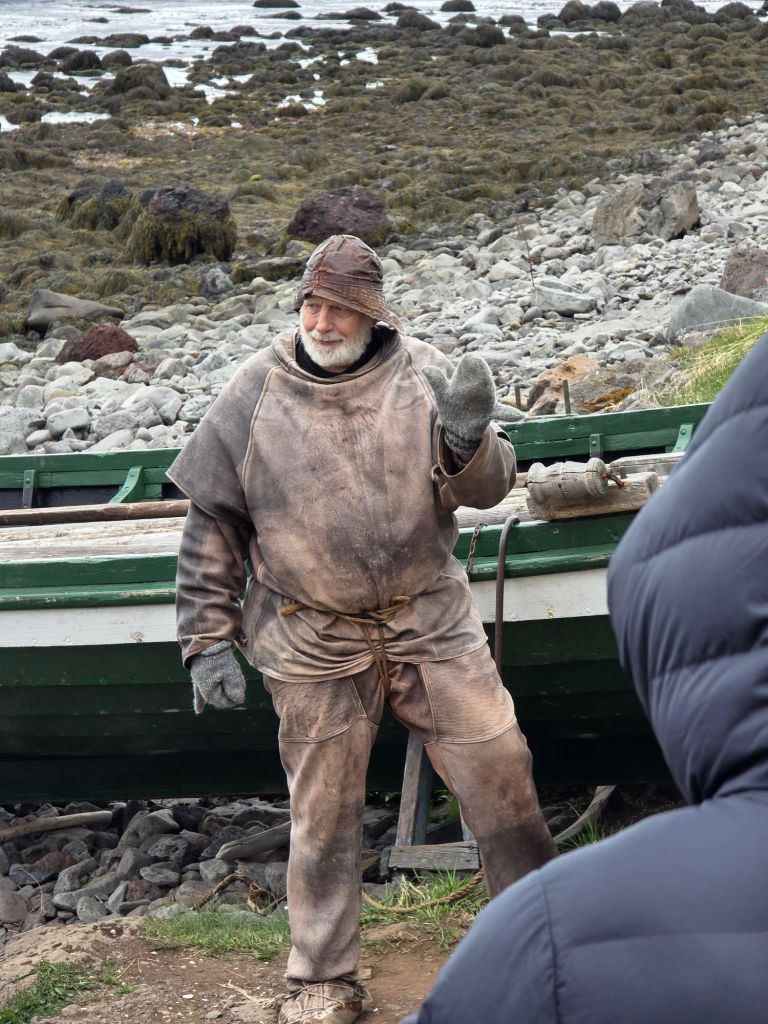
The gentleman above has lived in one if these tiny coastal villages for almost a decade now. He originally was from Poland. He came to Iceland for a summer and now it is his home. Another guide (no pic) immigrated from the Basque region of Spain. He also came for one summer and, perhaps to his surprise, never left.
When asked why they chose to stay and put down roots, their replies were strikingly similar. They love the people and the culture. Sure, winters are cold and you can forget about any sun for weeks. On the other hand, the people are warm and friendly. Everyone looks out for each other. And yes, taxes are high but services are provided to all without the constant bitching and whining we find in the U.S. Consider this, if you need highly specialized care, the government will pay for your medical trip to Norway or Denmark. In the U.S., we are slashing at our impoverished health care system, if you can even call it that. There is something to be said for a culture that supports the common good.
Our last stop was in Heimaey, an island community located off the southern shore of the Island. In 1973, a reminder that Iceland is geologically active became all too real. In the middle of the night, a nearby hill erupted and spewed lava and ash for 5 months. Much of what had existed was buried under many feet of molten lava. One third of all the homes were destroyed with many more damaged. But the community acted as one, got everyone out and across the seas to the mainland with no deaths. A number of men and women stayed behind to fight the lava flows…actions that saved the harbor and the life of the community. The techniques they tried out of desperation are now common practice. Best of all, Heimaey is back.
At this moment, we are in Montreal waiting for a connecting flight to the U.S. I love experiencing new places and absorbing the culture and history of others. However, I hate air travel with a passion, perhaps because I did so much of it during my career (oh, to return to the days when Midwest Expess treated everyone as 1st class passengers).
The only snafu so far was finding our flight out of Reykjavik. Even the Viking helpers at the airport gave us conflicting and even wrong info. You would think they could figure things out. All I had was info for a United Airlines flight. Turned out we were on an Air Canada flight. Just made it in time.
Still, small inconveniences are nothing. One must grasp the beauty of our world. We know not how long we have before our stupidity and short sightedness ruins everything.
We essentially are circling Iceland in a clockwise direction making several stops on the way. Each stop is at an unpronouncible town ranging in size from a high of 20,000 folk to today’s stop which contains only 700 souls … the population on our ship (1,400 passengers and crew) comes to twice that size.
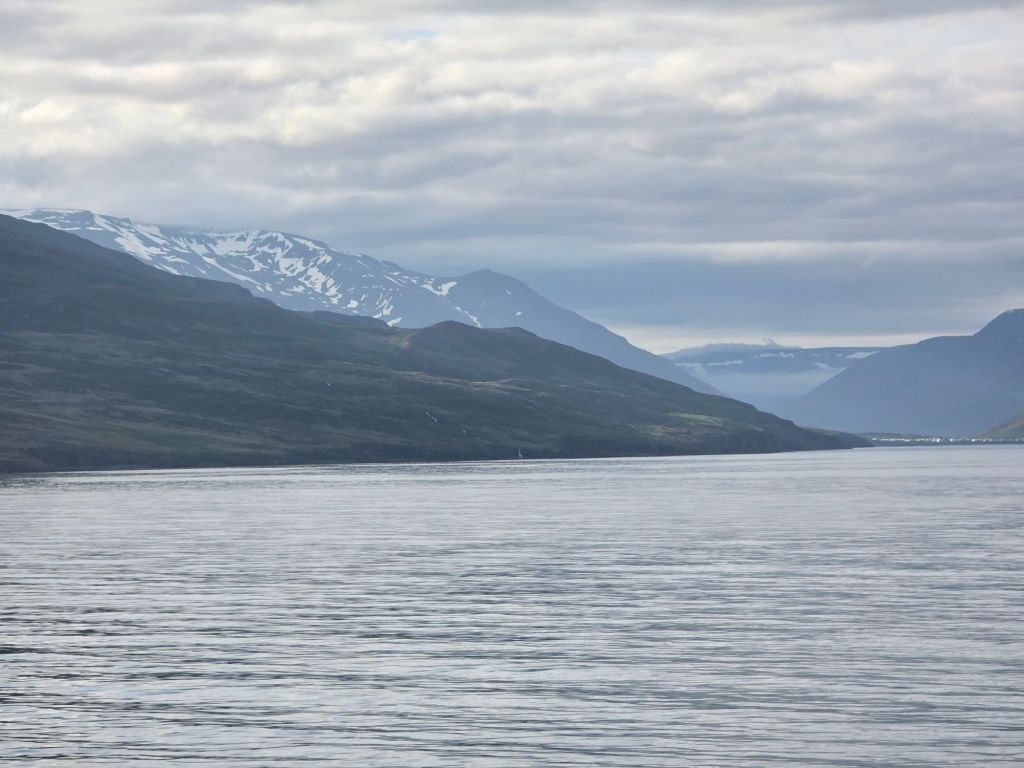
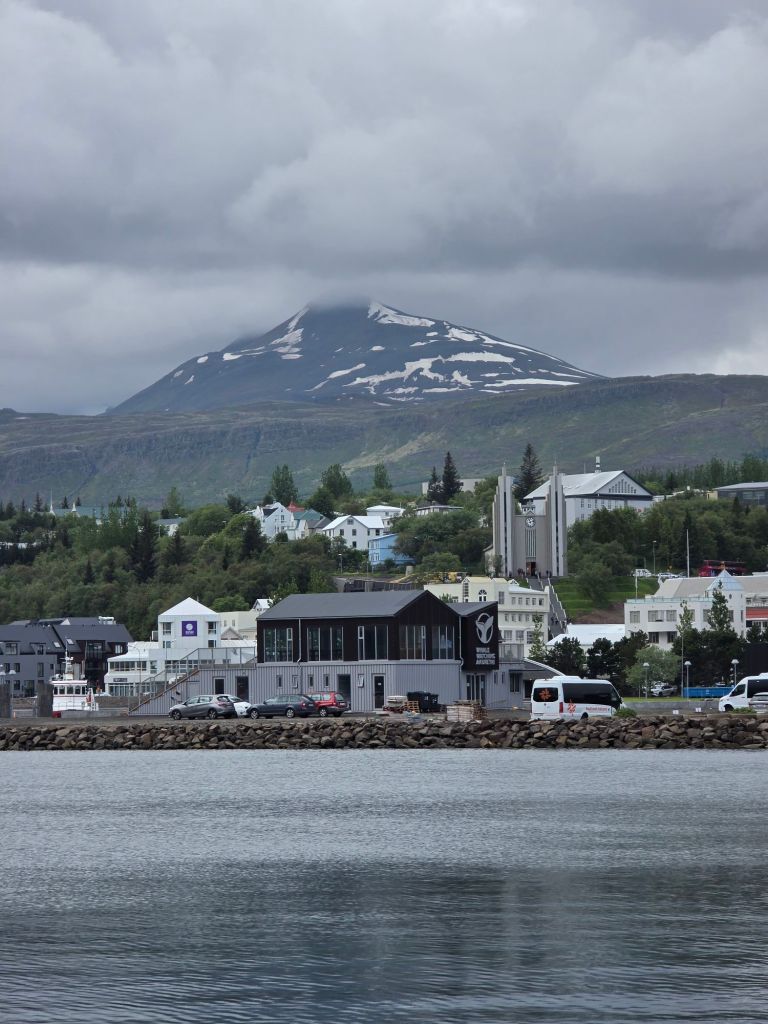
Each stop so far involves smallish settlements located deep within large fjords. The mountains that soar above the waters edge provide both shelter from the elements along with magnificent visual tableaus. When they coined the term God’s country, this is what they had in mind.
Entering a fjord.Seeing our next stop.
Ironically, 80 percent of Greenland is covered with a permanent (more or less) ice cap. The glaciers on Iceland, on the other hand, cover about 10 percent of the land. Still, the elements can be demanding. Even summer temps struggle to get into the 60s, even while being assisted by near 24 hour daylight.
For the earlier settlers, life was harsh. Rugged men went out in small boats in dangerous conditions to fish for food, or for the whales and seals from which fuel for kerosene lamps might be obtained. People huddled together in rough abodes covered with turf as protection against savage winds and storms. In winter conditions, an overturned iceberg might spell death for the crew of six that manned the small oar-powered craft. Tough men indeed. I would not have lasted a week. Hell, I would not have lasted an hour.
Actually, the first immigrants we know much about were the 8th century Irish monks who stumbled on this land of fire and ice. The fire comes from active volcanic activity while the ice is self explanatory. The first thing the monks did was to erect an Irish pub (just kidding, I think). The Vikings next found this enchanted land in the 9th century. The first Parliament almost anywhere, the Althing, was established in the year 930. They instinctively were a democratic lot. In 1262, the 1st Norwegian king gained titular control of the Island. For a long time, Denmark and Norway competed for control. Slowly, though, the Icelanders moved toward independence. In 1848, Denmark began to give up some daily control. By 1874, they had gained some degree of home rule, something that was further extended during the chaos of WWI. Full independence was achieved toward the end of WWII when the island was in the hands of the Allies and Denmark remained in control of the Nazis. The 800,000 sheep on the island were ecstatic at the news. Iceland joined NATO in 1949 and is a member on the EU.
Today, Iceland is a modern, cosmopolitan nation. Some 20 percent of all Icelanders come from non-Scandinavian ancestry. They even have Indian restaurants and eateries that focus on kebabs of various kinds … much preferable to whale and seal meat of earlier diets..
What marks Icelandic government today is the strong role played by females. In the early 1970s, the women of Iceland went on strike for equal rights under the law. They succeeded! At the same time, the ERA (Equal Rights Amendment) movement in the States stalled and then floundered. In 2008, during the finance and housing crisis that resulted in a near global credit collapse, Iceland was particularly hard hit. The male dominated banking and finance systems came under extreme criticism. This economic crisis served to finalize the feminist revolution of recent years with women asserting greater control even of the nation’s financing systems. Today, the Island basically is run by women who hold virtually all the top positions of power.
Modern Iceland even in small towns.For some, the shopping never ends!
From what I see, the women must be doing something right.
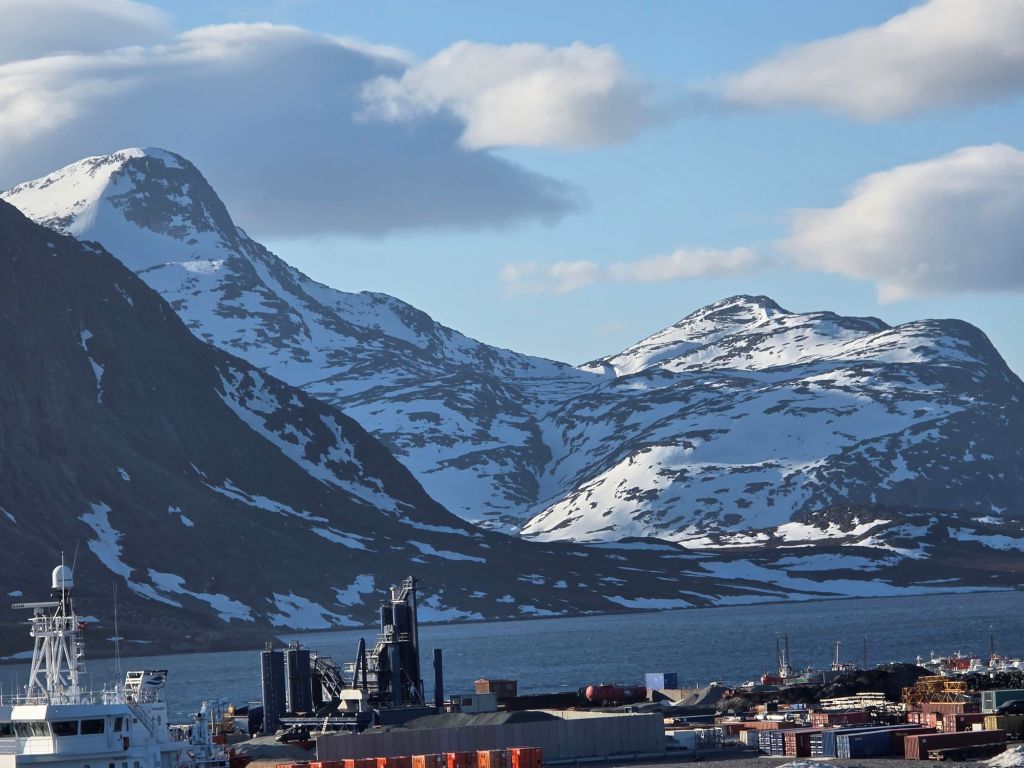
The pic below is not from Iceland. No, it is a final shot from Nuuk Greenland. As you know, Eric the Red first colonized this then unknown and barren land in the 10th century. He had been banished from Iceland for some indiscretion that remains debated to this day. Clearly, though, he did not want to live alone, so he came up with an early bait and switch tactic … he called this new paradise Greenland. Since most of the island lay above the Arctic Circle, people were not fooled for long.
As we set sail again toward the high seas, I lingered over what we were leaving behind. There was natural beauty everywhere. One did not have to obscure reality to sell the virtues of this magnificent place. It really is one of God’s better works of art … even if survival could be harsh at times. Too often, it would appear, the beauty was offset by the challenges to mere survival.
We learned that Inuit children have an exceptionally high suicide rate, perhaps the highest in the world. This tragedy is most common in the small, isolated communities that dot the coastline of this massive island. Each settlement is detached and utterly isolated from the others, the human connections severed by miles upon miles of rugged terrain and inhospitable waters. In the long winters, absent sunlight, the loneliness must be overwhelming, even oppressive. Or perhaps that’s my own preferences speaking.
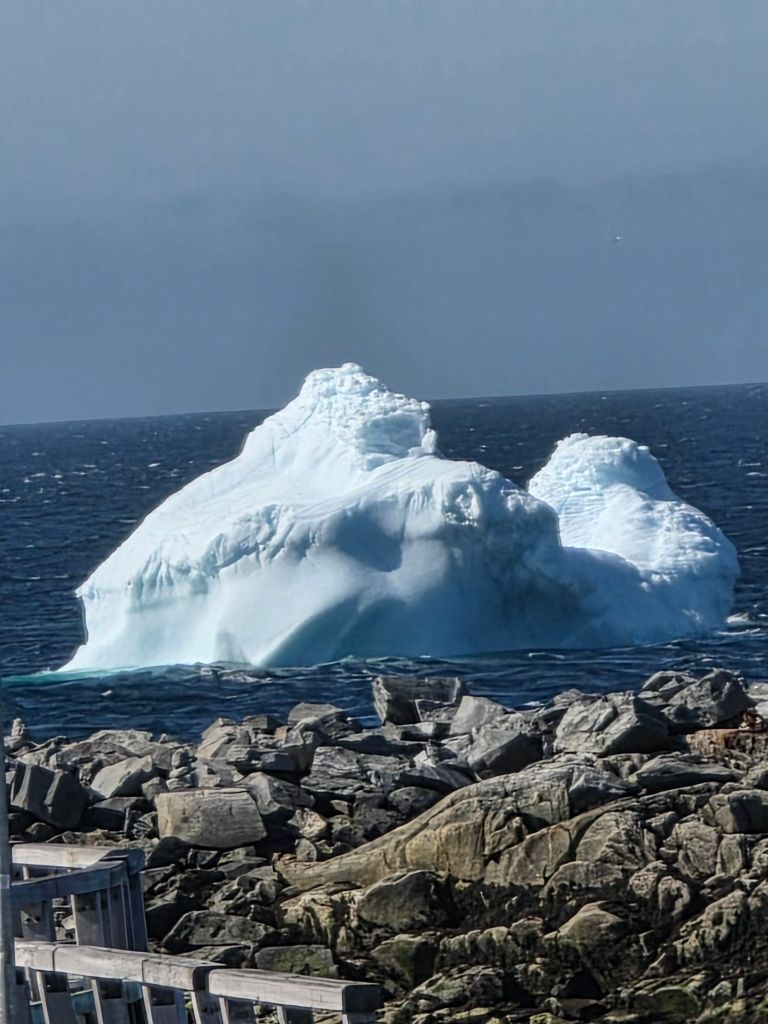
Our current course on the high seas takes us down the west coast, around the land’s south tip, then up straight to the to a port on the northwest coast of Iceland. The west coast is the more sanguine for human habitation since the ice cap is less dominant here. Still, outcroppings of ice gliding along the water’s surface were omnipresent, generating unwanted memories of the Titanic’s horrific fate. But modern ships have much better ways of detecting disaster, or that is what I prefer to believe.
Apparently, these floating ice islands get blown into the southernmost communities at the lower tip of the land mass, the ones we originally were scheduled to visit. So much ice apparently piled up in these harbors that it was deemed too dangerous for the tenders that were to ferry us to land to operate. Thus, the last minute switch to Nuuk and more time at sea. Apparently, Viking had never stopped at Nuuk before. My guess is that it may become a regular stop in the future.
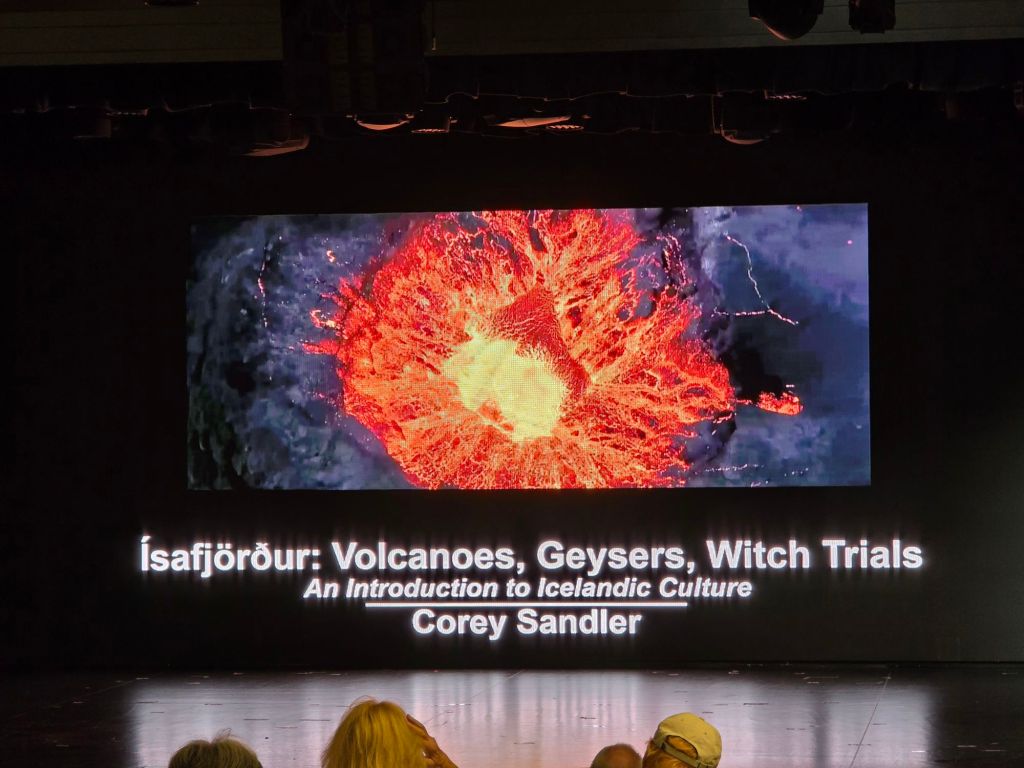
The 1st of several lectures.
We have the option of attending several lectures today. This is the aspect of the sea going Viking experience that surprised me. The level of available expertise in various arenas (history, nature, culture, anthropology, etc) exceeded my expectations. The river cruise was good in that respect, but then we were doing shore excursions every day. There was less time for preparatory learning experiences. Our educational experience here can only be described as exceptional. The backgrounds and levels of expertise among speakers is beyond impressive.
A Brief Preview. The current stock of Icelanders began to arrive over a millenia ago, primarily Norse explorers from Scandinavia. Today, some 390,000 people call Iceland their home, the second largest island in Europe (remember that Greenland is considered part of North America). That gives us same population density as Australia. As in Greenland, most residents live in or around the capital … Reykjavik.
What sets Iceland apart is its active underbelly. Even before seeing it, I think of our destination as a huge Yellowstone National Park on steroids. The place is a bubbling thermos bottle of hot gases, geo-thermal baths, and lava flows punctuated by mountain peaks and icy glaciers. There are 30 volcanoes still considered active, even if they haven’t erupted in some time. Perhaps the source of all this subterranean activity can be found in the nation’s unique geological situation. Iceland is divided by two continental plates (North American and Eurasion). They are moving away from one another at an amazing rate of one inch per year. These perpetually grinding plates result in a land heated by geo-thermal sources and an active shaping of the land’s surface.
The other dominating fact explaining Iceland’s uniqueness is found in its proximity to the Arctic circle. The top of the island touches this hypothetical line that circles our globe some two thirds of the way between the equator and the north pole. In practical terms, this means that anyone on this line will experience a full 24 hours of sunlight on the summer solstice. Conversely the sun will not appear on thewinter solstice. For reasons I don’t fully understand, that line is moving. Perhaps that has something to do with a slowing of our global rotation. Just like my long ago student days, I tend to doze off during lectures.
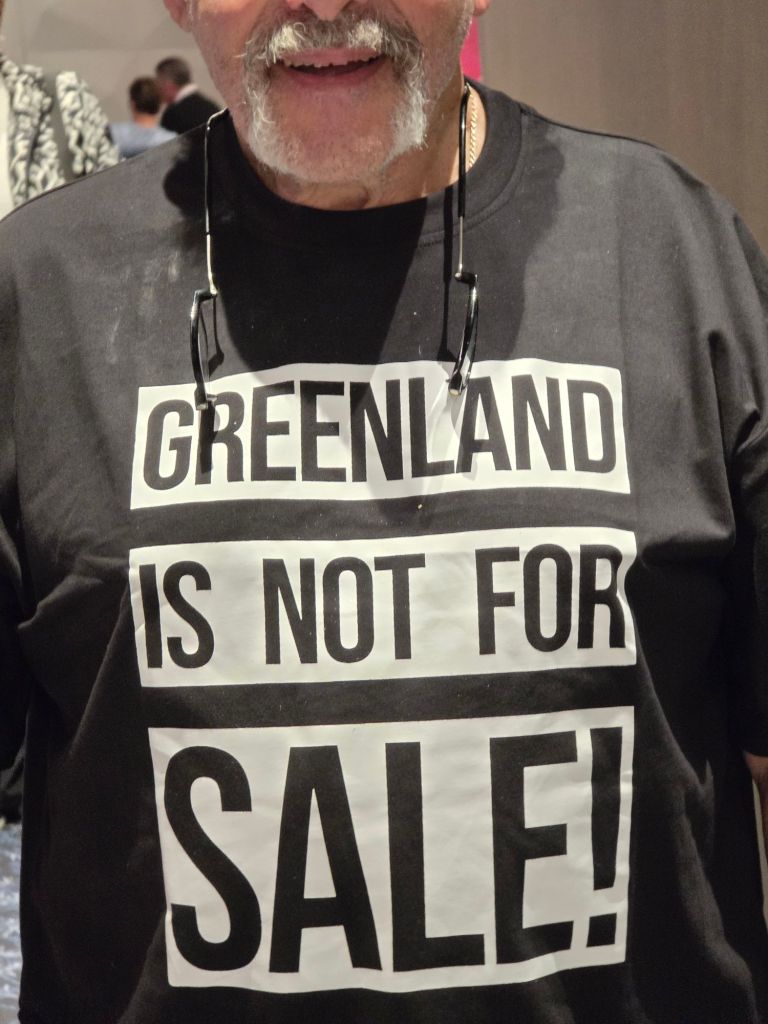
Saw this on our ship
Before moving on, I wanted to share this t-shirt I saw today. I sense that the clear majority of fellow travelers share my disgust with our impossibly incompetent American leadership.
Next time I write, I should have actually experiences on the island. 😁
The best laid plans of mice and men … . This line from the Scottish bard, Robert Burns, contains a universal truth. Our cruise on the oceans blue has not exactly gone as planned. Three stops were canceled because ice buildups at their harbor entrances made them too risky. So, we have spent more time on the open seas on our Viking cruise as we have ventured further and further north. I realized that when it was yet light out at 1 AM last night.
Our new destination was Nuuk, the capital city of Greenland. That may sound impressive but we are talking about a metropolitan area of some 20,000 hardy souls, a milestone just reached this past year. By the way, the word Nuuk means the tip of as in the tip of land jutting toward the sea. It was also apparent that we had ventured into wilder, northern waters. Navigating around even this large ship proved challenging as the seas became increasingly tempestuous.
The community of Nuuk can trace its history back to Eric the Red who, after being chased out of Iceland by his Norse brethren, founded several colonies in the land he called Greenland as a clumsy marketing tool. It worked for a while as the Vikings prospered in several communities that clung to the shore of this mostly ice packed island, the 2nd largest island in the world (after Australia). One of these colonies was in the very fiord in which Nuuk is situated. By the way, if the ice pack that covers some 80 percent if Greenland were to melt away (which it is doing at an ever faster rate) the global sea levels would rise by over 20 feet. Goodbye Florida!
Leif Erickson, one of Eric’s sons, ventured further west and south. He stumbled across what we now know as Canada, which he called Vineland after grapes he found growing wild. That is, Leif discovered North America 500 years before Columbus. Eventually, though, the Vikings retreated from Vineland and Greenland as another climactic fluctuation made farming virtually impossible. They were gone by sometime in the 1400s.
Today’s, the most common stock in Nuuk, and Greenland as a whole, are the Inuits. They are a hardy, resilient people who probably migrated out of Mongolia at one time in the past when a prior ice age made it possible to walk from Eastern Russia into what is now Alaska and Canada. They yet retain an Asian countenance. At the same time, Nuuk is growing with an influx of immigrants, especially from the Phillipines and Thailand. One attraction may be the very low unemployment rate.
The Government Building.
Greenland has evolved into a semi-independent jurisdiction, and sees itself as a completely independent nation someday. Older residents can recall when it was a mere colony of Denmark. That began to change a while back and home rule was granted earlier this century. Denmark remains in control of a few areas … security and foreign relations being the most important. It is through that remaining connection with the Danes that Greenland enjoys the benefits of EU and NATO membership.
That brings us to the elephant in the room. Donald Trump has said he would absorb Greenland as an American controlled jurisdiction one way or another. Visits by J.D. Vance (and wife) and Donald Jr. were ignored by Greenland officials. It has been reported that 86 percent of Greenlanders reject the prospect of becoming part of the U.S. partly because Trump is viewed as a clown. Only 6 percent support this possibility, probably because they misunderstood the question. Apparently, only Americans are backward enough to fall for this con man’s obvious BS.
Though small, Nuuk has the feel of a growing and vibrant metropolis. The buildings are new and modern. Moreover, it is an area that might be helped by climate change. The summers already are longer, the winters less severe. Who knows, perhaps this would be a place to set down roots if one were younger. The air is pure, there is low crime, and a promising future lies ahead. At least one wouldn’t have to put up with the nonsense that passes for rational politics in the States.
And there is the beauty of the place. That cannot be denied … it is all about you.
Just a short note on the eve of my 81st year. We left New York harbor on Sunday.
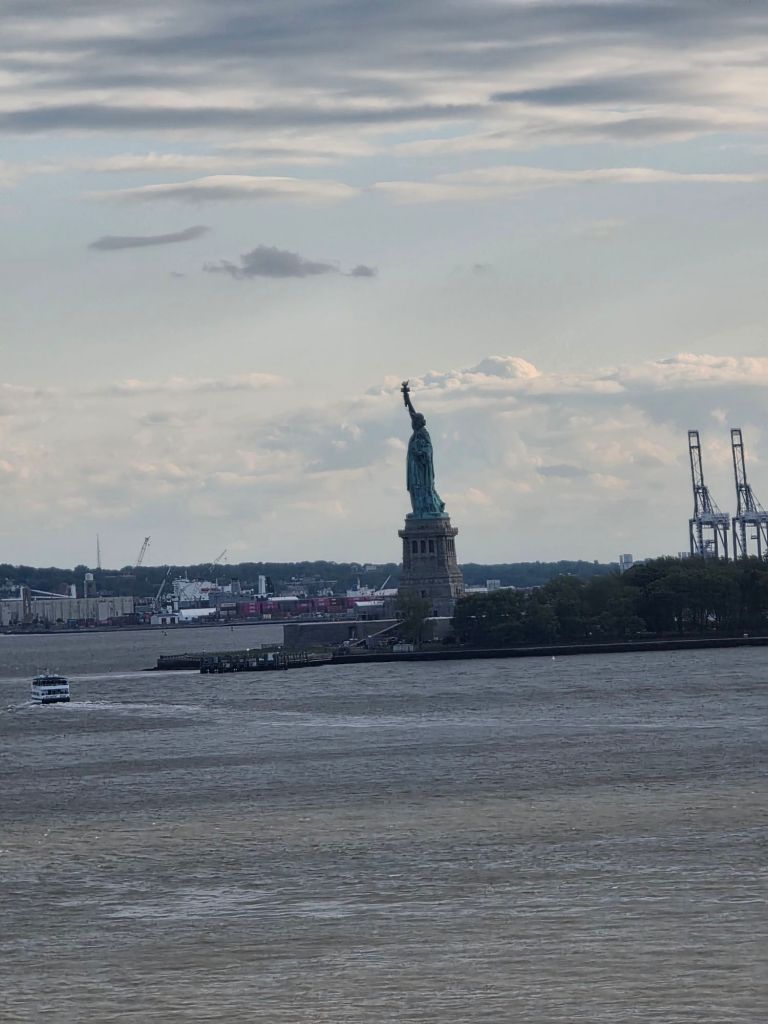
On the way out, we passed the Statue of Liberty. How far we have fallen from the ideals chiseled on this monument. We no longer are the beacon of hope and liberty. We are a mockery of such noble sentiments. A tear formed in my eyes at the sight of this forelorn lady, and the memory of what we have lost recently.
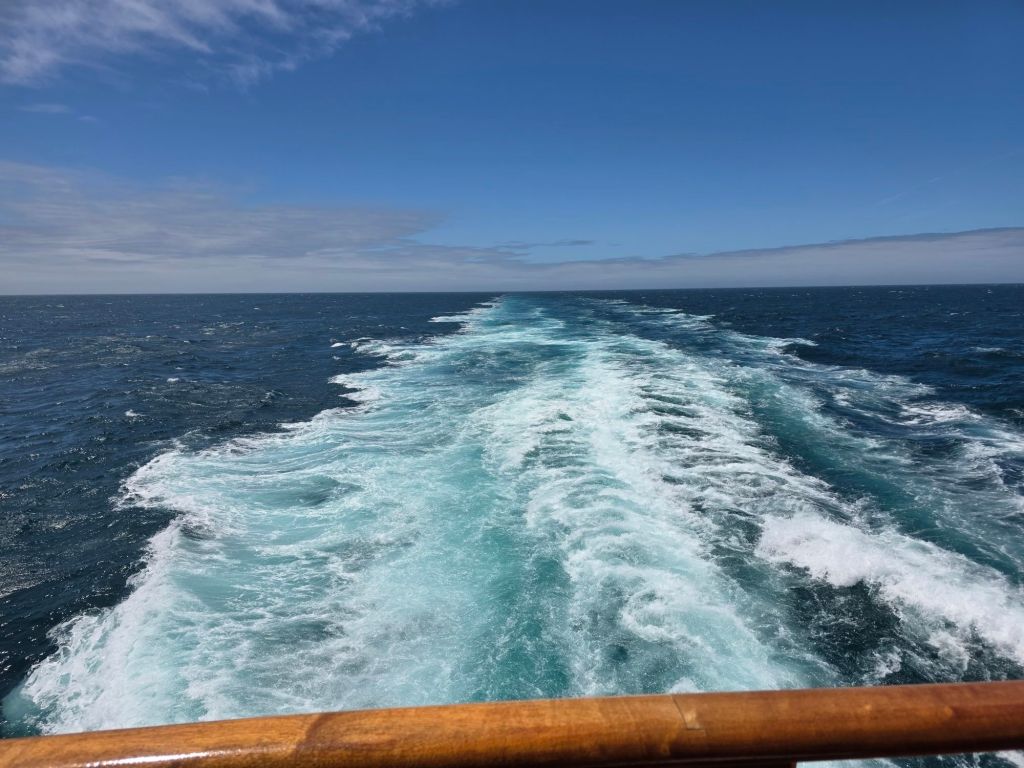
Today was spent on the high seas. I marvel at the North Atlantic … cold, grey, and somewhat angry. I marvel at the thought of how many Mariners risked their lives confronting all the possible dangers and challenges imposed by the eternal seas. So many found watery graves as final resting places.
Our journey will be marked by learning experiences and over indulgence at the dinner table. All has been prepared to provide for our hedonistic comforts. Good thing, I am not one to face mortal dangers nor minor inconveniences for that matter.
After another stop in Newfoundland, it is off to Greenland and then Iceland. Trump has asked me to claim these lands on behalf of the United States. I think not. As I understand it, they are civilized peoples, unlike what Americans appear to be. Better that these good folk remain in charge of their own destinies and their lands.
I recently finished a so-called Plato course on a seminal period in American history … the period from 1960 to 1975. I might note that Plato courses are designed for adults from the Madison Wisconsin community who wish to pursue topics of interest to them. They are taught by knowledgeable volunteers with expertise in that substantive area. This particular course was led by an engaging octogenerian who taught at the university level throughout his career. Virtually all the students were old enough to have experienced the 1960s up close and personal.
No question. This tutorial of sorts was a personal tour through the most significant period of my life. Similarly, it appeared to be seminal to most course participants who are approaching (or have reached) their dotage. By the end of our tour through the past, the intimate and personal impact of those years became clearer to all of us.
In 1960, I was 16 years old. America was a largely conservative and settled society marked by homogeneous beliefs and an abiding faith in government and in our essential institutions. In that year, I pretty much was an unthinking Catholic, working class kid who embraced the conventional beliefs of my religion, my class, and its associated (if suffocating) culture. At that time, some 75 to 77 percent of survey responders expressed confidence in our elected leaders. We believed that government institutions could be trusted to do the right thing.
I was different back then. For example, I seriously considered leaving my studies for the Priesthood to join the military during the height of the Cuban Missile crisis. I was, by any measure, a patriot. By 1975, all that had changed radically both at the societal and on a personal level. By then, the proportion of Americans expressing trust in our government had fallen to about 35 percent. Over the intervening decades, this erosion of faith has worsened. In recent years, the level of trust has bottomed out … to slightly over one-in-five Americans.
What happened during that period from 1960 to 1975? Why such a galactic shift in public confidence and personal dispositions? Perhaps the more cogent question is what didn’t happen? Below is a brief rundown of key events:
Key political assassinations. There were a few assassinations that we all remember well… John F. Kennedy, Robert F. Kennedy, Martin Luther King. They shocked our senses and disrupted our complacency. Other tragedies sometimes intruded on our peaceful outlook. Civil rights activists Medgar Evers and Malcom X, the three civil rights workers in Mississippi, and President Diem (our Authoritarian ally) in Vietnam come to mind.
The Violent End of Legal Apartheid. Though slavery had ended formally in a violent civil conflict that cost over 600,000 American lives, the legal oppression of Blacks continued for another century. The civil rights to enslaved African-Americans granted through the 13th amendment to the constitution (ratified in 1865) were soon thwarted by intimidation, violence, and segregation enforced by Jim Crow laws. Between 1960 and 1965, a series of blows against racial oppression finally erupted, often punctuated by outbursts of horrific resistance to integration by intransigent whites. The scars from this social turmoil would remain, never to be completely erased from the country’s soul.
An Ill-considered Foreign War that We Lost. Our national obsession with Communism led the country to replace France’s role in southeast Asia after Ho Chi Min and the Vietnam nationalists successfully expelled their former colonial oppressors by the early to mid 1950s. Though a series of miscalculations and deceptions, the U.S. turned that civil conflict in SE Asia into America’s war premised on irrational fears about the inexorable march of the Red Menace. That insanity resulted in 2 to 3 million Vietnamese deaths, the killing fields of Cambodia, and some 58,000 American deaths. In the end, what likely would have happened at the beginning came to pass. The country was reunited in 1975 as US forces beat an embarrassing and humiliating retreat. More scars remained on the American soul.
An Explosion of Additional ‘Rights’ Movements. The racial civil rights movement was replicated by several other similar revolutions over the succeeding decades or so. Gay rights, LGBT rights, women’s rights, Native American rights, disability rights were just a few to explode on the scene. Each social revolution challenged the existing social order, leaving a detritus of anger and uncertainty to be dealt with in the future. As a background to these challenges to conventional norms, the counter-cultural movement explicitly mocked middle-class norms and values. A deep generational divide emerged.
Violence at the Community Level. The 60s started peacefully enough but was marked by rising community violence. Who can forget the beating of civil rights marchers at the Edmund Pettis bridge, the fire hoses and snarling police dogs attacking Blacks trying to register to vote in Alabama. Who could ignore the burning of dozens of Black churches and later, the emotional bursts of rage in Watts, Detroit, and scores of other cities after MLK had been gunned down. And who, during those years, can forget the rage expressed in reaction to this inexplicable war halfway around the globe that dragged on and on while consuming so many lives. I was in Wisconsin when the UW Physics building on campus was blown up one night. The widow of a researcher killed in that terrorist attack later worked at my research unit on campus. We forget now, but bombings, riots, and assassinations were commonplace during these tempestuous years.
A Restructuring of Our Political Landscape. Another monumental political shift took place during this era. The South had been rabidly Democratic since our Civil War. After all, it was the Republican Party of Abraham Lincoln that ended slavery through military power and then attempted to integrate southern society through federal force in the immediate post-civil war period. Even as the Democratic Party shifted to the left during the New Deal of the 1930s, southern conservatives hung in with the party that had rationalized slavery in the past, though the cracks in that devotion began to show by the 1948 presidential election. When Lyndon Johnson signed the 1964 and 1965 Civil Rights Bills, the old emotional political ties were shattered. Former southern Democrats and racially motivated conservatives flocked to an increasingly hard-right Republican Party. While bipartisanship had permitted (in fact, proved indispensable) to passage of the civil rights and anti-poverty measures of the Great Society, the two parties were soon organized around radically different normative dispositions and national visions. The cultural divisions at the basis of our sectional discord increasingly were embedded in our political apparati. The era of hyper- polarization had begun and, decades later, would get much worse. Remember Richard Nixon’s southern strategy?
A Presidential Scandal of the Highest Magnitude. Unless you are in the flower of youth or were living under a rock in the early 70s, you must remember the Watergate scandal. Minions working to reelect Richard Nixon broke into the Democratic National Committee offices located in the Watergate office building in D.C. They were looking for political dirt on Nixon’s likely political opponents. Unfortunately, for them, they got caught while trying to bug the Dem’s national offices. In retrospect, this seemed like the theater of the absurd since the leading Dem candidate, George McGovern, had no chance of unseating the incumbent. (In the 1970s, I worked with one of George’s daughters … Susan).
The evolving drama slowly unwound as two low-level reporters from the Washington Post never let up on the story, eventually tracking the bread crumbs directly to the heart of the White House and the President. Nixon did himself in by trying to cover up the nefarious deeds of his rabid followers. Back then, however, there remained standards in the Republican Party. Nixon had to resign when his impeachment became a virtual certainty.
Today, we look back on those times with a sense of disbelief, if not shock. Sometimes, our national agony appeared unreal in retrospect. I was in rural India from 1967 to 69. In that era, without internet and cell phones, I might as well have been on the other side of the moon. The news that reached us isolated Peace Corps volunteers seemed unreal at the time, like the police riots at the 1968 Democratic presidential convention in Chicago. I can recall talking with my fellow volunteers as we wondered if the country was falling apart, literally disintegrating. What would be left upon our return?
In 1975, I would be starting my career at the University of Wisconsin-Madison. I was nothing like the young man who got on a Greyhound bus in 1962 to enter the Maryknoll Semimary in Glen Ellyn Illinois. In those dozen or so years, I had evolved from an unquestioning believer in America and her moral superiority to being an unapologetic liberal, if not an outright leftist. I even joined the Students for a Democratic Society (SDS) while in college (before those idealistic kids descended into nihilistic insanity). I also formed and led the student group in college that opposed the Vietnam War. We called ourselves the Student Action Committee (SAC). That cleverly was like the Strategic Air Command (SAC) … those guys who flew 24-7 to respond to any Russkie attack on us.
All this led to one of my more humorous early experiences. The draft caught up with me in the early 1970s when I was required to take my physical exam in Milwaukee. During that fun day, I encountered a question on some paperwork that asked if I had ever belonged to an organization that advocated the overthrow of the American government. I asked the sergeant overseeing this part of the process if SDS qualified as such a nefarious group. ‘You bet your ass it does,’ was his reply. So, I put YES in response to that query.
That got me grilled for several hours by three uniformed guys from military intelligence. In my view, this entire drama was hysterical. At one point, I recall one asking if I would fight any and all enemies of the United States. I gazed at the ceiling (as if I were taking this nonsense seriously) before suggesting the following in return … first, I believe we should definewhat we mean by the term ‘enemy.’ Alas, I’ve always been a bit of a wise ass but, all in all, it proved to be a most enjoyable afternoon.
How did this dramatic personal metamorphosis in perspective come about in the first instance? In part, it emerged via endless conversations with my fellow students along with voracious readings to satisfy my inquisitive mind. Beyond those analytical dissections of the world about us, I was consumed with an insatiable curiosity about things. I realized I needed to figure things out for myself. Merely absorbing input and beliefs absent rigorous inquiry seemed insufficient, if not lazy. I could no longer simply accept the givens of my youth.
I don’t recall any authority figures (professors) attempting to influence my thinking. Certainly, no one brainwashed me. When I was on the other side of the podium as a university academic, I recall trying to be rigorously fair. I wanted to refine my student’s ability to think critically, not shape how or what they thought about things. That is precisely why MAGA types hate our research universities so much. They help our youth to think for themselves.
During my critical college tears, I recall learning facts that shook my naivete to the core. I learned that our leaders overthrew elected regines elsewhere merely because we found them inconvenient (like the government in Iran in 1953). In my head, our government slowly lost its innocent glow as I read about the authoritarian dictators we supported simply because they were on our side. Slowly, then with a rush, the patina of unquestioning devotion to what had become a tarnished set of ideals fell away. The answer to my military intelligence inquisitors during my draft physical was clear. No, I would not fight any and all so-called enemies. I first would decide for myself who the enemy was. My wise-ass response to their query turned out, indeed, to be a heartfelt conviction.
On a macro scale, a similar process was happening across the land. Slowly, more people realized that we were dragged into a horrific conflict in Vietnam based on distortions and fabrications by our leaders in Washington. People could see that we paid homage to high ideals like equality and opportunity for all while, at the same time, beating and lynching minorities for simply trying to vote. People came to realize that even the highest officials in the land, those in the Oval Office,betrayed the public trust merely to secure and maintain power. These were devastating epiphanies to so many raised in the penumbra of patriotic illusions during the years after WWII. These indeed were painful realizations. For many in my generation, for me personally, it was as if a band aide had been ripped off, leaving behind a deep and ugly scar.
Today, so many decades later, we all have retreated to our own truths. We absorb what we believe from our own boutique information sources that comport closely to our normative priors. There is little to unify us in a common culture or set of beliefs … should I say illusions? In the end, I’m not totally certain if this new world is better or worse than the vanilla, illusory world of my youth. All I can say is that the process of getting here was, indeed, painful. Still, I am desperately glad I had the ability and opportunity to make that journey. It was worth it.
No matter how delusional he might be, he can not become Pope.
Soon, I will be focusing on my next trip abroad. Be forewarned, therefore, that my political rants may slow down for a while, which I am sure will devastate many of you 💔 🙂. This upcoming ocean trip will take me to several stops in Canada, Greenland, and Iceland. Let me assure you, however, there is no truth to the widespread rumor that I will be claiming these lands in the name of King Donald I. While he asked for this small favor, I turned him down flat. I’m more worried that our friendly Canadians and Greenlanders will recognize my American accent and stone me upon stepping ashore. The term ugly American has taken on an entirely new meaning since last fall.
Our plummeting reputation around the globe does reflect one positive note stemming directly from the Trump Presidency. Yes, I’ve actually stumbled upon something positive about the Donald. His behavior and policies are so awful that other nations are turning away from extreme right-wing candidates. In effect, Donald is a walking advertisement for an authoritarian disaster. In both Canada and Australia, heavily favored conservative candidates suddenly and inexplicably suffered easy defeats. Thank you, Donald.
The heavy hand of MAGA extremists may well turn the tide in the U.S. as well. The most significant bell weather election in the early reign of Donald the First took place a little more than a month ago in Wisconsin. A pivotal state Supreme Court race wound up costing almost $100 million dollars, with Elon Musk throwing in some $20 to $25 million behind the hard-right candidate. The election took place one day before Prince Donald announced his liberation day tariffs, an ill-considered policy thrust that wrought immediate havoc across the economy and in the equity markets. Still, what had been considered a toss-up election in a decidedly purple state became a route for the liberal candidate. This is quite surprising given that the Donald had won in the Dairy State just 5 months earlier. Thank you again, Donald
We all have our favorite theories to explain such unexpected reversals of fortunes. It is, however, hard to ignore the possibility that our wannabe King/Dictator (or is it now Pope) has ruled with such capricious incompetence that parts of his base now are appalled. Consider the furious turnouts of furious residents in Congressional Republican town hall sessions. Can you imagine what soy bean farmers in Wisconsin are thinking now that their hero is tanking their livelihood with tariffs that are drying up their foreign markets and that virtually all mainstream economists consider to counterproductive at best and likely ruinous in the extreme.
More recently, his minions are threatening to arrest Wisconsin’s popular twice elected Democratic governor simply for suggesting that state officials check with lawyers before cooperating with demands by ICE (the American Gestapo). I mean, the man at the top, Prince Donald, explicitly stated that he was not sure whether he was required to uphold the Constitution. Think about it! The presidential oath of office explicitly calls for the chief executive to uphold the Constitution. But Donald remains unsure about this. It seems reasonable that the chief executive of a state guarantee that standard constitutional protections are applied to his state’s citizens. Apparently, the whims of an authoritarian are sacrosanct.
Let me move on to the topic crowding in on my beleaguered brain … budgets and what they ultimately mean. In discussing the most recent GOP budget proposal, Public Policy professor Don Moynihan (University of Michigan) noted that all budget documents are morality tales. What we support as public goods including how much we are willing to pay, whom we tax to finance these expenditures, and how costs are allocated across programmatic areas ultimately reflect our collective values. Every policy wonk knows this core truth in an intimate way. That is one of the inescapable facts that make the doing of public policy so consequential, so compelling, and ultimately so fractious. I know! I was intimately involved in the welfare debates of the 80s and 90s. Few public policy issues were as normatively contentious as that one.
Budgets also reflect our fundamental world views in stark ways. Simplifying everything to the extreme, there are three dimensions to the budget process. As suggested above, these are (1) how much to spend, (2) how resources are allocated across competing interests, and (3) who will foot the bill. Like I said, this is really a simplified discussion.
How muchto spend? The optics of MAGA’S early days suggest that federal outlays will be down substantially. Elon Musk’s DOGE effort promised at least $2 trillion in savings. Ron Johnson, my Republican Senator (and prime candidate for the dumbest member in the Senate, though the competition for that honor is fierce) asserts that we will need $5 trillion in savings to fund the aggregate tax cuts the MAGA crowd desires. As with all previous Republican tax initiatives, this one is highly schewed to the uber-wealthy. Moreover, conservatives love programs that kill people. They are willing to spend big bucks to see that happen. The defense budget will soon exceed $1 trillion for the first time. Moreover, the Donald has other whims. He wants to expand and refurbish the former Alcatraz Prison (now tourist site) which was closed in the 1960s for being too expensive to operate. Apparently, cost is no object when you are erecting new concentration camps.
Alas, when all is said and done, it is likely that more will be promised than delivered. Musk and the DOGE operatives never defined waste and fraud. MAGA cult members erroneously thought waste and fraud meant cuts in prograns they did not use. Oops, not true! Thus, all those outraged attendees at town hall meetings even in red political jurisdictions.
Moeover, other reversals are emerging to these wholesale budget cuts. Initial reductions are being quietly reversed; the courts are applying legal brakes; and some staff cuts (e.g., IRS) will cost plenty down the road. Moreover, we see Donaldthe First employing the usual misdirection ploys to obfuscate any expected bad news. Negative economic outcomes suddenly are Biden’s fault even though he left us with an economy that The Economist, a centrists and highly respected publication, stated was the ‘envy of the world.’
Who will pay thebills? In a prior blog, I waxed eloquent about the notion of fairness in deciding how to allocate the tax burden among various population groups defined by income and wealth status. I won’t repeat that entire discussion here. Let us simply say that the MAGA crowd (the leaders, not the slavish cult followers) remain true to several core Republican principles of the past six or seven decades.
The wealthy, either because they have the power to do so or because it comforts with their view of fairness, should pay less than working folk, at least according to the GOP braintrust. Less usually means being exposed to a proportimally smaller tax burden than those who actually work for a living … those who labor for their wages (thus Warren Buffet’s common observation that his secretary had a higher tax rate than he). This is called a regressive tax strategy.
In recent years, their greed is unbounded, marked by systemic efforts to pay less even in absolute terms. Thus, the GOP dream of expanding and extending Trump’s earlier tax cuts is a classic example of their twisted logic. It would add $5.8 trillion to our deficit while giving those at the top of the wealth pyramid at least a $180,000 annual windfall (on average) and virtually nothing to the bottom two quintiles.
The bottom line is this. Working class stiffs will continue to carry a proportionally larger tax burden while receiving fewer public benefits for their outsized contribution. And, the elite will continue to work assiduously to enhance their privileged position. It was estimated that 100 top billionaire families invested $2.6 billion dollars toward federal campaigns in 2024. That is up some 160 times since the Citizens United decision opened up our elections to an unlimited flow of money. The future role of ordinary folk in our political process is dim indeed.
The allocation exercise … where morality plays out in defining the PUBLIC GOOD.
If anything clearly defines our moral stands in the budget process, it can be found in which programs win and which will lose. That is, comparative outcomes are very illuminating with respect to our dominant values. Let us look at how various federal agencies fare under Trump’s most recent GOP budget document (note, this is a reconciliationbill and not a law):
The big losers are internationalassistance programs … down a whopping 84 percent. This reflects a retreat from global concerns andthe return to extreme isolationism. One consequence, some 25 million more deaths (many children) in the next few yearswhen medical outreach disappears as America retreats from its former international role
The National Science Foundation are on the block for a 54 percent cut. America became the preeminent scientific center in the world in the 1930s as Fascism destroyed Europe’s intellectual community. Post-war federal investments then made U.S. universities the envy across the globe. We attracted the best and the brightest to our shores. These and related cuts will reverse all that. Already, the EU is investing over a half billion dollars to lure top scientists from our universities to their institutions of higher learning across the pond.
The Environmental Protection Agency is expected to see a 54 percent cut in support. Think about this. The globe is poised on the brink of no return as we face a climate apocalypse. Yet, America is turning its back on one of the existential crises of our time … a kind of environmental Armageddon.
The Departments of Housing and Urban Development, Labor, and the Small Business Administration are on the block for cuts ranging from 33 to 44 percent. Many of these programs serve average people, smaller entrepreneurs, workers, and those looking for housing in increasingly expensive markets. This directly attacks the very people who flocked to Trump for support and who looked to him as their savior. (In retrospect, a foolish decision to depend upon a pathological narcissist.)
The Department of the Interior will see budget reductions in the neighborhood of some 30 percent. This includes drastic cuts to what has been called America’s greatest idea … our national parks. What is ironic about this is that the park service, like most federal programs, is run on a shoestring. In recent years, total personnel fell from 22,000 to about 19,000 while park attendance increased by 17 percent. Despite DOGE claims, there was little waste here nor in many other programs being slashed.
The Department of Health and Human Services is expected to face a budget cut of some 26 percent. Major cuts are anticipated in both the provision of health care and the prevention of disease and infections. The CDC and the FDA are prime targets here. As old diseases like measles spread and the world yet recovers from the Covid catastrophe, the MAGA crowd simply wants to ignore dire threats to the public’s safety and well-being. Bill Gates has listed future pandemics as a leading apocalyptic possibility, an eventuality for which we are increasingly unprepared.
Finally, NASA faces a 24 percent cut in federal support. Again, science and technology are to be sacrificed. So many technological breakthroughs have been made as we explored our universe. But no more. America risks becoming an intellectual backwater since the MAGA crowd harbors deep suspicions of intellectuals and the institions that train them.
Who will be the winners …
The Department of Defense will see a 13 percent increase. The military budget will see increased support, pushing total funding past the $1 trillion dollar mark. This will happen even while America shrinks from its historic support for Western values and democratic principles as it abandons the Ukraine and NATO.
The Department of Homeland Security is on tap for a whopping 65 percent increase in support. Are we facing new terrorist threats from Islamic extremists? No! This expansion will be the cost of riling up the MAGA base toward imagined threats from GOP created political scapegoats … illegal aliens from Central and South America or, more generally, people who don’t look like us. This will be the cost associated with the MAGA attempt to initiate a modern era ofthe American ethnic cleansingpolicy.
So, how do we sum up our moral scorecard?
The winners and losers are clear. Investments in human capital, in the health and wellness of most Americans, in the infrastructure we all depend upon, in science, in children (and thus our future) are all losers. Some projections put the nation’s total debt at $50 trillion in about a decade or less. And, since the pressure in Republican politicians is to come up with the next tax break favoring the super rich, that may be an underestimate. Who will ultimately bear these enhanced fiscal burdens … our children.
We can only guess at the economic instability being introduced by a sociopathic leader who has few restraints and absolutely no moral compass. Of one thing can we be certain … our collective destiny will pay a huge price for today’s greed and profligacy.
Intead of a rational political debate about critical global issues like climate change and the socio-economic consequences of the AI revolution, we focus on whether our wannabe dictator will honor his oath to abide by the Constitution. We look on in dismay as he insists on a military parade to honor his birthday … an over-the-top extravaganza that will include 6,600 soldiers, 7 bands, 150 vehicles, and 50 helicopters. The anticipated cost of this glitzy show is close to $100 million. We look on in horror as the institutions upon which democracy rests and upon which a free people rely come under increasing attack and persecution. The bad news continues with an unending urgency.
There is a new work titled Peak Human by Johan Norberg. While Donald Trump essentially argues that the way to make America great again is to erect big, beautiful barriers to keep out foreign goods and people. Donalds vision, after all, is fortress America … a self- contained island floating supremely and independently in a hostile and competitive globe. Norberg argues the opposite. The historical great powers became such precisely because they opened themselves up to foreign ideas and people. They became petri-dishes in which ideas and innovation were spawned through exchange and intense interactions.
He notes many examples. The ancient Song dynasty in China exploded with growth and new ideas as Europe stagnated. For example, the movable-type printing press was introduced in the eastern kingdom several centuries before Gutenberg stumbled across the same concept. The subsequent Ming dynasty turned inward, and China inevitably declined as a world power.
America needs to do some serious soul searching. It is on the cusp of losing its preeminent position in the world. Much more importantly, it is on the cusp of forfeiting its moral center. That may well be a defeat from which recovery can not be assured. Empathy, after all, is a key moral attribute, the core of any civilization worth sustaining over time.
A pathological condition associated with the absence of any moral center.























 Tom's Musings