• Sample Page

Tom's Musings

  • On the High Seas!

    May 19th, 2025

    Just a short note on the eve of my 81st year. We left New York harbor on Sunday.

    On the way out, we passed the Statue of Liberty. How far we have fallen from the ideals chiseled on this monument. We no longer are the beacon of hope and liberty. We are a mockery of such noble sentiments. A tear formed in my eyes at the sight of this forelorn lady, and the memory of what we have lost recently.

    Today was spent on the high seas. I marvel at the North Atlantic … cold, grey, and somewhat angry. I marvel at the thought of how many Mariners risked their lives confronting all the possible dangers and challenges imposed by the eternal seas. So many found watery graves as final resting places.

    Our journey will be marked by learning experiences and over indulgence at the dinner table. All has been prepared to provide for our hedonistic comforts. Good thing, I am not one to face mortal dangers nor minor inconveniences for that matter.

    After another stop in Newfoundland, it is off to Greenland and then Iceland. Trump has asked me to claim these lands on behalf of the United States. I think not. As I understand it, they are civilized peoples, unlike what Americans appear to be. Better that these good folk remain in charge of their own destinies and their lands.

  • Pulling the Scab Off Our Common Illusions.

    May 14th, 2025
    A radical thought!

    I recently finished a so-called Plato course on a seminal period in American history … the period from 1960 to 1975. I might note that Plato courses are designed for adults from the Madison Wisconsin community who wish to pursue topics of interest to them. They are taught by knowledgeable volunteers with expertise in that substantive area. This particular course was led by an engaging octogenerian who taught at the university level throughout his career. Virtually all the students were old enough to have experienced the 1960s up close and personal.

    No question. This tutorial of sorts was a personal tour through the most significant period of my life. Similarly, it appeared to be seminal to most course participants who are approaching (or have reached) their dotage. By the end of our tour through the past, the intimate and personal impact of those years became clearer to all of us.

    In 1960, I was 16 years old. America was a largely conservative and settled society marked by homogeneous beliefs and an abiding  faith in government and in our essential institutions. In that year, I pretty much was an unthinking Catholic, working class kid who embraced the conventional beliefs of my religion, my class, and its associated (if suffocating) culture. At that time, some 75 to 77 percent of survey responders expressed  confidence in our elected leaders. We believed that government institutions could be trusted to do the right thing. 

    I was different back then. For example, I seriously considered leaving my studies for the Priesthood to join the military during the height of the Cuban Missile crisis. I was, by any measure, a patriot. By 1975, all that had changed radically both at the societal and on a personal level. By then, the proportion of Americans expressing trust in our government had fallen to about 35 percent. Over the intervening decades, this erosion of faith has worsened. In recent years, the level of trust has bottomed out … to slightly over one-in-five Americans.

    What happened during that period from 1960 to 1975? Why such a galactic shift in public confidence and personal dispositions? Perhaps the more cogent question is what didn’t happen? Below is a brief rundown of key events:

    Key political assassinations. There were a few assassinations that we all remember well… John F. Kennedy, Robert F. Kennedy, Martin Luther King. They shocked our senses and disrupted our complacency. Other tragedies sometimes intruded on our peaceful outlook. Civil rights activists Medgar Evers and Malcom X, the three civil rights workers in Mississippi, and President Diem (our Authoritarian ally) in Vietnam come to mind.

    The Violent End of Legal Apartheid. Though slavery had ended formally in a violent civil conflict that cost over 600,000 American lives, the legal oppression of Blacks continued for another century. The civil rights to enslaved African-Americans granted through the 13th amendment to the constitution (ratified in 1865) were soon thwarted by intimidation, violence, and segregation enforced by Jim Crow laws. Between 1960 and 1965, a series of blows against racial oppression finally erupted, often punctuated by outbursts of horrific resistance to integration by intransigent whites. The scars from this social turmoil would remain, never to be  completely erased from the country’s soul.

    An Ill-considered Foreign War that We Lost. Our national obsession with Communism led the country to replace France’s role in southeast Asia after Ho Chi Min and the Vietnam nationalists successfully expelled their former colonial oppressors by the early to mid 1950s. Though a series of miscalculations and deceptions, the U.S. turned that civil conflict in SE Asia into America’s war premised on irrational fears about the inexorable march of the Red Menace. That insanity resulted in 2 to 3 million Vietnamese deaths, the killing fields of Cambodia, and some 58,000 American deaths. In the end, what likely would have happened at the beginning came to pass. The country was reunited in 1975 as US forces beat an embarrassing and humiliating retreat. More scars remained on the American soul.

    An Explosion of Additional ‘Rights’ Movements. The racial civil rights movement was replicated by several other similar revolutions over the succeeding decades or so. Gay rights, LGBT rights, women’s rights, Native American rights, disability rights were just a few to explode on the scene. Each social revolution challenged the existing social order, leaving a detritus of anger and uncertainty to be dealt with in the future. As a background to these challenges to conventional norms, the counter-cultural movement explicitly mocked middle-class norms and values. A deep generational divide emerged.

    Violence at the Community Level. The 60s started peacefully enough but was marked by rising community violence. Who can forget the beating of civil rights marchers at the Edmund Pettis bridge, the fire hoses and snarling police dogs attacking Blacks trying to register to vote in Alabama. Who could ignore the burning of dozens of Black churches and later, the emotional bursts of rage in Watts, Detroit, and scores of other cities after MLK had been gunned down. And who, during those years, can forget the rage expressed in reaction to this inexplicable war halfway around the globe that dragged on and on while consuming so many lives. I was in Wisconsin when the UW Physics building on campus was blown up one night. The widow of a researcher killed in that terrorist attack later worked at my research unit on campus. We forget now, but bombings, riots, and assassinations were commonplace during these tempestuous years.

    A Restructuring of Our Political Landscape. Another monumental political shift took place during this era. The South had been rabidly Democratic since our Civil War. After all, it was the Republican Party of Abraham Lincoln that ended slavery through military power and then attempted to integrate southern society through federal force in the immediate post-civil war period. Even as the Democratic Party shifted to the left during the New Deal of the 1930s, southern conservatives hung in with the party that had rationalized slavery in the past, though the cracks in that devotion began to show by the 1948 presidential election. When Lyndon Johnson signed the 1964 and 1965 Civil Rights Bills, the old emotional political ties were shattered. Former southern Democrats and racially motivated conservatives flocked to an increasingly hard-right Republican Party. While bipartisanship had permitted (in fact, proved indispensable) to passage of the civil rights and anti-poverty measures of the Great Society, the two parties were soon organized around radically different normative dispositions and national visions. The cultural divisions at the basis of our sectional discord increasingly were embedded in our political apparati. The era of hyper- polarization had begun and, decades later, would get much worse. Remember Richard Nixon’s southern strategy?

    A Presidential Scandal of the Highest Magnitude. Unless you are in the flower of youth or were living under a rock in the early 70s, you must remember the Watergate scandal. Minions working to reelect Richard Nixon broke into the Democratic National Committee offices located in the Watergate office building in D.C. They were looking for political dirt on Nixon’s likely political opponents. Unfortunately, for them, they got caught while trying to bug the Dem’s national offices. In retrospect, this seemed like the theater of the absurd since the leading Dem candidate, George McGovern, had no chance of unseating the incumbent. (In the 1970s, I worked with one of George’s daughters … Susan).

    The evolving drama slowly unwound as two low-level reporters from the Washington Post never let up on the story, eventually tracking the bread crumbs directly to the heart of the White House and the President. Nixon did himself in by trying to cover up the nefarious deeds of his rabid followers. Back then, however, there remained standards in the Republican Party. Nixon had to resign when his impeachment became a virtual certainty.

    Today, we look back on those times with a sense of disbelief, if not shock. Sometimes, our national agony appeared unreal in retrospect. I was in rural India  from 1967 to 69. In that era, without internet and cell phones, I might as well have been on the other side of the moon. The news that reached us isolated Peace Corps volunteers seemed unreal at the time, like the police riots at the 1968 Democratic presidential convention in Chicago. I can recall talking with my fellow volunteers as we wondered if the country was falling apart, literally disintegrating. What would be left upon our return?

    In 1975, I would be starting my career at the University of Wisconsin-Madison. I was nothing like the young man who got on a Greyhound bus in 1962 to enter the Maryknoll Semimary in Glen Ellyn Illinois. In those dozen or so years, I had evolved from an unquestioning believer in America and her moral superiority to being an unapologetic liberal, if not an outright leftist. I even joined the Students for a Democratic Society (SDS) while in college (before those idealistic kids  descended into nihilistic insanity). I also formed and led the student group in college that opposed the Vietnam War. We called ourselves the Student Action Committee (SAC). That cleverly was like the Strategic Air Command (SAC) … those guys who flew 24-7 to respond to any Russkie attack on us.

    All this led to one of my more humorous early experiences. The draft caught up with me in the early 1970s when I was required to take my physical exam in Milwaukee. During that fun day, I encountered a question on some paperwork that asked if I had ever belonged to an organization that advocated the overthrow of the American government. I asked the sergeant overseeing this part of the process if SDS qualified as such a nefarious group. ‘You bet your ass it does,’ was his reply. So, I put YES in response to that query.

    That got me grilled for several hours by three uniformed guys from military intelligence. In my view, this entire drama was hysterical. At one point, I recall one asking if I would fight any and all enemies of the United States. I gazed at the ceiling (as if I were taking this nonsense seriously) before suggesting the following in return … first, I believe we should define what we mean by the term ‘enemy.’ Alas, I’ve always been a bit of a wise ass but, all in all, it proved to be a most enjoyable afternoon.

    How did this dramatic personal metamorphosis in perspective come about in the first instance? In part, it emerged via endless conversations with my fellow students along with voracious readings to satisfy my inquisitive mind. Beyond those analytical dissections of the world about us, I was consumed with an insatiable curiosity about things. I realized I needed to figure things out for myself. Merely absorbing input and beliefs absent rigorous inquiry seemed insufficient, if not lazy. I could no longer simply accept the givens of my youth.

    I don’t recall any authority figures (professors) attempting to influence my thinking. Certainly, no one brainwashed me. When I was on the other side of the podium as a university academic, I recall trying to be rigorously fair. I wanted to refine my student’s ability to think critically, not shape how or what they thought about things. That is precisely why MAGA types hate our research universities so much. They help our youth to think for themselves.

    During my critical college tears, I recall learning facts that shook my naivete to the core. I learned that our leaders overthrew elected regines elsewhere merely because we found them inconvenient (like the government in Iran in 1953). In my head, our government slowly lost its innocent glow as I read about the authoritarian dictators we supported simply because they were on our side. Slowly, then with a rush, the patina of unquestioning devotion to what had become a tarnished set of ideals fell away. The answer to my military intelligence inquisitors during my draft physical was clear. No, I would not fight any and all so-called enemies. I first would decide for myself who the enemy was. My wise-ass response to their query turned out, indeed, to be a heartfelt conviction.

    On a macro scale, a similar process was happening across the land. Slowly, more people realized that we were dragged into a horrific conflict in Vietnam based on distortions and fabrications by our leaders in Washington. People could see that we paid homage to high ideals like equality and opportunity for all while, at the same time, beating and lynching minorities for simply trying to vote. People came to realize that even the highest officials in the land, those in the Oval Office, betrayed the public trust merely to secure and maintain power. These were devastating epiphanies to so many raised in the penumbra of patriotic illusions during the years after WWII. These indeed were painful realizations. For many in my generation, for me personally, it was as if a band aide had been ripped off, leaving behind a deep and ugly scar.

    Today, so many decades later, we all have retreated to our own truths. We absorb what we believe from our own boutique information sources that comport  closely to our normative priors. There is little to unify us in a common culture or set of beliefs … should I say illusions? In the end, I’m not totally certain if this new world is better or worse than the vanilla, illusory world of my youth. All I can say is that the process of getting here was, indeed, painful. Still, I am desperately glad I had the ability and opportunity to make that journey. It was worth it.

  • A Question of Morality.

    May 8th, 2025
    No matter how delusional he might be, he can not become Pope.

    Soon, I will be focusing on my next trip abroad. Be forewarned, therefore, that my political rants may slow down for a while, which I am sure will devastate many of you 💔 🙂.  This upcoming ocean trip will take me to several stops in Canada, Greenland, and Iceland. Let me assure you, however, there is no truth to the widespread rumor that I will be claiming these lands in the name of King Donald I. While he asked for this small favor, I turned him down flat. I’m more worried that our friendly Canadians and Greenlanders will recognize my American accent and stone me upon stepping ashore. The term ugly American has taken on an entirely new meaning since last fall.

    Our plummeting reputation around the globe does reflect one positive note stemming directly from the Trump Presidency. Yes, I’ve actually stumbled upon something positive about the Donald. His behavior and policies are so awful that other nations are turning away from extreme right-wing candidates. In effect, Donald is a walking advertisement for an authoritarian disaster. In both Canada and Australia, heavily favored conservative candidates suddenly and inexplicably suffered easy defeats. Thank you, Donald.

    The heavy hand of MAGA extremists may well turn the tide in the U.S. as well. The most significant bell weather election in the early reign of Donald the First took place a little more than a month ago in Wisconsin. A pivotal state Supreme Court race wound up costing almost $100 million dollars, with Elon Musk throwing in some $20 to $25 million behind the hard-right candidate. The election took place one day before Prince Donald announced his liberation day tariffs, an ill-considered policy thrust that wrought immediate havoc across the economy and in the equity markets. Still, what had been considered a toss-up election in a decidedly purple state became a route for the liberal candidate. This is quite surprising given that the Donald had won in the Dairy State just 5 months earlier. Thank you again, Donald

    We all have our favorite theories to explain such unexpected reversals of fortunes. It is, however, hard to ignore the possibility that our wannabe King/Dictator (or is it now Pope) has ruled with such capricious incompetence that parts of his base now are appalled. Consider the furious turnouts of furious residents in Congressional Republican town hall sessions. Can you imagine what soy bean farmers in Wisconsin are thinking now that their hero is tanking their livelihood with tariffs that are drying up their foreign markets and that virtually all mainstream economists consider to counterproductive at best and likely ruinous in the extreme.

    More recently, his minions are threatening to arrest Wisconsin’s popular twice elected Democratic governor simply for suggesting that state officials check with lawyers before cooperating with demands by ICE (the American Gestapo). I mean, the man at the top, Prince Donald, explicitly stated that he was not sure whether he was required to uphold the Constitution. Think about it! The presidential oath of office explicitly calls for the chief executive to uphold the Constitution. But Donald remains unsure about this. It seems reasonable that the chief executive of a state guarantee that standard constitutional protections are applied to his state’s citizens. Apparently, the whims of an authoritarian are sacrosanct.

    Let me move on to the topic crowding in on my beleaguered brain … budgets and what they ultimately mean. In discussing the most recent GOP budget proposal, Public Policy professor Don Moynihan (University of Michigan) noted that all budget documents are morality tales. What we support as public goods including how much we are willing to pay, whom we tax to finance these expenditures, and how costs are allocated across programmatic areas ultimately reflect our collective values. Every policy wonk knows this core truth in an intimate way. That is one of the inescapable facts that make the doing of public policy so consequential, so compelling, and ultimately so fractious. I know! I was intimately involved in the welfare debates of the 80s and 90s. Few public policy issues were as normatively contentious as that one.

    Budgets also reflect our fundamental world views in stark ways. Simplifying everything to the extreme, there are three dimensions to the budget process. As suggested above, these are (1) how much to spend, (2) how resources are allocated across competing interests, and (3) who will foot the bill. Like I said, this is really a simplified discussion.

    How much to spend? The optics of MAGA’S early days suggest that federal outlays will be down substantially. Elon Musk’s DOGE effort promised at least $2 trillion in savings. Ron Johnson, my Republican Senator (and prime candidate for the dumbest member in the Senate, though the competition for that honor is fierce) asserts that we will need $5 trillion in savings to fund the aggregate tax cuts the MAGA crowd desires. As with all previous Republican tax initiatives, this one is highly schewed to the uber-wealthy. Moreover, conservatives love programs that kill people. They are willing to spend big bucks to see that happen. The defense budget will soon exceed $1 trillion for the first time. Moreover, the Donald has other whims. He wants to expand and refurbish the former Alcatraz Prison (now tourist site) which was closed in the 1960s for being too expensive to operate. Apparently, cost is no object when you are erecting new concentration camps.

    Alas, when all is said and done, it is likely that more will be promised than delivered. Musk and the DOGE operatives never defined waste and fraud. MAGA cult members erroneously thought waste and fraud meant cuts in prograns they did not use. Oops, not true! Thus, all those outraged attendees at town hall meetings even in red political jurisdictions.

    Moeover, other reversals are emerging to these wholesale budget cuts. Initial reductions are being quietly reversed; the courts are applying legal brakes; and some staff cuts (e.g., IRS) will cost plenty down the road. Moreover, we see Donald the First employing the usual misdirection ploys to obfuscate any expected bad news. Negative economic outcomes suddenly are Biden’s fault even though he left us with an economy that The Economist, a centrists and highly respected publication, stated was the ‘envy of the world.’

    Who will pay the bills? In a prior blog, I waxed eloquent about the notion of fairness in deciding how to allocate the tax burden among various population groups defined by income and wealth status. I won’t repeat that entire discussion here. Let us simply say that the MAGA crowd (the leaders, not the slavish cult followers) remain true to several core Republican principles of the past six or seven decades.

    The wealthy, either because they have the power to do so or because it comforts with their view of fairness, should pay less than working folk, at least according to the GOP braintrust. Less usually means being exposed to a proportimally smaller tax burden than those who actually work for a living … those who labor for their wages (thus Warren Buffet’s common observation that his secretary had a higher tax rate than he). This is called a regressive tax strategy.

    In recent years, their greed is unbounded, marked by systemic efforts to pay less even in absolute terms. Thus, the GOP dream of expanding and extending Trump’s earlier tax cuts is a classic example of their twisted logic. It would add $5.8 trillion to our deficit while giving those at the top of the wealth pyramid at least a $180,000 annual windfall (on average) and virtually nothing to the bottom two quintiles.

    The bottom line is this. Working class stiffs will continue to carry a proportionally larger tax burden while receiving fewer public benefits for their outsized contribution. And, the elite will continue to work assiduously to enhance their privileged position. It was estimated that 100 top billionaire families invested $2.6 billion dollars toward federal campaigns in 2024. That is up some 160 times since the Citizens United decision opened up our elections to an unlimited flow of money. The future role of ordinary folk in our political process is dim indeed.

    The allocation exercise … where morality plays out in defining the PUBLIC GOOD.

    If anything clearly defines our moral stands in the budget process, it can be found in which programs win and which will lose. That is, comparative outcomes are very illuminating with respect to our dominant values. Let us look at how various federal agencies fare under Trump’s most recent GOP budget document (note, this is a reconciliation bill and not a law):

    The big losers are international assistance programs … down a whopping 84 percent. This reflects a retreat from global concerns and the return to extreme isolationism. One consequence, some 25 million more deaths (many children) in the next few years when medical outreach disappears as America retreats from its former international role

    The National Science Foundation are on the block for a 54 percent cut. America became the preeminent scientific center in the world in the 1930s as Fascism destroyed Europe’s intellectual community. Post-war federal investments then made U.S. universities the envy across the globe. We attracted the best and the brightest to our shores. These and related cuts will reverse all that. Already, the EU is investing over a half billion dollars to lure top scientists from our universities to their institutions of higher learning across the pond.

    The Environmental Protection Agency is expected to see a 54 percent cut in support. Think about this. The globe is poised on the brink of no return as we face a climate apocalypse. Yet, America is turning its back on one of the existential crises of our time … a kind of environmental Armageddon.

    The Departments of Housing and Urban Development, Labor, and the Small Business Administration are on the block for cuts ranging from 33 to 44 percent. Many of these programs serve average people, smaller entrepreneurs, workers, and those looking for housing in increasingly expensive markets. This directly attacks the very people who flocked to Trump for support and who looked to him as their savior. (In retrospect, a foolish decision to depend upon a pathological narcissist.)

    The Department of the Interior will see budget reductions in the neighborhood of some 30 percent. This includes drastic cuts to what has been called America’s greatest idea … our national parks. What is ironic about this is that the park service, like most federal programs, is run on a shoestring. In recent years, total personnel fell from 22,000 to about 19,000 while park attendance increased by 17 percent. Despite DOGE claims, there was little waste here nor in many other programs being slashed.

    The Department of Health and Human Services is expected to face a budget cut of some 26 percent. Major cuts are anticipated in both the provision of health care and the prevention of disease and infections. The CDC and the FDA are prime targets here. As old diseases like measles spread and the world yet recovers from the Covid catastrophe, the MAGA crowd simply wants to ignore dire threats to the public’s safety and well-being. Bill Gates has listed future pandemics as a leading apocalyptic possibility, an eventuality for which we are increasingly unprepared.

    Finally, NASA faces a 24 percent cut in federal support. Again, science and technology are to be sacrificed. So many technological breakthroughs have been made as we explored our universe. But no more. America risks becoming an intellectual backwater since the MAGA crowd harbors deep suspicions of intellectuals and the institions that train them.

    Who will be the winners …

    The Department of Defense will see a 13 percent increase. The military budget will see increased support, pushing total funding past the $1 trillion dollar mark. This will happen even while America shrinks from its historic support for Western values and democratic principles as it abandons the Ukraine and NATO.

    The Department of Homeland Security is on tap for a whopping 65 percent increase in support. Are we facing new terrorist threats from Islamic extremists? No! This expansion will be the cost of riling up the MAGA base toward imagined threats from GOP created political scapegoats … illegal aliens from Central and South America or, more generally, people who don’t look like us. This will be the cost associated with the MAGA attempt to initiate a modern era of the American ethnic cleansing policy.

    So, how do we sum up our moral scorecard?

    The winners and losers are clear. Investments in human capital, in the health and wellness of most Americans, in the infrastructure we all depend upon, in science, in children (and thus our future) are all losers. Some projections put the nation’s total debt at $50 trillion in about a decade or less. And, since the pressure in Republican politicians is to come up with the next tax break favoring the super rich, that may be an underestimate. Who will ultimately bear these enhanced fiscal burdens … our children.

    We can only guess at the economic instability being introduced by a sociopathic leader who has few restraints and absolutely no moral compass. Of one thing can we be certain … our collective destiny will pay a huge price for today’s greed and profligacy.

    Intead of a rational political debate about critical global issues like climate change and the socio-economic consequences of the AI revolution, we focus on whether our wannabe dictator will honor his oath to abide by the Constitution. We look on in dismay as he insists on a military parade to honor his birthday … an over-the-top extravaganza that will include 6,600 soldiers, 7 bands, 150 vehicles, and 50 helicopters. The anticipated cost of this glitzy show is close to $100 million. We look on in horror as the institutions upon which democracy rests and upon which a free people rely come under increasing attack and persecution. The bad news continues with an unending urgency.

    There is a new work titled Peak Human by Johan Norberg. While Donald Trump essentially argues that the way to make America great again is to erect big, beautiful barriers to keep out foreign goods and people. Donalds vision, after all, is fortress America … a self- contained island floating supremely and independently in a hostile and competitive globe. Norberg argues the opposite. The historical great powers became such precisely because they opened themselves up to foreign ideas and people. They became petri-dishes in which ideas and innovation were spawned through exchange and intense interactions.

    He notes many examples. The ancient Song dynasty in China exploded with growth and new ideas as Europe stagnated. For example, the movable-type printing press was introduced in the eastern kingdom several centuries before Gutenberg stumbled across the same concept. The subsequent Ming dynasty turned inward, and China inevitably declined as a world power.

    America needs to do some serious soul searching. It is on the cusp of losing its preeminent position in the world. Much more importantly, it is on the cusp of forfeiting its moral center. That may well be a defeat from which recovery can not be assured. Empathy, after all, is a key moral attribute, the core of any civilization worth sustaining over time.

    A pathological condition associated with the absence of any moral center.
  • The Hardest Thing to See … Evil!

    May 4th, 2025
    I’m surprised he made it into the top 50.

    The ‘I didn’t know‘ phenomenon is a curious thing. As I matured and became increasingly  curious about my world, especially the larger political issues of the 1960s, two questions that persistently bothered me were: First, how could a sophisticated nation like Germany fall for an obvious clown like Adolf Hitler? Second, how could so many Germans claim ignorance about Nazi atrocities after the regime finally had been smashed?

    The answer to the first query is now very apparent to me. Simply look at the cult of Trump movement in the U.S. Here we have a totally despicable and degenerate human being, a pathological narcissist with observable traits that mark him as a sick sociopath. At a minimum, he has a borderline personality disorder that, without his wealth and notoriety, would find him sequestered in a mental institution and not the Oval Office. And yet, he has been twice elected to the highest office in the land and reigns, without observable opposition, over one of our major political parties.

    Therein lies one of life’s confounding conundrums. If you are poor and nuts, you might get put away in an institution if deemed crazy and a danger to the public. If you are rich and nuts, you can rise to the highest office in the land. That fact reminds me of George Bernard Shaw’s elegant quip … steal a loaf of bread and go to prison; steal a railroad and go to Parliament. Even if you are a degenerate pedophile, you can become a savior-like figure of adoration to those both gullible and looking for permission from on high to hate the others of their choosing while avoiding much guilt. It doesn’t happen often, but it does happen.

    For example, during Germany’s economic struggles in the midst of a global depression, Hitler gained just enough electoral support to enter mainstream politics. Germany’s economic plutocrats, top military brass, and center-right politicians suddenly saw him as a useful tool, a clown without substance who could be manipulated for their own purposes. Three months after being appointed Chancellor, he had crushed democracy and created the 3rd Reich. They thought they had the tiger by the tail, and the tiger devoured them. Given the right circumstances, the inmates can be put in charge of the asylum. For Herr Hitler, the key was vague promises of glory (Make Germany Great Again) and specific vows against an easy scapegoat (mostly the Jews and Communists).

    The second question is more puzzling for me. Remember post-WWII Germans claiming they were unaware of the regimes crimes against humanity based on sheer ignorance. REALLY? What do they think happened to all those Jews, leftists, Gypsies, Slavs, and handicapped people? Some 10 million cannot be exterminated (including 6 million Jews) absent clear evidence of such atrocities. You would have to be willfully blind when so many people began disappearing. People didn’t know because they did not want to know. They did not see because they chose not to see.

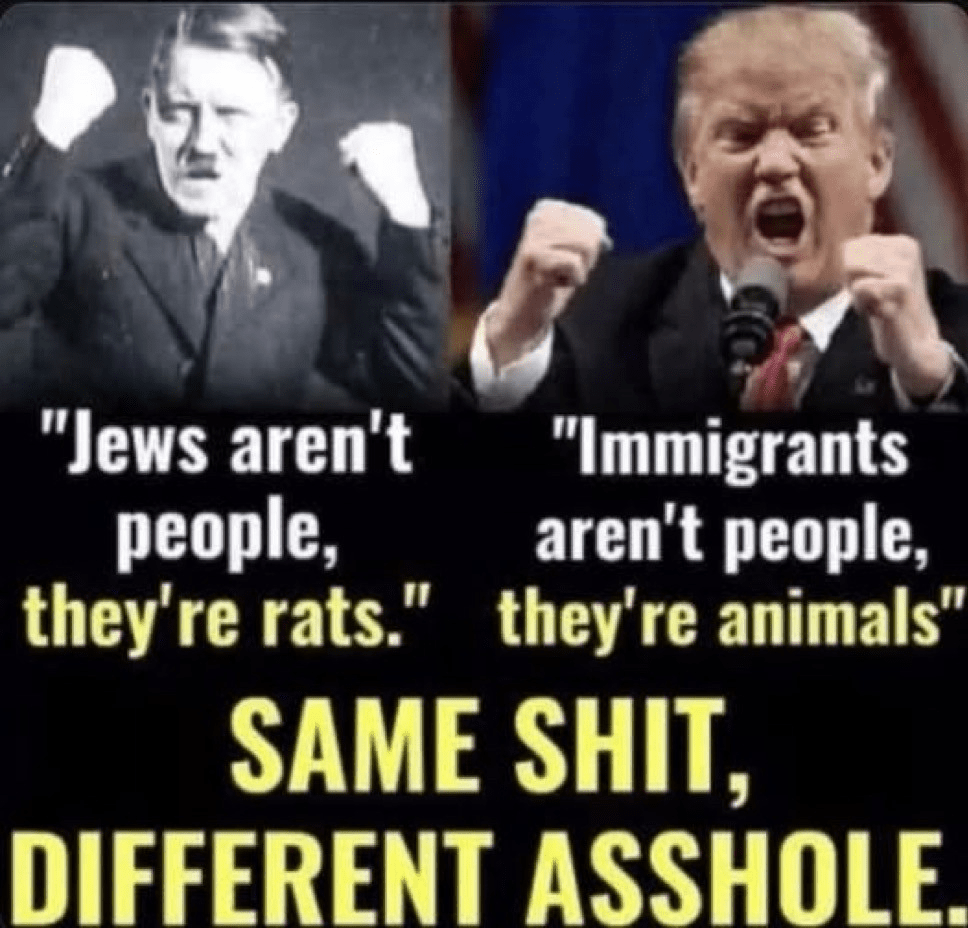
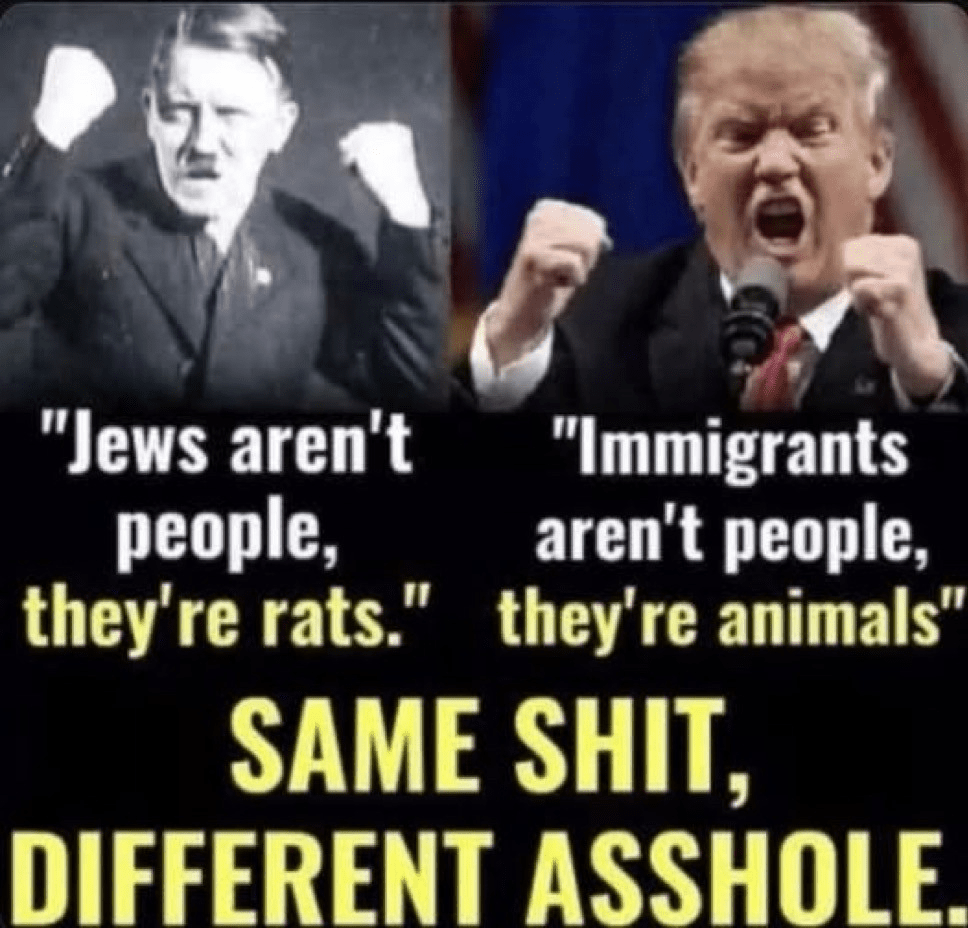
    In today’s context, we see a growing number of Americans expressing buyers’ remorse for their support of Trump in the last election. As suggested by the meme above, Trump’s support has plummeted (at least temporarily) as Elon Musk ran wild and the Donald’s absurd tariff plans have resulted in the expected equity market chaos. Realty has sunk in for even the most gullible that the wizard behind the curtain promising a new utopia was just another conman. Initially, Musk promised $2 trillion in savings. That goal evaporated over time to $150 billion. But some cuts by DOGE are now seen to cost money (e.g., IRS staff cuts might result in the loss of $500 billion over time). In any case, the Republican controlled Congress is struggling to codify a measly $9 billion in DOGE cuts. The MAGA utopia has become a delusion, if not a nightmare.

    The common response by disenchanted supporters runs along these lines: ‘I thought he’d lower the price of eggs.’🙄 Or, I thought he would understand my concerns better than the Democrats.’ Of course, these may be classic obfuscations to hide underlying beliefs that are socially frowned upon. ‘While I’m talking about inflation, I’m really freaked out by the growing diversity in our society.’ Put another way, I’m just your garden variety racist. Therein lies the core truth of political discourse. There is the veneer put on our public positions. Then, there are the primitive passions governing our darkest choices. For MAGA extremists, hate for the other dominates all else, especially rational thought.

    Now, my guess is that some 30 to 33 percent of the population are hard core Trumpers. Basically, they don’t care what he does or how he does it as long as he attacks ‘those‘ people that his cult followers hate with a passion … those that look and believe differently. They would have been the good Nazis in 1930’s Germany, and they are the devoted MAGA types in America, 2025. Hate, when primed by unreasoning fear, is a primal motivator. For today’s GOP, they would easily sacrifice our government of laws, an experiment some 250 years in the making, to preserve the illusion of a white, nativist, Christian America … our version of an Aryan Supremacy.

    I recall an incident that took place just before the election last fall. (Note: I’m apologizing in advance if I’m repeating myself here.) My good female friend was preparing the sailboat used at her summer lake cabin for winter storage. As we approached the place of business in rural Wisconsin where the work would be done, she told me not to drive on to his property. Why? I asked. She responded as follows: If the owner saw my Harris-Waltz sticker, he would go ballistic. This rural Wisconsin resident, like many of his neighbors, really believed that a Democratic victory would bring Communism to America. As with so many others, he had lost touch with reality. His fears and prejudices drove out any ability to see his own self interests, never mind objective reality.

    When my female friend and I would drive through rural Wisconsin to her lake house, virtually all the farms had Republican signs out. Forget the fact that it was Democratic administrations starting with the New Deal of FDR that virtually lifted agricultural from deaths door to make it what it is today. The Dems are now seen as WOKE … catering to urban minorities and educated elites while looking down on hard working Americans.

    It matters not what reality is. It matters not that Democratic administrations have a superb economic record in recent decades … more job and wage growth, fewer economic downturns, lower poverty rates, and so forth. Reality across the American landscape is shaped by the propoganda spewed forth by right-wing and increasingly by mainstream outlets. As a result, we have a new Orwellian dystopia… black is white, up is down, and the GOP are the defenders of workers and farmers. Wow! As Joseph Goebbels popularized in the 1930s, lies told often enough become accepted truth.

    We have all heard the rationalization about why rural and working class citizens vote against their self-interests. They feel threatened by the pace of change. They see an uncertain future for themselves and their offspring. They are struck by primitive fears about changing demographics where their tribe (e.g., white, Christian, nativists) lose their dominant place in society. When fear displaces reason, rational thought tends to evaporate. We see working class and rural families rushing to conservative, MAGA candidates as saviors for their way of life. The absurdity of this reaction is beyond calculation. You might decide that Democrats don’t talk your language, but why in the world would you rush to a party which consistently has favored the interests of the top 1 percent, really the top one-tenth of 1 percent over your legitimate concerns. Why not just shoot yourself in the head if you want to commit suicide. It would be quicker. One answer … the right is far better at telling people what and who they should fear and, of course, at offering themselves as saviors.

    Again, we now see responses from those same demographics claiming they are surprised at how Trump and his minions are governing. They are shocked that they may pay a price merely to enable a further redistribution of more income and wealth from the bottom 90 percent of the population to the top of the pyramid. Again, this is no secret. It is calculated that some $50 trillion dollars has been redistributed from real people (the bottom 90 percent) to the elite (top 1 percent) since the Reagan revolution in 1981. The proposed GOP tax bill would further this redistributive imbalance while adding some $5.8 trillion to the federal deficit over the next several years. The GOP has been the masters of duplicity and misdirection. They use emotional questions (transgender issues that impact a tiny few people) to mask massive thefts from huge portions of the American Public.

    In truth, the public never should have been surprised by what is going on today. Virtually all of my acquaintances and colleagues could see what was coming with total clarity. It was no secret at all to us. It was laid out in the Project 2025 plan in great detail. Beyond that, all the tell-all books from Trump’s first administration focused on how much time and effort it took by the common-sense people in the WH to keep Donald from destroying the country. His proclivities and instincts were totally at odds with good government and the well-being of the public good. But, that first time around, he was sufficiently unsure of himself to keep some mainstream officials in his orbit. That saved us.

    It was also clear that Donald would be much worse this time around. This time around he would NOT surround himself, as he did in 2016, with enough real experts to keep his worst instincts at bay. Trump never forgave those who kept him from joining the mob attacking the Capitol on January 20 when the election results were being certified. This time, he has surrounded himself with sycophants and toadies. His cabinet meetings resemble obsequious displays of adoration of the supreme leader. He will spend perhaps $100 million on a military birthday parade for himself while trying to kill needed spending in health care to keep people alive.

    No one should be shocked by this. NO ONE! It was clear to me and to everyone I know. It was clear to U.S. Grant almost a century ago. If anyone did not see this disaster coming, they chose not to look, not to see. Like the good Germans in 1945, they will pretend to be shocked. Like those Germans pretending ignorance, they will pretend innocence.

  • A Source of Comfort.

    April 30th, 2025

    Our political landscape is a disaster. We have a mentally and morally challenged executive who, enabled by a spineless majority party, is a walking disaster. Trump is tearing apart almost 250 years of the American experiment … democratic governance under the rule of law. He is attacking historic allies while courting the worst authoritarian rulers around the globe. His economic policies demonstrate an astounding combination of avarice coupled with unimaginable ignorance. He has peppered the Civil Service and his cabinet with incompetent toadies whose only redeeming quality is obsequious loyalty to himself. He has purged the Pentagon and other federal agencies of competent leadership on grounds that only make sense in his warped mind. He uses the Office of the President to push products for personal gain and to seek revenge on an ever expanding list of enemies. He has permitted an unelected outsider to dismantle federal institutions and eviscerate the civil service without any real thought to longer-term consequences. He is systemically attacking science and the (to date) best higher education system in the world. He has attempted to bully key institutions and individuals into total compliance, wesponizing the nation’s law enforcement organizations for this nefarious purpose. He has advanced a key principle inherent in all totalitarian regimes … attacking a defenseless scapegoat group to stir up negative and irrational passions. He has waged unceasing war on the poor and the vulnerable while seeking to further enrich the top tenth of one percent of the income and wealth pyramid. In the latest GOP budget bill, that elite group would see another $180,000 in federal benefits while the bottom 40 percent of all Americans would come out losers.

    It is hard to imagine a more horrific scenario than the one we are in. It is like living in a Steven King novel of unending terror with a plot that suggests no easy escape from the enveloping pain. The resulting hopelessness arises, in part at least, from the knowledge that we have done this to ourselves. No one invaded us. No one imposed tyranny from without. This was evil willingly and knowingly embraced by Americans themselves. They did so eagerly, with some apparently believing that Trump has been divinely sent to save us. And therein lies the ultimate horror. Even though our wannabe dictator is experiencing short-term declines in favorability polls, I have no faith that the electorate will not be fooled again. Or worse, perhaps this is what they ultimately want from our government.

    However, I do have a source of comfort amidst all the pain. Virtually everyone in my circle of friends and associates (with at least one obvious exception) shares my views and concerns. Every conversation I have quickly descends into a corrosive discussion of the dire state of our public affairs. The highly educated members in my collegial orbit are stunned and depressed by what they see. We all express disbelief that our fellow citizens, who often appear normal on furst glance, apparently suffer from a debilitating form of cognitive decline. How tragic. How depressing.

    While discussions with like-minded associates afford some relief, they often result in further agitation. We tend to feed into each other’s senses of despair and anger. Not good! Not good at all!!! Fortunately, there is a more soothing form of relief. Oddly enough, it comes from an unexpected place … a place one might not suspect. It comes from out there. Not just out there, but in places where our poor capacities for apprehension typically fail us. I am soothed by the incredible majesty of our magnificent cosmos.

    When I look at the night sky above, all I can see are a few scattered stars. There’s just too much light pollution. Perhaps, if I get out into the country I can catch a bit of the Milky Way Galaxy … which is our celestial neighborhood. But that’s little more than looking at the ground around me. I can still recall seeing a canopy stars when I spent two years in rural India. That was the one time in my life when I fully appreciated the visible heavens above. Still, even that was a mere taste of what exists out there.

    In truth, there is no way to fully embrace what is out there directly. That is beyond our meager powers. No, we have become creatures of technology. Thousands of years ago, our ancestors started with the simplest tools … clubs and flint sharpened with rocks into tools for both conflict and domestic use. Now, we send incredibly sophisticated machines with highly calibrated, digitally controlled telescopes to penetrate the edges of the known universe and the origins of time. These are toys of incredible sophistication and possibility.

    The pictures that have been sent back by our amazing new technologies have reimagined our universe in ways no one would have conceived a mere century ago. Then, the limits of the cosmos were contained within our own galaxy. Soon, however, as we could peer deeper into space and farther back into time, unimaginable worlds and spectacles opened up to us. There were black holes and giant stars and novas and super novas and billows of interstellar gases whose dimensions defy understanding. But mostly, the known universe kept expanding and expanding as we looked in wonder at someone’s (or something’s) creative masterpiece.

    How does this affect me? Well, today we have identified somewhere between two and three trillion galaxies out there. Each of these has billions or trillions of stars. Who knows how many earths or earth-like planets are out there. Who knows how many life forms exist in this vast cosmos or even how close we have come to calculating its boundaries. Perhaps we have only touched upon a corner of what exists. And then, of course, there are those theories, articulated by the advanced mathematics of brains far superior to mine, that postulate many parallel universes. Perhaps what we can see, or measure, is merely one of a multitude of possibilities that defy our meager intellects.

    How might we think about all this? I can not speak to what others think or how they might react. For me, the awareness of these otherworldly dimensions of time and space is extraordinarily humbling. We are nothing in this vast tapestry of cosmic wonders. We are one planet orbiting a very ordinary sun that is situated in a remote spiral arm of one galaxy among billions and billions of such. Homo-sapiens, our species, has been around for maybe 100,000 years. Seems like a long time, but that’s a blink of an eye over the 14.5 billion years since the initial big bang (or is it the latest big bang). Of those 100,000 years, settled humans have existed for 10 percent of that period; urban societies perhaps 5 percent; our industrial world perhaps two-tenths of one percent; our modern, technological society has been around for a mere nanosecond in the history of the species and much less in the history of life and even less in the duration of the cosmos as we know it.

    I am totally humbled as I think on such things.

    Is there any meaning in contemplating our magnificent and mysterious cosmos? If so, perhaps it lies in the miracle of consciousness. Think about this. I once had a friendly debate with a scholar who also happens to be my neighbor. He argued that the probability that life formed anywhere was the product of an almost infinite number of serendipitous and highly unlikely events. He thought we were probably the only advanced life form around. I countered that with so many galaxies, stars, and planets out there, the prospect of multiple life forms is more than reasonable. There are countless potential petri dishes out there for endless experimentation.

    Even if we are the only game in town (or the cosmos), we have no idea where evolution can take us. Look how far we have progressed since the emergence of deductive scientific methods and the industrial revolution. And just consider how fast the pace of evolution and change is occurring. Can we even imagine the possibilities when human creativity is merged with advanced technologies. It could be mind-bending. Then again, it might also be Armageddon.

    Is there a bottom line? For me, contemplating the cosmos and the broad sweep of evolution leaves me with a sense of wonder. It helps me put our petty problems into perspective. Small minds like Trump and the MAGA minions cannot see the bigger picture. Their lives are circumscribed by petty goals and limited ambitions. They seek power and money as if such things mean much in the broader scheme of things. I feel bad for them.

    If there is a divine presence out there, the cosmos being unfolded before us is His or Her masterpiece, an ultimate work of art. And if the struggling species of homo-sapiens manages to survive, perhaps our primitive consciousness might evolve into some higher form that we can not possibly envision. At some point, perhaps we can shift our sights from irrelevant earthly issues and petty political squabbles to the bigger questions out there.

    There is so much more to understand. And it is so much fun speculating about the possibilities.

  • Finding One’s Moral Center.

    April 22nd, 2025

    I started this message Easter morning, then got distracted by other things … a rather typical occurrence. While it has been many decades since I’ve believed in the Easter bunny or that the Son of God miraculously rose from the dead, this celebration yet strikes me as a good moment to reflect on more elevated matters. What counts in life? What matters? Where is meaning found? Whether or not we are judged by some divine arbiter at the end of our days, how will we judge ourselves in the final analysis?

    I came of age in an era when college age youth routinely asserted that developing a coherent personal philosophy was the most critical challenge they faced. (Today, a similar cohort of young people stress a need to make a lot of money).

    Personally, I believe we were fortunate. My parents were grounded in the harsh realities of the great depression. Economic survival was critical to them. While I was raised in near poverty, what I saw about me was confidence and hope in the future. For some reason, making the world a better place was more important than merely making money. Perhaps we were fortunate to come of age during what economists called the great compression … that three decade period after WWII when income and wealth inequality narrowed and the vaunted American middle class expanded. This occurred despite top income tax rates of 90 percent. Even we poor kids saw opportunity before us. That might partially explain why the youth of the 60s responded to President Kennedy’s call to do something for your country with such intense fervor.

    That inherent sense of possibility, perhaps better thought of as optimism, was reflected in how I approached my higher education. To me, getting a degree had little to do with a future career. It had everything to do learning more about the world. I studied what interested me in school, which largely focused on how our political and social world worked. I explored such macro-issues such as peace, justice, and fairness as opposed to mastering technical skills in order to make money. I examined issues, including our own history, both critically and with an objective eye. Finally, I focused on that central challenge that captured the attention of so many of my peers … formulating a core moral center upon which to ground a personal philosophy. Many of us struggled to understand our world rather than merely accept what we were told.

    Those interests, that perspective, was far different from what I saw in my university students several decades later. They were hyper-anxious about the future, the debt they had accumulated, the uncertainties that clouded their confidence. They seemed dominated by a sense of angst … a feeling that the future was full of peril. Too many were hemmed in by an inchoate sense of dread that I felt limited their vision and freedom. It certainly added to their overall feelings of anxiety.

    I came of age in the 1950s and 1960s, graduating from high school in 1962. In some ways, those few years were an inflection point in U.S. history. At the beginning of the 60s, most of us kids were quiet and submissive. True, the Port Huron statement had been penned by future radical Tom Hayden. It was a call for a questioning of society by the young, a call that led to the creation of Students for A Democratic Society (SDS). Moreover, the first Southern lunch counter sit-ins to oppose American apartheid were reigniting the civil rights movements that Rosa Parks had sparked a few years earlier. Still, it would take some time, including Kennedy’s assassination and the making of the conflict in Vietnam America’s war, for these early rumblings to emerge into outright rage and then revolution.

    By the time I had finished college and took off for India as a Peace Corps Volunteer, the quiescent 50s seemed like a distant dream. I had gone from a good working-class boy who entered a Catholic seminary to become a missionary priest to being the leader of the leftist anti-war movement in college … Clark University in my hometown town of Worcester Mass. But that transformation was not casual or easily accomplished. It was the result of endless dialogue, study, and debate among my peers. It was the result of a deep process of self- examination and personal questioning. Moreover, it could be painful since it involves first questioning and sometimes rejecting long-held truths and ingrained ethical precepts.

    On the morality and wisdom of Vietnam, perhaps the seminal issue of my young world, there was an identifiable and specific turning point in my personal views. I remember it this way. I had been selected as one of several top students to do summer research with a National Science Foundation grant. Another one of those selected (who would go on to get his doctorate at Harvard) and I spent one whole day discussing the war rather than working on our projects. I remember trying my best to cling to my childhood script that we Americans were in the right, that the domino theory was real, and that our efforts were entirely defensible. After all, just a couple of years or so earlier, I had contemplated leaving the seminary and joining the military during the height of the Cuban Missile crisis. The correctness and righteousness of America was the myth in which I had been raised. It was deeply embedded within my psyche … a belief system that was extremely difficult to question and harder to repudiate. Discarding it was like excising part of my being.

    I did not admit it in the moment, but I knew that the other student had bested me that day. The doubts that had been creeping into my worldview soon overwhelmed me … replacing my naive beliefs with a new and more questioning framework. That transition was assisted by many endless debates about policy issues and ethical dilemmas that often went deep into the night. Perhaps I should have studied more but, in hindsight, this seemingly endless dialogue proved to be my real education. This is where I sharpened my analytical and debating skills on which my later career rested.

    Why was this transition all so important? That is, why was this period of self-examination and change so critical to whom I became. I will answer that query with a story about what I saw coming back from India in 1969. Upon my return, I was in a masters program in Wisconsin. The anti-war fever still raged. However, when I attended my first protest since returning to campus, there was something off. It was as if the students were largely repeating slogans they had been programmed to utter. I had no evidence that they were not sincere. But I felt somehow that they had not earned the right to resist. It was not clear to me that they knew why they were protesting. It seemed more like they were doing the in thing rather than the right thing. Silly, perhaps, but that is how I felt. Protest ought not to be mere parroting of socially acceptable scripts. It should emanate from one’s core set of beliefs.

    Perhaps it does not matter how and why one arrives at their personal moral position. Perhaps the actuality of opposition, of taking a stand, is all that counts. In the end, though, I can’t accept that. How we arrive at our moral positions does matter. Beliefs arrived at without effort, absent some pain, appear somewhat shallow to me.

    I often considered my reactions during those turbulent years of my youth over the succeeding decades. In truth, those of us who rose up in protest were always a minority. Despite our rosy recollections of that era, most kids ignored all the righteous uprisings that erupted on campuses and in the streets. Most of my peers saw the protests, the tear gas, the shutting down of campuses as mere inconveniences. Why did only some of us take it so seriously when most went on with their lives without much, if any, reflection?

    To this day, I can not answer that simple question fully. There are, however, hints in my distant memory. As I’ve written about before, my early years were spent in the suffocating confines of rigid Catholicism, ethnic tribalism, and working class orthodoxy. Prejudices and this feeling of superiority surrounded me in childhood. The WASPS were our social and political enemies. Anyone of a different color or religion or cultural background was deemed inferior. Even those in my environment who differed slightly were suspicious.

    There were five Catholic churches nearby. Two catered to the Irish; one to the Polish; one to the Lithuanians; and one to the French living in the general area. People would walk past the nearest Catholic church to get to their Catholic church. In short, I lived in a Balkanized and divided world. Imaginary hierarchies and artificial divisions were everywhere.

    The first question you might be asked on meeting someone new was what are you? I would say half Irish and half Polish … a child of a mixed marriage in this strange world. Then, the questioner would know where to situate me in the mosaic of religion, ethnicity, race, and class. Of course, there was that moment when, as a toddler, I was confused by the question and said I’m English … because that’s the language I spoke. My father immediately gave me the lecture on why we Irish hated the English. I never made that error again.

    As I grew up in this rigid society, and despite my dad’s diatribe on our hatred of the Limeys, I started to think differently about things early on. I rebelled against the stereotypes prevalent in my world. I rejected the ethnic prejudices and casual racism so easily embraced by those around me. I surely dismissed what I saw as religious arrogance that assigned non-believers in the Catholic faith to limbo or purgatory or even Hell. That was a non-starter for me. Early on, I even questioned why we were divided into all these distinct countries. Were we not all residents on this one fragile globe? From afar, in space, there were no visible dividing lines. Why all the fighting? It made no sense to my young mind. And why, when we had such surplus crops, we’re we not feeding a suffering world. That made even less sense to me. Sharing with those in need is what my image of Christ would have demanded.

    I can recall so many moments in my youth when I felt things (or expressed ideas and opinions) that were at odds with my environment. It was only later, with years of experience and perspective, that these anomalies struck me as odd. Why, for example, did I argue in defense of the Brown vs. the Board of Education Supreme Court decision as a preteen? No one I knew felt that way. Where did these strange notions come from. Few, if any, in my young world had such beliefs, at least not that I recall. It strikes me that the seeds of my future rebellion had been planted early on. They resided within me from the start.

    Of course, one can not discount nurture or our environmental inputs. In that regard, one vignette that I’ve shared before involves an article that I read many, many years ago. Obviously, it struck a deep nerve in me since I keep retelling it. A justice of the New York Supreme Court recalled his college years growing up in the 1930s. As with many of his peers, he dabbled in leftist politics during the horrendous economic sufferings associated with the great depression. He even flirted with Communism for a while. That youthful experiment didn’t last long. Still, he considered himself lucky to have come of age when he did. The challenges of that decade forced him to question everything about him. In desperation, he had to formulate his own personal worldview … not merely embrace something off the shelf. He had to forge a moral code unique to him. That personal journey made him a stronger adult. I felt the same about my trail by fire during the 60s.

    There it was. I am a product of nature and nurture. There always was something inside pushing me to see beyond artificial barriers. In part, it probably was some inherent accident of biology, some structuring of my brain, that drove me inexorably beyond the strictures and limitations of tribal codes. It was a byproduct of the intense exloration that I, with the help of close college peers, experienced as we tried to make sense of our changing world. Is there a label for that byproduct, that personal attribute? Well, we might call it empathy.

    Like the New York Justice, I came of age in a tumultuous decade and feel so very lucky that I did. It was not economic necessity that drove me (us) but the inexorable winds of change. The old codes were challenged, sometimes radically. Racial injustice, gay rights, Native American exploitation, women’s emancipation, and environmental degradation all became subject to intense scrutiny and change. And there was the elephant in the room, an ill-advised war half a world away that sapped our sense of moral superiority.

    At the end of the day, one either dug in and ignored those winds of change or confronted what was going on about them. Today, over five decades later, we are in another turbulent era. Everyone must either bury their heads in the sand or confront the moral and ethical challenges about them. Will each of us retreat into our tribal shells (i.e., Make America Great Again) or will we think and act with sensitivity, understanding, and empathy.

    And there it is. In the end, all the self-examination and moral questioning come down to simple choices. Do we only consider our own needs? Or, conversely, do we see each of us as connected to a complex matrix we call mankind? Do we only think about today, or can we look into the indefinite future? Do we have that basic attribute essential to our longer-term survival … empathy.

    I remember a moment in college when I was probably attempting to seduce a young lady. The effort, like most of them, probably failed. Nor can I recall her identity. However, I recalled one moment in that conversation. I said something like the following: “Life is hard. We are born and then, after many years, we pass. The best we can do during those intervening years is not cause much harm to others. If fortunate, we might even pass along a few smiles to those we touch on our journey.”

    My guess is that the words are approximated. The meaning, though, is rather exact. All these years later, oddly enough, I could not improve upon them. They still capture whom I wanted to be.

  • The New Doomsday Clock.

    April 16th, 2025

    I grew up in an era when we paid attention to the so-called Doomsday Clock. This virtual timepiece purportedly represented how close the world was to nuclear annihilation … an apocalypse in which innocent victims like myself would be incinerated in a flash of atomic insanity. The timepiece was managed by a group of concerned scientists who monitored world events to determine how near to global Armageddon we were at that moment. It struck us as real back in the day. After all, who among us ancient farts can yet recall the school exercises where we scrambled under our desks … not to escape mad gunmen with AR-15s but rather to futily protect our fannies from Soviet ballistic missiles.

    That persistent dread receded with time. Though miscalculation remained a threat, it increasingly became clear that rational minds, or perhaps the reality of mutual annihilation, would restrain the worst impulses of global leaders. The collapse of the Soviet Union around 1990 seemed to end the presumed utility, or at least relevance, of the Doomsday Clock. The minute hand had always hovered near midnight, the moment of truth, but thankfully never touched it. With the Soviet walls crumbling, that eschatological threat now seemed quite remote.

    Perhaps, however, we were premature in our optimism. After all, nuclear annihilation has never been the only substantial threat to what we considered the freedoms of Western Democratic traditions. While the ominous shadow of Communist totalitarianism seemed to recede with the collapse of Moscow’s empire, another threat, once considered ended in the aftermath of a Second World War, emerged to replace the tyranny of the left. Right-wing authoritarianism had seemed relegated to the ash heap of history given that 60 million or so had perished to destroy it once and for all. Unfortunately, neither wars nor wishful thinking bury pernicious ideas deeply enough. Like a bad horror movie, they have a way of coming back to life.

    Ironically, this new authoritarian threat from the hard-right does not reside outside our borders. It will not be imposed upon us by some nefarious foreign power. Its seeds were nourished within the frailties of America’s own birth and evolution. Slavery was tacitly supported within our foundational documents … including the Constitution. That signaled a malignancy within the DNA of what purportedly was an exciting experiment (at the time) … what might be termed a democratic republic. This was to be a government of law for the people, by the people, and of the people. Alas, with a wink by our founding fathers, the concept of ‘people,’ it turned out, meant only some of the people.

    In his Gettysburg address, Lincoln dated the birth of the American experiment to the Declaration of Independence, not the enactment of the Constitution. Using that date, it took about 190 years to fulfill the promises embedded in the so-called American experiment, that all men are created equal. The civil rights bills of the mid-1960s represented a high water mark in the long, tortuous, and nonlinear path toward social justice and full civic participation by all. Since then, the pushback has been relentless and growing. Today, the unfulfilled American promise totters on the brink of extinction.

    The reelection of Donald Trump, especially the full-on charge to enact the provisions of Project 2025, constitutes the most serious threat to our Republic’s integrity in my lifetime, perhaps in our history. (Project 2025, lest you have forgotten, is a detailed plan to replace our democracy with an authoritarian alternative.) As I’ve said before, no external threat in my lifetime realistically seemed likely to replace our democracy with a totalitarian regime (no matter what the John Birch Society claimed). That is not to say that outside forces might well have unleashed horrific military harm and destruction in the attempt to do so. They simply were unlikely to succeed, as reflected in the ‘domino theory’ employed by war hawks to justify our national embarrassment in Vietnam.

    No, the only legitimate threat to our democracy is found internally, in that DNA flaw that has been with us throughout our history. It is located in the pernicious belief of a racial and ethnic hierarchy in which some people are deemed superior based on accidental attributes … for example, skin color and ancestral origins. It is that very premise that first rationalized slavery, the rejection of Irish famine immigrants, Oriental exclusion policies, the near genocide of Native Americans, and the building of walls at our southern border. It is the premise that led to the southern ante-bellum mudsill theory where some people are destined and ordained to lead and others to labor quietly in subservient subjugation. It is a perspective that facilitates and sustains the creation of the KKK, neo-nazis skinheads, and a host of other hate groups throughout the country. It is a world view that prepares us for an ordained hierarchy where a plutocracy (an elite aristocracy) rules without limits and with few or no constraints. It is a governing philosophy where the people evolve into bleating sheep, having sacrificed freedom and responsibility for the illusion of security touched with more than a hint of tribal superiority.

    And therein lies the fertile ground in which American Fascism has thrived. There lies the fascination of so many Americans with the cult like adoration of a man without any redeeming qualities … Donald Trump. He offers a promise that almost half of the country finds seductive…the promise of permanent group superiority … namely in their insular tribe of native-born, white Christians. That utopia is guaranteed, though, only if one provides the cult leader with unyielding loyalty and unstinting devotion. It is, in the end, a patently false promise driven by fear and irrational hate, our two most deeply embedded tribal emotions.

    Will the clock strike 12?

    The plan for this new utopia has been laid out for us in Project 2025, a document developed by right-wing think tanks in preparation for Donald’s 2nd administration. Each day, since inauguration, we see giant steps toward its full execution. In reality, the foundations for this final push toward revolution have been long in the making. Slowly, over several decades, control over the courts, the media, local political apparati, some educational organizations, and other key institutions has been carried out with laser focus and incremental precision. Now, with control of Congress and the White House in hand, the final push for a unitary executive has arrived. All power is to reside in the hands of the sitting president.

    But is the minute hand of our contemporary Doomsday Clock really about to strike midnight? Are we on the precipice of a full-blown authoritarian regime … a dictatorship on steroids. While that seems like a hyperbolic claim, is this fear justified in reality? Perhaps, in actual fact, we are only facing a clownish Bavarian beer hall putsch in which Hitler failed to secure even local control. Or, to the contrary, perhaps we are confronting the Fuehrer’s successful assumption of total control with passage of the Enabling Acts after the staged Reichstag fire almost a decade later (1933). I fear we must take this threat seriously. Let us review several ominous signs:

    1. The MAGA movement is becoming more brazen in ignoring or repudiated judicial decisions they do not like. Refusing to bring back wrongly deported Kilmar Abrego Garcia is a brazen disregard of a high court decision. Our independent judiciary is on its last legs.

    2. Top military brass deemed insuffiently loyal to the MAGA regime continue to be purged. Now, the military may be assigned to the Mexican border to perform domestic duties. This also is an ominous sign. While the military take an oath to defend the Constitution, will they do so when the crunch comes? Or, will they merely follow the illegal whims and dictates of one man?

    3. Trump continues to threaten law firms and legal representatives he deems to be disloyal. His threats to an increasing list of firms (and individuals) include being banned from public buildings unless they perform pro-bono work for his causes and fall in line with his wishes. Non-compliance would seriously damage their bottom lines.

    4. Trump now routinely threatens media outlets when he finds them too independent. A 60 minutes segment raised his most recent ire. Threats of retaliation are increasing. The days of an independent media may soon be history. All dissenting views are under threat of attack and revenge.

    5. Trump threatens more and more individuals whom he has designated as enemies. When the Governor of Pennsylvania’s home was firebombed by a MAGA devotee in an attempt to kill the Governor and his family, Trump remained silent. Some believe this was a tacit endorsement of right-wing terror.

    6. Trump is extorting our top universities to fall in line with his right-wing agenda. Billions are at stake for each schoolp. Harvard, which stands to lose more than $2 billion, finally took a brave stand. But will they be alone?

    7. Trump and his minions are rewriting history, redesigning official bureaucratic websites and, in other ways, banning all thought not consistent with his regime. This is an updated version of the book burning carried out by the Nazis in the 1930s.

    8. Trump met with the President of El Salvador in the White House. He asked that this central American country erect five more prisons to house domestic Americans deemed criminals or perhaps undesirable. Given the erosion of due-process protections, will these not be today’s version of Germany’s initial concentration camps? The first inmates of Nazi camps were not Jews but rather the 95 members of the Reischtag that did not fall in line with the 3rd Reich, along with many other political prisoners.

    9. The MAGA crowd is seeking access to social media accounts of students, public servants, and private citizens. The intent is clear. Foreign students deemed disloyal will be arrested and/or deported. Public servants will be fired at the least. Private citizens will be harrassed and, if important enough, may find themselves in an El Salvador prison.

    10. The administration has fully enacted the fundamental step essential to any totalitarian regime … defining and vilifying the outgroup (or groups) to generate emotional allegiance to the ruling clique (and leader). For this regime, hordes of the criminal element on our southern border will serve that purpose (much like my desperate Irish ancestors were vilified when they long ago washed ashore in Boston and New York).

    The next mass demonstrations against the MAGA movement are scheduled for April 19. The first of these drew some 5.2 million people into the streets across America. How will the notoriously thin-skinned Donald respond to such continued expressions of opposition? Then again, he doesn’t need much provocation.

    Like the false flag used by Hitler to justify his invasion of Poland on September 1, 1939, any excuse will do. Some imaginary crisis could be employed to invoke the Insurrection Act, constitutional provisions usually only considered in times of war or a legitimate crisis. Under a pretext that exists only in the feverish minds of the MAGA gang, our democracy could be summarily strangled. It is already half dead.

    I cannot forget the moment in the campaign when Trump promised his evangelical base that, if they vote for him one more time, they will not have to worry about voting again. Why? He knew, or at least presumed, that we would no longer have a democracy going forward. After all, this was the man who encouraged a full-scale insurrection of our nation’s Capitol, a mob that wanted to hang his own vice president and subvert the peaceful transfer of power established in our Constitution.

    Is the minute hand about to strike midnight? I hope not. BUT I CAN NOT COUNT IT OUT 😕! All the signs are there. In the darkness of my soul, I hear the hourly chimes of this virtual clock approaching the midnight hour. It is an ominous sound.

    And blame ourselves!
  • The Rape of the Average Jane & Joe!

    April 13th, 2025

    Our political landscape is not a constant … it evolves over time. When the modern GOP was launched in 1854, it was clearly the progressive party of America. This fledgling faction wanted to limit slavery, had deep suspicions about states-rights, and wished to increase federal investments in the national infrastructure. On the other hand, the Democratic Party was centered largely in the south and among some urban immigrant groups. It supported the oligarchic tendencies that underly autocratic rule among slave states. In addition, it was eager to let the Confederacy secede to end hostilities.

    Over time, the character of the parties evolved in surprising directions. The Republican Party emerged as supporters of big business by the time of the gilded age. Dems, on the other hand, became the defenders of Western and rural ‘white’ progressive interests even as they yet defended racial apartheid. It wasn’t until the New Deal of FDR that minorities started flocking to the Democratic Party, a shift partly attributed to Eleanor’s (FDR’s spouse) support for Black causes. Then, with Lyndon Johnson’s passage of the 1960s Civil Rights bills, a full partisan political realignment ensued. The Dems emerged as progressive stalwarts while the GOP started their long drift to the extreme right.

    Demographic allegiances also shifted significantly since the 1960s. When John Kennedy won the White House in 1960, his extremely narrow victory (by little more than 100,000 votes) was largely powered by support from average working class Americans, including many living in rural areas. The working class went for the junior senator from Massachusetts by a massive 2 to 1 margin. White, college educated voters preferred Richard Nixon by a similar majority.

    Fast forward six decades, and everything is reversed. In 2020, Joe Biden won with the support of college educated voters while Trump claimed the loyalty of the working classes and rural interests by margins similar to those found six decades earlier, except in the opposite directions.

    In my youth, farmers had been thankful to the Dems for bailing them out of the depths of the depression, for stabilizing farm prices, and for investing in rural development. Those memories diminished as the optics associated with the Dems brand went negative. Somehow, the party was now deemed both elitist and catering to the needs of various urban minority interests. As I would drive through bucolic Wisconsin farmlands in recent years, all I would see are signs for Republican candidates. (One small exception … the city of Ripon Wisconsin, where the Republican Party was first formed to fight the extension of slavery, surprisingly went for the liberal candidate by a small margin in a recent statewide supreme court race of national import).

    Therein lies one of the great mysteries to us residents of the elite, urban bubble. How could struggling working class voters (or those living in hard-pressed rural communities) favor what has become a hard-right reactionary political cabal … the MAGA dominated Republican Party. If there has been any consistent theme within the GOP since the Reagan revolution, it is that the new party of Lincoln cares only about one interest group … the uber wealthy. Every social and economic policy challenge leads to the same solution, more tax cuts favoring the rich. As the saying goes, every problem looks like a nail if your only tool is a hammer.

    Let us examine the plans of the titular autocrat running the GOP at present, the would-be king Donald Trump. How would hard working-class Americans and rural workers fare given his policy predilections?

    1. High on Trump’s agenda is the extension of the 2017 tax cuts that expire this year. The GOP plan being proposed in the Senate is like most Republican initiatives … it highly favors the wealthy. The 2017 plan resulted in benefits averaging some $60,000 for those at the top of the income pyramid compared to $500 on average for those in the bottom 60 percent of the income distribution. Worse, this version of the extension is projected to add almost 6 trillion to the deficit over the next decade (see below).

    Annual deficits add to our structural debt. This debt requires continuous servicing unless we wish to default and damage irreparably our ability to borrow in the future. Already, paying the interest on our $36 trillion dollar debt has mushroomed to a major budget outlay. This crowds out other possible spending priorities, especially on programs designed to help workers and farmers.

    2. Let’s look at Donald’s favorite cure-all for everything…reciprocal tariffs (targetted on specific nations) and general tariffs. He has even promised to replace the income tax with tariffs since he apparently believes they are paid by foreign governments (as opposed by American consumers). In fact, they do function as a kind of tax on foreign goods. Obviously, Trump’s genius plan immediately ran afoul of reality, thus resulting in erratic decision-making and costly market instability.

    If Trump executes what he wants, estimates place the cost to typical American families at about $4,700. That’s a huge hit on the working class. And farmers, they don’t fare any better. The last mini trade war cost soy bean farmers in America almost $30 billion as American exports in that commodity were replaced by Brazilian farmers.

    3. As DOGE slashes their way through the federal bureaucracy, the claim is made that waste and fraud are being eliminated. In fact, they haven’t even addressed step number one if that were the case … actually defining waste and fraud. They are merely slashing anything they don’t like.

    For example, the hard right has always hated universities and the educated, so higher education (and the research they do that keeps America competitive) are under attack. But the real damage will be to programs that assist average people. The cuts to big ticket items such as Medicaid and Social Security (personnel) will be devastating to the average Jane and Joe.

    Cuts in federal spending are justified in the minds of the GOP as providing cover for further tax breaks which, as we know, inevitably favor the wealthy. In effect, this is merely another tactic for redistributing wealth from those who haven’t got much to those who have way too much. That is, this is clearly a way to further enhance income and wealth inequality.

    4. Let’s look at two sets of cuts in particular. Some of the first to be axed (fired) were independent budget and program auditors and evaluators. These are the very people with the skills to actually detect fraud and abuse. The more recent ax fell on personnel in the IRS. Guess what many of these people do, ensure that (mostly) high income individuals pay their fair share in taxes. Absent anyone reviewing what the well-connected do with our federal treasury and with fewer watchdogs holding the wealthy accountable for paying taxes, fraud and waste will have a field day. There will be no one left to protect Joe and Jane from the predatory machinations of the powerful. Yale University experts estimate that the costs in lost revenues attributable to these cuts could approach $2.5 trillion over the next decade, another addition to our ballooning national debt.

    5. Speaking of fraud for a moment, rumors are rampant that the tariff gyrations in recent days were a perfect opportunity for insider trading and market manipulation. Now, some will argue that Trump’s erratic decision-making was merely his inability to think coherently … the incompetence argument. The other explanation is that he knew exactly what he was doing. He would tank the market, permitting his wealthy followers to sell equities short. Then, he would delay the implementation of announced tariffs so that his buddies can buy at the trough and enjoy the upside of the sharp recovery. That only works if insiders get an advanced signal. Some have noted that Trump issued a statement that this is a great time to buy just hours before he rescinded many of his reciprocal tariffs. Coincidence, or a signal to those on the inside?

    6. I might also mention that Trump has gone after regulations that safeguard average folk. In particular, he has eviscerated consumer protections. Such cuts are always justified as ending burdensome regulations. On the other hand, consumer protections do lessen the costs average folk pay for unscrupulous or manipulative corporate activities. I personally don’t experience government bureaucrats trying to con me out of money. However, I’m bothered daily by cons from unscrupulous persons and companies. They hound me all the freaking time. In the future, they will prey on us without limits. A Dickensian world of survival of the fittest is upon us.

    7. Finally, who will suffer when (not if) our economy collapses. While the uber-wealthy might appear to lose some of their net wealth, they have a huge cushion to begin with and will suffer no substantive disadvantage. Moreover, they can move capital easily around the world, taking advantage of shifting fortunes and opportunities. Once again, the recession/depression will fall hardest on the very working class folk and farmers who supported Trump’s election in the first instance.

    Let us reconsider the big question. Will working stiffs stay with Trump and the MAGA crowd even as this plutocracy systemically eviscerates their interests? Will they yet claim that this pathological narcissist and privileged autocrat understands their needs and festering angst better than the traditional party of working class folk back in their father and grandfather’s time? I suspect the answer is yes, even if conservatives experience a temporary setback.

    For one thing, the right better understands how to appeal emotionally to the less educated population. They aim for emotionally charged narratives that stimulate primitive fears and concerns. Those politicians of a more liberal persuasion tend toward analytical and evidence based appeals. That works in academia and among policy wonks but not on the streets. [NOTE: I did notice that both the liberal and the MAGA candidates in Wisconsin’s Supreme Court race of national interest attacked each other on slimy issues, attacks that had nothing to do with what justices actually do. This seemed juvenile to me. Then again, the liberal easily prevailed for a change. Slime, like sex, sells.] It also helps that conservative money and interests now control most media and social media outlets. They are in a prime position to shape public opinion.

    The bottom line is this. If I recall correctly, it was W.E.B. Dubois, the first African-American to earn a Doctorate at Harvard, who noted the effectiveness of psychological compensation for working class whites. They will sacrifice potential monetary gains to retain an apparent superiority over those whom they believe challenge their quasi-privileged social position. What Trump and the MAGA crowd know is that the white, working class crowd will pay an exorbitant price to be enabled and supported in their fear-driven hate for those whom they loathe and see as a threat. In their eyes, the Democrats have become the party that defends and tries to help minorities, immigrants, and those who believe and behave differently than they do. They can not forgive that sin, even as Republicans continually violate their class concerns for their own selfish interests.

    Therein lies the frustration of liberal snobs (like me). I was raised in a struggling, working-class family. They were firm Democrats (until my mother shocked me by voting for Ike in 56). Watching working people flock to a common grifter and con man like Donald Trump is exceptionally painful and bewildering. It is like watching innocent people, my poor Janes and Joes, being wantonly and repeatedly violated (e.g., raped) while knowing you are impotent to do anything about it.

    Time to figure out your self-interests.
  • It Tolls for Thee!

    April 9th, 2025

    The denoument of English poet John Donne’s iconic poem on the significance of death goes like this:

    Each man’s death diminishes me,

    For I am involved in mankind.

    Therefore, send not to know

    for whom the bell tolls,

    It tolls for thee.

    Strip away the heightened language, Donne’s words speak a simple truth. We are all connected in obvious and less obvious ways. One person’s passing ripples through families and communities in ways both incontrovertible and incalculable. The same might be said for the institutions we create.

    Two recent incidents remind me of this elegant concept … one at the institutional level and the other at a more personal level. First, I got a message that Elon Musk’s DOGE team apparently visited the National Peace Corps office in Washington last week. For many federal programs, such visits signal an imminent programmatic death knell, or nearly so in many instances. The second was a message that a fellow volunteer, Jerry, was near death after a lengthy battle with cancer.

    He and I were members of India-44 B, young men and women who, being inspired by John Kennedy’s words to ‘do something for our country,’ spent up to three years as Peace Corps volunteers. We served in hot and remote rural villages in Rajasthan and Maharashtra doing our best to improve public health or advance agricultural development.

    Our overseas service was challenging to say the least. We faced disease, isolation, torpid heat, cultural frictions, and the embarrassment of working in technical areas that we had barely mastered. Hidden amidst the debris of self-doubt and second-guessing might lie the real reason we persisted in our mission on the other side of the world. For all our deficiencies and frailties, we showed the people of India a different kind of America and Americans. From movies and the media, they saw a society ridden with violence and exploitation, a people who too often employed power and arrogance to get what they wanted no matter the cost to others. That was the aggressive America and the ugly Americans.

    In contrast, here were some Americans who lived among them, simply and without much pretense. Here were Americans who shared their lives and difficulties at the rawest levels. Here were Americans who tried to help, without apparent gain or advantage. If we left only a single contribution as volunteers, it might well have been a more balanced and favorable image of who we were as human beings with the mask of cultural superiority stripped away and discarded.

    In doing that, we opened ourselves to new experiences and challenges barely perceived at the beginning of our journey. Our tenure on the other side of the world remained a time out of time. In the end, we experienced humor, doubt, success, loneliness, connection, some fear, embarrassment, understanding, and bewilderment. We endured a kaleidoscope of sensory and emotional assaults that it might take others a lifetime to accumulate. But, to a person, no matter how difficult the struggle, we felt that we emerged as better human beings, or at least different. Perhaps that was all we could expect.  Perhaps that was enough.

    As many know, the Peace Corps had a rather accidental birth. Presidential candidate John F. Kennedy landed in Ann Arbor in the middle of an October night in 1960. He was shocked to find some 10,000 yet waiting for his arrival, mostly students. Despite weariness from a just finished debate with Richard Nixon (in which the Vice President accused Democrats of being the war party), Kennedy spontaneously sought to strike a different tone in his remarks. He harkened back to some unformed thoughts he had been considering:

    How many of you who are going to be doctors are willing to spend your days in Ghana? How many of you are willing to work in the Foreign Service and spend your life traveling around the world? On your willingness to do that – not merely to serve one year or two in (military) service – but your willingness to contribute part of your life to this country, I think will depend the answer whether our society can compete.

    What happened over the next few weeks is the stuff of legend. Rumors of a new volunteer program flashed across college campuses even in those pre-internet days … a program that did not exist. The Kennedy campaign was flooded with queries about this new and exciting voluteer initiative. Kennedy’s simple questions that late night lit a spark under a restless generation, those on the verge of adulthood seeking a new world overall and a new role in their personal lives. So many in that moment and from that generation desired to make some positive contribution to what they saw as a possible brighter future.

    Responding to a demand that refused to be extinguished, Kennedy created the Peace Corps by executive order on March 1, 1961. Since then, close to 230,000 Americans of all ages have completed tours across the globe. In 1966, when we started our long training as college juniors, over 15,500 volunteers would be serving in some 46 countries while tens of thousands of all ages, but mostly recent college graduates, would seek to serve. A half century after its creation, some 13,500 applicants would compete for 4,000 available slots.

    Jerry mastering rural Indian technology.

    A young man named Jerry grew up in Evanston, Illinois. As he approached completing college, he and others (like me) applied for a Peace Corps program that admitted college juniors into an experimental program that integrated training for a difficult tour of foreign service with their final college year. That would be our group … India-44.

    I recall Jerry being extremely bright and imbued with a deep interest in philosophical issues, including a passion for social justice. He fully embodied the spirit of the times. He did not finish his tour, running afoul of medical issues that necessitated an early return to the States. Disease was one danger we all faced, and from which a number of us suffered. It later became apparent, however, that his desire to somehow contribute never flagged.

    A while back, I became aware of a blog he created called Feathers of Hope. In it, he argued that we needed to resist our nation’s slow descent into autocratic rule and hard-right ideologies. He fought to give his readers hope as well as specific and well-considered actions through which the rising tide of Fascism might be reversed. As I read his blogs, I marveled at his eloquence and his tenacity. It was clear that the inner fires that prompted his service in India had never been extinguished.

    And that was true of virtually all of those with whom I seved. They went on to exemplary lives of service to others and to society. An extraordinary number would earn graduate degrees from our best universities before embarking on highly successful careers. One cannot measure what our Peace Corps service might have contributed to this remarkable record of achievement, but one cannot discount that the input was substantive.

    And then, last week, I received a notice that this would be his last blog. It was a brief message … mostly noting that Jerry was in the final stages of a battle with stage 4 cancer. He had never mentioned it. Perhaps that was to be expected. His personal struggles were of little consequence when pitted against our national peril. He can be assured of one fact, however. His spirit will endure … through the words he left to others and his undying devotion to what he believed was good and right.

    These thoughts bring me back to why Peace Corps has been important and successful. Ultimately, it was the quality and sacrifice of the 200,000 plus individuals who, over the past half century, gave part of their lives to the simple notion that sacrifice and giving of oneself is a good and decent thing to do. It was never easy, nor does it always turn out as anticipated or like the feel-good ending of the movie Slum Dog Millionaire. Yet, if given the choice, we of India-44 likely would do it all over again.

    Undoubtedly,  we are better human beings for the experience. Perhaps more than that, we belonged to something special. We were, in fact, a band of brothers and sisters, with a connection that was forged half way around the world a lifetime ago. And yet, those bonds, that sense of sacrifice and commitment, endures to this day.

    In those hopeful days, Richard Goodwin, an iconic speech writer for JFK, LBJ, and RFK (and who briefly worked with Sargent Schriver in the early Peace Corp days) penned the following:

    Peace Corps touches on the profoundest motives of young people … that idealism, high aspirations, and ideological convictions are not inconsistent with the most practical, rigorous, and efficient of programs. [And that] every one of you will ultimately be judged – will ultimately judge himself – on the effort he has contributed to the building of a new world society.

    If we do begin to hear the bell tolling for the Peace Corps, the sound will signal the passing of a noble experiment first heard in the heady days of the early 1960s. Back then, despite the rumblings of war in Southeast Asia and discontent with legal apartheid at home, we were a nation that dared to hope. We had big dreams for the future. If the bell does toll, it will foretell the sad passing of those grand aspirations. It will note the woeful sigh of a people too willing to accept small dreams and selfish aspirations.

    These days I weep for many things … for Jerry, for the possible loss of this iconic program in which we both served and, lastly, for the passing of any sense of hope and idealism that once lit a sense of anticipation and belief in our youth. If we bequeeth anything to the next generation, it should be that … an insatiable desire to create a better world.

  • Is the sky falling?

    April 7th, 2025

    Many are wringing their hands now that Trump has started a gobal trade war. But will disaster happen? Will the proverbial sky really fall this time? Will the Republican Party pay the piper for Trump’s seemingly terrible policy choices? My answer … who knows?

    I can recall when Bill Clinton raised taxes in the early 1990s. He even had the temerity to hike the top income tax rate to something like 37 percent from around 33 percent. The Republican Party went ballistic, screaming that the sky surely would fall and that the end of Western civilization was nigh.

    Reality, of course, proved quite different. Equity markets boomed, employment and wages increased, and we actually ran budget surpluses for several years. Despite all the good results, the hyperbolic political screaming had an impact … Republicans took control of Congress in 1994, thus scuttling (among other things) the welfare reform bill I had spent time in D.C. crafting as well as the long overdue health care financing repair bill. Over the next few years, Newt Gingrich, the fiery revolutionary, led the GOP into an era of ever heightened political confrontation and highly partisan conflict.

    Unfortunately, the American electorate is not known for being astute or even awake most of the time. They believed Republican propoganda that Clinton was tanking the economy even as the good times rolled under Bill’s leadership. To put it more bluntly, at least half of the electorate couldn’t locate their self-interest with GPS and a guide dog.

    Actually, Gingrich violated his never compromise with the enemy (any Democrat) principle at least once that I recall. He agreed with Bill Clinton on the North American Free Trade Act (NAFTA), a bill that paved the way for easier trade with our neighboring nations. Newt went to great lengths to explain his violation of the one sacred rule he imposed upon his caucus about collaborating with the other side. He seemed profoundly and deeply embarrassed that he did something for the public good. How odd!

    In those days, though, the premise of open and free trade enjoyed support across the partisan divide and among most economists. There were opponents of course … remember Ross Perot? Not surprisingly, support for open trade led to considerable anguish with some observers who once again predicted that the sky would soon fall. That is, all our jobs would end up south of the border.

    Reality proved far more sanguin. While there always is some discomfort and adjustment issues with any major policy initiative, the sky is falling crowd were again proved wrong. The American economy continued to grow (until Republicans screwed things up again with the 2008 housing crisis).

    In light of Trump’s drastic reciprocal tariff move on Wednesday, the one piece of bipartisanship in the Gingrich years seems oddly misplaced. Suddenly, free trade orthodoxy within both parties has given way to extreme protectionism among the Republican faithful (i.e., the slavish devotees of the GOP cult leader). Moreover, Republican views of our good neighbors to the north have soured in recent weeks. The percentage of Trump devotees claiming that Canada is an enemy has more than doubled. Canada, for Christ’s sake. They would swallow any nonsense spewed by Trump.

    You would think they might learn something from earlier disasters for their party. Republican President William McKinley (Trump’s idol) imposed protectionist tariffs at the end of the 19th century. His party subsequently lost dozens of Congressional seats and control of Congress.

    As the economy reeled during the early months of the 1930s, the Smoot-Hawly Act was passed that increased protective tariffs by some 40 to 60 percent on some 900 imported items. The intent was to protect American businesses. The result was to deepen the recession into a global depression as other countries retaliated. As one can see from the chart below, the U.S. economy struggled in the late 1890s and the first year’s of the 20th century, the period Trump claims was America’s golden age due to high tariffs and low income taxes.

    Of course, Trump’s reciprocal tariffs might be different. He promises that we soon will be so rich that we won’t know what to do with all our money. On the surface, that claim seems preposterous. His plan is based on nothing that makes any rational sense. He has taken the trade imbalance between the U.S. and each other country and simply called that an unfair tariff on American goods. It is nothing of the kind.

    A poor country doesn’t have the money to buy expensive American products. But they might well export stuff to us because of lower labor costs. Thus, a trade imbalance. No tariff or national tax was involved, simply the dynamics of supply and demand. Trump lying about normal trade imbalances merely is the excuse he needs to levy punitive tariffs. Did he really believe that others would roll over and play dead?

    This is what happens when you let the children play with critical policies. They screw things up. Over the past few days, global markets are on the verge of collapse. Consumer confidence is collapsing. Over five- million Americans took to the streets Saturday to voice their displeasure at the actions of Trump and his sidekick Elon Musk … whose wholesale cuts to federal spending can be expected to exacerbate any tariff induced decline in domestic economic activity.

    Will the Trump shock realign our politics for the intermediate future? We have had profound realignments in the past. The Civil War (and the reconstruction era in its aftermath) relegated the Democratic Party to a second class status for decades. The great depression did the same thing for the Republican Party (Eisenhower was hardly a Republican). And President Johnson’s successes in passing the Civil Rights Act in 1964 and the Voting Rights Act in 1965 shifted political fortunes back toward the Republicans just as he predicted. If a tectonic economic disaster unfolds during Trump’s tenure, will we see another such transformation? Will the sky fall for the Republican Party?

    Only time will tell. Of course, perhaps Trump does have a secret plan. Right now, it looks like he will try to bargain with specific nations and individual industries to strike better deals or enrich himself personally (see meme below). If he can somehow make a buck, he will.

    After all, he is the ultimate transactional president. He does little based on principle and everything on personal self-interest and pecuniary gain. Nevertheless, the tariffs and the wild spending cuts are adding up to a seeming death knell to what last Fall had been widely recognized as the strongest economy in the world.

    There is at least one reason I have doubts that the Republican Party will pay a substantive price should the sky actually fall this time. Half the country is not responding to reason and reality anymore. They don’t believe in evidence, reject objective reasoning, and have lost all faith in our central institutions. They are molded and driven by pure propganda spewed about by outlets designed to distort, incite, and inflame passions and communal divisions. I no longer know if the conservative base can be reached by rational analysis. The MAGA base now behaves much like the followers of Jim Jones. Rather than question their bizarre belief systems, they will eagerly drink the kool-aid even as the sky falls upon them. There is a popular meme going viral that says the only difference between Donald Trump and Jim Jones is that Trump would charge his victims for the kool-aid.

    I desperately hope I’m wrong. But alas, I’m not optimistic respecting future. There simply are too many brain-dead folk out there … way too many. Just how did we get so dumb?

←Previous Page
1 2 3 4 5 6 … 30
Next Page→

Blog at WordPress.com.


Loading Comments...
 

    • Subscribe Subscribed
      • Tom's Musings
      • Join 38 other subscribers
      • Already have a WordPress.com account? Log in now.
      • Tom's Musings
      • Subscribe Subscribed
      • Sign up
      • Log in
      • Report this content
      • View site in Reader
      • Manage subscriptions
      • Collapse this bar