Skip to content
    • Sample Page

Tom's Musings

  • A Revolution that Backfired!

    April 17th, 2024

    I’ve been reading and thinking about social media recently. 🤔 Mostly, I’ve been noodling how a technology that was purported to generate a revolution in human consciousness and social relations led, in fact, to a form of tribalism that has resulted in hyper-polarization and worse. As always, the specter of unintended consequences (though obvious to any reasonably intelligent observer who thought about this for a moment) has bitten us in the ass.

    This potentially is a huge topic, so I might approach it in bite-sized chunks. To start, two initial assumptions about social media innovations (e.g., Facebook, Twitter or X, YouTube, etc.) deserve mention:

    1) The level of sharing enabled by such technologies was expected to create a new level of communications that can literally transform how we govern ourselves and our social relations. Some anticipated that an evolved form of democracy would emerge. And 2) such hyper-forms of connectivity will bring us together and unite previously distinct social and political tribes. Yes, a new form of interconnected society based on an unprecedented level of sharing was promised to us, at least in the early days. Old divisions would dissipate, even disappear, in this brave new world.

    What, however, do we have? We have increased partisan and ideological polarization almost beyond description. We have a new generation of divisive politics and tribal hatred that beggar belief and challenges our comprehension. In the U.S., old political disputes where individuals adhered to separate belief and normative positions have always existed. Members of political tribes argued passionately but yet managed to converse, compromise, and conducted our public affairs. Remember when Ronald Reagan and ‘Tip’ Oneil got together and shared laughs. Now, members of our political tribes demonize one another as if the others were Satan’s kin. Talk of a final disintegration of America’s democratic traditions is entertained by very serious observers. Civil conflict, if not all-out war, is anticipated by many. A movie was just released envisions a dystopian conflict that erupts as America disintegrates into warring factions. We now demonize each other in ways seldom witnessed in the past. I’ve seen conservatives being interviewed expressing a desire to kill all Democrats and liberals.

    It is argued that sectarian violence and divisions around the world have been attributed to the destructive effects of these major communication applications. Sectarian violence is not new of course but persuasive arguments are being put forth that flare-ups, accompanied by widespread mayhem and even killings, have erupted in Myanmar, Brazil, Sri Lanka, India, and many other places around the globe. The resurgence of far right and hate-dependent political movements has occurred in several European countries (e.g. Hungary). These events and trends increasingly are seen as emerging from these new technologies gone amok. I must admit that the supportive arguments for this hypothesis are rather persuasive.

    Though they should have seen this coming, the top-level officials of these platforms continued to spew pollyannish statements right up until Trump was elected in 2016. In the aftermath of this disaster, a number of top Facebook executives ruminated on what went wrong.

    The author of The Chaos Machine put the hand wringing as follows: “The results of the 2016 election show that Facebook has failed in its mission,” one executive posted on the companies internal message board. Another messaged that Newsfeed (a Facebook feature) optimizes for engagement (more users on the platform longer). “As we learned in the election, bullshit is highly engaging.” Another wrote, “Facebook (the company) is broken.”

    What I find remarkable is not that the designers and executives of these companies finally saw the downsides of their creation but that it took them so long. The unintended consequences attached to their creations should have been obvious from the beginning. I mean, these are what I call ‘brittle bright’ folk. They are logic and math whizzes who can unravel the most complex of intricate puzzles. But they are also incredibly narrow in their thinking and their approach to things, often lacking elementary understandings from history while being constrained by the limits of the ‘quant‘ mindset where optimization and efficiency trump (no pun intended) all else. All challenges are technical in character and as well as all solutions. In short, I remain stunned by their naivete and provincialism.

    For now, quick comments on their two most obvious blind spots. As noted, the prosletyzers of the social media revolution argued that their platforms would create a kind of universal town hall meeting where the collective wisdom of the crowd would prevail and common sense reign. Sure! This is what happened during the French Revolution where a more universal democracy would prevail, or so the revolutionaries argued. Everyone called each other citizen, and all were equal. Soon, some were more equal than others, and the guillotine was busier than ever. And remember the Communist revolution and worker’s Soviets that would soon replace the state with localized people’s governments. They very quickly evolved into a dictatorship of the proletariat where a select few ran everything.

    Organic democracies emerging from either ideology or technology are fictions. There are few shortcuts to governing well and competently. It takes hard work and constant diligence. Easy solutions appeal only to the simple minded.

    The second, though related, blind spot is that more and more communication would miraculously lead to shared values. The more we exchanged thoughts and norms, the closer we would come to a contemporary utopia. Social and ideological frictions could be worked out through our new hyper-communication technologies. Soon, ancient conflicts would be diminished while new agreements were forged. Right, and I have some wonderful land in Florida for sale.

    Here is how all these social media platforms actually operate. They are trapped by market dynamics. They are driven to grow and thus reap ever more profits. To do otherwise would confront, even deny, the imperative that governs all large enterprises. Social media networks grow by steadily increasing engagement … more users who stay on longer. Then, you can sell more advertising and grow even faster. Thus, ‘engagement’ becomes the prime outcome measure that drives all corporate decisions. That’s just common sense.

    But how to increase engagement? Psych 101 provides the answer. Provide content that appeals to core emotional feelings. The key is to arouse people (though steering people to sexual content might get you into trouble). So, the solution is to steer people toward content reflecting their emotional normative or political priors. But engagement is limited and will soon go extinct if the same material is offered. You have to keep upping the ante by exaggerating the emotional impact of subsequent offerings.

    Think about demagogues like Rush Limbaugh or Alex Jones or Tucker Carlson. Their claims become increasingly bizarre to keep their audience hooked. Soon, Jones is claiming that the Sandy Hook kids who were gunned down by a mass murderer never existed … the event was staged to take away everyone’s guns. You link users who have identified their initial leanings to ever more egregious content of heightened emotional impact. They will keep hitting the lever to get an ever more impactful hit (increased levels of dopamine) of moral outrage and identity confirmation. Soon, you are steering them into the realm of the paranoid, worlds all but untethered from reality.

    It is not long before you have large groups that believe Hillary Clinton runs pedophilia rings out of pizza parlors or that vaccines kill hundreds of thousands of people while implanting the vaccinated with brain-alternating devices designed by Bill Gates and paid for by George Soros. . And these gullible people believe they have done their own research.

    The process is remarkably simple and transparent. Market imperative demand profits. Social media profits are based on engagement (number of users plus intensity of use). Engagement demands playing upon initial differences in emotional and normative values. Protocols then facilitate linkages to ever more highly emotional content feeding on those initial differences while amplifying the messages beyond reason. Soon, a moderately conservative or liberal individual succumbs to radical beliefs and positions.

    The end result is a radicalization of many users and the demonization of those who don’t agree with them. The people running these platforms are quants by nature. They are outcome driven and prize optimization strategies. Thus, both the culture of the marketplace AND the culture of their technical training and orientation. Both lead them in a similar direction. What they typically don’t possess is a sense of history, context, and a broader understanding of things we usually label as wisdom. They are remarkably narrow while seeming to be whip smart..

    The imperatives just described are not new. Simply think back to the days of yellow journalism from well over a century ago. You had many competing local newspapers, the social media of that day, if you will. They also were driven by engagement … how many consumers bought their product as opposed to someone else’s. Inevitably, they also evolved toward making larger and larger unsupportable statements in each edition, hyperbololic claims to grab the reader’s attention and to keep it. Often, each paper had its own political and ideological orientation. The process hasn’t changed much over time. The technology (and its potential impacts) has. Sadly, the potential damage has increased exponentially.

    My bottom line is that anyone with any sense of perspective or history could have predicted what would happen. But few did. Did they merely overlook the obvious, or were they merely blinded by power and greed? All we really know is that the stakes are huge!

  • Surely worth it in the end!

    April 11th, 2024

    The pic above was from my career at the University of Wisconsin (UW). At that moment, I was being taped while expounding wisely on the topic of using evidence to make public policy decisions. Excerpts from this interview are still being used many years later. By the way, the issue of Evidence-based Policymaking was one of the several themes on which I focused during my academic career.

    I must note that, in some respects, I was a terrible academic. I could never focus on a narrow, single topic and then drill down to where I arrived at that point where I knew everything about essentially nothing. No, I was attracted to the bigger societal topics, the more challenging the better. I most enjoyed seeing relationships among seemingly unrelated issues. I was, alas, a big picture guy who wanted to both understand and to change the world.

    Still, I was good (or decent at least) at many things in my career. I was a competent and well-liked leader of a research entity on campus. I could raise research money with relative ease. I could administer complex research projects that might confound many eggheads. I was on the speed dial of reporters around the country to comment on poverty related and welfare reform issues. I was on the road constantly while consulting in D.C. or with state and local governments on a variety of human services and welfare reform innovations. Finally, I was asked continuously to give talks or participate in conferences and like events (apparently, I was edifying or at least entertaining). In short, I was a very busy man.

    Yesterday, however, I was walking with two neighbors whom I consider close friends … which is odd since I never think of myself as having friends. The female half of this couple had earned an MSW in social work at UW shortly before I began teaching at the school. She asked something along the lines of whether she might have profited from being a student in one of my classes.

    My immediate reaction was to say … of course! But her query got me thinking seriously on this matter. In truth, I didn’t have to teach. I was busy enough, and more importantly raised enough money, to focus only on research, consulting, administration, program and policy development, and giving talks to a variety of audiences. Yet, no matter how busy I was in these other areas, I made time for teaching. That, to put it mildly, was not always easily done.

    I gave my friend, and her spouse, a cursory response at the time. But this morning, on further reflection, I sent them an email. An abridged version of this missive is below:

    ……………………………………………….

    Ann … your question about the teaching part of my career got me thinking. I had reservations about being a traditional scholar (which I wasn’t). I rebelled against the narrowness imposed by the academic culture (all about publishing technical work in specialized peer reviewed journals targeted to narrow audiences to the virtual exclusion of all else). And don’t get me started on faculty meetings, which were a form of excruciating torture and irrelevance.

    But I did enjoy teaching even when I didn’t have the time to devote to it (there were semesters when I taught full time, was the Acting or Associate Director of the Institute for Research on Poverty (IRP), was the principle director of several research projects,  consulted with the feds and with state/local governments, raised research money, and gave many talks around the country). That frantic schedule might well be responsible for the nightmares I still have. 

    However, my time in the classroom remained special … to the point where I was determined to teach no matter how frantic my life had become. Shockingly, I came to believe I was talented at it (my supply of endless BS apparently had one positive use). I mentioned one incident yesterday, but there were many such memorable feedback moments. For many years, I would get emails or other communications from former students thanking me for changing their lives, etc. That made it all worthwhile. 

    Just one additional story. An undergrad approached me after my policy class one day (I mostly taught graduate students, but I did get stuck with undergrads on occasion). She went on and on about how hard my course was, how she had to study for it all the time, etc. I worried she might have a breakdown (it happens on college campuses far too often). So, I must have stored her name in my head (most undergrads were indistinguishable).

    Anyway, a few years later, I had another of those seminal ‘moments.’ At one of the unending conferences I attended, an economist sidled up to me at the buffet line. He was an IRP affiliate on the faculty of Georgetown University (at the time as I recall) whom I knew quite well. He asked if I recalled a certain student (and threw out this name). It hit me (though the last name was different than his), that he was referencing that gal I feared I had driven to desperate straights back in the day. It turned out she was his stepdaughter. My immediate reaction was… ‘Oh my god, he’s going to sue me for the years of therapy she needed after suffering through my class.’

    But he shocked me by next saying that she always told him I was the best professor she had at UW and that she had kept all the class notes from my course. That was an epiphany for me. Here’s the thing! You NEVER knew the impact you were having in the classroom. I then recalled a few of my college instructors who had an outsized effect on me. They had no idea that their off-hand comments or casual vignettes shared in class were normative or intellectual turning points in my life. 

    Bottom line, my teaching experiences (while a modest fraction of what I did as an academic) remained very consequential to me, irreplaceable, in fact. Apparently, I did impart lessons that shaped many young lives.

    Teaching proved well worth the effort no matter the personal cost. This insight has always brought me great comfort. I might have earned far more money had I pursued other career paths, but passing lessons on to the next generation can not be matched for personal satisfaction.

    Sorry about the length here. I got started and then carried away. Thanks for asking that question. 👍 
    ………………………………………………

    On occasion, I am asked for recommendations by parents trying to help their kids decide on an undergraduate college. In this regard, I can only speak for myself. At research-focused universities like the University of Wisconsin (which ranks 8th in research spending) many students can get a fine education. It helps, however, if they are self-starting and know where they are going in life.

    I was clueless upon entering college. Fortunately, I went to a small, liberal arts university in my hometown (we had no money). Clark University was a very good, but not an elite, school. But it had two advantages. It had the right scale (small and manageable) and undergraduate teaching was prized. My life trajectory was fundamentally transformed there.

    Certainly, some of my colleagues at U.W. did try in the classroom. But that is NOT what the scholarly culture rewards, especially at the undergraduate level. You won’t lose points in your annual reviews (which determine pay and promotions) by teaching well but only if your students don’t revolt and you can keep them quiet without breaking a sweat. Devoting too much time to this task suggests you are not a serious scholar … the kiss of death.

    At the end of the day, three foci stand out to me as the most profitable and personally rewarding. 1) Keeping the Institute for Research on Poverty afloat; 2) consulting with governmental bodies on innovative policies and programs; and 3) teaching. This last one likely is the most rewarding of all but that remains a close-run thing

  • Time to Reflect?

    April 9th, 2024

    Amidst the growing political turmoil we see about us, I am sinking into a sense of ennui, if not outright despondency. I have often noted that the world into which I was born had horrendous challenges. A World War was raging. Genocide and mass murder were facts of life around the globe. We had legal apartheid in the U.S. even as we touted the grand principles of democracy and opportunity for all.

    And yet, as a young man, I believed things would get better. I had a visceral hope that my generation would lead the way toward a more inclusive and just society. After all, we were the emerging generation of hope in the aftermath of a global conflict. We would spawn a generation of change agents … the freedom riders, a youth that overwhelmed Kennedy’s Peace Corps with willing recruits, and idealists who opposed a senseless war on the other side of the globe. Surely, we would realize the so-called American dream when we took control of things.

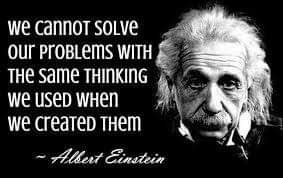
    When I became an adult (doing and teaching public policy), I found that principles are one thing while practice is quite another. The meme above has remained my core mantra throughout my life. Strip away all the nonsense, and this simple principle constitutes my core values, my most fundamental spiritual core, and my essential politics. It is a bit like the lesson attributed to Christ … spirituality is all about love and kindness. Nothing more!

    Designing and implementing the apparati through which to achieve our noble goals, however, is quite another thing. There are challenges everywhere with unintended consequences and tradeoffs dogging even the most well-intentioned reformers at every step. Yet, our aspirations never dimmed, nor our hopes for a better world. At least, not until now. The devil is in the details. No question. But our aspirations must never erode nor fade.

    Fast forward several decades and what do we have. About half of the states have separatist movements that advocate a political disconnection from the national government. A movie is about to be released (Civil War). It depicts the breaking apart of the U.S. into warring factions. The producers rushed it into production since they feared that reality would overtake art, making their work an historical piece as opposed to a morality tale. (Note: I personally believe that Lincoln’s dream of a United country may be over.)

    We have a nation divided in two utterly distinct halves that cannot understand one another. A Trump supporter being interviewed recently unabashedly asserted that he wanted to hang all Democrats from the highest trees. I wish I could claim that is an isolated opinion.

    Our divide across values and politics continues to widen even as we fail as a workable society. The litany of American shortcomings is too long to list here. A few examples must suffice:

    * We have experienced a growing hyper inequality since 1980. While worker productivity has grown by some 70 percent over recent decades, their pay has stagnated for the most part while compensation for those at the top has skyrocketed.

    * We have the most expensive medical system for providing health care in the world, yet mediocre (at best) health outcomes. We have some 40,000 amenable deaths annually because people cannot afford care or essential medicines. No other advanced country presents their citizens with such draconian choices.

    * We are the world’s shooting gallery. In excess of 100 gun related deaths per day occur in the U.S. Again, no other advanced nation comes close to such self-inflicted carnage. A number of our peers have fewer such deaths in a year.

    * In the past, we have been the defender of democracy and Western values in a world under threat from totalitarian regimes. Now, we are in danger of becoming one of those regimes. The Republican candidate for President openly supports anti- democratic strongmen and promises to give the worst of them (e.g. Putin) free reign if elected. Oh, and he intends to stay in office no matter what. Democracy be damned as inconvenient to his narcissistic aspirations.

    * We spend endless amounts of time debating athletic contests or the fate of the Kardashians while the existential threats associated with global warming and the AI revolution loom.

    The most discouraging fact about our contemporary situation is that a major party endorses this national failure, what can only be described as a collective insanity. I mean, really? We have a Republican base that devoutly adheres to the most insensible and outrageous conspiracies. No, Hillary Clinton does not run a pedophilia ring out of a string of pizza parlors. And no, the solar eclipse yesterday did not mean the Rapture was about to commence. OMG!

    I look at the MAGA base today with disbelief. I could understand the Republican Party of my youth. Eisenhower was a fine man and a good President. Even Nixon espoused some excellent policies though he was flawed as a human being. But the party of today is dominated by people I cannot pretend to understand nor with whom any constructive dialigue is possible.

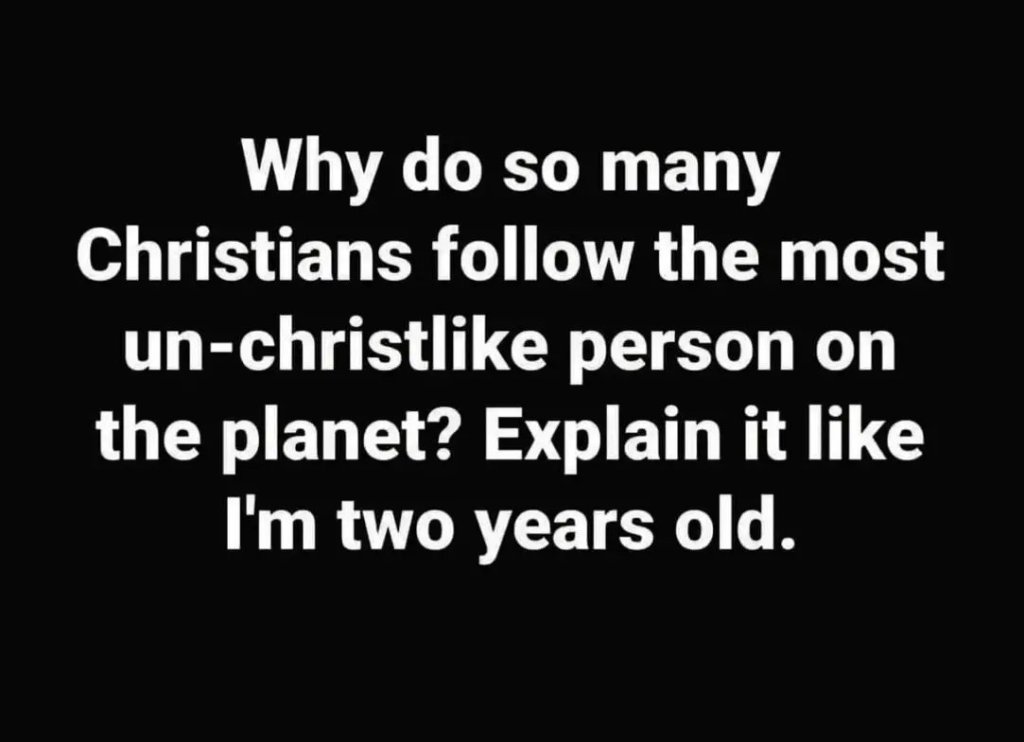
    Nothing, however, is more incomprehensible than those claiming to be Christian while devoutly following the worst example of a human being possible. The meme below captures my total confusion on this matter completely.

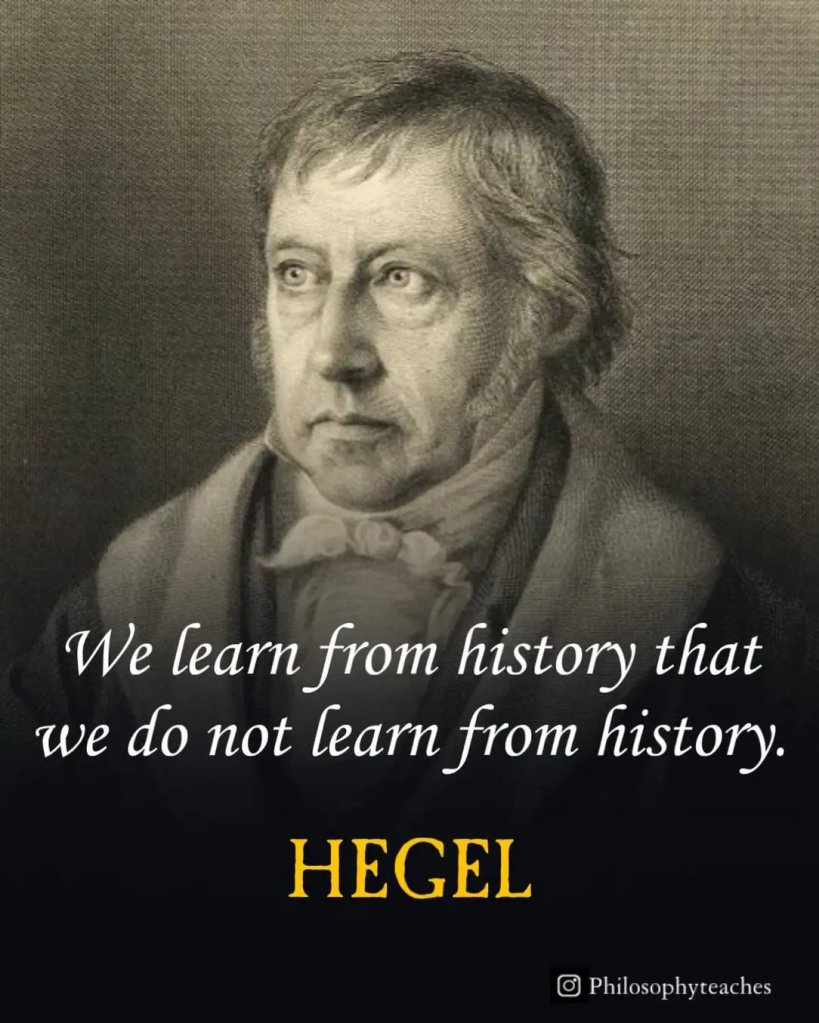
    What astounds me is that we have learned so little from the historical record. We seem to have forgotten the lessons hard won from our own prior experiences. Do we not remember the bitter conflicts to defeat Fascism or to face down Communism? Have we already forgotten the pain suffered by minorities simply hoping to use public transportation,to vote, or to live without fear?

    If we have forgotten such things, I’m not shocked. The old saw that those who ignore history are doomed to repeat it remains instructive today. On occasion, I have seen interviews with young people who cannot answer the simplest questions like who fought in our Civil War. They may be great digital gamers but stunningly ignorant about the great questions we face. I can remember spending hours upon hours in college debating what kind of society we should construct. I taught at the University level for many years. I seldom witnessed the same intensity among my students.

    Now, I look about me and see societal and political failure everywhere. It is as if we’ll have a collective form of mass amnesia. But is that surprising? After all, the right wing is desperately trying to whitewash our historical record, ban the classics of literature, and erase any hint of past struggles for a better world. Who else did such things. Oh yes, totalitarian regimes on the left and the right.

    Perhaps it is time for another book. It won’t help the world, but it might do wonders for me. A good rant might just be what the doctor ordered, if one could actually get a doctor’s appointment these days.

  • Conundrum # 4 (continued).

    March 29th, 2024

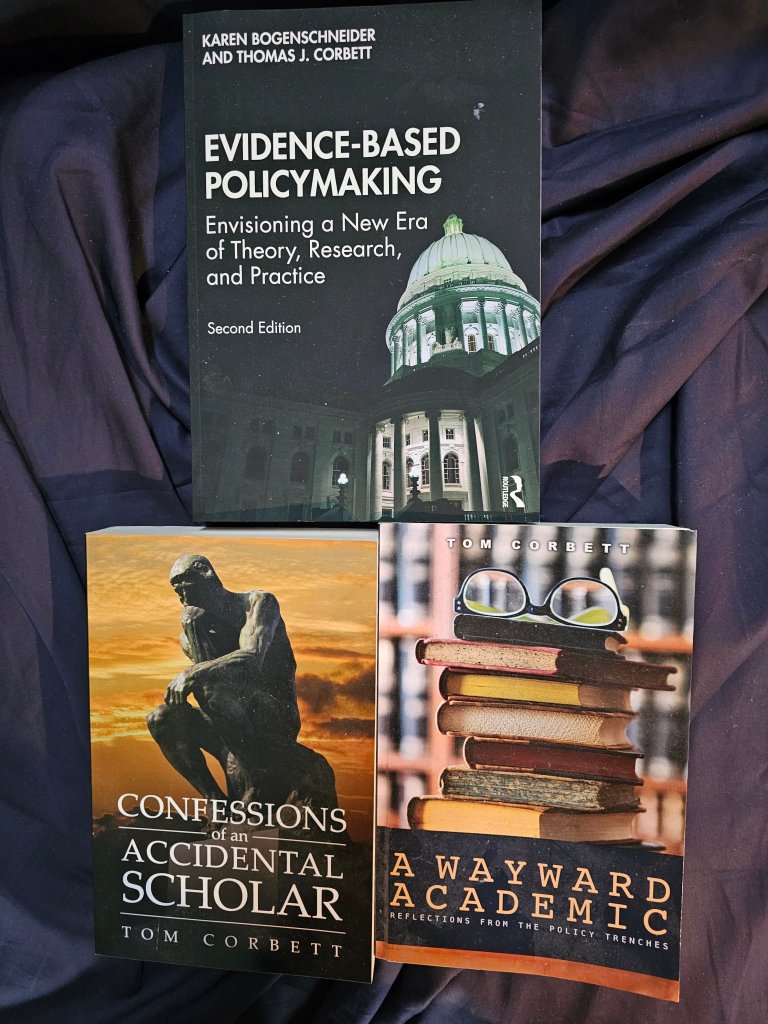
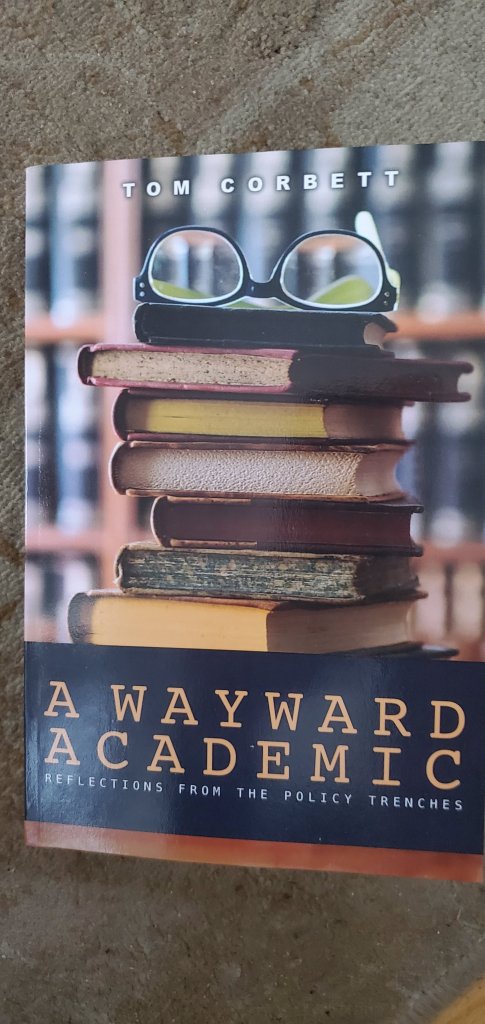
    I’m moved to add a bit more to yesterday’s post, though I’m not totally convinced this is merely an addendum to what I previously offered. No matter, this touches on an issue I have dwelt on for many years. In fact, I’ve covered such in several books (see pic below).

    Last time I focused on the faith versus science dichotomy, a chasm that goes back at least to Galileo if not much earlier. Yet, that societal tension might well be overly simplistic. For one thing, faith can provide a good deal of emotional comfort as long as it is kept in perspective. That is, don’t push your beliefs on others and don’t substitute your faith for constitutional protections or sensible laws or scientific facts.

    On the other hand, science also has an element of faith. We put our trust in those who have mastered the scientific method and technologies that few of us understand. Thus, when scientists announce they have measured the Higgs Boson, a critical sub particle first hypothesized mathematically a number of decades ago, the reality of this discovery remains a matter of trust for us mere mortals. We will never see it, feel it, or have any contact with this ‘thing.’ Yet, some of us share in the excitement of its discovery. After all, a collection of cooperating countries spent billions erecting the hadron collider, a miraculous piece of technology that spans two countries, just to find (among other things) some proof that this mysterious thing exists.

    There is another gap beyond faith and reason that deserves mention. There is a chasm between what I call knowledge producers and knowledge consumers. This is another oversimplification that separates scholars (and scientists) who search for mostly new knowledge from those who purportedly employ that knowledge for the betterment (we hope) of society. Naturally, members on both sides of the divide create and use knowledge but apportioning these distinct roles has some face validity.

    What separates knowledge producers from users are culturally embedded barriers that hinder communication. Each tribe has different aspirations, goals, language, operating styles and institutional rewards that render collaboration difficult to say the least. My colleague, Karen Bogenscneider, and I called it cultural dissonance.

    I’ve written much on this topic (see above publications) so won’t belabor it here. However, during my long career in academia (though I considered myself more of a fake academic), I was most dismayed at how provincial and narrow my colleagues remained. Most remained within the confines of a scholarly prison. The peer reviewed literature was the source of all knowledge, their disciplinary peers remained the only audience worth their time, and publication in select disciplinary journals their only worthwhile products. Given a choice of curing cancer or publishing an article in a top-rated journal, most of my peers would not hesitate to choose the latter.

    I would laugh when I came across university propaganda suggesting that faculty would be assessed on research, teaching, and public service. Right! In my experience, teaching only counted at the margins and only if you didn’t put too much effort into it. If you did, you were not a serious scholar. Nor did all research count, only that which found its way into accepted academic journals. And public service, forget about it. Doing good for society was always seen in the negative. Clearly, you were wasting your time tackling social issues no matter what fine language was included in University mission statements.

    Aside from restating my age-old gripes about the myopic academic culture, I do have a point to make. We are way too tribal. Some tribes are obvious … the politically left and right, the wealthy versus those struggling, black and white, urban versus rural, the list could go on. Those believing in science versus mere faith/personal experience is another social divide. And within those leaning toward reason, we have the tribe of knowledge producers and consumers. Too many ways of separating us and keeping us apart. At the same time, too few visionary thinkers engaging in lateral thinking to bring us together.

    In the end, we need more cultural bridgers of all kinds. We need those who can walk across the divides, who can translate the distinct languages, and who can forge new cross-cultural relationships. The future will be built on cooperation and collaboration. Those who can make that happen will be the heroes of tomorrow.

  • Conundrum to Ponder #4

    March 23rd, 2024

    What and Why We believe

    At the core of the human predicament lies the question of faith … what do we accept as truth and why? With the emergence of Artificial Intelligence (AI) and enhanced digital techniques, not even our senses can be trusted. Science itself has become so. sophisticated that we average humans must exercise trust in those who bring us the latest advancements. Thus, faith is key, even fundamental to how we formulate our world view and, more critically, our moral center.

    For eons, truth lay in religious teachings, whether articulated by recognized institutions or cultural lore. One did not have to think, or at least not very hard, to understand the world. Truth merely had to be accepted and embraced even when interpreting truth was clouded in ambiguity and obscurity.

    Scholars of the bygone eras attempted to decipher the meanings lying within surprisingly vague and opaque religious teachings. You would think a Supreme Being might be more specific or at least less ambiguous. But no, spiritual teachings unfortunately left much undecided, if not contradictory.

    Take the Bible for example, all manner of bad behaviors including butchery, polygamy, infanticide, slavery (and much more) are both condoned and condemned depending on where you look among the thicket of God’s so-called teachings. The various authors wrote parts of the Bible over several centuries as the concept of a Supreme Being evolved. Thus, consistency proved impossible. Earlier versions of a Supreme Being seemed to possess most of our basic human attributes (envy, jealousy, possessiveness) though coupled with an enhanced capacity to shape their desired outcomes.

    Confounding the extent to which we can rely upon ancient texts for modern guidance is the reality that they are, in fact, so ancient. As I recall noting elsewhere, the various parts of the Bible were originally put down in Aramaic (or other languages of the time). They subsequently were translated into Greek, later Latin, and then English and other modern languages.

    Each translation often occurred in the midst of political disputes regarding whose version of truth should prevail. William Tyndale translated the Bible into English around 1526, about the time the Vatican was first being challenged. This facilitated the Protestant Reformation and helped spread English as a more uniform and national language. Over time, each successive translation introduced ever more deviations from what had been set down in the first instance.

    And poor William, he was executed for heresy some 10 years later despite his contributions to the English tongue and in making religious teachings more available to the common man. The point being this … we have no idea whether what we see as God’s word bears any resemblance to what was set down in the first instance. There were too many changes over time and across the myriad of translations. In addition, the selection about which ancient writings were to be included was made by a committee … a committee for crying out loud! Not much of a divinely inspired process.

    Up until the early 17th century, we relied upon revealed truth and deductive reasoning from first principles to ascertain truth and understanding. Certain premises were taken as givens, and all flowed from these immutable truths by the rules of logic. Wisdom was presumed to have reached a zenith in the Hellenic golden age. We looked back in time to the ancients for inspiration. The world was immutable … static and hierarchical.

    Francis Bacon is oft credited with introducing the principles of inductive reasoning, the foundation of modern science, in the early 1600s. Apparently, he was a busy man. Some argue that he, not Shakespeare, wrote the greatest classics of English literature. In addition, he held high posts in the administration of King James the 1st.

    At its core, inductive reasoning rests on empirical observation and moving from careful measurement of the real world to the formulation of testable hypotheses. Truth was no longer given but something discoverable through observation and rational consideration. Modern science was being born. Of course, Bacon wasn’t the first to stumble on such thoughts. Thinkers in Baghdad during the Islamic Golden Age (circa 600 to 1200 CE) had similar insights. But Bacon’s rediscovery had legs, as they say.

    Early on, say for three centuries, science competed with religious truths for supremacy. Witness Galileo’s problems with the Vatican. As late as the 1950s, the great Jesuit thinker Pierre Teilhard de Chardin struggled with his superiors as he tried to integrate evolutionary thought with Catholic dogma. These two worlds (faith and reason) kept colliding.

    Today, we believe that science has prevailed, though I question that at times when I witness the nonsense being issued by MAGA devotees. Can we really be certain that today’s Republicans once again won’t start burning academics and scientists at the stake for heresy. 🤔 Perhaps they will settle for lengthy jail sentences starting with Anthony Fauci (an eminent doctor and scientist who devoted his life fighting infectious diseases through modern medicine).

    Science has created the world around us … everything from wonder-drugs to the miracles of modern communications to the technologies probing distant galaxies. Such miracles come from the techniques and discipline of the insights launched by Bacon’s revolution. Yet, there is a black hole quality to much of science today.

    What do I mean by that? The gap between science (scientists) and the common man is growing. In the late 19th century, it was widely accepted that an undergraduate degree is all an educated man needed. The first graduate degrees were not created until Johns Hopkins (1870s) and Clark University (1880s) decided that additional years of study were necessary to master certain disciplines.

    Today, every discipline has multiple sub-specialties. Scholars focus on tiny topics and dig deep into them. The language of science has become increasingly technical and unavailable to even well-educated persons. I have doctorate but cannot fathom the work being done in many other disciplines. Ever peruse the math through which physicists communicate with one another. It is like trying to comprehend the Bible in the original Aramaic.

    The academic culture, unfortunately, reflects and supports the chasm between modern sciences and people. Scholars who try to bring their work to larger audiences are derided and marginalized. At the extreme, they are the William Tyndale’s of the modern world.

    We need a better marriage between knowledge creators and knowledge producers. My UW colleague, Karen Bogenscneider, and I have written much on this topic including two volumes on Evidence Based Policymaking. Accepting science should not remain an act of faith, like religious truth. Researchers and scientists have an obligation to discover new knowledge and also bring their understandings to the wider world.

  • Conundrum to Ponder # 3

    March 17th, 2024

    What does it all mean?

    There is one significant difference between faith-asserted beliefs AND hypotheses based on rational inquiry using the scientific method. The former typically are offered as invariant, even eternal, truths. The later are couched in modest, more humble, language. Knowledge and truth are merely what we know today. All is subject to additional examination and reformulation. Today’s consensus may be tomorrow’s discarded theory.

    Of course, some physical laws appear certain. If they were not, we could never have explored space nor created many of the technical wonders that amaze us. The bigger and more meaningful the question, however, the more uncertain we are about the current state of our understandings. I recently talked about Dark Matter as a fundamental, though still mysterious, aspect of the universe, perhaps even being responsible for our universe accelerating toward an ultimate entropy state of cold emptiness.

    But here’s the thing. We don’t know if dark matter is real. We cannot measure it directly, only through mysterious gravitational impacts seeking some kind of explanation. Some argue that, in the end, Dark Matter will be little more than an intriguing possibility that turns out to be false.

    Science is not the final explanation. Rather, it is an approach toward making progress. One way of looking at God is that it (he or she) is truth being revealed … though slowly and with considerable pain. The fun of science is in the journey, though the potential destinations admittedly are alluring, if not enticing.

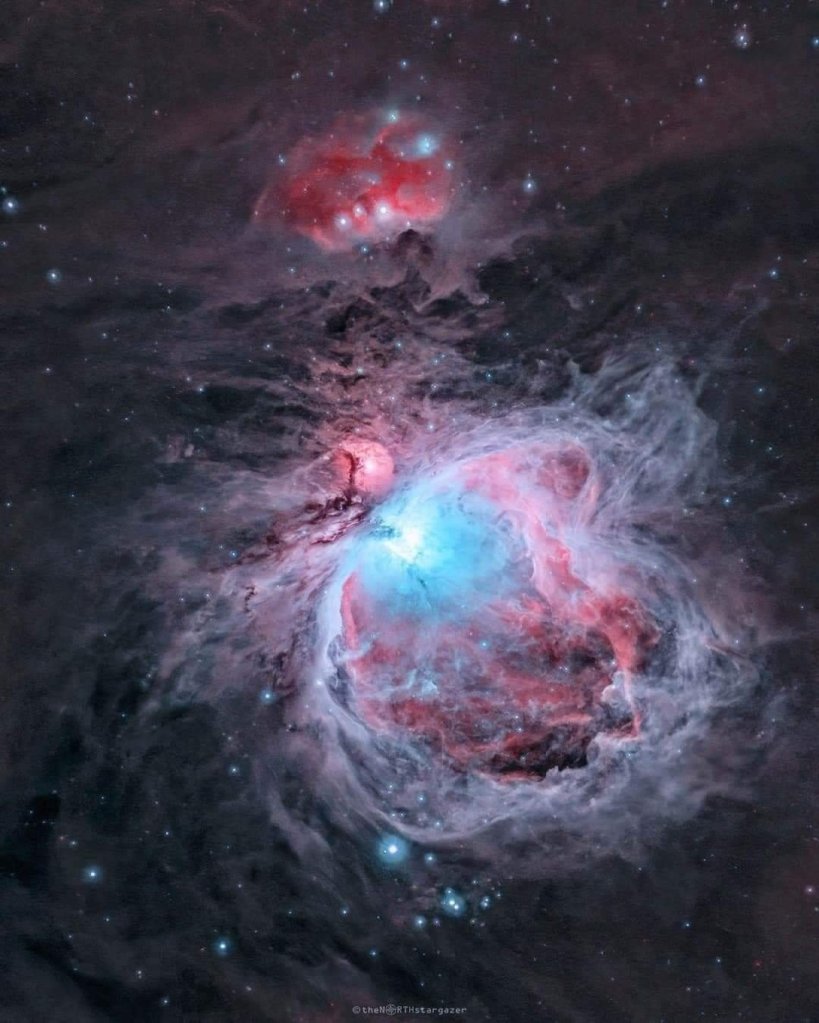
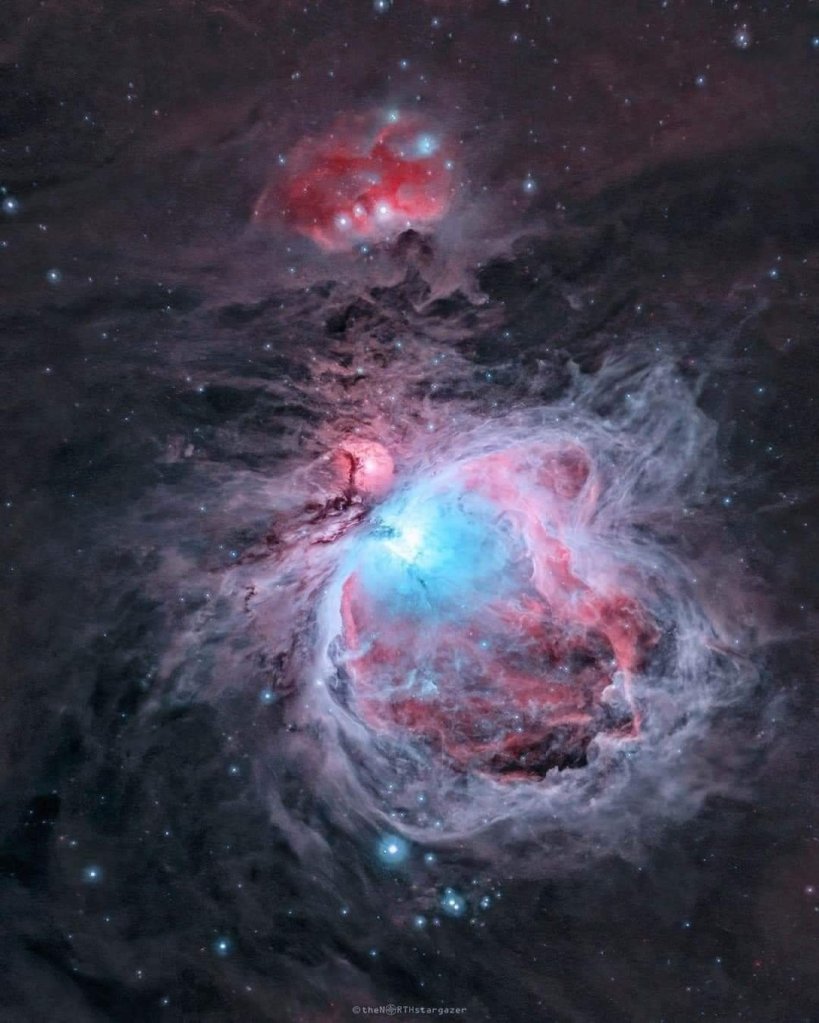
    A second benefit of science, or technology, is that it permits us to perceive great wonders. With our naked eye, we see so little. With our newest technologies, a magnificent canvas embracing wonderous creations opens up to us. Rembrandt, Carravagio, Botticelli, and Reubens have nothing on the forces that created the art out there. Starting with the Hubble spacecraft and advanced telescopes, we have an inkling of just how poetic and beautiful is our universe.

    One ‘big mystery‘ stands out among our most basic or fundamental questions. Where is the universe headed? What might the end state look like? For me, that is like asking what does all this mean?

    In the last century, we have entertained several versions of this ‘big’ question. First, we realized that the cosmos was not a static entity, fixed in time and space. It was alive with motion … expanding in fact. But we couldn’t quite figure out if the expansion was slowing or not. If it were, perhaps we were at the end of the initial cosmic expansion after our most recent big bang. All would soon (or eventually) begin to contract. Theoretically, all would return to the singularity that existed at the initiation of our last Big Bang. That, logically, would lead to the next expansion.

    Recently, we have measured an increasing rate of cosmic expansion. This has led to a very different image of the end times (not to worry, a time billions of years in the future). The image presented by this latest revelation is not any more reassuring. All matter, all that we can measure out there, eventually would disperse and cool. All that complexity and magnificence out in the vastness of space would evolve into complete entropy … dark and empty void. A rather drab ending indeed.

    Some astrophysicists argue for a more dramatic ending … the Big Rip. This image of the end times reminds me of the Rapture anticipated (with surprising glee) by many evangelicals. In the Biblical rapture a rather vengeful version of Christ would rip apart the non-believers (i. e., liberals like me) though why the Prince of Peace would do this is beyond my understanding. In this version of the cosmic end times, all matter would rip itself apart. The end, however, would still be that cold, empty, lifeless void

    I’ve been partial to another possibility. There is that metaphorical scenario found in Hindu mythology. Brahma breathes in and out every 85 billion years or so (which leaves room for many reincarnations). Each exhale would represent a cosmic ‘big bang’ expansion while each inhale represents the resulting contraction. The new singularity would inevitably result in another expansion, thus repeating the cycle for eternity.

    None of these scenarios sound promising 😒. So, I will exercise my imagination absent any empirical proof whatsoever. Imagine that the human species is a mere step in a larger evolutionary scheme. In fact, imagine that we are at the end of our run 😳. The very beginnings of the Artificial Intelligence (AI) phenomenon mark the transition to an intelligence and set of capacities we can not begin to imagine. This would be like apes looking at homo-sapiens in total wonder and admiration. Homo-sapiens would become the future apes, and sooner than you can imagine.

    Think about what might be in the future as all knowledge becomes available and usable while the pace of evolution accelerates beyond what we thought feasible. In fact, don’t even try to imagine it. You can’t! It would be like European peasants struggling to survive during the dark ages attempting to imagine today’s technological world 😕. Not a chance!

    Nevertheless, consider some future version of a really advanced entity capable of intergalactic communications who are able to command all knowledge in the universe. If possible, could such entities somehow shape cosmic evolution? Could the pointless ends we now envision be avoided … might some more meaningful future be consciously pursued.

    I have no freaking idea. But it beats a cold, empty, lightless universe or endlessly repeated expansions and contractions. But consider this! If what we become can influence and shape cosmic outcomes, then we will have found God. Such a phenomenon would be us or, more accurately, what we become.

    Surely something to ponder!

  • Conundrums to Ponder #2.

    March 15th, 2024

    Space-time … our newest deity.

    Is there a God? I am humble enough to admit I don’t have a clue. As suggested in the previous blog, I don’t believe there is a personal deity who is imbued with human attributes and seemingly afflicted with rather ordinary emotions and concerns. I can not accept as proof of such a personable deity the existence of ancient writings of questionable provence that are replete with mind-bending contradictions and impossible assertions. Heaven help us, excuse my use of this phrase, if the extreme religious fanatics lurking in today’s Republican Party take control and replace our Constitution with the Bible. Look at Iran or Afghanistan to see what happens when popular versions of so-called religious truths replace secular law.

    Yet, we can see out there a cosmic majesty so improbable that we are left humbled and, in my case, frankly curious. How could something like this exist? Why does it exist? Where is it all going which, in truth, is a bit like asking what does it all mean?

    Imagine our long ago ancestors peering up into the night sky in wonder. They could only see a tiny portion of what lay out there and see only the Cosmos as it recently existed. Now, with our human ingenuity, we peer into the immensity of space and thus deep into our past. The distant images we now detect with our telescopes in deep space represent what existed billions of years ago. That is how long it takes for light to reach us from such unfathomable distances. We are looking into our deepest history. If our ancestors were impressed with the night sky, I am blown away by what is out there and by what contemporary science reveals to us.

    We all search for causes we can understand. Humans have conjured up mythical heroes, human like gods, or impressive deities like Yahwey or Allah or Brahma or he with no name. Such entities are credited with creating all we know for reasons that cannot be convincingly discerned. For virtually all of history, our creation narratives were a matter of faith since there were no other alternative explanations.

    Contemporary science changes all that. Yet, it also contains an element of faith since I cannot comprehend the mathematics on which it is based nor the technologies employed to penetrate the mysteries of our universe. Still, there is a fundamental rigor and an empirical basis for how we see things through the lense of modern science. It is the best we got and rests on actual observation.

    The current creation narration, based on science, goes something like this (an extremely simplistic overview). Some 13.8 billion years ago, there was a tiny speck of energy so small that neither time nor space (as we understand such things) existed. Then, for some reason, this tiny speck of unimaginable dense energy expanded at a rate inconceivable to us in what we call cosmic inflation, or the Big Bang. In this Big Bang, the universe went from literally nothing to a cosmos containing all the elemental ingredients essential to creating the universe we know today.

    Suddenly, an immense field of particles and light existed. Yet, much more needed to happen before the known universe came into existence. Oddly enough, this theory was first formulated by a Catholic Priest and physicist … Georges Lemaitre about a century ago, soon to enjoy empirical support from the work of Edward Hubble. As with all radical interpretation of things, acceptance took time, and many mysteries remained.

    Creating our known world we see about us took longer than six days, nor is it the product of divine choice as ordinarily understood. No, in the moments after the Big Bang this expansion of elementary materials (mostly hydrogen) there existed tiny imperfections in the cosmic expansion taking place. If those tiny fluctuations had not existed we would have a dull and uniform cosmos of evenly distributed hydrogen … no celestial bodies, no humans, no Space-Time phenomenon as we know it.

    But these tiny variations in density did exist. In turn, such anomalies resulted in the emergence of local gravitational fields which, in turn, permitted the aggregation of swirling matter into clumps and, over time, increasingly more sophisticated and complex stars, planets, and various other celestial bodies.

    The process took billions of years. As these bodies increased in size, they increased the gravitational fields around them. These fields in turn helped shape the architecture of the cosmos through endless and often violent collisions in space as bodies of increasing complexity were drawn to one another. Stars grew as they absorbed surrounding gases and matter. They became hotter, some of them exhausting their fusion based energy sources before exploding in galactic fireworks. In the process, the immense energy created and then thrust into the universe included all the heavier elements that had been forged in their cores. These extravagant explosions created the building blocks needed for the world we see around us today. We ourselves are stardust created by such ancient explosions.

    Governing this chaotic birth and celestial development was the fundamental notion of Space-Time itself. This abstruse concept is considered by scientists as the fundamental architecture that connects everything in the known universe. From what we know, IT is responsible for the very character of the cosmos.

    This mysterious entity also contravenes our usual perception of things. The two dimensions are intimately related to one another. That is why the two words (space and time) are inseparable. Moreover, the two dimensions act differently than our human apprehension permits. Space curves in the presence of solid objects. A straight line is not always the shortest difference between two points.

    Time proceeds at different rates depending on the position one is in with respect to our space-time continuum. We will age faster if we lived our lives at the top of the Empire State Building than if we lived on the first floor. Gravity (the curvature of space) is stronger on the earth’s surface which, in turn, impacts time. The satellites orbiting above us off which our telephone signals bounce must continuously adjust their clocks to account for slight differences in the pace of time as measured on earth and in orbit. Without such corrections, our GPS based on those advanced orbiting systems would quickly lose their accuracy.

    In some ways, this space-time phenomenon is the essential foundation for the architecture of the universe. It theoretically explains how all the stars, galaxies, solar systems, nebulae, black holes, and the other stuff came to be. From a rational perspective, this is the closest thing to a God-the-Creator we have. And yet, it remains a matter of faith for me.

    When I ponder such notions, I feel like the ancients pondering the stars in the night sky. As with the excitement of each new day, I keep hoping for more understanding. But that is illusion. Such full understanding is beyond me. There remains so much we yet do not know at present. And I am too dull to appreciate most of it.

    The Big Bang is not over. Our galaxies continue to rush away from one another at an accelerating pace. A mysterious entity called dark matter (which presumably constitutes 70 percent of the universe) may be responsible for this apparent fact of this increasing rate at which things are flying away from one another. Are we destined in a few billion years to see our magnificent universe die a slow death of ultimate entropy? Some believe that is to be the case.

    Intriguing question … is it not! In the meantime, should we consider space-time (or this mysterious dark matter) to be the rational equivalent of God. Is this the creator we have sought so long. 🤔 Hmmm 😒!

    The great thing about being a human is not that all the answers are given to us in the form of religious truths. No, our blessing is that we have an opportunity to reflect on our immense world in a rigorous manner. We can peel back our ignorance to reveal God (or reality) as it actually exists. How about that.

  • Conundrums to Ponder … #1.

    March 13th, 2024

    I’m back! Let the celebration begin.

    Admittedly, I’ve been AWOL lately. For one thing, I’m juggling three book clubs along with a long list of other literary works demanding my attention. Like a kid in a candy store, I grab more delights than I can possibly consume. Thus, my blog output has suffered. That is hardly a crisis given that so few read these repositories of personal wisdom. Still, I’m not ready to cease writing totally.

    My short- term solution is to focus on random thoughts that flit through what passes for my brain. Over time, I have found such dialogues with myself fascinating. I keep thinking … Tom, you are a clever sot. However, I seriously doubt anyone else would agree.

    Note Bene: Unlike my previous series exploring aspects of my sordid past life, there likely will be little to connect the next bundle of posts into coherent themes, but who knows. Some will be short, others long. Most will be inane, though a few might have merit. After all, profundity (much like profanity) is in the eye of the beholder.

    A Spiritual Conundrum or two!

    As you know, I was a believer in Christianity in my youth … Catholicism to be more precise. I tried hard to be a true believer, though I would argue with several of the Catholic tenets to which I was exposed in my High School religion classes even as I was being inexorably drawn into the seminary. There was always a war between rationality and a need to believe in something beyond myself.

    I do not denigrate that innate need. It is fundamental to the human experience for most of us. Creation myths, for example, are universal. Assigning meaning to forces beyond our experience is fundamental. Personalizing that force is understandable. Few of us can embrace the abstractions demanded by a rational approach to things.

    In my war between reason and faith, certain insights (or perhaps doubts) intruded. While anything is possible, not everything struck me as plausible. A prime example is that a personal deity cares about me and whether or not I believe in him, her, it. Not just belief but a total acceptance of rules laid out in writings set down long after the events took place (the Bible), texts selected by a committee (ever served on a Committee?) and then changed many times as the original works were retranslated from Aramaic to Greek to Latin and then English. Astonishingly, failure to follow the rules results in everlasting pain. Such a harsh and unforgiving God! Let’s look closer at this.

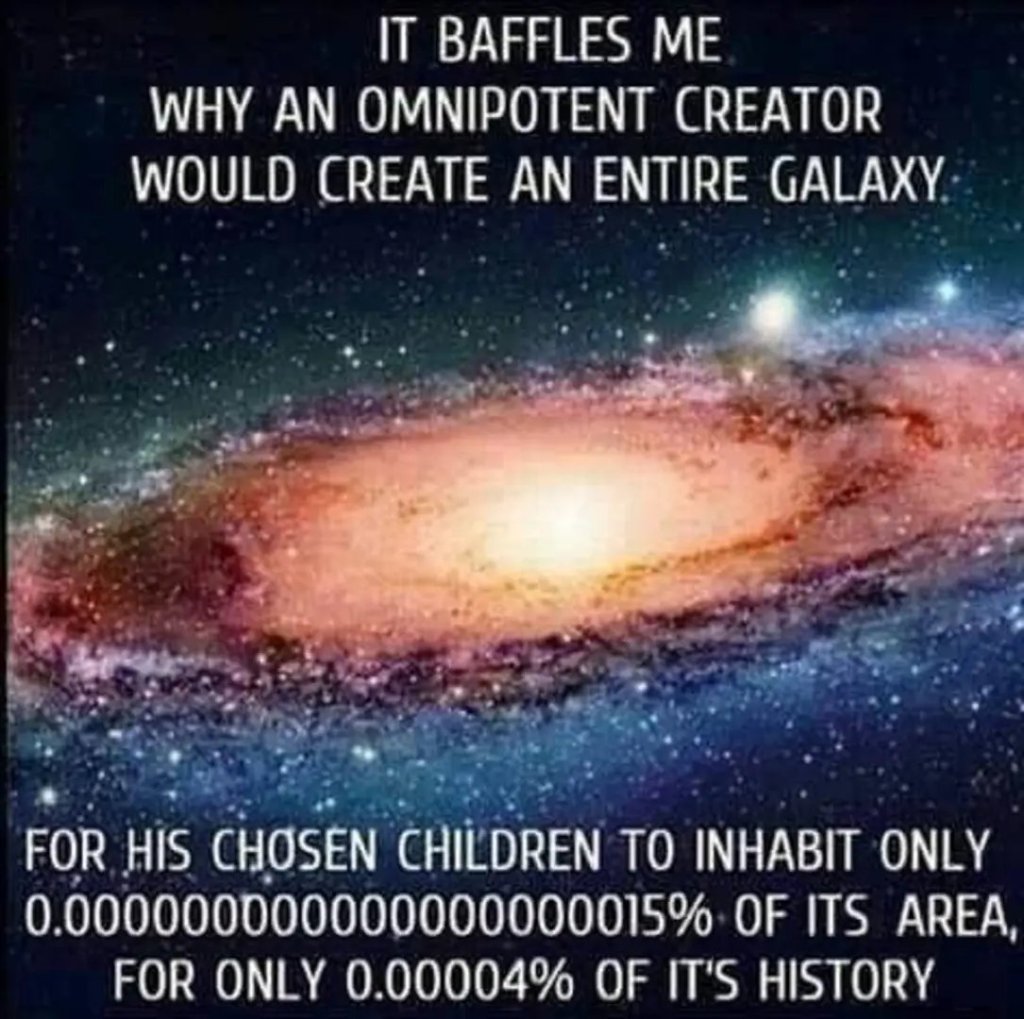
    As the above meme suggests, why would a grand creator (or force) focus on an insignificant species on a remote planet hidden among so many galaxies … a species that has only been around for mere moments in our cosmological timepiece.

    And why would this force, one that presumably created this vast galaxy some 13.8 billion years ago (if reason and science are to be embraced) care one wit about what one single member out of some 8 billion humans does on a daily basis. What benefit to such a force if these miserable creatures petition it for respite from their petty problems. And why would this force take attendance at weekly ceremonies devoted to the adoration of a concept well beyond man or woman’s understanding. It just doesn’t compute.

    You would think that a force (I can’t anthroporphize this notion by saying being) would have better things to do. After all, the above meme only encompasses our galaxy, the Milky Way which, in truth, is comprized of some 50 galaxies in what is defined as our Local Group. Astoundingly, there are billions upon billions of such galaxies, as many as two trillion by some count. And that figure only applies to the known universe which keeps getting larger as our technologies permit us to look further into time and space.

    Now, if we assume that our Miky Way is an average galaxy, astronomers estimate that there are 200 trillion billion stars out there. Given other estimates of the number of earth sized planets seen in other solar systems, there may be 40 billion earths out there (likely a low guess). Of course, we would like to think we are unique, God’s chosen species if you will. But really, the odds are we are not alone, even if we are the product of mere evolution (which requires an immense number of fortuitous events to take place) and not divine intervention. Only arrogance and unsupportable hubris would lead us to conclude that we are the only conscious species in the cosmos.

    Even decades ago, when the known universe was much smaller, these facts about the cosmos in which we exist served to humble me. I am not arrogant enough to discard all possibilities that a force or phenomenon beyond ordinary human comprehension may explain our amazing world. At the same time, the simple creation myths provided by several religious traditions and the very notion of a personal deity looking over my miserable existence seem wholly implausible. I cannot fathom a deity that would create such a vast and magnificent universe only to care about one struggling species on one planet stuck in the backwater of a single galaxy. Really?

    Such conundrums demand additional noodling. You can be assured that I will return to this question.

  • Seeking a moral compass.

    February 28th, 2024

    I’ve been missing from blog duty for about a week. Wow, in the beginning, I was writing a blog daily. Where did I find the time to do that? I do suppose it helps when you don’t have a real life.

    No matter, I am back. Once again, I had hinted that I was past reflecting on my early years only to disappoint everyone with yet more memories on things of absolutely no interest to others. 🙃 Perhaps those who assert that I’m self-absorbed are spot-on. Still, I cannot finally move on before touching on my ill-considered effort to achieve sainthood.

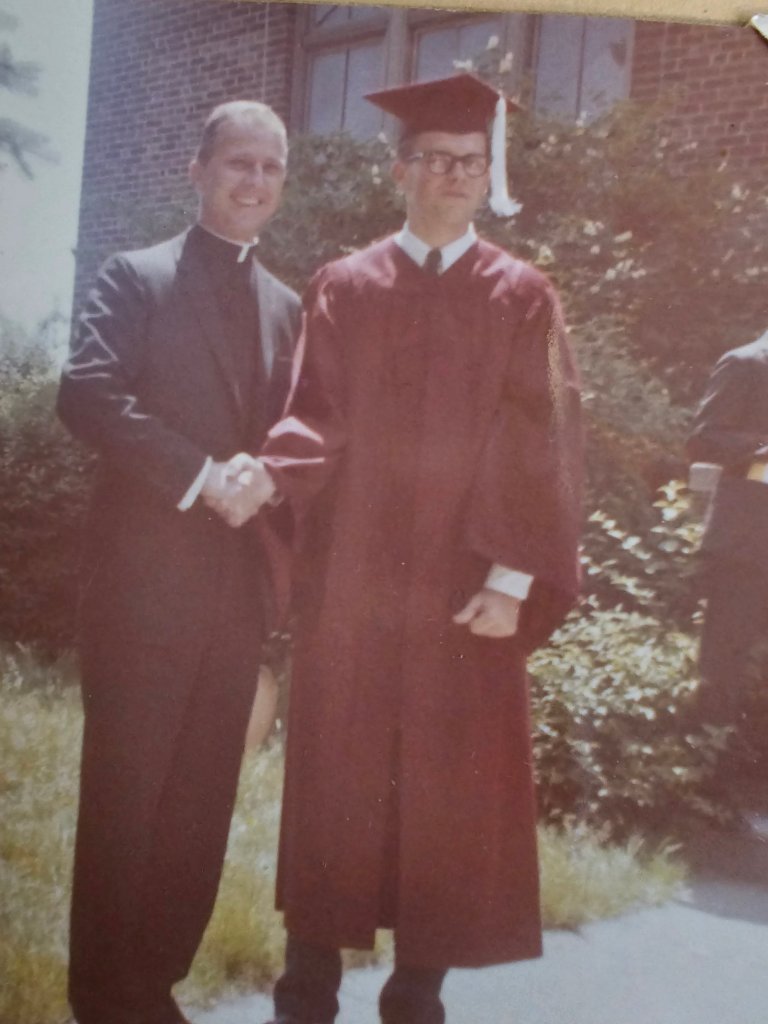
    Above, I am shaking hands with Father Beck, a Catholic priest who essentially recruited young men for the Maryknoll missionary society, an order dedicated to (in turn) recruiting souls living in foreign lands to the Catholic church. That may seem to be an unlikely path for a future left-wingish Rebel. However, that’s not at all the case. Idealists are idealists. Sometimes, it merely takes some time to figure out what you are being idealistic about.

    As you know, I grew up in an ordinary ethnic, Catholic, working class family. I don’t recall either of my parents ever attending mass or displaying any form of formal belief structure. However, they did pack me off to Catechism class so that I might be indoctrinated into the one, true, and universal church (or so we were told by those instructing us).

    The more I think on it, they must have dragged me to church in my younger years, though I have no recollection of that. I do recall loving the serenity found in empty churches (before they were filled with noisy people). I was attracted to the smell of incense, to the candles flickering at the sides where devotees made offerings to special causes, and to the mystery of the Mass. Back then, the celebration was in Latin and some of the sermons were in the language of the dominant ethnic group for that church … Polish or Lithuanian.

    I cannot say I was drawn to the church in any particular way as a kid. All my friends were Catholic. It was merely part of the background noise of my life. I resisted going to one of the Catholic elementary schools I’m the early days. There were a slew of them back then, a holdover from the times when the Church maintained separate institutional systems (schools and hospitals) to avoid mingling with Protestants whom we knew were going to Hell. All the Catholic elementary schools were taught by nuns who had a hellish reputation.

    High school was different. I wanted to go to Saint John’s Prep … the best religious school in central Massachusetts taught by the Xaverian brothers. This was the place to go for kids from my tribe. There, I would be indoctrinated into the basics of the faith along with a rigorous curriculum that prepared us all for college. It was a no-nonsense place where discipline was rigorously enforced and academic excellence prized. Hell, the teaching brothers had no life other than beating some knowledge (and good behaviors) into us. The beatings occasionally were literal.

    As I have written earlier, I developed a keen sense of purpose during these years. I became increasingly sensitive to the injustices around me, especially regarding civil rights and matters of equality of opportunity. It seemed built into my DNA. I won’t dwell on that awakening since I’ve discussed it elsewhere. Suffice it to say that I started looking about for a place to satisfy my growing attachment to a purposeful life.

    Enter thoughts of the Priesthood. I cannot recall when this became real for me. I do recall attending daily Mass in my senior year of high school. Yet, there were doubts even then. I would sit in religion class arguing (only in my own head) against some of the Catholic teachings in which we were being indoctrinated. But I pushed those doubts aside. That proved to be an error, as I would discover soon enough.

    So, in the Spring of 1962, I visited the Major Maryknoll Seminary in Ossining New York … a lovely site overlooking the Hudson River as I recall. That hooked me. In late August of 1962, I got on a bus and headed for Glen Ellyn Illinois (outside of Chicago) to the order’s minor or college level seminary.

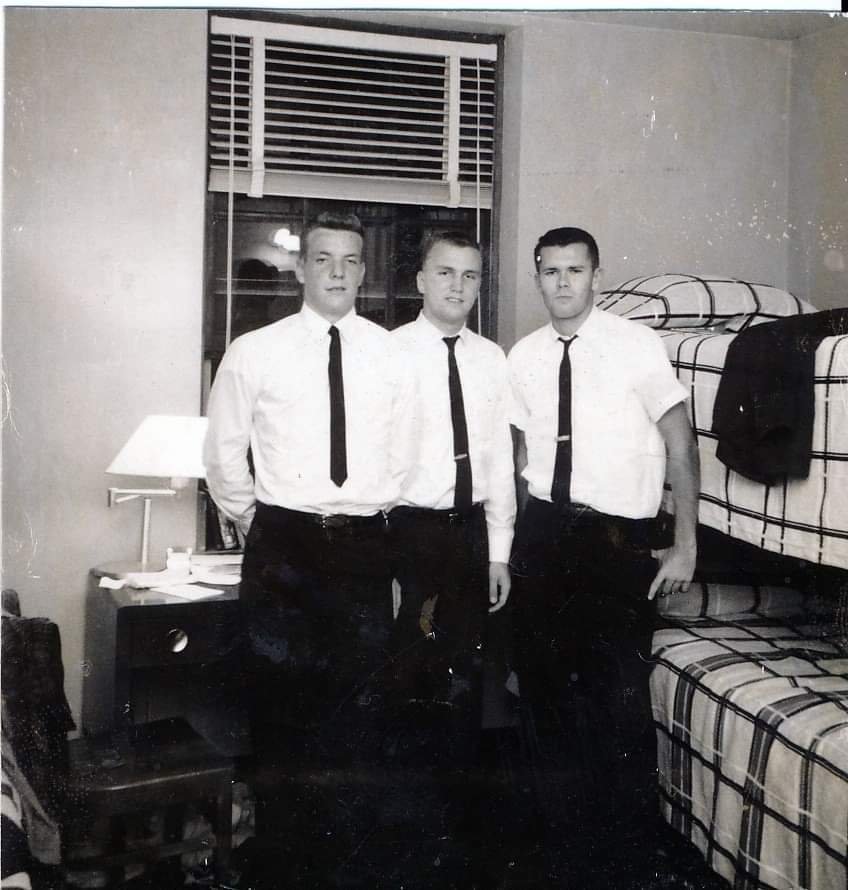
    Here I am (on the right) with my freshmen roomatesĺ. My God, was I ever that innocent? I suppose a seminary is a bit like a military academy. Each day is highly structured. You go from a wake up alarm at 5:30 or so through religious services, classes, mandated work assignments, physical training, more indoctrination, and then more studies. There were long periods of enforced silence and few opportunities to leave the campus.

    In many ways I liked it. My fellow seminarians were nice. I did well in my studies. There were places on campus where I could walk and think about things. It was all encompassing and became comfortable. The thought that it would take 8 years to become a missionary priest was a bit daunting but so be it.

    We were not saints. We broke the silence rules, played tricks on one another, and worked out our frustrations in vigorous athletic competitions. I can yet recall pitching an entire basball game for the first time in many a year. I could barely move the next day.

    There were some special moments. I can recall the Easter celebration in the circular chapel. We all filed into a darkened chamber at midnight. Each of us had a candle, each of which was lit one after another. In the glow we repeated the phrase ‘he is risen’ again and again. Goosebumps return at the memory.

    In the pic above, I am with my second year roomates. By this time, doubts I could not ignore were creeping in. The internal arguments I suppressed in high school religion class kept returning and with greater force. Yes, I wanted to do good. Yes, I wanted to find purpose in life. Yes, I was searching for meaning. But no, when I looked deep inside, I did not believe in a God deeply enough to support a vocation. I was way too rational.

    You can recall the rest. I realized one day that I had been fooling myself. It was time to face reality. I left, returned home, enrolled at a secular college, and shed any remaining religious beliefs. Rather than resolving my search for purpose through the salvation of souls, I would find alternative ways of finding meaning in life. That search started with trying to stop an ill conceived war (in my estimation) and continued in a life working on critical social issues.

    And that really is the bottom line. My Seminary experience was never a failure. It was merely a temporary detour in the search for what I was meant to do. In the end, it was a good thing. You seldom make real mistakes. Rather, you stumble upon learning opportunities all the time, but only if you recognize them as such. Just make sure you see them as gifts … not errors.

  • A Wayward Academic.

    February 13th, 2024

    One more recollection from my past … at least until another thought pops into my head. I may even give you a short break after this one. We will see.

    I should say something about my professional career, or what passed for a career in my case. On paper, I ended up as a Senior Scientist at the University of Wisconsin-Madison and the Associate Director of the Institute for Research in Poverty … a nationally recognized research entity that focused on social policy questions.

    Nominally, that sounds impressive. If you were an academic type into issues of domestic policy, this definitely was the place to be. There was one slight problem. I was not, by disposition, a scholar. True, I had many related skills … I raised tons of money for research; my students generally loved me; I wrote beautifully; I was excellent in the logistics of complex research projects; I was in demand as a speaker; and I consulted at all levels of government on a variety of public issues. Though rather disorganized, I was creative enough to be considered a talented administrator. I even had the respect of my Institute and academic colleagues (outside of Social Work that is), including the hard ass economists. Finally, I was on the speed dial of reporters across the country and very well known within the national domestic policy community.

    So, what’s the problem you ask. Well, I believe there were two problems for me. First, I detested writing for the disciplinary focused, peer reviewed journals. They struck me as highly stylized, overly narrow in substance, and targeted only on a small audience of peers. Unfortunately, that is the only expectation for academic based scholars. Though they talk about research, teaching, and public service, only the first counted in my day. You put effort into the other two only at night and when no one was looking.

    Second, I had the attention span of a hyperactive gnat. Good scholars drilled down to explore the minutia of sub-issues. I gravitated toward cross-cutting questions of relevance to the real world. I was a round peg in the square hole. Worse, I could never focus for long on an topic. There always was something new to capture my attention. My first title for my professional memoir was Browsing Through My Candy Store because that was what my career felt like … I was surrounded by enticing problems to explore and kept moving on to the next glamorous challenge that grabbed my attention.

    Nevertheless, I did love academia. I enjoyed the freedom to explore whatever I wanted. I reveled in not having a nominal boss. I loved being surrounded by really smart people and constantly being exposed to new ideas and thinking. I was drawn to the intellectual challenges and, because I was associated with a top-notch research entity, people assumed I was some kind of an expert, smart even. I loved being in a professional environment where I got to fly around the country to work on complex and challenging issues with some of the brightest folk around. Better yet, they paid me to do this. It was heaven.

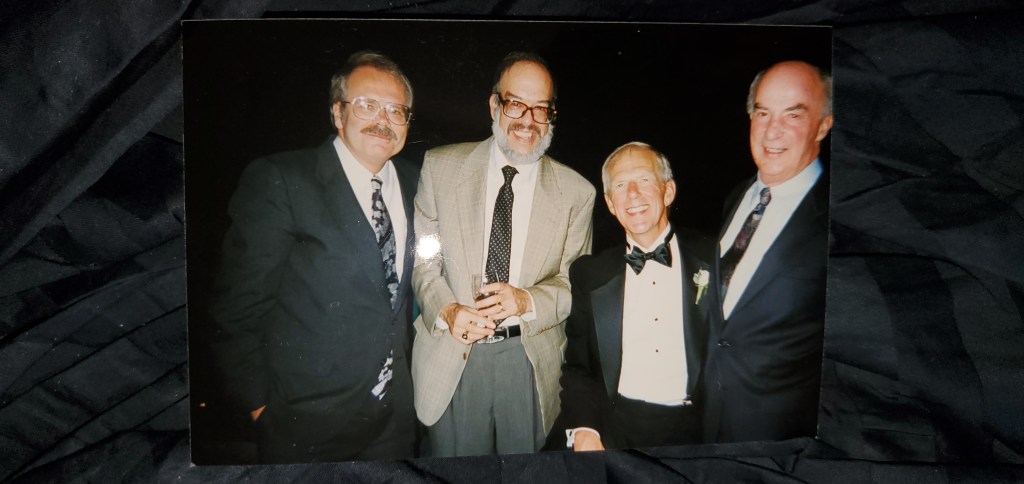
    I particularly loved the people, some of them at least. The above pic was taken at the wedding of Robert Haveman’s (seated with bow tie) stepdaughter in New York. On the right is the late Irv Piliavin. He was a delightful character who first recruited me to the university from Wisconsin State service. He needed someone who knew state government to run a large research project for him. I next worked closely with Bob Haveman on a legislative mandated welfare reform study. We put together an innovative reform plan that led to several innovations in the state’s social safety net. Soon, I quickly moved on to working with Irv Garfinkle (next to me) on child support issues which, in turn, quickly led to a fascination with creating integrated or one-stop work-welfare systems (where I worked with economist Michael Wiseman (visiting from Cal-Berkely) and Political Scientist Lawrence Mead (visiting from NYU). The internationally famous Kenosha model was the result. These were just a few topics in the beginning days.

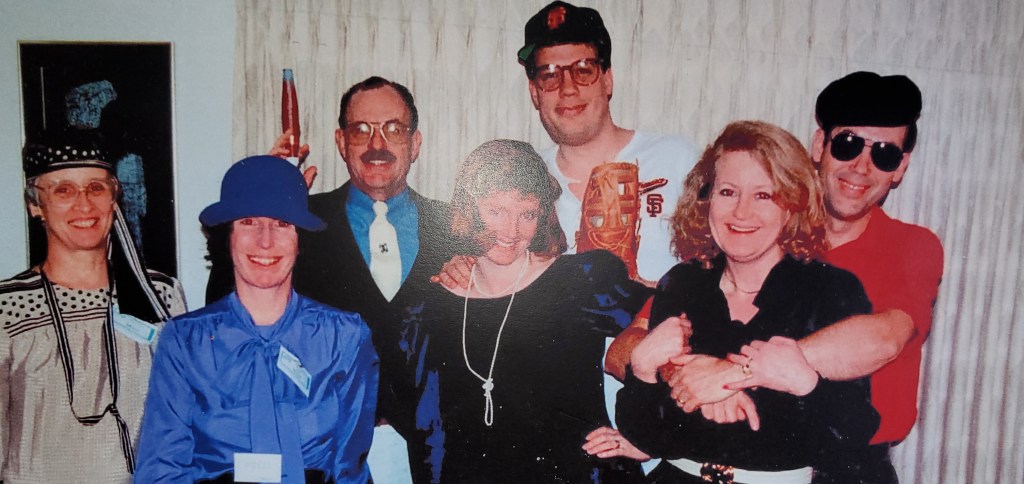
    It was not all work. There were times for friendships and frivolity. The three men (and spouses) above were close colleagues. It was taken at a theme party my spouse (blue dress) and I threw at our house. The man of the left was a visiting Federal official who was very helpful to me when I spent a year in D.C. working on Clinton’s welfare bill. Next to him is Karl Scholz, then a junior economist at UW. He went on to become Provost at UW and currently is President of the University of Oregon. The man on the right is Gary Sandefur, a Native American Sociologist who later became Dean of L&S at UW before heading back to his native Oklahoma to assume the position of Provost at Oklahoma State University. These were not only treasured colleagues but friends as well.

    Above is Jennifer Noyes. I must admit that my choice of professional colleagues shifted to the feminine side over time. I found women to be organized and focused while I was … NOT. When I first met her, she was working as an advisor for Governor Tommy Thompson, the ambitious Wisconsin Governor who ran for U.S. President and became Secretary of HHS in Washington. She also headed his nationally renowned welfare replacement program known as W-2. Tommy disliked me and the Institute, but I found that I could work with Jennifer. We repaired IRP’S fractured relationship with the State. In time, I strongly encouraged her to move to the University where we collaborated for a number of years on developing Peer Assistance Models for states attempting to reform their welfare programs and with others pursuing integrated models for their human service systems. She now works directly with the UW Chancellor.

    Below is another female colleague … Karen Bogenschneider (left) and her graduate student (a Harvard Grad) at the time. Karen and I wrote two books on evidence – based policymaking along with several articles. I also helped her develop what were called Family Impact Seminars, a successful method for bringing research to state legislators in Wisconsin and across the country. She was the epitome of organization and focus.

    There were so many others, on the Wisconsin campus, at other universities around the country, or located in government, think tanks, advocacy groups, and foundations. I knew more people in Washington than many who actually worked there. I worked with local and state officials across the U.S. as well as Canada. Almost all were dedicated, committed, and very hard working. They taught me so much.

    I will only mention three people who impacted my professional life in a large way. Bob Lampman (a UW economist) was considered the godfather of the War On Poverty launched by President Johnson in the 1960s. He was a giant in poverty studies and one of the nicest individuals I ever met in academia, or anywhere.

    Sheldon Danziger was an economist by training but situated in the School of Social Work (he went on to Michigan and then to Russel Sage in New York). I mention Sheldon because I never would have gotten my doctorate without him. As usual, I was too busy or distracted to finish my dissertation despite receiving rave feedback on my prelim exam responses (when they were real exams) and having tons of data from projects on which I had been working. When Sheldon was IRP director, he pulled me aside one day with a plan. He suggested throwing together several papers I had written and calling it a dissertation. It must have set a record for length (2 volumes and some 600 to 700 pages), but the scheme worked. It was a variation of the ‘baffle them with length and bullshit’ approach. They were desperate to get rid of me.

    Finally, I must mention Barbara ‘Bobbie’ Wolfe, an economist and public health scholar. She was director of IRP when I first served as Associate Director and then Acting Director (in her absence). We guided the Institute during a period when its funding was under serious threat. There were lots of sleepless nights in that era. She and I made a good team. She was the serious academic while I was the schmoozer who worked in the public arena and kept the Institute’s brand visible.

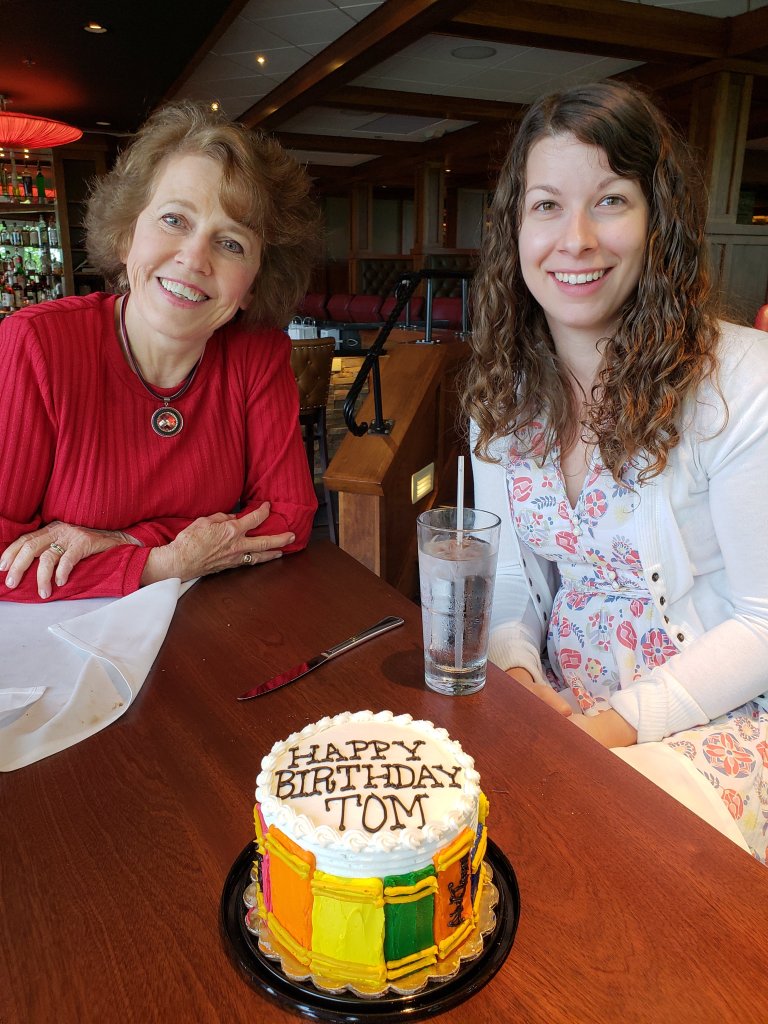
    Others come to mind. The couple above is my spouse with Luke Geohegan. He was a Harkness Fellow from England whom I mentored during his six month stay at UW. We remained close, visiting each other over the years. He went on to become warden of Toynbee Hall (a famous British landmark known in policy circles) and is now the head of research for the Britain-wide organization of Social Workers. They play a key role in advancing social policies.

    The elderly gentleman was Jack Westman. He was a child psychiatrist attached to the Medical School at UW. He drew me into an organization called Wisconsin Cares as Vice President. This was a group of retired movers and shakers from state government and the university. We kept busy working on public issues affecting children and families in retirement.

    One of my final projects at UW was to run (with Bob Haveman) what was called the Poverty 101 workshop. We brought in academics from around the country who taught poverty related courses. Over a week, we exposed them to intensive seminars given by IRP affiliates. My plenary talk at two of these courses (The Rise and Fall of Poverty as a Policy Issue) was considered a classic.

    One thing is certain. We all fade from the scene but not entirely. The above pic is taken from an interview I did discussing evidence based policy making. Just this past week, I realized that it is still used in training sessions for those who run Family Impact Seminars around the country. I wonder if anyone listens.

    I also hope that some of my papers yet resurface from time to time. My paper (Child Poverty: Progress or Paralysis) was a sensation when it came out in 1993. Another paper on welfare motivated migration was read into the Congressional record. Several papers on service integration written by Jennifer Noyes and I created a stir in the policy community. For years, we would get calls from policy makers praising our unique take on the topic as well as invites to consult. A lead article to a major IRP publication around the year 2000 was seen as a seminal summary of the welfare revolution that was beginning to wind down by then. That is what I enjoyed, bridging the gap between research and practice to take a fresh look at what is going on and writing about it for broad audiences.

    It wasn’t all fun and games. I grew to hate the constant traveling. And the workload was brutal at times. I can yet recall semesters where I had a full-time teaching load, served as Associate Director of IRP, was the principal investigator on several projects, organized a number of conferences, and gave numerous talks around the country. I would organize a talk on the plane out to whichever city in which I was scheduled to talk and plan my next lecture on the return flight. I would wake up each morning at 4:30 or so in a panic, feeling way behind. That’s only because I was.

    Yet, I only had one regret in all this. Apparently, the university administrators at UW wanted me on the faculty (I was a senior scientist at this time even though I performed all the roles of a faculty member). They first set me up with something called the Department of Governmental Affairs. I barely learned where they were located. That arrangement collapsed while I spent a year in DC during Clinton’s tenure.

    When I returned, they had set me up for a tenure track half-time position as a clinical professor in Social Work. I was way too passive in these matters. I would say ‘whatever’ but not change my work style one bit, other than to add faculty meetings and mandated faculty assignments to my already overwhelming schedule. How stupid of me. I initially thought my national reputation would make this a slam dunk. By the third or fourth faculty meeting, I was disabused of that notion. While individual academics can be whip smart, in a pack they can be remarkably hide bound and culturally rigid. But we have always done it this way. I knew they would be paralyzed by my situation since I never played by the rules.

    My greatest (and only regret) was not ending this doomed experiment immediately. Thus, my passivity resulted in me losing a lot of money (which bothered me little) and, more importantly, stretched my limited time and energy way too far. At the time, though, I knew I would retire (at least partially) before my half- time tenure clock expired. So, I let this uncomfortable experiment continue on, much to my ultimate regret. I was way too nice.

    Nevertheless, it was a blessing to spend a life in Madison Wisconsin at this gorgeous campus on the shores of Lake Mendota. I had the opportunity to engage in every major issue impacting poverty and welfare policies during my tenure as a fake academic, way more than I can mention here. And this was the era in which these topics were front burner issues. Back then, welfare reform was known as the Mideast of domestic policy. I fully enjoyed being a player on the national scene.

    As I always say, being an academic, even a fake one, beats working for a living even if it consumes your life. It remained an exciting joy. I often said that I probably would have continued working even if they stopped paying me. I’m not sure how many people can honestly say that.

←Previous Page
1 … 13 14 15 16 17 … 34
Next Page→

Blog at WordPress.com.

Loading Comments...
  • Subscribe Subscribed
    Tom's Musings
    Join 43 other subscribers

    Have a WordPress.com account? Log in now.

  • Tom's Musings
    View site in Reader
    Manage subscriptionsSign upLog in
    Report this content
    Collapse this bar