• Sample Page

Tom's Musings

  • The Celtic Curse.

    February 11th, 2024

    There are a few attributes, one might say gifts, that I inherited from my Irish heritage, or so I believe. I’ve been touched with a bit of the blarney even though I have seen, but never actually kissed, the Blarney stone. That inherited story-telling ability helped me through school, in my professional life, as a university teacher, and in many social situations where any substantive skills on my part were decidedly lacking.

    I credit my father, a 100 percent Irishman, for this fortunate and useful blessing. As I have often said, if you cannot dazzle them with brilliance, baffle them with bullshit. That seldom fails. I was blessed with an abundance of BS.

    However, there is another side of my Celtic heritage. It is far less glamorous, deadly in fact, even though it often is romanticized. That would be a fondness for the spirits typically found in the local pub. The lure of booze to the sons of Eire is a well-known weakness among my tribe. It is known as the Celtic curse, an affliction from which many of us have suffered. In the extreme, it has killed some of us.

    Booze was ever present in my home and culture. I grew up in an environment where the consumption of alcohol was ubiquitous and continuous, or so it seemed. It was the lubricant that eased all problems, deflected disappointments, and offered solace in the face of unmet aspirations. It was the go-to cure-all for those whose lives did not match expectations.

    I recall the day I turned 21. My dad took me to the pub he frequented after-work and bought me my first legal drinks. I was determined to keep up with him, but it was a struggle. After all, he had several decades of experience on me. I was so relieved when he said it was time to go. I rose and aimed for the exit, hoping I wouldn’t hit the floor in a drunken heap. That would have been so embarrassing. I made it, and he seemed proud of me. In retrospect, not a good omen.

    I recall my mother most mornings. She would be on the phone, drinking her first beer, and smoking a cigarette. It never even struck me as odd that one would start drinking in the morning. When they got together with friends, often to play cards, the booze flowed freely. Everyone drank … a lot. I am amazed that there were no DWI tickets or accidents. Intoxication was seen as normal in those days.

    While I had a few beers in high school, it was not until well into college that I started any serious consumption of spirits. Being afflicted with serious self-doubt, a form of imposter syndrome, liquor took the edge off. It gave me the confidence I did not naturally possess. I thought a few drinks made me funnier, smarter, more sociable, and sexier. I absolutely felt I needed something to attract the opposite sex, mostly by diminishing their judgment and lowering their standards. Booze was the ultimate remedy for a wanna-be neurotic, or so it seemed.

    In the early days, I prided myself (as did others) on my ability to ‘hold my liquor.’ Much later, I realized that was another early warning sign. I also began to experience occasional anxiety attacks. Alcohol, at first, seemed to relieve the distress. That proved to be the onset of a crucial causal error … booze as an anesthetic. Finally, the amount of my intake increased slowly, so incrementally that it escaped my notice for a long time. In those days, it seemed we all drank socially. You went to someone’s house and you were offered a drink. You met friends at a bar. Most never went beyond social drinking while a few of us went well beyond. Those days appear yo be past, thank god.

    Of course, over time I experienced more and more warning signs. I would sneak drinks, hide the extent of my drinking, and engage in an array of denial and evasion tactics. By my late 30s, it was clear that I was sliding into full-blown alcoholism. As I approached my 40th birthday, I was on the verge of losing everything … my job, my marriage, perhaps my life (if I didn’t change course). I won’t even attempt to describe the dark days at the end other than to say I was desperate indeed. I had become a maintenance drinker.

    One day, right around my 40th birthday, I read about a new program being started through a local hospital. I sat looking at my phone for a long time. I had never felt so exhausted in my life. You cannot imagine how draining it is to hide things from the world and from yourself. Eventually, I did pick up the phone and made one of the most critical calls of my life, one that (no hyperbole here) saved my life.

    I remember going through a triage interview where a savvy intake worker drilled into my drinking habits and my life. I am a slippery character who can think quickly on his feet. But these guys are skilled in detecting bullshit. I knew he really wanted to put me into an intensive hospital treatment modality. But I managed to convince him that an alternative outpatient program would work just as well. Thank God it did.

    I’m not going to explain the program. Perhaps I was simply ready for change and any treatment would have done the job. Nevertheless, three things still stick with me. The social workers running the program were highly skilled. That helped. In addition, the discussion in the group sessions was enlightening. I could see that what I considered my private hell was not unique to me. It was a more universal experience, an insight confirmed in later AA sessions.

    The 3rd factor is more surprising. They suggested a book at one point. Being an academic, I grabbed on to that immediately. I am probably the only ‘patient’ to devour this work from cover to cover. While I cannot recall the title some 40 years later, it struck me like a thunderbolt. Here is the gist. At one point, they explained how the bodily chemistry of addicts differs from non addicts. I have no idea if this was bogus science or not. It did, however, totally convince me that alcoholism indeed was a disease rooted in our biology. An alcoholic was not someone who drinks too much but someone who can not drink at all simply because we process alcohol differently.

    A second point (there are likely others now long forgotten) hit me with equal compelling force. Why are some ‘tribes’ like the Irish and Native Americans so susceptible to alcohol addiction while other ethnics who start drinking early in life tend to escape this disease (e.g. Italians)? Their explanation seemed plausible. Alcohol was first fermented (more or less) in the Eastern Mediteranian. We might assume that the proportion of the local population who were biologically disposed to addiction was a constant across groups. However, after many, many generations, those who tended to be drunks did not survive as long (for reasons we can all surmise). Thus, they were slightly less likely to pass on their faulty genes and impaired chemistry. Over a long time, the proportion of those susceptible to addiction declined.

    Now, it took a long time for the technology of booze to drift north. There also were mini ice ages to slow the spread. By the time that booze reached the outposts of civilization … Ireland, Scandinavian outposts, and Natives in the America’s, there was not enough time to weed out the susceptible through evolution. Besides, other advances in civization permitted people to live longer and to pass on their poor genes. I have no idea if this passes scientific muster, and I won’t ask. All I can say is that it helped me to get and to stay sober. Good enough.

    After the program, I did attend AA for a while. I liked the discussions but never could get into the spiritual side of things (that struck me as falling back into the moral failings trap) nor the 12 steps. I found other aspects of my recovery to be more essential. For one thing, I finally got the causal direction right. Alcohol did not relieve anxiety and stress. Rather, it exacerbated such bad outcomes. For another, I realized that being sober did not diminish my humor, intelligence, curiosity, or all the other attributes that I cherished. These were my traits, not something enhanced at all by booze. And finally, I discovered that a sober life was liberating. All seemed fresh and worthwhile. After many sad years, life was again worth living.

    Perhaps, I am just lucky. I know that others struggle mightily to stay sober. For me, every day in the subsequent months was a freaking delight, if not a miracle. If there was any temptation to fall back, I simply remembered just how miserable I had been. As a handy reminder, I still have a couple of scars from falls I had taken during blackouts. If I had not changed course, I would likely have died many years ago.

    We all have bad times in life, challenges that bring us low. The Celtic curse was mine. But I am yet here to talk about it. I am thankful for that.

  • Breaking away!

    February 9th, 2024

    I keep thinking that each recollection of times past will be my last. Then, however, another thought or image intrudes. Once again I say this will be the last one. But then it isn’t.

    In my last blog, I noted two transition points in my life that, even all these years later, remain as seminal transformative moments. My Peace Corps experience is one. My college experience at Clark University is the second. Oops, I just thought of a 3rd, when I quit drinking some four decades ago. Sorry, one more personal blog may be coming.

    Why the Clark experience? A lot of people attend college. Most have some fun, perhaps lose their virginity, and a few might even work hard and actually study (I was not one of those). The majority gain some knowledge (if lucky) or a credential that advances their later career aspirations and earnings potential.

    All that is good. For me, though, Clark was the moment I became myself. It was way beyond any ordinary educational exercise. It was more of a fundamental metamorphosis where the caterpillar mutates into a butterfly. Now, that was a labored metaphor for sure. Still, it is very true in several important respects.

    I am the doofus little kid with the big smile on the left, surrounded by extended family members. It was your average working class Catholic family (blue collar and minimally educated) with the exception of my uncle Bill at whose feet I am seated. He was the one member of that generation to go to college and have a white collar job, becoming a regional sales manager for Nabisco. Still, it was a very typical family in the post WWII era.

    I grew up in the first floor flat of this three-decker on Ames St. in Worcester. The street was teeming with kids, mostly Irish (the Clancy’s and the Monohan’s etc) with a few Lithuanians thrown in. Virtually everyone had blue collar jobs, were Catholic, and voted Democratic mostly because WASPs (white, anglo-saxon Protestants) were the enemy). When you rode the bus past one of the five Catholic, ethnic churches on Vernon Hill, many on board made the sign of the cross. It was a tight-knit community where most thought and believed the same.

    I went to Upsala Street grammar school, now a set of residential condos. My cousin asserts we were taught well there. I have no recollection of that, though I felt very average if not behind academically in a neighborhood of few scholars in the making. For some reason, when I graduated to Providence Street Junior High, I was placed in an advanced class. (I always thought that happened due to an administrative error.) There were only 5 boys and 20 girls in this class. Once again, I was an average student (at best) among the boys. I have no idea about the girls who remained total ciphers to me, but I assume the majority of them were superior to me. That would not have been difficult. There was absolutely no sign of intellectual promise in me.

    I took religion seriously, as did several in my family. Above, I am with my female cousin who entered a convent. I worked hard on being a good Catholic, though I should have noticed the warning signs as I embraced increasing doubts about many church teachings. Her time as a nun was short as she sickened and passed away in her early 20s. Perhaps that contributed to my doubts about a just Deity.

    For high-school, I took the entrance exam for St. John’s Prep, the best Catholic School in Central Mass. It was still taught by the Xaverian Brothers then. They were demanding and no nonsense. You acted out and they would whack you across the face. If you were stupid enough to tell your parents, they would whack you on the other side of your head, just to maintain a sense of balance.

    I must have been educated well since almost everyone in my class went on to college. It simply was expected. But we were also regimented in the faith and in Catholic values. It is still considered an excellent school, though I no longer contribute financially to them as I did for many years. I find many so-called Catholic values (re. Gays, same sex marriage, abortion, etc.) reprehensible and divisive now.

    Above, we are off to my senior prom. I’m with my one high school girl- friend (Maribeth), a good Catholic girl. That is, I had zero chance of scoring. The other guy is a classmate from Chili. His parents sent him to the U.S. since they feared a leftist coup around the time Castro came to power in Cuba. I now hate to think of what their politics might have been, but he was a good kid.

    As I’ve said before, I was headed to Holy Cross College, a good Catholic School that I could see from our back porch after we moved from Ames St. But I detoured into the Maryknoll Seminary where I intended to save the dispossessed of the world as a Catholic missionary. My favorite movie then was The Keys of the Kingdom, a story of a Scottish missionary priest who spends his life in pre-Communist China. It starred Gregory Peck, and I cried every time I saw it.

    But then, after leaving the seminary which was located in a Chicago suburb, I arrived at Clark University. That happened only because Holy Cross did not permit Spring admissions. It proved a stroke of unexpected luck.

    That serendipitous event dramatically changed my life’s trajectory. I entered as a typical ethnic, working class, Catholic young man with many of the provincial attitudes and dispositions of that culture. Okay, that was not quite true. I already had this do-gooder streak in me and nascent rebellious thoughts, but I yet harbored many narrow beliefs embedded from the provincial world of my youth. I thought the world divided into good and bad (we were the good guys). I had been most willing to leave the seminary to enlist in the military during the Cuban Missile crisis.

    Clark was founded in the 1880s as the 2nd Graduate School in the U.S. after John’s Hopkins. By the time I matriculated in the spring of 1964, it had grown into a well respected, though not a top-tier, liberal arts school. The psychology department was first-rate. Sigmund Freud came here to give his American lectures (see statue above) and the American Psychological Association was founded at Clark. Physicist Robert Goddard launched the space age by developing the first liquid fuel rocket. More recently, it was written that Clark was a school where undistinguished students came and somehow were transformed into academics who could compete at elite universities. Amazingly, that was true of me.

    There was an intellectual feel to the place, or at least I found my intellectual curiosity there. The people and the environment forced you to think. I would talk to my high school friends who went to Holy Cross. They were pushed academically but in a conventional manner. They were not expected to think independently nor with creativity. As the decade of the 60s emerged and the Vietnam War heated up, most of us at Clark in those years confronted all the encrusted beliefs with which we entered college. It was an emotional crucible in which we challenged our priors and reconstructed our world views. That process could be painful, yet exciting.

    Carol (see above pic) was typical of those with whom I bonded. She was Jewish, whip smart, and grew up in an environment much different than my own. We first connected in what was to be a brief encounter after class one day, probably over some course assignment. That turned into a deep dialogue that lasted for hours. Though she was technically engaged to a guy living in another state, we became very close, very close indeed. As with others in our intellectual orbit, we spent hours debating the great issues of the day as we worked to arrive at our own core beliefs and develop our personal moral compass.

    One day, before the anti-war movement had really taken hold, she and I joined probably the 1st anti-war March in Worcester. We barely escaped the angry mob surrounding us (who considered the marchers to be traitorous Commies), but there was no looking back. My prior support for the war (and in America’s purity) was one of the last pieces of my old world view to dissolve, after my belief in God and other such trivial matters.

    My change of heart on America’s righteousness came after a day of debate with a fellow student (David) who, like me, had an NSF undergraduate grant to do independent research over the summer. We went at it for hours that day. In the end, I realized he was right and I was wrong. Both David and Carol would go on to get doctorates from Harvard. I always thrived around smart people.

    Clark was a place that pushed you intellectually. It was small so that you could get to know faculty and the grad students. In fact, some of my better friends were grad students. In addition, it was not locked into a rigid world view like most Catholic schools were. You largely were expected to question all and figure things out on your own. For the first time as a student, and as a person, I began to thrive.

    I cannot say I evolved into a complete adult there. But I had started on a new trajectory. I abandoned psychology when I had to kill the rats at the end of my summer research project. But my intellectual curiosity had been sparked. I would never stop asking questions for the remainder of my life. By the time this above pic was taken, I was at the University of Wisconsin at the beginning of a long career as teacher, researcher, consultant, and (my favorite role) policy wonk. I never stopped asking questions and never ceased trying to change the world. I didn’t necessarily succeed in that, but it was one hell of a journey.

    Again, you can find the longer version in A Clueless Rebel.

  • Our Grand Adventure.

    February 6th, 2024

    The other day, we in Stonefield Terrace gathered for our weekly gab fest on the great and small events in the world. The discourse eventually turned to travel and then to the Peace Corp service that a couple of us experienced in our misspent youths. That brought back many memories, and a few long dormant stories.

    I’m sure that I’ve shared more than a few of the pics and stories you will find below. No problem, at our ages, repetition is not only good, it is necessary. I can barely recall my name most days. While we all have seminal experiences that shape who we become, a few really stand out. Foremost for me are my days at Clark University and my Peace Corps days in India. So, here goes with only a token effort at coherence … a quick review of my Grand Adventure.

    The first pic is my yearbook shot during my final year at Clark. I don’t look much like a Rebel and left wing trouble maker, but some saw me as such. I did lead the anti-war group on campus. We called ourselves the Student Action Committee or SAC, which was the same acronym employed by the Strategic Air Command (the bombers that flew continously in case of a Commie sneak attack). The Cold War was yet real, and we young rebels who despised the global insanity about us thought we were so clever.

    All that may have contributed to my decision to head to the other side of the world in the Peace Corps. Nuclear annihilation struck me as a decidedly dubious idea. A better bet was to contribute to global understanding, no matter how small that contribution. Besides, I had been on this do-gooder quest for years, my seminary days being one example, working nights in a hospital to pay for school, trying to save disadvantaged kids, etc. Graduate school was an option, but a 2 year stint in the service of others struck me as ideal in the immediate term. Higher education could wait.

    Below are the college kids (and PC staff) gathered in 1966 during the first week of Peace Corps training at the University of Wisconsin- Milwaukee. I am 2nd row, 2nd from left.)

    We were so naive. The training would be long and arduous. And India would prove to be far from the romanticized, idealistic paradise of our imagination. The Hindu culture was harsh and demanding. We would confront unrelenting heat, loneliness and isolation, disease, frustration, and the realization that we had been assigned a task beyond the skill sets of city college kids, no matter how smart. Only in hindsight did we realize we had signed up for one of the most difficult tours the Corps offered.

    Many of these kids fell by the wayside. Some dropped out during training. Others were deselected (told to go home), sometimes for reasons obscure to the rest of us. Still others left when confronted with the harsh reality of India and two years of life in a remote desert. And a few fell ill to the diseases and dangers all around us and were medically discharged.

    In the end, only about two dozen were left to gather in the Bay Area some 4 decades after completing our service (Most of the survivors are in the reunion pic below. I am back row, 2nd from right).

    I must say. While we had our challenges, and yet displayed a few emotional scars all these years later, this was an extremely talented group who did some amazing things in life. I cannot decide whether the Corps picked good people or the PC experience added value to our life trajectories.

    Below, I am in transit to the other side of the world. I am contemplating what is ahead of me as I gaze over the River Thames. How little we knew.

    I can no longer recall how many of us made it to India, perhaps 40 or so. We were in two groups, males who were headed to Rajasthan to eventually work in agriculture (India 44-B) and mostly females who would do public health in Maharasthra (India 44-A).

    The next pic looks at many of the 44-B group as we continued our training. Yes, they tried hard to turn us into farming experts, a hopeless task given that we were all city kids. But this was yet what was considered the ‘Wild West’ of the PC concept where it was believed that smart US kids could do anything. We did a lot, I suppose, but we were far from miracle workers.

    The pic above shows us getting still more Ag training before the final selection of who would stay was made. I was always stunned by how few of my University colleagues several decades later could accurately identify me in this group shot above (6th from the left). Perhaps it was the abundance of thick, dark hair back then that confused them.

    Before we were sent to our sites, we had some basketball games against a team of students from the University in Udaipur. (See pic below… I am front row, left.) We triumphed in a couple of games until they brought in an army team that proceeded to beat us into submission. Still, three of us were asked to join the Udaipur team competing in an All-India tournament. Alas, we were easily ousted in the first round, but it was fun.

    Eventually, the survivors of our ordeal were sworn in as official volunteers. We had one final party at the famous Lake Palace situated in the middle of Lake Pichola, now a world famous luxury hotel. (See pic below) I am the tall one on the left who is chatting with two of our language instructors. Okay, I had a crush on Usha … the gal on the right.

    The reality of actual service was a shock. My partner and I were assigned to the town of Salumbar, situated in the desert about 50 kilometers south of Udaipur. It was a harsh environment in an equally harsh and unyielding land. Below is our government housing (all the other government workers lived in town about a mile or two away). Randy is in the middle, surrounded by the two locals who kept us alive… Rooknot and Cutchroo. Do I have stories about those two! The local officials promised us electricity but that took about six months to arrive. Everything in India was ‘just now coming.’ ‘Now’ meant in five minutes, five days, or five months … but not to worry.

    Salumbar itself was a decent size town situated in a bleak desert area. It was spotted with mostly tiny farms fed by well water drawn up by technology perfected in the 12th century or much earlier. Most of the poor farmers barely scratched out a survival and spoke Mewari, a local dialect I could never master. But the town was big enough to include some more educated folk we could work with. I never escaped the guilt of focusing on the local gentry, however. I was creating even more inequality in the local economy. We were trying to convince the locals to try new and high yield varieties of seed. However, many things could go wrong. If you screwed up the annual crop of a poor farmer with a large family, the guilt would have been unbearable.

    The pic above is a street scene in Salumbar. I never got over the sense of living in Dodge City in the 1880s. I expected Wyatt Earp to show up, guns blazing. There was little question that we were immersed in a dramatically different culture. That itself was to prove a priceless experience for later life. I can yet remember when a bunch of menacing looking guys rode through town on camels while sporting rifles and much ammunition across their chests. I always wondered if they were bandits. On another occasion, a group of Jain Saints arrived to the great joy of the locals. They were into self mortification. I watched one pull all the hair out of his body. I decided to just let my remaining hair fall out naturally

    A lot of the day to day experience involved battling the tedium and heat and loneliness and disease and guilt (from feeling incompetent) and cultural friction. As noted, India was known as one of the most difficult countries for volunteers. The culture was complex and mistakes were not easily forgiven. In short, we were tested on many levels, nor did we have the options for letting off steam available elsewhere.

    Still, we were not completely hopeless. In order below, I show one of the farmers with whom I worked. He successfully grew a demonstration plot using the new high yield seeds we were pushing. That was followed up by a chicken coop Randy and I built on top of our housing. And that is followed up with a demonstration garden. The chicken and garden demos were an attempt to inspire others. There were other projects, but you get the idea.

    I don’t know how much good we did, if any. I always joked that we went to India amidst a failure of the monsoon for several years and in the midst of a severe drought. In fact, things were so bad that India had been importing grain. When we left, the crops were good, and they were exporting grains again. While I took credit, the turning point more likely was the return of the monsoons. Still, numbers don’t lie 😀.

    I was pessimistic about the area when I left. What would happen to these small farmers with so many kids. 🤔 They could not divide these tiny plots any further. I feared social conflict was right around the corner.

    Above, however, is a wider shot of the government offices in Salumbar and the surrounding area (our estate was on the far right). Nothing but parched desert with little apparent hope of development. The pic below is that same area from a recent Google earth shot. The area has been transformed, with many green working farms just beyond this pic. There are hospitals and higher educational institutions now available. Disaster didn’t happen, further development did. Oddly enough, I often would dream about my site, and it had always blossomed into an American type suburb. That turned out to be somewhat true… thank goodness.

    Our one consensus group conclusion is that we volunteers benefited most from our experiences. We were tested and became stronger for the challenges we faced. We became more culturally aware. We learned how to show initiative, to adapt when challenged, to appreciate differences, to see realities beyond our own blinders. These are lessons that can not be learned in any classroom. They had to be experienced.

    More than all that, we bonded with our fellow volunteers. Intense shared experiences breed a closeness and a common understanding. In the pic below, I am with Haywood (on the left) and Bill (on the right). Haywood came from a very poor sharecropper family and (after post PC graduate school) went on to become a national labor union leader in DC. Bill (a scholarship student at Yale from a large Catholic family) went on to earn a graduate business degree from The Wharton School and Ph.D in economics from NYU. In his career he did international banking in Paris but eventually became a top analyst for the Federal Reserve. He found the lack of ethics in banking disturbing and returned to working for the public good, or at least trying to.

    The India 44-A&B volunteers have gotten together several times since 2009. These were the ONLY reunions I have ever attended. We were a band of brothers and sisters. Below is Bill (on the right) with his good friend Mike (also a member of India 44 B). It is Mike’s 75th birthday, and we are embarking on a boat trip with his family up the Hudson to celebrate. I am proud to know these great people.

    I could only scratch the surface of this adventure. You really should read the book. Hilarious, sometimes sad, and very insightful.

    I sometimes think that all young people should experience a seminal life experience while they are still young. Clark helped me formulate my world view while India tested me as an adult. I am not sure what and who I would have become without this personal trial. It proved unforgettable, that is certain.

  • More self-promotion.

    January 30th, 2024

    As promised, a few words on selected fictional works.

    First, some background. I’ve mentioned often that I had this fantasy of being a writer as a child. That was an odd ambition for a relatively poor, working-class kid whose parents had little education. I believe my mother dropped out of school after the 8th grade while my dad may have made it through high school, but I’m not totally sure about that. However, he did read Perry Mason detective books and received copies of Reader’s Digest condensed books, which I devoured. Somehow, I had been touched by the Celtic muse.

    In high school, where I did not stand out at all academically, I received rare praise for a short story I wrote. You remember any praise when it is directed at you so infrequently. In college, I was a Psych major, the best department at Clark University. But I loved my English Lit courses the best. One day, I ran into my English prof in the cafeteria line. Since he was trapped, I mentioned my interest in becoming a writer one day. He didn’t laugh at me. He merely asked a question … could I tell a good story.

    In the Peace Corps, with plenty of time on my hands as I baked under the desert sun in Rajasthan, I wrote a novel. I somehow convinced a few women to type the thing up (I was charming even though I very seldom got any action) and carried it with me for a long time. But I did not have nearly enough confidence to do anything with it. I did show it to the best prof in my Master’s program who highly praised the writing. Still, I stuffed it somewhere and did nothing. I had enough of a practical bent in me to somehow find my way into academia and a fascinating public policy career. After all, the prospect of starving as I tried to make it as an author had no appeal to me. I did enjoy 3 meals a day and having a roof over my head. Besides, being a respected policy wonk was a hoot and a half.

    As explained in my previous post, I picked up my long dormant interest in writing after I retired, and after my spouse began her long descent into early onset Alzheimers. As during my my Peace Corps service, I had plenty of free time as I cared for her. It was time to answer the question that plagued me from my college days … could I tell a good story.

    I am now satisfied that I can. Above are my fictional works. These are the final versions. Like Walt Witman (Leaves of Grass) or the essayist Michel de Montaigne, some of these efforts went through several iterations. Oblique Obsessions, for example, was first published as Tenuous Tendrils, then reworked and republished as Casual Choices. Then I reworked it one final time. Like Montaign’s constant revisions, each new iteration was longer. Words, it seems, poured from me effortlessly.

    Let me try a brief overview of these works:

    Oblique Obsession was the first. It is about a young man who gets caught up in the revolutionary fervor of the anti-Vietnam war movement. The bulk of the book takes place when he is retiring from the University of British Columbia after spending his life in exile. During his retirement week, his past catches up with him. Admittedly, I draw on a few of my own youthful experiences, but the major storyline is fictional. The narrative deals with how each of us creates our personal moral compass and then deals with the consequences.

    Papable Passions started out as an image. Having been entranced by the bravery of Malala Yousafzai (the precocious Pakistani teen who was shot in the head by an Islamic fundamentalist for advocating education for girls), I wanted to explore the world of a bright young Afganisthani girl caught up in the cultural repression of the Taliban regime. I intended to contrast her story with an American family where the children rebel against the family patriarch’s extreme right-wing views. These two families would intersect.

    Well, it turned out that one book was not enough. For one thing, I fell in love with my characters who, it turns out, take on a life of their own. Eventually, four were written. They cover two plus decades of the 21st century’s descent into madness in Afghanistan as well as America’s flirtation with authoritarian dictatorship and the embracing of Orwell’s dystopia laid out in his classic, 1984. The final work, Refractive Reflections, was inspired by the return of the Taliban after U.S. troops left at the conclusion of the longest military conflict in American history.

    All of these works deal with universal themes … the power of culture, breaking away from crippling constraints, seeking a moral center, and living with the consequences of one’s choices. Amazon reader reviews ranged from 4.4 (out of 5) for Palpable Passions to 4.9 (out of 5) for Ordinary Obsessions. Reviewers consistently praised the structure of the narrative, the pace, and the fact that it made them think (which pleased me no end). Many observed that once they had started, they could not put the book down. They were swept up by the characters and by the intricate plot.

    Again, more information can be found at:

    http://www.booksbytomcorbett.com

  • The rest of the story.

    January 29th, 2024

    I’ve recently been on a narcissistic rant in these blogs, talking a lot about my distant past. That is what old people do, which is exactly why young people avoid them so assiduously. I’m surprised I haven’t been arrested for manslaughter by driving readers into a coma via extreme boredom. 😅

    Here’s the thing, though. I sense that the few out there reading my personal recollections rather enjoy them. Well, you lucky people, I want you to know that there are unabridged versions of my collected memories … works that go on for many volumes 📚 . Yes, my friends, your life is about to become complete.

    When I retired, and my spouse started to decline cognitively (which largely ended our traveling days). I needed something to occupy my restless brain 🧠. So, I turned to non-academic writing ✍️. This was a dream I had as a child. While other kids wanted to be athletes, I dreamt of being the next Eugene O’Neil or James Joyce (at least after I realized I had no athletic talent). At the same time, neither did I want to starve, so I drifted into a day job as an academic. Over a dozen years or so, starting around 2010, I wrote (and rewrote) many books … some fiction (which I will discuss separately) and some memoirs of various sorts. It turned out there was something to my childish fantasy about being an author. I simply loved engaging in expressive writing that was not strangled by the academic straitjacket. If I was known for anything in the academy, it was my skills in expressing myself via the written word.

    So, if you liked my recent reflective blogs at all, even a smidge, you will love ❤️ the longer versions. I describe several of the most recent versions of my memoirs below:

    A Clueless Rebel. This is a hilarious recounting mostly of my early years in the post WWII period. I realized I made an impact on the world right from the start. My parents took one look at me and said, “we are not making this mistake again.” Thus, I was an only child. My most amazing feat was surviving to adulthood at all. I had no demonstrable skills or talents but have made it this far. My entire life is a testament to the fact that you can fool way more people than you ever imagined. Anyway, Amazon readers gave this gem 4.9 out of 5 stars.

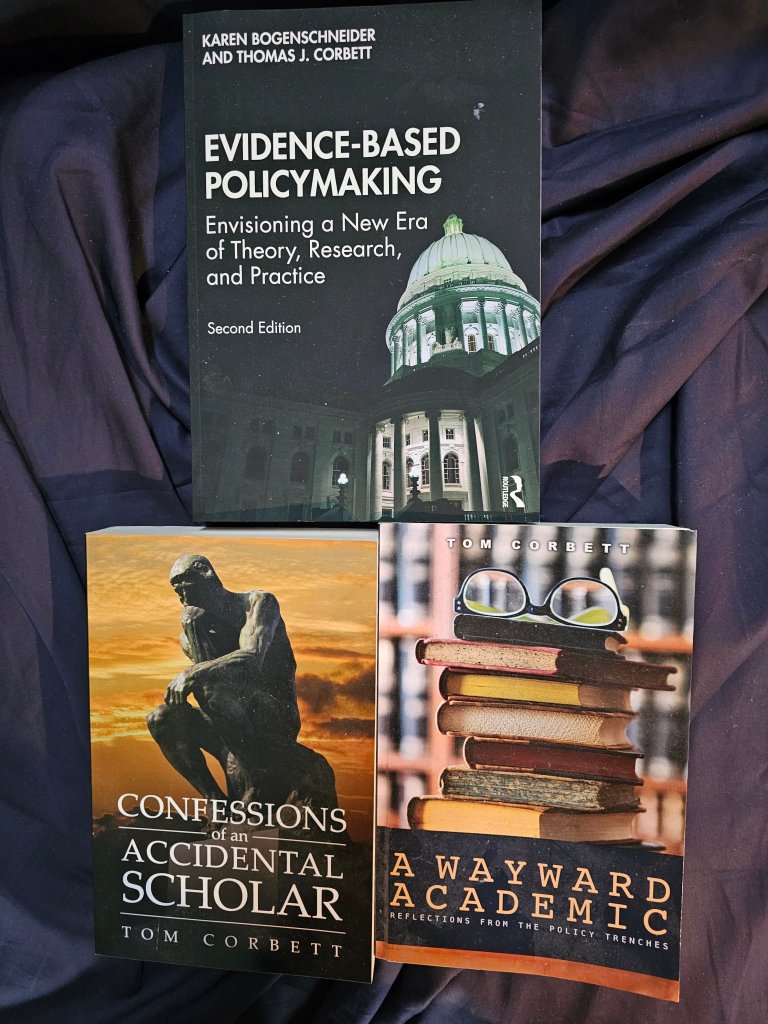
    The work above to the right is my final academic book, so I will skip over that unless you suffer from insomnia and need a sleep aid. The book on the left, A Wayward Academic, covers my years as a policy wonk and academic. Though I spent virtually all my life in the academy, I was never an academic by disposition. I loved doing public policy. I was fortunate enough to be at a premier policy research entity during the era when poverty and welfare reform were front burner issues. In this work, I tell the story of how we went from a war on poverty to a war on the poor from my personal involvement. Again, I relate this fascinating story with great humor and more than a bit of insight.

    Our Grand Adventure. I pretty much got into personal writing ✍️ after my old Peace Corps group (India 44) gathered for a reunion in 2009 to celebrate the 40th anniversary of our return from the sub-continent. It was the only anniversary I ever attended and proved so significant that some members subsequently wrote two edited volumes on our PC experiences. Those efforts lighted my writing bug. Eventually, I took some of that material and turned it into a more personal memoir (this is my 2nd effort). It is funny, sad, and inspirational. Peace Corps was a transformative experience for virtually all of us.

    Finally, Confessions of an Accidental Scholar. This is more of a crossover book than a memoir. It contains abridged versions of my better thoughts (and writings) that I had as an ersatz scholar and academic. I liked being in the academy but disliked the rigidity and limits of being an academic. Still, I used my own approach and style to influence both the academic and policy worlds. This is drier than the other works but remains engaging nevertheless. Non academics can well enjoy it, especially if you have any interest in public policy.

    All of these are available on Amazon.com (most also in Kindle form).

    See http://www.booksbytomcorbett.com for more information.

  • Coda … an ending.

    January 22nd, 2024

    A Coda is a term suggesting the denouement of a musical piece. This blog is a denouement of sorts … a few comments on an important part of my life that came to a rather sad end. As I write this, I feel a little like Michel de Montaigne. He was a minor French nobleman and late 16th century essayist who wrote about his everyday experiences. As such, he is considered the first blogger, though absent the convenience of cyberspace. No, you would have to plow through one thousand pages of print to absorb his sensitive and even profound insights.

    I suspect it takes a special form of hubris to believe that anyone else might possibly be interested in your personal thoughts. It has occurred to me that I am such a narcissist. Either that, or more likely, I am writing simply for me. I wonder if Montaigne felt the same way.

    Anyway, the pic below is my wedding to Mary Rider. It took place on December 22, 1972. It was a small affair … Mary and I, our two witnesses who were work colleagues (and friends), and one other couple who took pics. We walked across the street from where we worked to the Dane County courthouse to be married by a liberal Judge (in 1972) and future neighbor who did not mind that Mary kept her name, wore no wedding ring, and that I wrote our personal vows that very morning.

    Then, we drove up to the Twin Cities to break the news to her family. We’re they surprised! When her dad got up and left the room, I feared he was retrieving his hunting rifle. But no, he brought out a check while saying, ‘upon acceptance of this gift, the property in question can not be returned.’ The real awkward part was that her dad, not knowing we had lived together, thought this was our wedding night. Oy vez!

    I met Mary in a master’s program where we both were students. We had just one date, and I sort of moved in with her. I stayed despite the fact that she served me the worst breakfast imaginable the following morning. You see, her mother (an instinctive feminist) made a deal with her only daughter. If she did well in school, Mary would not have to learn any domestic skills. She eagerly accepted that bargain. As a result, she had acquired no conventional domestic skills.

    I found Mary to be smart, witty, independent, and seemingly uninterested in marriage … which was just the way to penetrate my anti-commitment defenses. We lived together for over a year before I suggested marriage, in the bathroom as I recall. Then, a bit to my surprise, she full-court pressed to get this wedding done before we were to visit her parents that Christmas, only a short time in the future. When my birth certificate was late in arriving from Worceter, she called the post office and the city clerk’s office to light a fire under them.

    Much to my surprise, marriage turned out okay, even better than that. Based on my folk’s disastrous union, I assumed it would be little more than a lifetime of pain. Just the opposite, we had many laughs, both of us evolved into excellent careers, and we enjoyed many joint adventures, including a fair amount of travel.

    Above, we are either in Greece or (then) Yugoslavia in the late 1970s. We were amazingly compatible and our values and personalities meshed well. Okay, we had some differences. On this trip, she still wanted to save money and chose one of the cheapest accommodations available. I, being a hedonist, wanted to go more upscale. On Corfu, she won and we stayed in a very cheap hotel with no bathroom (in the room) or running water. There was a pan of water. After Mary washed her hands, she casually asked what she should do with the dirty water. ‘Throw it out,’ I replied without thinking. She did … out the room window. A moment later, we heard screams from the outdoor restaurant below.

    I can’t fully summarize our lives together here, nor our many narrow escapes. But I must share one vignette. Early on, before I moved to the University and she moved to assume the position of Deputy Director of the Wisconsin Court System, we worked in the same office building. One day, she needed to use the restroom, which was on a different floor. As she came off the elevator, she noticed a very handsome man leaning over a water fountain as he slaked his thirst. For some reason, she assumed it was me. Checking that no one was around, she crept up behind her victim and reached between his legs to give his family jewels a good squeeze.

    It was not me. It took an hour for the rescue squad to scrape this poor bastard off the ceiling. But I did get several sympathy cards from him over the years for sticking with this raving lunatic. As I said, many laughs.

    The above pic was taken later in our lives. I am pretty sure this was taken at Blackhawk Country Club early in her cognitive decline. We were members there and had tortured ourselves for many years on their demanding golf course. I might add that she did get a hole in one while I did not … proof that there is no God. This was not something she would let me forget until her early onset Alzheimers robbed her of that memory among so many others.

    This last pic is Mary at Brookdale memory care. That devastating disease is known as the long goodbye for a reason. The stricken person suffers from a progressive decay of their mental functions until full-time care is necessary. Her decline was painful to watch. This honors graduate from the UW school of law eventually could no longer recognize the important people in her life, including me. The Covid pandemic was especially brutal. Only cyber visits via computer were permitted.

    In 2022, she passed while in Hospice care. For a long time, she had not been Mary, just a mere shell of herself. Unlike other Alzheimer’s victims, she never lost her sweet personality. And until she ceased to recognize me, she never stopped wacking me in the stomach … her lifelong yet futile effort to subdue my awful sense of humor. That’s what I miss the most … her love taps as she called them. Of course, if they ever do an autopsy on me, the medical examiner will look at my damaged internal organs and wonder if I had been a POW at Hanoi Hilton 😀.

    For a guy who dreaded the thought of marriage, life turned out amazingly well. Thanks Rider!

  • Seeking a better world.

    January 20th, 2024

    I have long wondered why I turned out as I have. By that I mean one of those woke liberals (if not a socialist), a snowflake that MAGA types loathe with particular ferocity. Perhaps my worldview was due to the indoctrination I received at Clark University, a liberal arts school in my hometown known in Catholic circles as a den of Atheists and Communists. I only ended up there because Holy Cross, a good Catholic college, would not accept spring semester admissions after I left the Seminary (more on that later).

    But no, while Clark changed my life by opening up my intellectual curiosity, it did not infuse me with my liberal impulses. Those started much earlier and their origins yet elude me. I am not alone in this. I’ve talked with many others who grew up in conservative homes or environments, and whose siblings remained true to these conventional beliefs, yet who struck out on the road less taken. They are puzzled as well.

    My white, Catholic, lower working class world had all the prejudices and bigotry one might expect. Not only did they evidence the usual disdain for conventional minorities, but WASPS were intensly disliked along with Jews and a host of fellow Catholics from what we’re deemed as the wrong ethnic tribes. Irish Catholics would walk past the Polish and Lithuanian churches to get to their own Catholic church. The tribalism of bigotry was universal.

    And yet, even when I was young, I had different impulses. I wondered why we didn’t give more of our abundance to those suffering around the world. I even joined something called the world federalist society at a very young age (probably a Commie front organization) because I instinctively thought the notion of separate countries an ill-conceived and divisive concept. None of my neighborhood friends (nor the adults in my orbit) thought like I did.

    When the Civil Rights movement started after Brown versus the Board of Education Supreme Court ruling, I was outraged by the fact that we yet had legal apartheid in the land. I was enraptured by young blacks (see above pic) braving fiery mobs to attend integrated schools or risking their safety to sit at segregated lunch counters or their lives by riding freedom busses into terrible dangers. They were my early heros. I recall arguing with visitors from Virginia about why the Supreme Court desegregation decision was a good and proper thing. I was only 12 or 13 at the time. Where did that come from? No one I knew felt the same way.

    In the above pic, I am with my two roomates in the Maryknoll Seminary in Glenn Ellen Illinois. I entered right after graduating from my demanding Catholic high school which had rigorous academic standards and exacting behavioral expectations. The Xaverian brothers would whack you if you misbehaved. Then, your parents would whack you again if they found out about it.

    This particular Catholic order was a missionary society. It was a very regimented experience that started around 5:30 AM with morning prayers and Mass. Each day was filled with studies, work assignments, more religious activities, physical exercises, and enforced periods of silence. But I didn’t mind all that, not even the absence of females since I had only known Catholic girls to that point, which was pretty much like mandatory celibacy.

    No, the problem was more subtle. I came to realize that I had chosen this route, not because of any real belief in a deity, but from a fundamental impulse to do good. I wanted to improve the lives of needy 3rd world folk and not necessarily save their souls.

    It was then I matriculated at Clark University, a decent yet small liberal arts school that started out as the second graduate school in the U.S. (after Johns Hopkins). Not unexpectedly, I veered further to the left in college. I can not recall any form of brainwashing in the classroom at all. However, after I realized I could handle college work (which I doubted going in), I spent hours dialoging with fellow students on the great issues of the day. If anything helped me become a critical thinker and sharpened my analytical tools, it was these intense and never-ending discussions. Unlike the kids I saw less than a decade later, we endured a crucible of doubt and transformation in which we discarded our childhood myths and recreated our moral compasses. It was a trying transition, yet thrilling. By the end of my college years, I headed the left wing group on campus … a more sophisticated version of what drove me into the seminary years earlier.

    I had started working as a freshman in high school and never stopped. While I had a couple of normal jobs (for a while I was night watchman for the Worcester sewer department during which time not a single sewer went missing 😅). But I tried hard to find work compatible with my instinct to do good. During my college years, I worked the eleven to seven shift in a Catholic hospital and then later worked lwith disadvantaged kids in an early War on Poverty neighborhood program. I kept looking for socially meaningful work, not just work to get me through school. Between work (especially the 11-7 shift), chasing women with little success, trying to stop the Vietnam War, and my full-time studies, I can not fathom now how I survived, much less graduate.

    But I did graduate (with honors by some miracle). When I asked my advisor where I might consider graduate school, he said without hesitation … Harvard, Yale, or Stanford. I thought him daft, my self- image was that of a working class kid who somehow made it through college with charm and a heavy dose of Celtic blarney. I was stricken by the imposter syndrome.

    But inside, I knew what I really wanted to do. In 1962, my impulse to save the world pushed me toward the Priesthood and an overseas missionary society. By the middle part of the 60s, the Peace Corps was a definite possibility. I applied for a program doing public health in India. After all, I had spent several years working the graveyard shift in an urban hospital. I was accepted but would wind up doing agriculture in the desert of Rajasthan, a poor area bordering on Pakistan.

    We were a bunch of college kids who had never seen a farm. Really, what was Peace Corps thinking? But we had hubris and thought we could do some good. Our training was long and demanding, and India proved a very harsh site for a number of reasons. Of the 100 or so wanna-be volunteers on day one, only about two dozen made it to the end.

    However, when we gathered some four decades after our return in 1969 (see above pic, I am back row, 2nd from right), we agreed that the experience transformed us in many ways. My PC colleagues did amazing things with their lives. They might have in any case, but I suspect this testing experience exerted a value-added component to their subsequent lives. For me personally, spending two years in a hot desert area fighting boredom, loneliness, disease, a fascinating but hard culture, and doubts about your technical skills, I was grounded in the lessons of cultural relativity. I came back a changed person. My later work as an academic reflected those lessons.

    As you may recall, I eventually went on to get a Doctorate in Social Welfare from the University of Wisconsin while studying under some of the leading poverty scholars in the land. I never left UW, eventually becoming the Associate Director of the nationally recognized Institute for Research on Poverty, the only such think tank to receive federal support continuously since 1966. I also taught social policy classes to a generation of undergraduate and graduate students at Wisconsin and consulted wth federal and state officials on a variety of human services issues. I can not think of a more fitting career for a wanna-be do-gooder.

    But let me be honest here. While I did satisfy my need to be relevant, I also realized I was not in the trenches as many activists are. My impacts on the public good, if any, were from afar. I salute those who worked directly with the vulnerable and remain guilty about my own failures in that regard. Still, I cannot be too harsh on myself. After all, I did what I do best.

    And consider this, I might have become a Republican. Oh my God! Perish the very thought.

  • Loves lost … (except for one)

    January 16th, 2024

    It is not snowing today but damn cold. The high today will barely climb above zero. So, more memories. This version will focus on my early love life, such as it was. I can’t claim to have much luck with the ladies, mostly due to a horrible self image … which unfortunately was justified.

    Here I am about to go to the prom with my high school girlfriend Maribeth. Since she went to a different school, we could have gone to two proms but I insisted on only one. I thought them pure torture as you can see by my expression. And check out my hairdo. I am so embarrassed. No wonder I thought myself unlovable though, to be honest, I considered myself an interesting character even then … quick and humorous. I just felt ugly.

    Anyway, Maribeth was cute, smart as a whip, and had a good sense of humor. Why she agreed to go out with me remains a mystery I have never been able to answer. However, when I wasn’t scowling, like I was at the very thought of a prom, we had many laughs but no sex. She was a good Catholic girl after all, and any carnal delights were never going to happen. The Catholic girls back then all prayed to the Virgin Mother of the pure bodily temple and would rather be dipped in boiling oil than put out. We guys suffered much.

    I must admit, though, she had all the makings of a good life partner but I was very anti-marriage then, having lived through my parent’s disastrous relationship. That soured me on any attempt at my own permanent coupling, so I made sure I didn’t drift unthinkingly into matrimony.

    No, I went into a Catholic Seminary after high school, an excellent dodge for a guy hell bent on avoiding longer commitments (except to the Almighty I suppose). At least I didn’t have to break up with her. I could argue that I had a prior commitment to God. It was a foreign missionary order. I would end up overseas. I was making damn sure I wouldn’t get nabbed.

    Maribeth did go on to get a Doctorate in Literature, which I would have guessed, so she likely was smart enough to dump me in any case. Unfortunately, I lost touch with her after that. But I imagine she was an excellent wife and had a good marriage.

    After I left the Seminary, I entered Clark University which had nothing to do with the Catholic church … thank God. Better yet, they had girls who weren’t Catholic. There, my first girlfriend was Carol. She was Jewish, which almost caused my mother to have cardiac arrest. I’m sure several relatives prayed for my endangered soul. But I liked her a lot. She was really smart, in fact ranking first in our college class as I recall. She went on to get her doctorate from Harvard and later became a Dean at Rutgers.

    I assume you have the same question I had. What is a talented (she also had a great singing voice) and lovely young woman doing with a loser like me. Again, I have no idea other than I may have seemed smart and could be amusing. It was all smoke and mirrors … I was blessed with the Celtic gift of gab. Better yet, from my perspective, Carol was engaged at the time to a guy who had somehow gotten drafted and was stationed in Alaska. That is, she was safe to me, and I may have seemed safe to her. There was no chance of a longer-term commitment even though I suspect she liked me a lot. We were very compatible. While she was appalled at my study habits (what study habits), I believe she also saw me as gifted intellectually, which proves you can fool even smart folk on occasion.

    Then there was Lee Delaney. She was my 2nd college sweetheart, the one I fell for on first sight. I saw her walk across a room and was immediately smitten. It took me weeks to work up enough courage to ask her out. She mumbled something about not being able to go out with me (I found out later she was being pursued by a man she didn’t really like but didn’t know how to handle it). Of course, being unlovable, I assumed she was rejecting me. I hibernated for many weeks licking my wounds.

    But I was in love. Eventually, I asked her to be a subject in a psych experiment. At the end of that subterfuge, I used my charms (such as they were) to get her to join me for a coffee. And that was the start. In retrospect, I realize we both were smitten with each other but were basket cases when it came to relationships. There were many ups and downs. But I never stopped being infatuated with her. She also was smart, quick with a quip, and very kind and sensitive. After all, she took pity on me.

    Of course, I panicked toward the end and went to my favorite go-to tactic. I RAN AWAY. This time, it was the Peace Corp and India. That seemed far enough to avoid being snared into marriage. I did raise the issue in letters I sent back. But my expressions of love were oblique and unconvincing. While she was working at Harvard she met a Post-Doc whom she married. It did not last and she went on to get a Doctorate in molecular something or other and spent her professional life as a research academic. Like I said, I really liked smart women.

    Four decades later, I ran across her on Facebook. I screwed up my courage, assuming she would immediately take out a restraining order. But no, she was delighted to hear from me, and we immediately struck up a cyber relationship. It was as if it had been 4 days since our last meeting, not over 4 decades. It turns out she kept all my letters and other such stuff. Her mother even made a case for me the night before her marriage (I always did better with mothers for some reason).

    We were both now in good marriages (her second). There was no danger of anything happening, but this connection did give us a chance at achieving closure. We did love one another back then. And we realized we still did when we reconnected though, soon enough, she discovered she was dying of cancer. Our connection, even though shortened and at a distance, was a blessing.

    Here I am, the coward running off to India. Okay, I really was a do-gooder looking to save the world. It wasn’t only because I feared a commitment, but it did prove a convenient escape at the time, as had the seminary.

    Here is the odd thing. After India (where I did not save the world), I met a gal in graduate school. We had one date, and I moved in with her. She played it perfectly, seemingly not interested in marriage. So, we got married after living together for a year or two. Turns out marriage wasn’t the hell I imagined. It was rather nice. We remained hitched for almost 50 years until she passed from early onset Alzheimers. She also was smart, graduating from Law School with honors and becoming the Deputy Director of the Wisconsin Court System.

    Once again, I ask. How could these smart gals fall for a loser like me. A true mystery. It just shows there is no accounting for taste.

  • Still snowing … more memories.

    January 13th, 2024

    More snow and blowing winds in Southern Wisconsin. Time for more memories of the old days.

    My memories of winter in Worcester, Massachusetts included plenty of snow and cold. Of course, recollections can be deceiving. But my images are firm. I recall large icicles hanging from the 3rd floor eaves of each three decker. We walked to our back doors with trepidation as we waited for one of these weapons of instant death to dislodge and impale our otherwise empty heads and dispatch us to our heavenly reward, if we were so lucky. My afterlife was most likely to be warm and toasty… very warm indeed given my sinful thoughts about the neighborhood gals.

    We spent many hours building snowmen (see pic above) and snow caves, or (when younger) sliding down the partially plowed streets in hilly Worcester on our sleds. There were many snow fights where we hurled hard missiles of ice-packed snowballs at one another. How we survived remains a minor miracle. On occasion, we even performed civic minded niceties for motorists stuck in the ever present snow piles by pushing their vehicles out to the middle of the street. The snow seemed deeper back then, and not many cars had front wheel drive. Vehicles would get stuck all over the place though we knights in shining armor were most willing to pitch in. Who knows. We might get a quarter for our efforts. Money was also to be made by shoveling out sidewalks and steps. We all were short of cash. Any way to gather some coin was welcome.

    I most recall the tactics employed to reserve parking spots on public residential streets. Once you dug your car out after a storm, you claimed that place as yours by placing a chair or some other item of household furniture in that shoveled out spot. Woe be to that nefarious evil-doer who then flung your chair aside and took your claimed space. Fisticuffs were soon to follow. Worcester was not a place for sissies.

    Speaking of random violence. Here is me with my dog Fritz. He was, as I was told, a toy German Shepard. I cannot say he was a cuddly pet, but he was fiercely loyal. I loved inviting unsuspecting friends into the house. Then, when Fritz was snoozing nearby, I would somehow trick my unsuspecting target into a pose where it looked as if he were about to strike me. Fritz, ever on guard even when napping, would leap into action, snarling as my poor victim fled the house in total panic for his life … leaving me doubled over in laughter. As you may be able to surmise, I had very few friends as a kid.

    A lot of memories involved my pathetic attempts at athletic prowess. I cannot say for sure, but this action shot above may well have been taken right after crossing home plate after socking my first home run for my little league team … Standard Foundry, my team’s sponsor. If I recall correctly, I had botched the first ball hit to me at shortstop and was yet burning with shame as I strode to the plate in the bottom of that inning. I gave the first pitch to me a mighty wack and watched with satisfaction as the ball arched over the fence in center field. On the whole, though, we sucked. I know I sucked.

    One moment of glory was captured in the press, which amazingly printed box scores and some stories of our little league games. Hard to imagine today. But yes, I was called in to pitch in relief of my best friend Jerry Petraitis. It was a moment of high drama. The bases were loaded, and there were two outs in the last inning. I recall working the count to 2 and 2. Then I reared back, saying silently … this is it! I let fly with my best fast ball right down the middle of the plate. The batter, their power clean-up hitter, swung and missed. Oh, the bliss of victory.

    There were a few more moments of glory, unrecorded by the media. In Junior High School, I became the starting pitcher halfway through the season. We had been 1-2 up to that point. After I took over, we went 2-1 coming within a whisker of sweeping all three games. In one contest, I had a no-hitter going into the 9th inning. In that one game we lost, we were only down 2 to 1 in the last inning but had the bases loaded and our best hitters coming to the plate. Alas, none of these losers got the ball out of the infield, and we lost by that single run.

    In another junior high game, I pitched against my cousin’s team. Here he (Paul Kadis) is next to me in his little league uniform though we lived in different parts of the city and never faced one another until our Junior High-School competition. So, we were, in fact. older by the time we faced each other on the diamond. It turns out that Paul’s father, a former locally famous semi-pro pitcher, umpired our game while standing behind me on the mound. He gave me a running commentary on my pitching technique, which didn’t exactly calm my nerves much. My cousin Paul was a really good ball player. In fact, he made it pretty far up in the Los Angeles Angels minor league system but not to the majors. We won the game (helped by my bases clearing hit), but I recall walking my cousin every time I faced him. I don’t believe I got a single pitch to him anywhere near the plate.

    I knew my athletic career was coming to an end one day while playing for the Vernon Hill team in what was called Intermediate League (roughly the same age as Junior High).

    I am 2nd from right in the back row in the above pic. Ralph Anderson, one of my best friends by this time, was 4th from the right (he went on to become a Coast Guard officer). That squad apparently were league champs during my tenure with them, though I have little memory of this level of success. What I do remember is the following. I made it to first base one day and, to my shock, the coach gave me the sign to steal second. I was truly stunned, having only one speed … glacially slow. He gave the sign a couple more times before yelling … steal second, you moron.

    So, on the next pitch I sprinted to 2nd base with all the speed of a wounded tortoise. I slid into the bag with a cloud of dust. Amazingly, no one tagged me out. How did that happen? Brainiac that I am, I concluded that the batter must have hit a foul ball. So, I started trotting back to first base. The opposing team, delighted at my utter stupidity, tagged me out to end the inning. All I could remember is the coach (on the left in the above pic) screaming obscenities at me while a kind team mate brought me my glove. That was the moment I realized I better study if I were to survive as an adult. No paid athletic career for me.

    Yes, I had a rough and traumatic childhood!

  • A memory or two.

    January 9th, 2024

    I’m not sure why, but watching the snow fall outside has me thinking about the past. Perhaps it is merely the reality that I won’t be venturing out today. Winter has finally struck. First, several inches of white snow to be followed up by a bitter cold snap. Yes, this is the time for snuggling up to some comforting memories. Well, memories at least.

    I thought we might escape winter entirely, a thought that left me with decidedly ambivalent feelings. The unaturally warm temps were welcome, of course. Still, what they meant in the longer term was unsettling. No matter, Jack Frost has arrived to get his due.

    Oddly enough, I don’t have many pics of winter scenes in my collection of childhood photos. Most seem to have been taken when tines were sunny and relatively warm, though I am bundled up as my parents display me in the first pic. They seem proud to have me. That is odd since I never felt wanted as a child. I always felt more like an inconvenient possession to be paraded in front of others on occasion.

    I’ve just finished a book on the Harvard Grant Study where a cohort of young men from that hallowed institution were prospectively tracked for over 7 decades. According to one of the principal investigators of this study, familial warmth experienced in early years was a strong predictor of later success. That is, feeling loved and protected while maturing is a critical factor to later success. But how does one appreciate that? We only have our own recollections, which are idiosyncratic and personal and decidedly subjective. Who can compare their internal feelings with what others experience? We can only know our own world. Perhaps all is illusion, distorted by our own neuroses. Given that caveat, what are mine?

    In this 2nd pic, my mother is holding me while my aunt Laura is holding her only child (my cousin, Walter). My mother’s brother married an Italian girl and lived on the other side of town. I suspect that was considered a mixed marriage (Polish & Italian) but my mother loved this brother. He was the good son. Her only other male sibling was a con man who spent a great deal of time in the slammer. But he was colorful.

    My own parent’s marriage also was suspect. Polish and Irish 😞. That was bad enough in my maternal grandmother’s eyes but she undoubtedly had concerns about my dad as a marital prospect. He ran around with the fast crowd, living on the edge. That must have made him appear attractive to my mother but not suitable husband or father material.

    Alas, he settled down after I was born and after he suffered a huge financial setback in an illegal football betting racket he was running. To the extent he went straight because of me, I doubt he ever fully forgave me. Another chunk of guilt I carried forward.

    Wally (shown being carried by Laura in the 2nd pic) was my cousin and very close in age to me. I recall visiting him a lot in the Italian section of Worcester … they lived in an old 3-decker owned by Laura’s parents (the Gorretti family). I loved the exuberance of family life in that community, the warmth and affection displayed among the adults. And I loved the bocce court they had in their yard, a traditional Italian game. Best of all, the railroad tracks ran next to their house so I could watch trains go by on occasion. I’m not sure the adults appreciated that as much as I did. Despite all, there was a sense of warmth there.

    Young Wally got seriously sick about a week after one of my visits when we were both about 12 years old. All I recall is that he was taken to Boston for care by specialists but soon passed. That devastated me. We were close to being brothers in a way. It was my first experience with the vulnerability of life. One never knows, does one. At the cemetery, I do recall my Aunt Laura almost whispering that she would soon join her only child. I thought that an idle expression of grief in the moment. But she died of cancer within six months. I doubt she had any will to fight the disease.

    The pic above captures some of my dad’s family. I am the doofus kid on the left with the wide grin. I can’t believe they didn’t return me to the hospital as damaged goods. Right in front of me is my dad’s sister, Agnes. At my back is her husband, Bill Connor. They were my surrogate parents growing up. As a child, they lived right up the street and I would spend hours at their house which, unlike mine, was filled with love and affection. Besides, Bill had actually graduated from college, something no one else in that generation had even tried.

    Ag and Bill never had children so they always welcomed me, or so it seemed. I still recall coming home one day after spending hours at their house. There was a small suitcase outside waiting for me. My folks told me that I should move in with Ag and Bill since I obviously preferred them so much more than my real home. I cried but, the truth be told, they were right.

    The man next to Bill is my uncle Tim, my dad’s brother. His son, Timmy, is seated in front of him. There was not a great deal of experimentation in the naming of children back then. My dad and Tim were about a year apart in age. In fact, my dad once told me that they were in the same grade until the nuns running the Catholic school they attended kept my dad back a grade since the brothers were always causing mischief and no one could tell them apart. Sounded more like a convenient excuse to me.

    To the right, we have my ‘nana,’ my dad’s mother and her other daughter… Winnie. Nana (Mary Boland), was from Ireland. She must have had a rough life. Her husband (Jeremiah Corbett) had some form of mental affliction and was in and out of institutions for years. I never met him as far as I can recall.

    Still, I recall spending lots of time with Nana and her spinster daughter (Winnie). I would spend hours up in her 3rd floor flat (we lived on the 1st floor). She would feed me and make the best eggnogs I ever tasted. Many a night, we would play the card game (Old Maid). The irony never struck me that Winnie was, in fact, an old maid. I can still recall, as a toddler, sitting in Nana’s lap and have her comfort me. I suspect those were the moments of love and warmth and love that I desperately needed.

    Of course. there was the streets. There were plenty of kids to play with. In the above pic. I show a small sample of the urchins that roamed the neighborhood. Next to me is Dave Bolio, the athlete among us. In front of me are the brood known as the Clancy clan. I can’t recall how many of them their were but their mother (Gert) managed to raise them without much help from her drunken husband Joe … who nominally worked as a bellhop at the downtown hotel. For a while, Gert would feed me at lunchtime during the school year when both my parents worked.

    I think that’s what I remember most about my earliest years, being elsewhere with other people. Sometimes, it was with my aunts and uncles. Sometimes, it was with my grandmother. Often, it was with neighborhood friends. Did this vagabond lifestyle and lack of familial attachment, early on at least, bother me. I can not tell for sure. I did grow up distancing myself from emotional attachments. On the other hand, I did enjoy a long marriage. However, I never could decide whether that was because I expected so little from adult attachments.

    Would the investigators in the Harvard’s men study assign me to the damaged group? Would they conclude that I could have done more in life than I did with just a little more parental love and attachment? We just don’t know. In the end, a life is what it is.

←Previous Page
1 … 10 11 12 13 14 … 30
Next Page→

Blog at WordPress.com.


Loading Comments...
 

    • Subscribe Subscribed
      • Tom's Musings
      • Join 38 other subscribers
      • Already have a WordPress.com account? Log in now.
      • Tom's Musings
      • Subscribe Subscribed
      • Sign up
      • Log in
      • Report this content
      • View site in Reader
      • Manage subscriptions
      • Collapse this bar