As you know, I am befuddled by how the MAGA extremists view the world, all Republicans these days to be accurate. Take Ron Desantis … no, really, take him somewhere, anywhere! I used to live half the year in Florida, was even a legal Florida resident for a while. There was a time when I suffered under far right governors in both Florida (Rick Scott and then Desantis) and Wisconsin (Scott Walker). Talk about two living Hells.
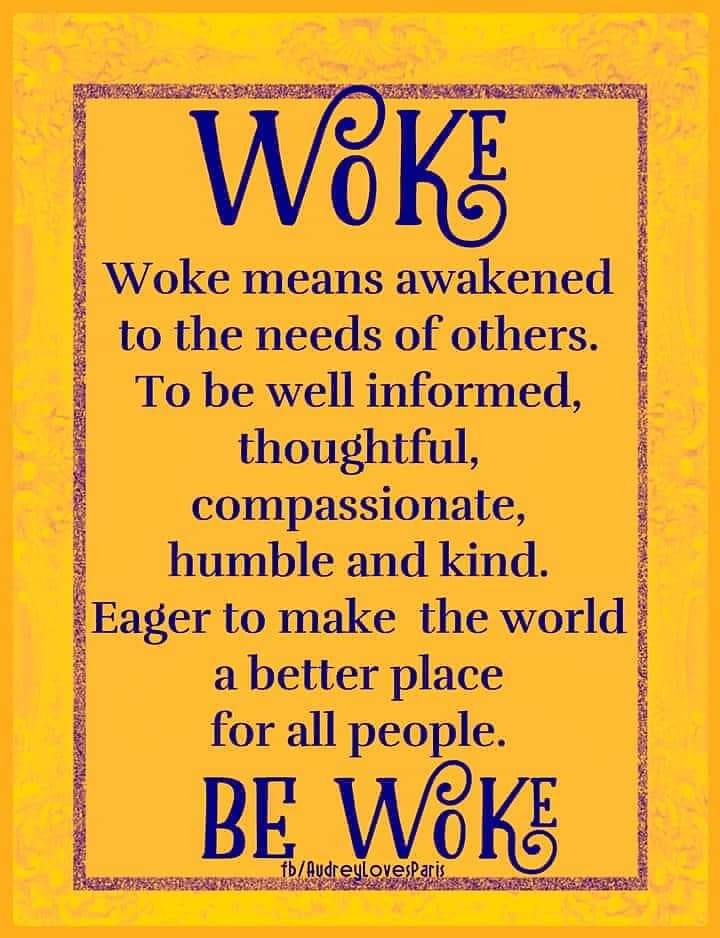
Such politicians throw around the term ‘woke’ as if it were the equivalent to being a sociopath or a pedophile. No, they consider it much, much worse than being either of those despicable types. If afflicted with ‘wokeness,’ you are nothing less than Satan’s spawn. That is why Governor Desantis is on a crusade to eradicate this abominable evil from the Sunshine state. Hmm, being one myself (one of those ‘woke’ types), I wonder sometimes what I did to deserve such negative animus. One thing you can say about the contemporary version of conservative values, those clinging to the Republican faith can be nasty, especially since they often brag about being such nice, loving Christians. Perplexing indeed.
How odd that they should hate folk like me so intensly. I’m such a pleasant sort … a virtual saint in my own mind! Okay, perhaps I am not ready to be canonized by the Vatican, but I am reasonably harmless, that’s for damn sure.
But here’s the thing … in my own mind at least. If you look closely, the dispositions and perspectives of all those ‘woke’ types at whom the ‘right’ hurl their invective are rather special and surely pose little threat. Let’s look at some of the attributes associated with these dastardly ‘woke’ blokes.
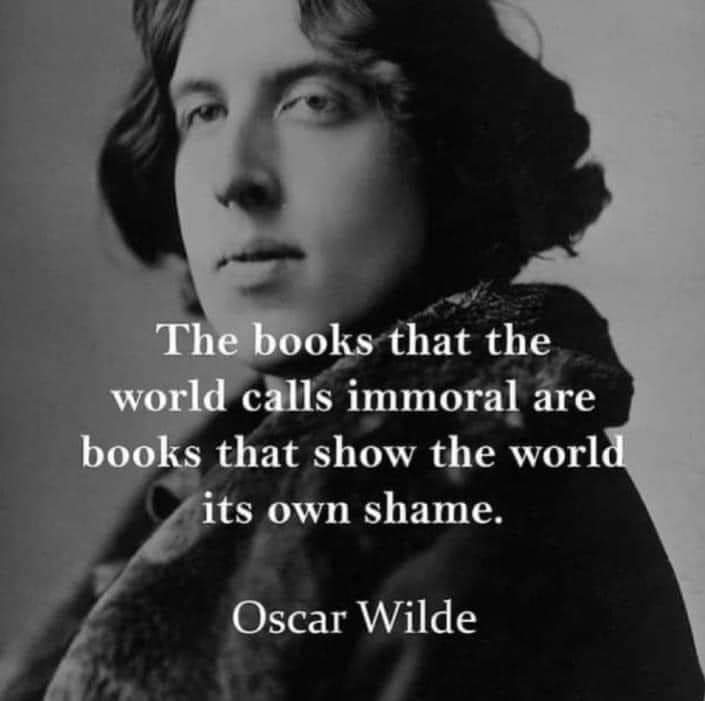
If ‘woke,’ you are someone who reads books, not burns them. In fact, you revere the classics and hope the young will absorb their lessons, and to think through critically what might pertain to their own lives (or not).You don’t ban the very literature that elevates and educates us and, most of all, helps us to be critical thinkers capable of understanding our world a bit better.
You embrace and cherish science, not reject it and the people who labor to both better comprehend what is all about us and (more importantly) improve our lives. Science is not absolute truth, but the honest pursuit of truth according to rigorous methods that have been refined over a long time. Our journey toward greater understanding is one of the most sacred tasks we have, and is a faciliity which makes us unique as a species.
A malleable perspective on what we know is critical. A ‘woke’ individual is willing to change their minds when new and credible information becomes available. This does not suggest shallowness of thought. Quite the opposite, it suggests an appreciation of the complexity of life, and a desire to pursue more credible truths based on reason and evidence.
You understand and appreciate that most issues are not black and white. We do not live in a binary world. Some things seem set in stone, like the speed of light. Even there, though, quantum physics suggests tantalizing exceptions. That is the joy and mystery of life itself … the joy that comes with discovering new things and appreciating the complexity of all about us in this mysterious and marvelous universe that is just now opening up to our understanding.
A ‘woke’ person believes in equality of opportunity for all people. This does not mean you believe in some notion of absolute equality of outcomes. That ancient Marxist trope was a non-starter from the beginning. But a ‘woke’ iindividual would like to see everyone have a reasonable shot at the starting line of life. The ‘freedom to succeed’ American narrative is largely a joke when our individual paths through life are so hideously uneven.Sometimes, we all need a helping hand.
A woke person has empathy, or at least treasures it. What demarks a ‘woke’ individual from many on the other side is that the strive not to be a sociopath or a psychopath or a malignant narcissist. They can ‘feel’ what others are experiencing and facing. It is not ‘all about them.’Life is not a Dickensian horror show, or shold not be at least.
Similarly, someone who is ‘woke’ embraces cooperation, civility, and community. We recognize that collaboration is better than unfettered individualism. It is what marks civilization and is responsible for much of human advancement. Margaret Mead, the iconic anthropologist, argued that finding skeletons with serious injuries buried with other members of nomadic tribes was a huge step forward for the species. Our ancestors started to care for one another rather than let the weaker members die alone. Working together helped us advance in the past; It is the way forward in the future.
A ‘woke’ person respects and defends the rights of others. We recognize that ‘no man is an island.’ If we do not defend the rights of others, we have no rights ourselves. We all recall the saying about “they first came for the disabled but I was not disabled, so I kept quiet; then they came for the Communists but I was not a Communist, so I kept quiet; then they came for the Jews …” In the end, if we always look the other way there will be no one left to fight for us when it is our turn.
When you are ‘woke,’ you believe that the arts, our creative impulses, have value. You value both art and artists. Life is more than the mere acquisition of material things, it is mostly about experiencing those perceptions and feelings that elevate our minds and souls. We must encourage and support such activities that explore deeper meanings. He who has the most toys at the end is not the winner in life. He who has experienced life more fully and with deeper feeling is richer by far.
And a ‘woke person’ cares about humanity and the planet. Let’s face it, we are a fragile species existing on a lonely planet on the fringe of one galaxy among billions, or trillions of such worlds. As far as we know, we are special and alone. We have a duty to preserve the human experiment as a whole (not just one nation or race or our own peculiar tribe), and to do our best to be a good steward to this planet on which we live and upon which we depend.Perhaps, if we don’t screw things up royally, we just might be in the process of creating our own form divinity in a way, since we have no way of anticipating where evolution might lead.
There may be more but this is a damn good start on defining what being ‘woke’ is. Call me ‘woke.’ I embrace the label. I really cannot think of a higher compliment!!!!!!!!
We see daily stories about heat records being broken, in various southern states like Arizona and Florida. Foor example, Arizona had 31 straight days of temps over 110 degrees, a streak that just came to an end. That has become expected. We usually hear less from overseas, perhaps because we Americans are rather provincial, or I am at least. Even from other parts of the world, we can see alarms being raised if we bother to look. Chile has broken heat records for early August, winter on that side of the equator. UK boy scouts were evacuated from South Korea because of debilitating heat. If there is one certainty about climate change, it is the inconvenient reality (to steal a pithy phrase from Al Gore) that it is a global phenomenon, not merely a local irritation.
The title of this blog, ‘settimana infernale’ is Italian for a phrase heard often in that country this summer … a week from Hell. That is, it has been damn hot there recently, even for a people used to intense summer heat. Then again, so much of this is relative. Those not ordinarily exposed to hot or humid weather will react when their typical norms are replaced with something different. It will be easy to dismiss such changes as temporary anomolies … until it is too late.
Had we paid attention to what matters as opposed to Megan and Harry or Hunter Biden’s laptop, we would notice many other disturbing reports. The U.K. hit 40 degrees Centigrade for the first time last year (104 F) and recently had its hottest June on record. In southern Europe and around the Mediterranian area, temps have been hitting 50 degrees (122 F) with alarming regularity this summer. Stories have emerged about hospitals in China and the U.S. immersing patients in bags filed with ice to lower body temps. Last year, some 60,000 deaths in Europe were attributed to abnormal high temps. Stories are coming out of Central America that local farmers are migrating since they no longer can live off their parched lands. Many fear that this is the tip of the iceberg (pun intended) where masses will begin to move as their traditional homes become uninhabitable. This is a challenge that goes beyond nation, ethnic group, or tribe. It is global in character and thus will demand, guess what, a global response.
Here’s the thing. Hot weather is more than an irritation or an inconvenience. It can, and already has, become a mass killer though the body count has yet to attract widespread attention. Too many eyes remain fixed on the shuffling of College football teams among the power 5 conferences in search of more media money … what a joke in the larger scheme of things. Short of mass deaths, rising temps are an affliction that can cause serious health issues, especially for those already vulnerable, as well as significant social and economic dislocation.
We can see impending disaster about us. Many Americans hibernate for several months out of the year since daily temps heading north of 110 degrees Farenheit (now 120 degrees) make life outside uninhabitable. In the desert southwest, this has become routine. Arizona recently ended a 31 day streak of 110 plus temps. Florida has somewhat lower temps but dew points high in the70s, an unlivable experience for a delicate flower like myself.
Many, of course, cannot stay hidden away in air-conditioned comfort. They must work outdoors or are sensitive to heat due to age or some other condition. And what happens when prolonged heat waves of historic proportions tax our energy grids to the breaking point or water supplies dry up or all other sorts of anticipated disasters become relality. Where can those facing sustained periods of fettimana infernale hide then? The Covid pandemic might look like a walk in the park compared to what is just around the corner. But let’s obsess about Hunter Biden’s business deals?
This raises an interesting question. Just how vulnerable are we as human organisms to excessive heat, foregoing for the moment all the ancillary consquences of a climate disaster (crop failures, coastline cities disappearing under water, deserts replacing arable land, wild fires ravaging life-giving forests, and devastating storms, to name a few).
Let’s just focus on the heat question as it affects our bodies. From what I’ve read, we can expect something like the following. Our bodies are an amazing machine, working hard to achieve a homeostatic state where there is some constancy of critical internal properties. One key to this is our hypothalamus which acts as a thermostat of sorts. This organ sends signals to various parts of the body to react when external conditions push our internal body temperature outside the normal range of roughly 37 degrees C (our normal 98.6 F), plus or minus a degree or two.
Of course, my normal is more like 36 C, but then there has always been some question as to whether I am a mammal or not. If your internal temp rises to 40 (C), or about 103 (F), you will experience physical changes like faintness at the very least. At 42 (C), or 107 (F), you are close to buying the farm, if you are not already arguing to St. Pete about your reservation within the Pearly Gates. If you have some condition that renders you vulnerable, age or pre-exisiting health issue, your ticket almost certainly has been punched.
The body does put up a fight as external conditions wage war on these internal regulatory responses. Given exposure to prolonged heat, your body temp will start to rise. Your heart begins to work harder as blood is pushed to the skin surface as a way of expelling excess inernal heat. An extra liter of blood circulates the body each minute, pushing one’s heart rate from a more normal 55 beats a minute to 87 beats (in a test case). Breathing rates increase from 10 per minute to 15 or higher as stress levels increase. Blood flows to the brain lessens by 8 to 9 percent, and therefore short term memory loss becomes measurable. This is not good for old geezer like me who normally forgets why I just walked into a room to get something very important that I can no longer recall. Soon skin temperature rises some 4 degrees (C). One’s body will put up a good fight but without relief or medical help, a typical person will progress from heat exhaustion to heat stroke to death.
That is the micro-impact on the individual unless, of course, science comes the rescue. And it is not inconceivable that there are technical solutions to many, of not all, of the challenges we can easily anticipate. I feel, though, that our dowmfall will be the result of a more predictable human failure. Look at the American response to a global pandemic. We fought over the science, over government regulations to save lives, over the costs both direct and indirect. The possibilities of political conflict and a failure of human will is much greater in this climate arena. Pandemics do exhaust themselves. This will not go away on its own.
Hell, Rand Paul, chief Libertarian nutcase, is trying to get authorities to throw Dr. Anthony Fauci in prison for, in his warped mind, lying to him. I can still see the Republican member of Congress arguing that there is no global warming as he brandished a snowball in that august chanber … compelling evidence indeed (that he should be held for a 72 hour psych evaluation. And these are the leaders who will lead us out of the greatest potential natural disaster since that big meteor hit the earth 60 plus million years ago and wiped out most large species on earth. The big diference is that T-Rex could do nothing about it. We can!
I will say this one more time, but surely not the last time … I am so glad I’m old.
Nothing says Irish better than humor, storytelling, and drinking. The next picture well captures the essence of having ancestral connections with the Emerald Isle. And I must say, I eagerly embrace most of my presumed Celtic gifts except for that drinking part. I did inherit that particular Celtic curse from my father. Fortunately, I kicked it with some difficulty almost four decades ago when I realized I had already consumed my lifetime allotment of spirits. Still, despite this failing, and a couple of others, you have to admit the Irish are a devilishly charming lot.
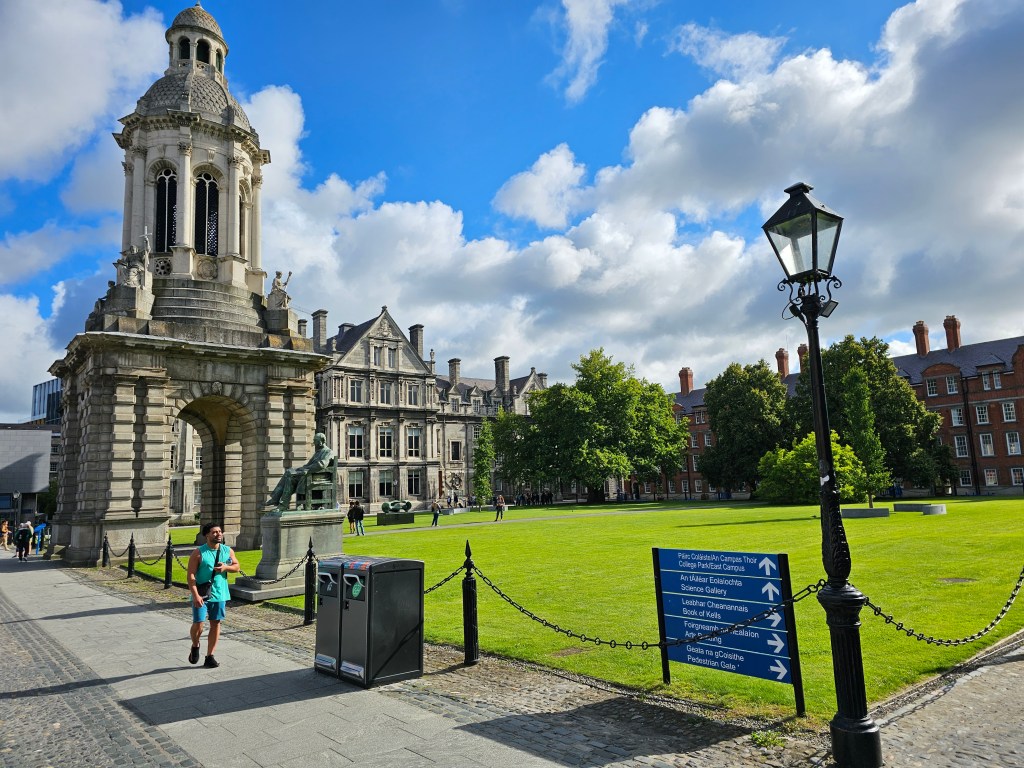
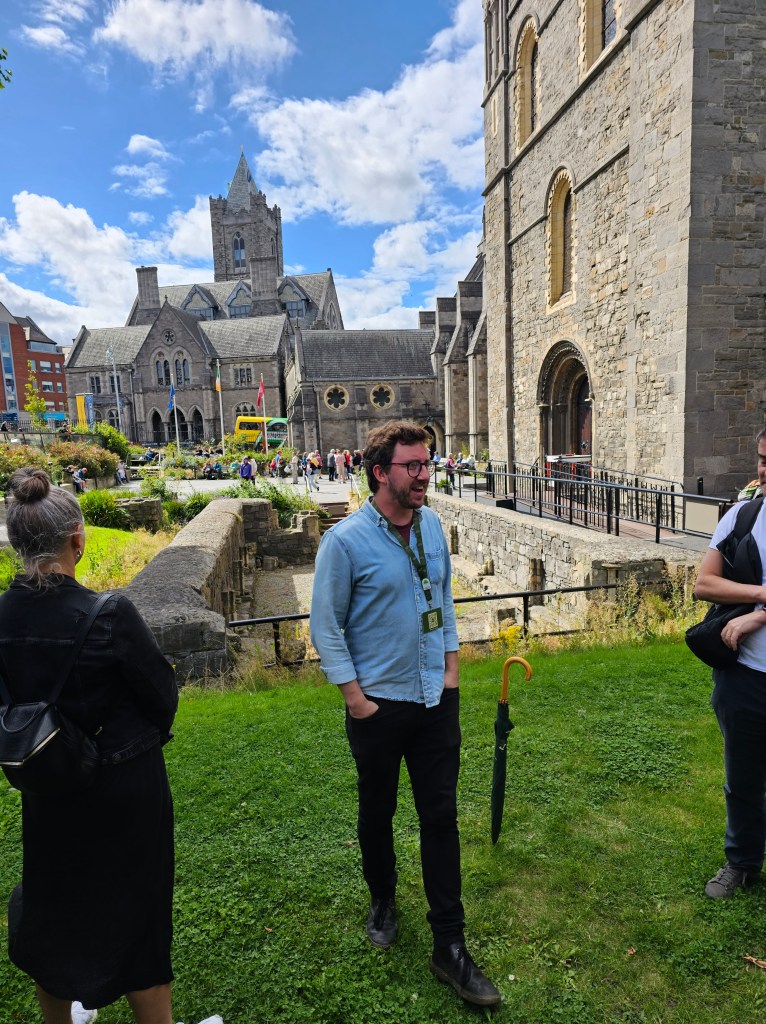
I’m thinking on such matters (as I laugh out loud at this truly awful joke) since I am soon off in a few days to the old sod for a short trip … mostly Dublin and Northern Ireland. Truth be told, I have never been to the six counties that remained attached to Britain after the Republic began to separate from English domination in the ealry 1920s. For that matter, I haven’t been in Dublin for over a half a century. How foolishly I wasted my life on things like work of all things … a classic four letter word I suggest others avoid if they can.
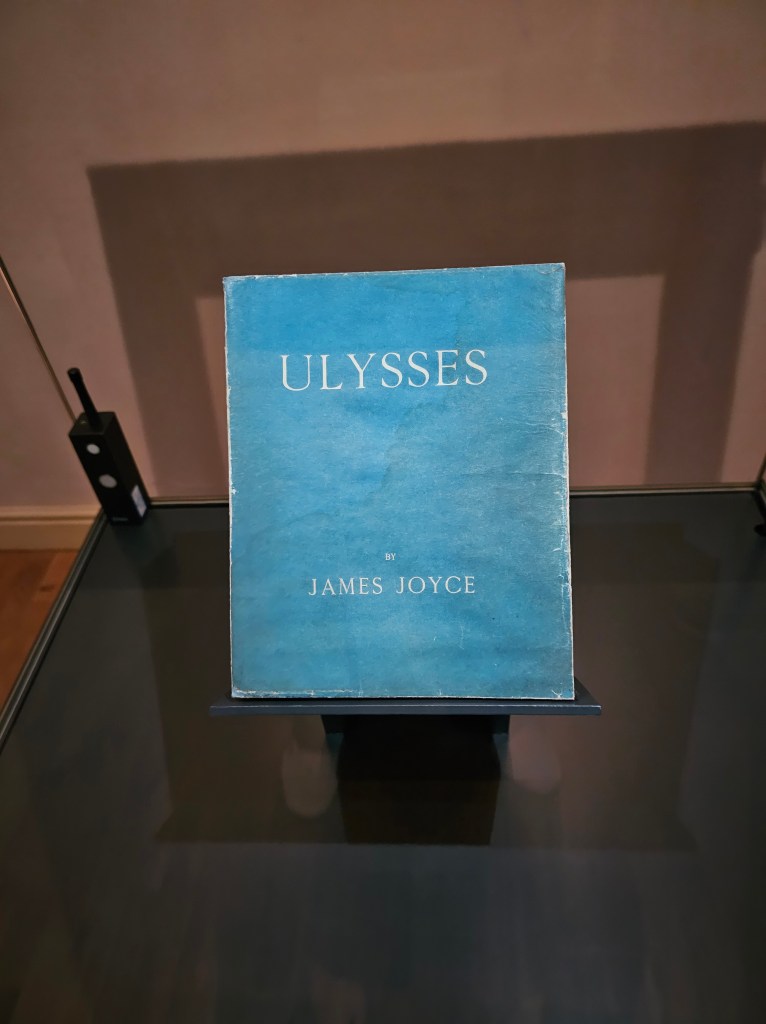
Dublin, an original Viking settlement and the city of James Joyce (Ulysses), will tug at my heart strings. It did in 1969 when I stopped on my way back from India. I am certain of that. I am sure to visit the old Central Post Office which was the heart of the Easter Rising of 1916. Patrick Pearse and other idealistic dreamers thought that the opportunity to break away was there, since the British were bogged down in Flanders and elsewhere on the Eastern Front in France. But the rebels soon were surrounded in their Post Office citadel by British regulars armed with cannons. While resisting bravely, they were pummeled into eventual surender. Some 16 of the leaders were quickly executed though the iconic Michael Collins would be spared (because of his young age) to lead a more successful fight for freedom after the war, only to be assassinated by those of his own tribe for signing an agreement with the Brits that left Northern Ireland separated from the rest of the country. Irish politics are complicated and, like most sectarian conflicts, can be unforgiving.
What has been less complicated is how the Irish feel toward the ‘old country’ and the history of oppression suffered by their tribe. I had my first lesson at a very young age. I was a toddler at the time when someone asked me ‘what are you?’ In Massachusetts, that meant I was to identify my ethnic origins, a way of communicating where one stood on the complex hierarchy of status which seemed imortant back then, and foolish now. But I was too young to even get the question fully. I recall thinking that I spoke English so maybe that was the answer to this strange query. [You could sense the budding academic in me even then.] Out it came … I’m English!
Bad move on my part. My very Irish father, born and raised early on in South Boston (an Irish Ghetto), was standing next to me. To say the least, he was not amused. I got my first lecture on being Irish AND why we hated the Brits. We were not far removed from WWII at the time. I would learn of stories where British sailors docked in Boston Harbor were told to avoid certain parts of the city. The so-called ‘Limeys’ would risk life and limb in Beantown … they would be safer visiting Berlin during the war.
Several hundred years of English domination had left its mark. It didn’t help that Oliver Cromwell made a serious stab at genocidal savagery. He surely attempted to wipe out the dominant culture based in a fervant form of Catholicism. Gaelic was prohibited, local peasants weref forced into a form of serfdom to British landlords, and great pressure was put on locals to convert to Anglicanism though that merely drove the country people deeper into their ancient customs and religion.
In the great potato famine of the mid 19th century, the Brits behaved with cavalier disregard for the native population. As a million starved to death, and well more than a million emigrated in a desperate move to survive, British landlords (often absentee) took harvests from their Irish estates and shipped them to other countries for profit. When starving peasants petitioned for soup and bread to survive, it might be offered but only on condition that they leave their Catholic amd Popish religion and swear allegiance to the Anglican Church of Ireland. Those who did were known as ‘soupers’ and were ostracized from their communities … another form of death.
It is not hard to see where relgious animosity in Ireland originated. Those ancient conflicts were never more evident than in Northern Ireland where a Protestant majority asserted dominance over the Catholic minority. For several decades in the 20th century, an uneasy peace held as tensions simmered underneath. The Republic of Ireland eventually found complete independence even as the North remained within the British fold. In Derry, Northern Ireland, a city west of Belfast, a Catholic majority bridled under minorty Protestant rule (unlike the rest of Ulster where the Protestants were a majority).
An ‘Orange Protestant’ contingent (after Willian of Orange who defeated the forces of Catholic James to guarantee British aegis early in the 17th century) annually would march through Catholic neighborhoods to taunt their ancient enemy and rivals. In 1969, allegedly inspired by the American civil rights movement, a Catholic mob attacked these enemy marchers. That is considered the begining of three decades of conflict, killings, and mahyem commonly known as ‘the troubles.’
During ‘the troubles,’ the two sides, along with British troops who generally sided with the Protestant majority, went at each other. This semi-civil war sometimes was fought with unconscionable brutality. Over three decades, some 3,500 people were killed, of whom about half were civilians and a third were members of British security forces. Only one-in-eight of those killed were members of paramilitary forces … either the Catholic IRA (Irish Republican Army) or the Protestant loyalists (the Unionists). The IRA is believed responsible for 60 percent of all deaths, the Union Loyalists 30 percent, and British Security Forces the remaining 10 percent.
At times, the carnage reached beyond the borders of Ulster with bombings of businesses, buses and subways in London itself and with the assassination of famous individuals like Louis Mountbatten, member of the Royal Family and the last Viceroy to India. The IRA came very close to assassinating PM Margaret Thatcher when they exploded a device which killed several and injured many at a Tory Annual political gathering at a seaside resort in the early 1980s. Names like Gerry Adams, Ian Paisley, and Bernadette Devlin became internationally recognizable during these years. Other actions caught the attention of the world as 10 IRA prisoners went on a hunger strike, demanding to be treated as prisoners of war as opposed to mere criminals. The ‘iron lady,’ P.M. Thatcher, refused to budge and all 10 starved to death.
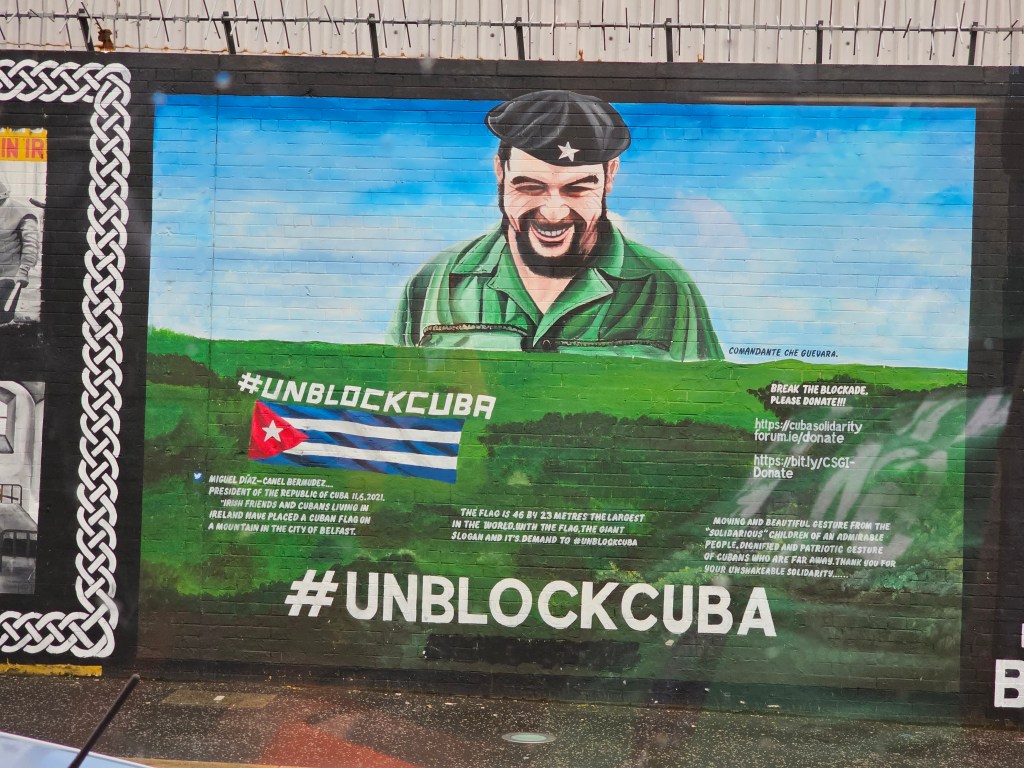
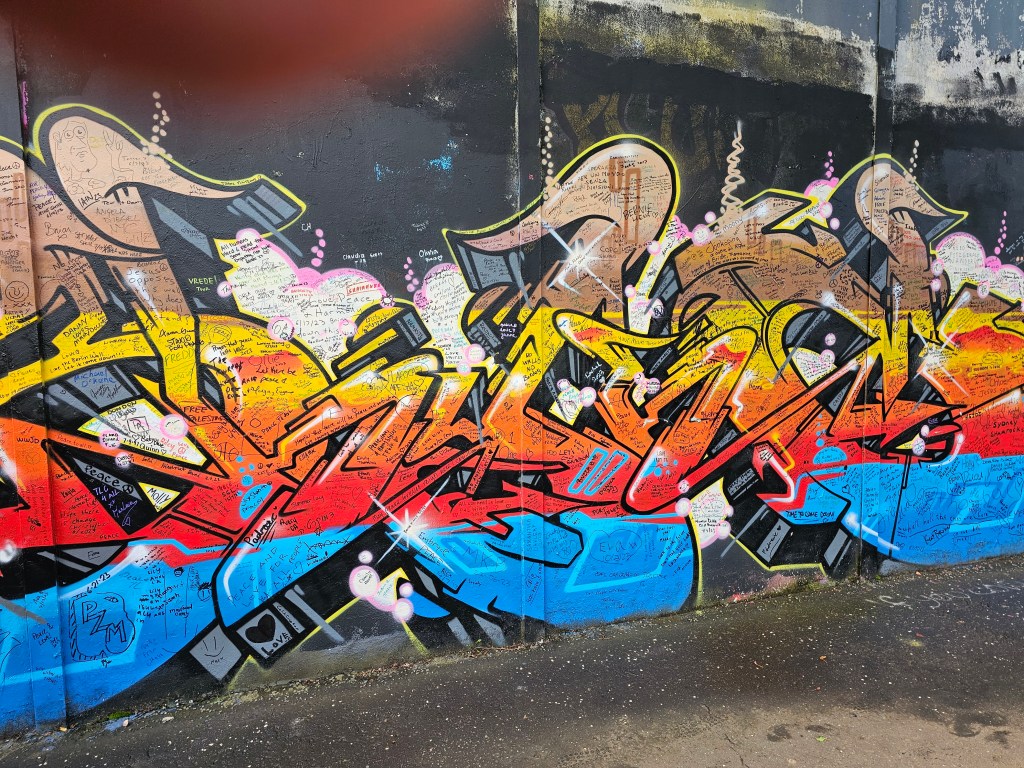
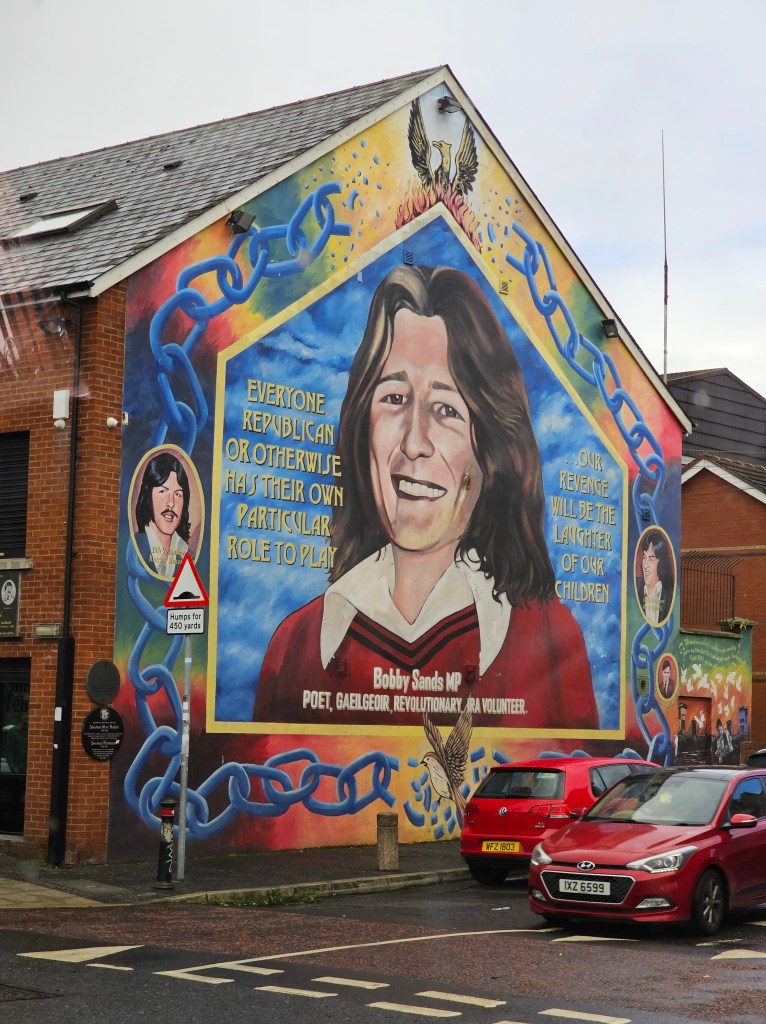
BY the 1990s, people were getting fatigued by the killings and the fear that violence would continue indefinitely to no productive end. After prolonged peace talks faciltated by U.S. Senator George Mitchell, the Good Friday peace accords were signed in 1998. All sides agreed to lay down their alms. Belfast had become a divided city. Walls separated Irish and protestant neighborhoods, some taller and more formidable than those erected during the Cold War or being planned for our Southern border by Trump and his minions. Apparently, colorful murals remain on walls depicting events and heroes of those troubled days … a kind of living memorial to lost and futile dreams.
I am anxious to visit Belfast and Derry (Londonderry to the Protestants). I want to get a feel for these places where so much hate festered for so long. I am told that a newer secularism has taken hold. I hope so. While religious devotion sparks positive sentiments in some, it is just as likely to generate the worst hatreds and atrocities in others. Few hate with as much virulence as those who act in the name of their gods.
I am told that hope has replaced hate. I fervantly wish that is true. I will let you know what I discover. But remember this! There are only two types of people in the world … those who ARE Irish and those who WANT to be.
Not long ago, a guy I know (his late spouse was a resident in the same memory care facility as mine) mentioned seeing the movie ‘Sound of Freedom.’ He said it was really good. Being clueless about so many things, I mentioned I hadn’t heard of it. He went on to say it was about human trafficking of children and assured the rest of us that they had avoided going overboard with graphic scenes. I thought, ‘hey, this is my kind of movie.’ I love serious movies about serious topics, especially if truth and justice triumphs in the end. Hey, I can cry at sappy movie moments with the best of them.
Before seeing the flic, I ran across a couple of news items talking about how controversial this movie was. Admittedly, I didn’t look for many such stories about the film, since I had already decided to see it. Still, it seemmed that the only substantive criticism focused on the fact that most kids caught up in this horror were kidnapped (as happens in the film) when, in reality, most are sold into slavery by people they know. I would presume this happens when family members are desperate or overly greedy. That struck me as a non-issue. Who cares how they got there. It really should be abut the vicitms no matter how they wound up in a living Hell (though I can see some benefit to having some data on this issue when crafting solutions). Still, this made me wonder. What’s going on?
At the end of the flic, more intrigue. There was a message from the star actor, Jim Caviezel. He asked the audience to spread the word since they didn’t have a big budget for marketing as most A-List movies have. Even more odd, it took some 5 years from completing filming to getting it released, and then only after many battles and overcoming significant odds. They even had an icon on the screen that you could scan and buy tickets for others to see the movie who might not be able to afford the cost of a ticket. Now, that was a first for me. By this point, I’m really wondering … what the f$#k is kerfuffle about!
So, when I got home, back to Google it was for me. It turns out that the movie, and the star, have divided the country like so much in our contemporary political world. Jim Caviezel is known for being a very devote Catholic and for having hard right-wing views, apparently bordering on the extreme at times. One of his previous movies was about the life of Christ (or the Crucifiction at least) where he played, guess who, Jesus himself. (They tried to cast me as Satan but I was otherwise engaged.)
Apparently, many on the right including Satan hmself (Donald Trump) endorsed the film, a fact that would ordinarily send me rushing to the nearest bathroom to vomit up lunch. Perhaps most importantly, the producers could not get the damn thing released since none of the major distributors (no major studio nor NETFLIX nor AMAZON) would touch it. They SAID they thought it would be a money loser.
Can you believe the entertainment industry brainiacs were wrong … again! It cost about $15 million to make (it strikes me that many actors waived their usual fees or agreed to a percentage of net profits). Hey, you can’t make a Super Bowl commercial for $15 mil. Those who went with a percentage deal (if any) lucked out. To date, it has earned ten times that amount, over $150 million and is only now being set for international distribution. The revenues have blown past several contemporaneous Hollywood releases with huge marketing pushes.
[Side note: The producers wanted a knpwn actor, Donald Sutherland, for a low-budget independent film titled Animal House. They hoped he would take a percentage of the profits deal as opposed to cash on the barrel head. He turned down the percentage offer thinking this turkey of a flic would never fly. WRONG! Animal House went on to make hundreds of millions (certainly in today’s dollars). Donald would have been a very rich man.]
But Hollywood big-wigs getting it wrong borders on the cliche-ish. What really bothers me is what the kerfuffle about this movie says about our society. I cannot escape the feeling that many attacked the project, or ignored its potential, simply because of the politics of those behind it. Of course, those conservatives promoting the project also got a little conspirital in their paranoia, as is their wont. Some of them claimed that movie theaters played dirty tricks to hamper ticket sales … like turning off the air-conditioning during showings. I can say with pride that the movie house in that liberal bastion of Madison Wisconsin kept the temp very comfortable, though the showings were oddly timed. Oh well.
Here is my beef! Child human trafficking sucks, period. I don’t care what your politics are. There are some issues we can all agree on. This is not a conservative issue or a liberal issue, this is a basic human issue. This is clearly an issue of right versus wrong. There are moments when we can all walk across the divide to shake hands. Even Newt Gingrich, the Republican father of never compromise with the enemy (Democrats), agreed with Bill Clinton on NAFTA though he twisted himself into knots to defend his one moment of bi-partisanship.
I don”t care who was behind this project. The movie was a powerful indictment of an international tragedy of epic importance. And, it is based on reasonably true events from what I can tell. CIaviezel plays an ex Homeland Security guy who know runs an international child rescue organization and did do what was portrayed in the movie, though perhaps dramatized a bit. Beyond that, this sytemic form of sexual child abuse remains a huge blot on our humanity. It is claimed that child (human) trafficking is a $150 billion dollar a year industry. They further note that there are more enslaved people today in the world than when slavery was legal. I am sure that is in absolute numbers. After all, the world’s population is much larger, so the proportion enslaved may be much less. Still, a shocking reality.
Bottom line … the movie is worth seeing. It is overly melodramatic at times (for my tastes) but I was engrossed throughout. More to the point, the human tragedy it displays is all too real to be ignored. The line that is used several times in the movie is ‘God’s children are not for sale.’ Who cannot agree with that, even if you (like me) do not believe in the conventional notion of a divinity?
In the end, it makes no difference whatsoever whether or not you are a believer in God or a believer in Animism, whether a Democrat or a Republican, whether a conservative or a radical ‘woke’ person … we can all acknowledge and denounce evil when we see it.
My rant for today! Thank you for putting up with me.
[Note: I was going to work on this some more but I had too many technical difficulties, so here it is as. Could be better.]
I zoomed with several of my old Peace Corps buddies the other day. The nominal reason for this cyber gathering was that one of our aging flock recently met with our Peace Corps training director who, as we realized at some point, was not much older than we were when he helped prepare us for our adventures in India. Now he is in his 80s while the rest of us are in our upper 70s. In some ways, our long ago a excursion to the other side of the world seemed like it happened yesterday. In other ways, it might have been from someone else’s life.
Let me say a few introductory things about the trials and tribulations of India-44. As the number suggests we were the 44th group to go to the sub-continent. We were all college kids, chosen in our junior years and given extensive training over two summers before being sent over upon graduation. All this happened during what has often been called the ‘wild west’ of Peace Corps service during the mid1960s when we started our service, or preparing for it at least. They hadn’t worked out all kinks yet and we were the guinea pigs for a number of innovations and experiments. But we were young, idealistic, and naive. Some of us thought it would be a great excursion into the unknown. Indeed it was.
Can you find me?
The training would be long and, in some ways, arduous. We started at the campus of the University of Wisconsin-Milwaukee where we were immersed in language training, technical preparation, cultural awareness initiatives, physical trianing, and a whole bunch of tests and challenges to see if we were fit and likely to survive. We met again during our between semester break in our senior years before returning for more intensive preparation before being sent abroad for (guess what) more training.
Amidst the on-campus lessons, I spent time on a Native American reservation in South Dakota (truly the end of the world) where we were exposed to a cross-cultural experience. The next summer I spent time on a farm just north of Madison in Waunakee Wisconsin where we lived in tents and tried to become farmers. I’m guessing the whole ordeal would have gone better if they had not changed the focus for India 44-B (my specific group) from poulty to agriculture. I am guessing the pic below is from our tenure on the farm. I’m the tall one in the middle and beginning to look a bit scruffy.
From a detailed journal kept by Mike Simonds (the young man on the left of the pic above), we were reminded of the grinding schedule. He lsited out several days of activities, classes, events that went from the crack of dawn to late in the evening.
At every turn you wondered if the ax would fall. Someone would be brought in for a meeting and sent home. The choices were bizarre. How could they have kept me when others who appeared more talented and dedicated were sent packing. Still, in the summer of 1967, we were off to India. This is me, looking over the Thames during our a brief break in London. I wonder what was going through my mmind at this moment? Probably somehting like ‘what the hell have I gotten myself into.’
Of course, we then landed we did more training. Here are a bunch of us from 44-B (see below), the would be Ag experts now refining our skills (or perhaps realizing for the first time that many foods grow out of the ground and do not appear by magic in grocery stores. Despite the staff’s good intentions, you cannot turn college kids from the city into farmers in a few weeks. Well, they couldn’t turn me into one.
You might be asking what happened to the women. They were assigned to 44-A, a public health group that were to be stationed in Maharasthra, the adjacent province to our south where Mumbia (then Bombay) could be found. While we learned Hindi, they learned Maharati. We were sorry to be separated but I suspect they were thrilled to be safe from a bunch of testosterone laden young males. I know they were ecstatic to be away from me. I tended to drool a lot when around them.
Can you find me here?
There were some high moment before we were sent off to our sites. We played several basketball games against the local college kids (see pic below) whipping them soundly before they got ther revenge. For the last game (before a large crowd) they brought in a new team, either from the army or the local prison. These bruisers did a job on us to the delight of the cheering local onlookers. Every time I drove to the basket, I would get pummeled. Hard to make many shots when your hurling them toward the basket from 50 feet away. But we survived.
Even better, three of us were asked to join a team representing Udaipur (we were to be stationed in the vicinity of this lovely city in Rajasthan) in the all India tournament in Jaipur. Myself (lower extreme left), Bill Whitesell (next to me) and Hatwood Turrentine (4th from left) were selected to help bring basketaball glory to the area. What we didn’t know was that the other teams could really play the game. We were soundly defeated in our first game, then won a consolation game, before heading home in shame. But it was fun.
In September of 1967, those of us who survived were sworn in as Peace Corps volunteers. We had one last party at the Lake Palace before two years in the desert. The Lake Palace was a former playground of the local Maharaja situated in the middle of lake Pichola. It is now considered one of the most luxurious hotels on the world. A good deal of one James Bond movies used it as a site (Octopussy?). Two of my colleagues stayed there a decade ago and attested to its splendor. It was like the last feast before the slaughter, the final meal before the long walk to the ‘chair.’
I am on the left (glasses) talking to Usha (one of our language instructers) on the right. I, and a couple of others, actually got to know Amar (next to Usha) and her family quite well. We were invited to the Punjab to witness the marriage of her brother (a military officer), a lavish affair that went on for what seemed like days. Indian marriages (and celebrations there in general) can make ours look tame. Making such connections enriched the experience immensly.
Reality hit the next day when three of us boarded the back of a truck with our trunks and all out wordly goods and hurtled out of the Adravelli Hills into the desert to the south. We arrived here on a Sunday. No one greeted us. Here was the local Panchayit Samiti, the government development office and our new home. The town of Salumbar was about a mile further over the next hill. The third of our group was to be located even further from civilization, there was no way he could survive.
I yet remember hopping on my bike and cycling to find someone who might be in charge, which I did. Randy (my site partner) and I took one of the government houses (far right). No other government official lived there, preferring to live in town. I could go on about life here, which had its good and bad moment. We were really isolated, no electricity for 6 months and never running water. We relieved ourselves in a small, smelly room with a hole in the floor. That bodily function was not easy to negotiate on nights without moonlight.
The temps often were north of 110 drgees except in the brief winter and the monsoon season (when all type sof crawling and flying creatures came to life). I recall checking out a desk in our place and finding a scorpian looking at me. During the rainy season, you kept a lid (a book?) on your cup, only lifting it to take a sip, then covering it again. If you didn’t, you would be ingesting several bugs with your next swallow. It was not for the weak of heart. Still, we often spent the evenings on our roof, as the desert cooled and the most amazing field of stars were revealed to us. I have never since been so close to nature.
Most of us felt quite incompetent. What made that critical in a way is that most farmers were marginal. They had small plots that could yield just enough to get them to the next year. But we were there to motivate them to try new seeds and techniques. Fine, but these innovations required good practices performed at the right times. If things went wrong, and so much could, the poorer farmers would be in deperate straights and our guilt would be astronomical. So, we selected our guinea pigs carefully. Below is one demonstration plot we worked on as an example to the community. Looks good to me.
Still looking for things to occupy our time, we thought a poultry demo would be good. We built this ourselves (the ONLY thing I have ever built in my life) on our roof to keep predators away. I still recall the excitement when the first egg was laid. Success was measured in the smallest ways.
And we did a bunch of other small things. Here is a modest garden outside our remote place. Our protective wall (at my back) worked for a while but not forever. We lost the crop at some point when the local predators breached our defenses. But we knew our produce was edible. Oh well, A for effort.
Below is a street scene in Salumbar. We spent a good deal of time here, made a few friends, and became part of the community. This scene best captured how I felt about the place. It struck me as a throw back to Dodge City in the 1880s. I thought surely Matt Dillon would face off with a desperado at high noon. I still recall one day watching several men, riding camels down a street (probably this street). They had rifles slung over their shoulders and belts of ammunition. I thought, the James Gang come to town to rob the bank. No such excitement.
On another occasion, a group of Jain Saints visited to great local fanfare. Apparently, this entourage walked around India and it was a significant event if they made their way to your town. What I recall most was one Saint pulling all his bodily hair out as an exercise in self-mortification. I then realized why I had left the Church.
Meanwhile, our sisters in 44-A were laboring in villages to our south. Since I had worked in a hospital while in college I had hoped to get into the public health part of the program. Such was not to be. I considered appealing my assignment early on in training but feared rocking the boat.
In any case, here are two of the intrepid gals, Mary Jo and Carol, doing something medical in their site. Mary Jo (on the left) was a nurse and one of the few with actual and relevant skills. In the end, nothing bothered us more than the feeling we had little to offer. I seemed to recall that there were two rumors about why we were there. One option was that we were CIA spies but there was nothing to spy on here. The other was that we were there to learn agriculture so we could be farmers back home.
Despite all the doubts, probably more got done that we recall. There were demonstration plots, some schools were built with volunteer help, wells dug, and so much else like poultry initiatives. We did not change the world but we might have altered a few lives. That is enough in the end.
What you don’t forget are some of the connections that are made. Here are the three I mentioned above that the local Udaipur College boys chose to play on their basketball team in that ill-fated tournament (discussed above). There is Haywood on the left, me, and then Bill. We are at the Delhi home of Amar (pictured in the Lake Palace foto). We grew close to that family.
In some ways, the three of us represent the diversity of our group. Bill was from a large Catholic family, perhaps considered lower middle class. He went of Yale on an academic scholarship, later getting a business degree from the Wharton School, and then a Ph.D in economics, from NYU. In life, he started out in banking in Paris but wanted to do something more worthwhile (and more ethical), ending up with the Federal Reserve. Haywood grew up in a large, and very poor, share cropping family in North Carolina. He always said they had no money but plenty of love. He credits Peace Corps with exposing him to new possibilities … eventually going on for advanced degrees in Geography and Theology and becoming a successful operative for a national labor union.
As I look at the faces below when we gathered for our first reunion in 2009, I am still in awe of the talent and accomplishments. I don’t know if Peace Corps had some magic in their selection methods or the PC experience itself altered people’s lives. However, the accomplishments of these people (not all are pictured here) are simply amazing. I am so proud of being associated with them.
Here is another group shot (below). It was taken in 2011, in Washington DC where we had our 2nd reunion. There was a 50th reunion of the creation of the Peace Corps and we thought that a good reason to gather. We are dressed up since we are on our way to the Indian Embassy for a fete they have arranged for those of us who served there and were in town. Apparently, we must have left a decent impression on them even though the country program ended in the mid-1970s.
We had just finished an edited collection of stories (written by individual volunteers), which I was able to hand over to the Embassy officials with great fanfare. The top Indian official there that night said something that resonated with us. He believed that the value of the program was not in the technical expertise we brought to their land. No, it was in the sharing and learning about each other that took place. In the end, I think he nailed it.
One last pic before ending. Below is a Google Earth shot of our site. Remember that lonely and bleak desert shot above Today, that same area looks thriving with all kinds of development including a hospital. A wider shot would show green fields and advanced irrigation where merely desert had been. I would like to take credit for all this but humility prevents me (LOL)
This was a cook’s tour of an incredibly complex esperience, one that did change all our lives. If you want more, here is where to go … Our Grand Adventure: The trials and triumphs of India-44!
I think I first noticed this phenomenon right where I live … Madison Wisconsin (Dane County). This is the site of the flagship campus of the University of Wisconsin system, the seat of state government, and the locational choice of an increasing number of hi-tech and professionally-oriented firms and businesses. What else makes the place special? It has become a liberal, should I say progressive(?), enclave.
In fact, it is shifting the balance of political power in a state that has been a toss-up arena for some time now. For years, voters in Dane and Milwaukee had offset strong Republican support coming out of the Milwaukee suburbs and the very rural areas of the state, those places where more cows than people live. Often, the votes from smaller cities decided each election, most of which were pretty close. More likely, voter turnout determined winners and losers with state-election outcomes being settled by razor thin margins. There were more Democrats in the state overall but victory depended on whether they could be persuaded to vote in large enough nuumbers.
That equilibrium seems to be changing. Democratic Governor Tony Evers, not the most dynamic campaigner you will ever meet, has won the last two Gubernatorial races. Even more surprising, the liberals have won back control of the State Supreme Court last spring and rather easily at that. This reversed a number of earlier losses where huge amounts of corporate money successfully backed very conservative jurists. Huge turnouts in Dane county with increasingly larger Democratic majorities explain much of these recent successes. The SCOTUS votes from Dane County in this last election totaled more than were cast in Milwaukee (the state’s much bigger city). More importantly, some 82 percent of all these votes were cast in the Democratic column.
It was not always this way. When I moved to Madison in the very early 1970s, I thought I had stumbled into a large farming town. Sure, the University (and an active anti-war movement) was here but the culture overall was not that progressive. The rural parts of Dane County held sway over the county board; there were almost no upscale restaurants; and local TV and radio ads were dominated by pitches for agriculture products. They kept warning me about root worm. It took me several months before I realized that was something that attacked corn, not humans. I was rather appalled by my surroundings at first.
That began to change soon enough when they got their first upscale restaurant (called Ovens of Brittany) and when a former left-wing student activist from Chicago named Paul Soglin upset the establishment by being elected city Mayor. His critics used the usual fear tactics, that the city would become a Commie satellite if this (Jewish) radical took charge. Amazingly, it didn’t work this time. On his election, a number of shocked Madison residents sold their homes and moved beyond the city limits, fearing God knows what. However, Paul turned out to be a superb mayor who led the city into modern times, eventually serving as chief executive off and on for several decades.
Today, the city and county are nothing like the burgh to which I relocated over five decades ago. It is an exciting and growing urban center with a plethora of cultural opportunities in all the arts, an array of fine eateries and ethnic restaurants representing cuisines from around the world, an extraordinary number of firms that attract highly educated and well-paid employees, and ample recreation opportunities. Mad city is no longer a sleepy big town (or was it a small city then) but now has emerged as a cutting-edge, cosmopolitan urban center where young professionals seek to to live and work.
Campus and Capitol
Not surprisingly, the cutural and intellectual winds have become decidedly progressive including several significant ethnic communities along with a vibrant LBGTQ+ community. It was recently ranked the 5th most educated city in the nation and the 6th most fittest city in the land. It often ranks in the top 3 in many such polls including where professionals want to live, a good place to raise families, and a superb place for those who enjoy the outdoors. Oh, and I just read an article suggesting it is the #1 college sports town in the nation (the Badger fan base admittedly is a bit wacko). The unemployment rate hovers around 2 percent or less and the place is growing like mad. They cannot put up new housing units fast enough with demand pushing the median price of single family dwellings to the $400,000 mark and beyond.
Republicans are not unaware of what is happening. Perhaps that is why they are trying to hurt the University so badly. Recently, the Republican controlled Assembly and Senate wacked $32 million from an already spare budget to attack diversity initiatives in higher education. They also refused to approve a new, and badly needed, engineering building, apparently out of sheer spite. Really, who turns down efforts to enhance the education of students in the STEM disciplines these days. You have to be totally deranged to do that. Oh my, I almost forgot which group I was talking about … Republicans.
Perhaps the words of former Republican Governor (and Presidential candidate) Scott Walker gets at their motivations. “Young voters are the issue. It comes from years of radical indoctrination … on campuses, in school, with social media, and throughout culture. We have to counter it or conservatives will never win battleground states again.” Of course, we fear Scott doesn’t know much about college campuses. He dropped out of college (or was thrown out depending on whom you believe) with a 2.4 or so GPA after a brief tenure at Marquette University, a decent (but not superior) Catholic Institution of higher learning in Milwaukee.
On paper, I would be one of the brainwashed college students that Republicans worry about … way back in the 1960s’ that is. I entered Clark University fresh out of my stint in a Catholic seminary and yet imbued with many core traditional values straight out of the playbook for my ethnic, working class culture. By the time I left to go to India after graduation, I was a very different young man. Among other sins, I had led the anti-war activities on campus.
Still, my political and intellectual metamorphesis seemed to have absolutely nothing to do with any brainwashing, at least not as far as I recall. I merely had access to a wide range of honest information about the world and, much more importantly, was encouraged to think rigorously and independently about things around me. To my recollection, no one told me what to believe, just how to think. That is a critical distinction. Nothing strikes fear into the hearts of conservatives more than people being able to think for themselves.
[Digression: My change of heart on the Vietnam war came early on. The key moment occurred in a day long dialogue with a fellow student as we both were working on our individual National Science Foundation sponsored undergraduate research projects (he deserved his, not sure about mine). Anyway, he stayed in psychology and went on to get his Ph.D. at Harvard. I certainly knew even then that he was a most worthy opponent. Still, being a stubborn Irishman, I told him at the end of the day that we would have to agree to disagree. But in my heart, I realized he was right and I was defending a hopeless position. I yet look upon that day as when my core political perspective began to shift.]
My Undergrad Alma Mater:
It changed my life.
Back to my main thesis. The call by Scott Walker to do something has not been ignored. Beyond Republican attacks on some of America’s leading research universities (Wisconsin is ranked among the top 50 such institutions in the world), the ‘right’is mounting their own form of brainwashing to counter what they believe the ‘left’ is doing. Hillsdale College, a small and very conservative liberal arts college in Michigan, is leading the charge to reshape the perceived indoctrination of the young toward a more conservative direction. They only have 1,700 students but an endowment approaching $1 billion, enough to push it’s hard right agenda on to the wider world. I had been on their mailing list for some time, but I found their stuff extremely hard to stomach. I do like to keep in touch with a broad range of opinions but only when shared by those who function in the real world.
They have initiated what they call the 1776 Curriculum. It reframes American history to emphasize what we think of as American Exceptionalism. You know, we are a Christian nation blessed by God to do good in the world and always have been such and done so. It mostly is aimed at high schools but they touch other levels as well. Some 8,400 teachers and administrators have downloaded the materials so far, which also includes suggestions on which books to ban. Their lessons and perspectives have crept into the college ranks. Some Florida schools of higher education are teaching that slavery was good for black people since it taught them useful skills. Perhaps, but it doesn’t come out very well for the enslaved in a benefit-cost analysis when all pros and cons are considered.
The potential Wisconsin political shift story is illuminating but only part of this larger story. There are some 171 cities and counties designated ‘college towns’ where the ambiance and environment is materially impacted by one or more local schools, at least as defined by several metrics. Since 2000, some 38 have flipped from red to blue, while only 7 have flipped in the other direction. Moreover, the Dems grew their percentage of the vote in 117 of these jurisdictions (representing an average of over 16,000 more votes) while less than half that many (54) drifted to the ‘right’ (by a smaller average of some 4,000 votes). Overall, the shift clearly is in a blue direction. In the year 2000, these towns went 48 to 47 percent for Gore. By 2020, the gap had grown to 54 to 44 percent for Biden.
Bascom Hall (Univ. of Wisconsin)
The University of Michigan is like the University of Wisconsin in many ways. Both Big 10 public universities though Michigan slightly outranks the Badgers on the academic prestige scale (both are considered world class schools). The home of the Wolverines is located in Washtenaw County which gave Gore a 34,000 vote plurality in 2000. Two decades later, they gave Biden over a 100,000 vote margin. Like Dane county, Washtenaw may be swinging the entire state into the blue column in what had become a swing state in recent times. Other states are seeing similar swings. Travis County Texas (the University of Texas) has seen a growth of some 290,000 democratic votes between 2000 and 2020. Henneppin County (the University of Minnesota) has seen a similar trend, up some 245,000 over the same period. The triangle area in North Carolina is driving similar trends in that state.
Unlike Scott Walker, I don’t blame recent Republican concerns all on so-called brainwashed students. They have other issues like knowing that your core base prefers candidates better suited to the looney bin than high office. And there are those large demographic trends. Caucasions of European ancestry are becoming a minority in this country, likely in another generation, an inevitability stoking the hostile animus of White Nationalists.
Putting such factors aside, I suspect a less obvious dynamic is at play here in these college towns. Younger people are concerned about things like climate change, growing hyper-inequality, and the still hidden consequences of Artificial Intelligence (AI) … things that are important to their future. The Republican Party focuses on abortion, the southern border, and mythical attacks on Christianity … emotional issues but hardly fundamental concerns to our future survival. You don’t have to be a rocket scientist to figure who is interested in governing and who is playing classic bait and switch politics. The GOP tells you to focus on this non-issue cultural thing over there while they feverishly continue to make their wealthy friends even richer (really, do the 1%, or the .01%, want it all?).
As students (and younger people generally) swing to the left in places where they tend to congregate, they inevitably set a broader tone for the community. Such places create a more accepting and progressive culture. More than that, research universities attract hi-tech and professional firms which, in turn, demand educated employees. A reinforcing cyclical pattern emerges. Smart, young, accomplished people are not likely to be embedded in the cultural grudges about which Republican enclaves stew. These are people much better able to connect the dots in general, absorb news critically. They tend to have stimulating conversations socially, read a lot, and can see the bigger picture.
My social gatherings (book clubs and just ordinary get togethers) are dominated by sparkling conversations of a remarkably high intellectual order. While my friends are from the geriatric set, they are really smart and accomplished … retired lawyers, engineers, doctors, academics, and other such types. We remain astonished that people out in the rural areas of the state continue to supprt a Republican Party that has evidenced absolutely NO interest whatsoever in addressing their problems or providing solutions for them … and I mean zilch, nada, zero interest. That conundrum continues to amaze me, especially when I see signs on rural farms saying Trump in 2024, stop the bullshit. Really? They are looking to the the biggest conman ever in public life for honesty? Now, that is insanity totally beyond measure.
No one knows what the future will bring but the above trends give me a measure of hope. Remember that our electoral college permits candidates to be swamped in the overall vote but still be elected. While Biden won by a 7 million vote plurality in 2020, some 50,000 to 60,000 votes distributed differently in just five swing states could have handed Trump the White House a second time. When national outcomes remain in doubt, extant trends in these college towns may prove to be a life raft for our democracy. They may save us from going over the edge into the abyss of conservative authoritarianism and even totolitarianism.
I hope so. I’m a bit old to seek political asylum in a foreign country though I may check out getting Irish citizenship (being of Irish decent on my dad’s side) during an upcoming trip to the old sod.
I started this blog for three reasons. First, I took a hiatus from writing (and then sometimes significantly rewriting) full-length books. I was stricken with a temporary delusion that I ought to consider getting a real life. How silly is that? Second, the Facebook (Meta) gestapo banned me from their platform … twice … presumably for life each time. The first exile happened when I had accumulated 30,000 followers. The second, initiated under a different name, was imposed when I had collected 7,000 followers. These were not temporary sentences to their jail which they did with regularity. No, I couldn’t even access their platform. I was considered a serious felon, worse than Trump. Third, several people who missed my FB posts actively encouraged me to start a blog. God knows why. You cannot go broke underestimating the judgment of most people.
Perhaps the most important reason for the blog is that I needed to do something that would get me in front of my laptop. In many respects, writing had come to dominate my life in these so-called golden years. Since 2011 or so, I have pushed out like a dozen big volumes. The exact number is fuzzy since some original works were rewritten and republished under different names and even publishers. Thus, the exact number depends on how to define an individual work. By any measure, it was a lot of writing and I needed a break from that frenetic pace.
I started this blog thing perhaps four months ago. For many weeks I was writing one a day. A neighbor of mine expressed amazement at my productivity, noting it would take him a week to write what I was putting out each and every day. Recently, I have eased back to about one every other day now that the total exceeds 100 blogs (is that what they are called?). My Facebook output also was seen by others as substantial, and apparently worth reading … thus the huge number of friends and followers for someone not known to the public. People would ask me how long I worked on it every day, believing it had to be many hours. In truth, it was surprisingly little time. I often picked the best material that crossed my news feed and passed it on, though some was original. At the time I was banned the first time I was adding something like 100 new followers each day. I had arrived.
I don’t quite know whether to lump my Facebook efforts as a legitimate literary endeavor though I feel it could be considered quite creative in some respects. (NOTE: After my latest (second) lifetime banishment I found another way to get back on as a new account though I am clueless as to how this was accomplished.) I am now cranking out jokes, insights, and leftish political comment at my usual pace. I’ve secured over 230 ‘friends’ in less than a week. There is considerable rejoicing among my old (or former) cyber acquaintances who have found the latest version of ‘Tom’ on that platform. Their glee is tempered by the legitimate expection that the heavy hand of the FB version of the KGB will strike again, and soon. Their gestapo seems to despise humor and original thinking. It is fine to make people hate, just not laugh or think.
Writing, even what passes for it on Meta (why did they change their name), has become my addiction. Over the past dozen years or so, I found myself drawn to my laptop (or even phone). If I wasn’t working each day on a book or some other writing project I would become jittery. I would not calm down until my fingers were flying over the keyboard, more like pecking at the keyboard. That sounds very much like an addiction to me. Either that or I am painfully aware that, if I am NOT pushing my creative instincts to the side, I would be forced to confront REALITY. Oh Lord, perish that thought! I might even have to tackle my disordered life, perhaps take on the cleaning of that hazardous waste site that passes for my domestic domicile. I believe death is a preferable fate.
Some Fictional Works
Sometimes, when I’m not gazing at my navel, I wonder about nonsense. For example, is this frantic writing just a convenient retirement hobby or something more fundamental to me as a person. If the latter, where does this impulse come from? I do know I started to seriously write non professional stuff (e.g., fictional works like those examples pictured above) when certain life changes happened in my late 60s, just as I was leaving my professional life behind. Even after partial retirement from the University, I remained somewhat active in a number projects. They were winding down by 2010 with the publication of my co-authored academic book on Evidence Based Policymaking. These remaining activities ended totally in 2015 after I had organized a week long conference to upgrade the skills for academics teaching poverty related courses around the country. I had co-managed this with the late economist Robert Haveman. In reality, though, I had left most of my professional life behind by 2011.
Around that time, my late spouse began to evidence symptoms of dementia which eventually was recognized as Alzheimers. Any one familiar with this affliction knows it better as ‘the long good-by.’ Your loved one slowly declines as the disease takes over more of their brain and slowly saps their cognitive abilities and then their motor functions. The process can go on for a decade or so on average. During this progression, the world the two of you enjoyed slowly becomes more constrained. There is no more travel, especially as you become a full time caretaker until institutional memory care becomes unavoidable. During this process, you find yourself more and more home bound, perfect for a writer. What else is there to do but sit on your fanny and let your mind and imagination loose upon the world.
All this makes it sound as if my personal writing frenzy was one of convenience. Nothing else to do so why not punch out some books. Not quite that simple! Anyone who has tried writing something like a book knows it is not as easy as it sounds. No indeed. It is more like a commitment, either that or something for which one should be committed. I now forget which. No, something else was afoot. So, let us look deeper.
I’ve reflected on this issue a number of times. One can always create, or recreate, one’s own history and biography. I’m well aware of that fact after being involved in several literary works focused on my Peace Corps group’s (India-44) experience as well as two more general memoirs, one professional and one personal. What I found is that it is most difficult to sort out reality from fanciful memory. But we can only do our best.
I can recall going through my dad’s effects, perhaps when he passed in 1987. I came across a clipping from a 1930’s newspaper on his high school basketball team. The reporter asked him what he wanted to do when he was an adult. His response took me back … bea journalist he replied. For some reason, that hit me hard. Really, he was just a poor Irish kid with no chance at college. After walking on the wild side a bit in his early years, he settled into factory work and a working class lifestyle. But I wondered if the Celtic muse lie somewhere within him.
He did have books in the house. I can recall a complete set of the Encyclopedia Britannica, the internet of its day; a whole set of Perry Mason mysteries by Earl Stanley Gardner, and the condensed books series from Reader’s Digest, a volume of which would arrive at the house on a predictable basis. I read everything I could get my hands on plus what I found at the local library, an institution not frequented much by my working class neighborhood friends. In fact, I kept my sojourns to that place a secret.
I also remember that he was a good story teller. He had that classic Irish wit and that dry sense of humor that I thankfully inherited, or so I like to claim. As he aged he would complain about my mother dragging him out to see people and socialize (he had become a bit of an introvert as I am). Yet, when he was in the public eye (so to speak), he would regale people with an innate charm and keep them laughing. Again, I would like to think I inherited such attributes which I see as core Celtic traits, along with some less desirable ones such as an excessive fondness for liquid spirits. We sons of Eire can be sociable, loquacious, and entertaining. Ah yes, self-delusion is a marvelous skill everyone should perfect.
As an only child, I probably spent more time alone than others of my cohort. With time, and fueled by books, I had an active imagination even early on. We kids all had dreams of what we would do as adults. Most of my buddies wanted to be athletes or cowboys or soldiers or something along those ridiculous lines … vocations related to the games we played in the streets and local parks. I, on the other hand, wanted to be an author. Of course, I never told my buddies. The scorn and teasing would have been intense and so humiliating, along with the physical beatings. I was slow but not totally stupid.
I can recall in high school. I was an average student at best (and that is stretching it), though I did attend in a good school. One day, the Xaverian brother who taught English gave us an assignment to write a short story. The others moaned while I beamed. I loved words, numbers not so much. That night I cranked out my masterpiece. It was a story that built up tension and drama as the story evolved. My brilliant stroke was not to reveal the actual context of the narrative until the final sentence. You thought you were reading about a dramatic and life-threatening moment until it was revealed that all the angst was about a harmless neighborhood basketball game. I was such a clever lad.
When the good Brother asked for a volunteer to read their story, all the others slunk deeper into their seats while my hand shot up. ‘Oh God,’ I could imagine him thinking, ‘not that idiot Corbett.‘ But he had to call on me since I was the only volunteer. As I finished my epic story, doubt seized me. I didn’t want to look up, afraid they were all laughing at me (a not uncommon event in those days). When I found the courage to peer around the class, I can still remember the looks on their faces. Mostly, they were shocked, and apparently impressed. The class idiot (one of them at least) had his moment in the sun. When you have so few, you remember them. I realized I just might have one talent amidst so much failure. It doesn’t take much to keep one going.
When I was in the Seminary, studying to be foreign missionary Catholic Priest, I had a course in something called Oral Interpretation. I think it had something to do with making you a better speaker. The Maryknoll Priest who taught the course had many contacts with the theater crowd in Chicago (the Seminary being located in a Windy City suburb), at least if the autographed pictures in his office were any indication. So, I assumed he knew a lot about the the creative process. One assignment was to pick a favorite literary passage of yours and read it to the class. I was into the playwright Eugene Oneil at the time and selected a passage from his classic, The Iceman Cometh. Again, I poured my interpretive juices into my rendition of an emotionally charged scene. When I looked up, I saw the same expressions of amazement I had seen in prep school. The teacher also looked amazed. I yet recall his words of praise … ‘Now that is oral interpretation.’
I left the seminary in my second year and transferred to Clark University in my home town of Worcester. It was a radical departure from my Catholic, working class roots. My mind exploded as I also found my intellectual (and somewhat radical) political roots. This so-called ‘den of atheism and communism’ (at least in the Catholic community) is just what I needed. Once again, I had a moment. While a psychology major (the best department at the university where Freud gave his only American lectures and the American Psychological Association was formed), I really loved my Literature classes. One day I ran into my Lit Prof while getting some food. Since he was trapped, I told him about my secret desire to be a writer, expecting him to laugh out loud. I got laughed at a lot.
He didn’t, which surprised me in the moment. It was not until I myself was a university teacher later on that I realized that you train yourself (most of us do at least) to respond to absurd student fantasies with a straight face. Charles Blinderman, that was his name, did so with me in that moment. But what he said next has stayed with me for something approaching six decades. It was a simple question. ‘Can you tell a good story?’
I didn’t know if I could, not really. So I don’t believe I responded at the time, standing there mute which is a state many have wished upon me but few have succeeded in achieving. My father could tell good stories (or perhaps that is a false memory) but, even if true, I was not sure that counted. Nor was I certain that it was an inheritable attribute. So, I took his words as a silent challenge. Alas, it would take decades before I seriously tried to answer him.
Even after college, I had no freaking idea what I wanted to do. There were no placements in the help-wanted ads looking for wanna-be authors. So I went to India in the Peace Corps. There, sitting in the harsh Rajasthan desert, I had a lot of time on my hands. So, in painstaking long hand, using the now extinct code of cursive script, I wrote a full novel. Those few who read it liked it, as did the women who volunteered to type parts of it up for me (I was such a charming lad), and as did my tough minded professor in my Master’s program in Milwaukee (after my return). And so I wondered, was this dream of being a writer possible. Could I? Had I answered Blinderman’s query.
The problem is that I liked eating on a daily basis. I also rather enjoyed having a roof over my head. I thought hard about trying to look for a publisher but, at the end of the day, I put the manuscript aside and went in another direction. By chance and serendipity, I wound up as something of a nationally respected policy wonk and a less respected academic at the University of Wisconsin where I found I had some administrative skills (including being good at raising money) and was a damn good consultant to govenrment agencies and assorted public bodies. In addition, I was a damn good teacher which, even at that level, is about imagination and story telling.
Amazingly, I discovered I had a few skills. I wasn’t as hopeless as I thought I was as a kid. This career of mine was all by accident, not by design. I never had a plan, certainly not one that would find me at a world class research university. One thing is for sure, I never intended to be a conventional scholar which required you to be overly narrow and (except for the most brilliant) constrained one’s imagination to keep a focus on a bunch of smaller, more technical, and (in my mind) trivial issues or questions.
So, I fell into a long career going between the academic and the policy worlds. I loved that. I could pick the topics on which I wanted to focus and approach them as I saw fit, as long as I could raise the money to support my intellectual interests which was surprisingly easy to do. Even better, I was not really responsible for any of the mayhem I created. It also turned out that being professionally located at a renowned research institute at this top-ranked university opened a lot of doors. People assumed I was smart and knew something. Go figure … the jokes on them!
When I retired, I told the audience at my final party that I had been so blessed. My only hope as a kid was that I would not end up doing manual labor later in life. I managed to avoid that, thank god. What I did do, as I told the audience that day, was to fly around the country addressing some of the most pressing social problems of our day while working with many of the best and brightest in the academy as well as in public service. And they even paid me to do this. I felt I had cheated life. It sure beat working for a living.
Of course, I had to put my writing dream on hold, or thought I did at least. The pace was brutal as I juggled so many roles … academic, teacher, administrator, money raiser, project administrator, consultant, and public speaker. But, in reflection, I realized that was not quite true. I did write, a lot. As a so-called academic, I did a lot of professional writing … reports, book chapters, articles, and so forth. I wrote more for outlets that would reach beyond an academic audience, thus was never respected very much as a scholar. The ONLY thing that counts in that culture are narrow and technical pieces published in provincial peer reviewed outlets read by a handful of scholars interested in your subject. I wanted to reach out to the world. You probably can see that my attitude would cause trouble. Still, I had this knack of keeping everyone laughing which permitted me to remain popular within my world and kept me involved as what I call ‘a player.’ I kept getting invited to be involved in the critical issues of the day.
Some Nonfiction Works
One thing was certain, I was highly respected as someone who could communicate with the written word, and give great public talks (or contribute to conferences and seminars) which I did endlessly. Over time, what really shocked me was my acceptance by the hard ass econometricians and other hi-tech scholars. As someone who had great difficulty with high school algebra, I should not have been where I ended up, especially in helping run a nationally known university-based research entity (my imposter syndrome often overtook me). Most surprisingly, I was embraced by many of the economists who dominated the Institute where I spent most of my time (I taught various policy courses in the School of Social Work but spent little time there).
Now, if you were to know economists, you would find them to be a disputatious and aggressive tribe. They surely do not accept those they deem fools with ease. And yet, I felt more accepted by these (what should I call them) hard-asses than I was by the softer social workers in the academy. My best guess is that my skill at cross-walking between several cultures (academia, government, the philanthropic world, think tanks, evaluation firms, public agencies, etc) and then integrating my observations into well crafted writings performed a service they admired. I gave them a window to the broader world. It certainly wasn’t my technical sophistication.
One vignette has remained with me. I was walking back to the Social Science building one day along the path that borders Lake Mendota. The campus is gorgeous. Anyway, this was early in my tenure at Wisconsin when I was less than nobody. Suddenly, I heard someone calling my name. It was Robert Lampman, a revered economist at Wisconsin. In the early 1960s, he served temporarily on the Council of Economic Advisors during the Kennedy years. During that service, he wrote a seminal chapter in the annual Economic Report to the President. This chapter was widely considered to be the intellectual basis for what later became the War on Poverty and for parts of the Great Society.
For the life of me, I could not figure out what this eminent man would want with a nobody like me. He then went on to praise something I had just written and put out within the Research Institute. It was likely the first thing I had written there. After exuberant praise that left me speechless, his last words before we went our separate ways were ‘Tom keep on writing.’ Those words also stayed with me. Bob was one of the finest men I ever met in the academy … I still cannot believe he was an economist.
I won’t bore everyone with more tedious vignettes but I can recall so many moments when I was the object of praise from my ‘hard-ass’ colleagues, or when I was asked to speak before rather distinguished audiences, or to be included in meetings at high levels including the Old Executive Wing of the White House. It was heady stuff for a working class boy from the mean streets of Worcester. I doubt all that happened because I was particularly bright. I never thought of myself as conventionally smart though I probably was imaginitive and clever in a way. I had a facility for seeing connections among seemingly disparate phenomena and for cutting through the fog to get to the core of any issue. Still, I think what gave me an edge at the end of the day was a command of language. I could speak and, more importantly, write well, even persuasively on occasion. I yet recall one colleague (trained as an economist) calling my writing style ‘Corbettese.’ It was not the style found in the academy.
So, my childhood dream of being a writer never came to pass. I put it on the back burner during my career, perhaps for reasons about which I am not proud. I lacked the courage to give my inner passion a full voice. Basically, at the end of the day, I didn’t want to starve to death. At the same time, it wasn’t as if I sacrificed all for some career that despised. That would have been a tragedy. There is little doubt that more money could have been made in other professions or avocations, but most of them would have driven me crazy. Besides, money is immaterial once the basics are ensured. Recently, I remember thinking about the young doctor who did my last colonoscopy procedure. For several reasons, there is a backlog in scheduling these invasive procedures, so it struck me that she might be doing them all day long. Undoubtedly, she is making good money but I could not help thinking … I would not last a month. I needed stimulation in life, new challenges, impossible problems to confront, and audiences (via talks and print) to share my observations and thoughts. And that is precisely the life into which I stumbled blindly. It was a good life.
Did I take the wrong road? Should I have pursued my passion with more vigor. Is a ‘good life’ enough? Who knows. What I can say is that I did employ that innate literary talent in the career I found, or rather which found me. That is something. More importantly, I have been given a second chance. I have time now, lots of it. While not wealthy by any means, I don’t worry about money. And when I am at my laptop stringing together words into images and thoughts and observations, I find myself lost in another world.
It turns out that I am comfortable in that world. On reflection, I think I will stay here for a while longer.
Perhaps time for some random nonsense. Okay, okay, you are saying that all my posts are nonsense. Point well taken.
…………………………………..
Hmm, I just came across one of those ubiquitous rankings of cities, best for this and that. This one was for the top ‘fittest’ cities. Madison (seen from across Lake Monona above) was again near the top … # 6. Let me say categorically that I dragged the city down on that one. Definitely would be in the top 5 if I were to move away.
Oh, and don’t forget … it also was ranked as the 5th top educated city in the land. If you want to be around people with sound minds in sound bodies, this is the place to be. Just to be clear, I’m not one of them (being unsound in both mind and body) but many others are.
To be honest, there is a petition circulating to encourage me to leave the city, a sure way of boosting the ratings higher.
…………………………………
I can’t see how Trump can be President again. It is not because he is a thoroughly disgusting, morally bamkrupt, pathological narcissist and sociopath. While those are his better points and self-evident, others of similar ilk have had successful political careers. No, Trump is ineligible since he would contravene the Constitution if he were to serve again … namely Section 3 of the 14th Amendment, this clause having been approved after the Civil War to prevent clear enemies of the Republic from usurping power. It says:
‘no person shall … hold any office, civil or military, under the United States who, having previously taken an oath … to support the Constitution of the United States, shall have engaged in insurrection or rebellion against the same, or given aid or comfort to the enemies thereof.’
Oh wait, I forgot. Didn’t the GOP tell me that those nice people beating the Capitol Police half to death were merely tourists ambling through our seat of government. How silly of me.
………………………………….
Did you know there were only 21 Whoopng Cranes in the world a few decades ago. That beautiful bird, one of God’s special creatures, was on the verge of extinction. Now there are some 830. A shout out goes to the International Crane Foundation (located just north of Madison) and George Archibald for his tireless work for some five decades in bringing this and other species of cranes back from the brink. I so admire dedicated people like this though they make me feel like a worthless slug.
………………………………….
For some reason, I just mused on the precise moment when I knew I would never make a living as an athlete. I was a pretty good baseball pitcher in my early teens, almost went undefeated for my junior high school team. Anyway, one day I was on first base when I got the steal signal from our coach. I was stunned, being the slowest runner on the team. I must have looked clueless to him since, after giving the same sign several times, he yelled … “steal second you nimrod.” So, on the next pitch I chugged down to second and slid in safely. I could not believe I had stolen a base and just assumed the batter had hit a fall ball.
In a move I have never forgotten by me (though I have tried deperately), I started jogging back to first base before our totally shocked opponents recovered to tag me out. I can still recall the adams apple of our coach going up and down as he yelled things at me that no young teen should ever hear. However, it was all for the best. A lesson was learned. I scratched pro-athlete off my list of possible future vocations.
I kept scratching off other possiblities as it became apparent that I had neither the talent nor disposition for each alternative considered. Manual labor, or real work, was never even an option to be remotely considered. At the end of the day, being a useless faux academic and pretty good policy wonk was all that was left. But I had fun … that’s what counts.
NOTE: That’s me in the middle flanked by two cousins. The one on the left went pretty far in the Los Angeles Angels minor league system but never quite made it to the majors.
…………………………………………….
The movie Oppenheimer is out. That got me thinking that about how anyone would have made the decision he did … to use his skills to create a weapon potentially capable of destroying civilization. Albert Einstein perhaps started the atomic bomb rolling when he signed a letter to FDR that had been drafted by fellow physicist Leo Szilard warning of the danger that Germany might create an atomic weapon. They had the brainpower to do it.
Both Oppenheimer and Einstein were toward the pacifist end of the political spectrum. Einstein was very critical of his fellow German academics who helped the war effort in WWI. He also fled Germany as the Nazi’s were coming to power. Both men (Oppy and Al) faced an incredible dilemna. They hated war. In a way, that made it easier for them to ease their consiousnesses about creating a super-weapon. It might save lives in the end by ensuring the Nazi’s would not win (I doubt Japan played much of a role in their thinking). Of course, Einstein never got to play a substantive role in the Manhatten Project. He was considered a security risk by the paranoid powers that be for some specious reason or another.
Truman had little doubt about using this new tool. He already saw the ally costs in lives lost associated with taking places like Iwo Jima and Okinawa by conventional means. If they had to invade mainline Japan, some estimates put the potential causualties as high as a million lives. We can never know for sure but the dropping the bomb on Horoshima and Nagasaki likely saved many lives. Conventional bombing alone to siften them up for an invasion would have killed more Japanese than the two atomic weapons did. As Oppenheimer believed, the horrific example to the world of using such a weapon may also have detered future use, a lesson that never would have been embraced had the bomb remained simply an unused threat.
Albert and Oppy, on the other hand, suffered from their participation and contribution to the creation of nuclear weapons. They gambled on Germany (and the Nazis) being far further along than they were. By the time that they realized they would not develop the bomb (though they did come up with jet planes and ballistic missiles by the end of the conflict), it was too late to reverse course.
Since I had trouble with high school algebra, I never would have been involved in the Manhatten project. But if that were possible, what decision would I have made? What decision would you have made? Remember this, while many of the scientists came to regret their actions at Los Alamos (and the satellite sites) it was assumed at the beginning that the Germans had a 12 to 18 month head start on the allies in creating a nuclear weapon. Who would wait and debate morality under such a threat?
Oddly enough, the Nazi’s hate of the Jews may have thwarted their best chance of ultimate victory. Hitler once said that quantum physics, the theoretical basis for the bomb, was ‘Jewish’ Science. He could never support it. In the end, his own irrational hate contributed to his downfall.
………………………………………….
Do you ever receive these emails from political campaigns that suggest they are sharing top secrets with you. I remember the Republican ones for some reason. They usually start with something about ‘the information below is for my eyes only,’ perhaps even suggesting that I delete the message after reading. A common variation on the theme is that they are ONLY sharing this inside info with a few trusted supporters, especially those who have been financially generous in the past.
Right there, my antennae go up. If the leaked secret info is from a conservative source, I never should be getting it. I have not given them a single dime even though some 70 percent or so of all the messages I get are from that side of the aisle. Could it be that they are playing me with a con? Perish the thought.
Then I read the ‘top secret’ message. After the blabber, it comes down to the Dems are ‘woke, radical, socialist, and pawns of Satan himself.’ They need all the money I have left to stop this grave threat to America, to our freedoms, and mother and apple pie. Ifyou need any confirmation as to the low regard in which politicians hold the public (including some, though I believe fewer, Dems) this is all the proof you need.
They, especially those on the right, think we are idiots. Oh wait, people still vote Republican. Perhaps they are correct.
…………………………………………
I have suffered from the ‘imposter complex’ most of my life, a debilitating affliction associated with low self-esteem. I’m not sure that people see this from the outside since I have taken on a number of challenges over time and, from what some have told me, generally look confident as I addressed them. The truth! Inside I am a bundle of doubts … always have been though the level of insecurity has diminished somewhat over time. After all, my favorite mantra now is ‘what are they going to do, fire me.’
Somehow, I managed to survive what seemed like a reasonably successful career as a policy wonk, as a manager of a university-based research entity, as a university-level teacher, as a consultant to the feds along with many state and local government, and as other such things. I gave hundreds of talks to all kinds of audiences, did untold print-media interviews and even a few TV appearances, and consorted with quite a few top government officials and academic luminaries. Yet, all along I kept waiting to be revealed as a total fraud and kicked out of the room. For some reason, that never happened and I cannot, for the life of me, explain why.
The key question is where did my affliction start. I had an epiphany during a recent power walk. Yes, I have sunk so low as to resort to exercise. Had to, really had gotten disgustingly fat. But I digress. My insight was that it all started on the playground as a kid. Now, it is true that my mother never praised me at all, though I found out later she bragged to everyone else about me (with lies). But I got nothing but criticism. Surely, that contributed to my sinking self-image.
The real culprit was located, I believe, in the despicable protocols for picking team members for those games we played as young urchins. Today, kids are spoiled rotten. They are driven to organized events by doting parents, play under adult supervision, and then given participation awards for not crapping in their pants during the contest. In my day, we simply marauded around the neighborhood until we organized ourselves into do-or-die sporting events on the nearby playgrounds or right in the streets.
For baseball, a common approach was to have one team captain (the captains were the best athletes there that day) throw a bat to the other captain who would catch it with one hand somewhere along the barrel. Each captain would then start alternating hands up the bat until one of the two could still cup the nob at the skinny end found on all baseball bats. That captain would get the first pick and then they would alternate as they selected their team members.
This was the excrutiating part. If you were a talentless schmuck like me, you stood there as all the healthy guys were picked, then the tomboy girl who insisted on playing with us manly guys, and then the walking wounded who were on crutches or in a wheelchair. Finally, they got to me. I could see the pain in the captains eyes as he looked about to see if anyone else was coming along. Absent any reprieve, he would sigh as he said ‘guess I’m stuck with Corbett.’ I think those words will be etched on my tombstone. It really wasn’t a good start in life.
NOTE: That is me on the left.
…………………………………………..
I had a breakthrough of sorts the other night. A neighbor sent me a URL that was linked to a Facenbook site. This has happened before and I’ve never been able to access them since I was banned from Facebook (Meta) many moons ago. This was not just going to Facebook jail, I was banned, exiled presumably forever twice (I am reduced to sneaking back on). That’s why I started this blog.
Anyway, I decided to give FB another try so that I could access the joke sent to me. Usually, such efforts would stall when I would get this message that I needed to prove my identity by uploading an official ID like my Wisconsin drivers license. I tried that a number of times and nothing. More recently, I’ve been getting a message that I had used an old password but none of my paswords seemed to work when tried. When I then tried creating a new one, I never made it passed all their security barriers. Hopeless, I figured.
Last night I tried a new account (not sure why). In the past, I would get just so far and they would say there was already an account with this email or phone number, but I knew I could not access that account since they would ask me for my ID again. Not last night, however. I would get a ‘continue’ message and, amazingly, I could. In he end, I was able to create an account under my real name … Tom Corbett. Were the FB Gestapo asleep at the switch?
The problem, however, is that once again I am starting out with NO FRIENDS (I am up to 120 plus already). Under Thomas Corbett I had 30,000 friends and followers before being banned for life. Under Jim Corbett I quickly accumulated 7,000 friends and followers before their vigilant Gestapo thugs threw me off (permanently) once again. My sin this last time was posting a pic of Jesse Owens getting a medal at the 1936 Berlin Olymic games (see below). I made the comment that it was unfortunate that FDR did not invite him to the White House but I understood the political reasons for why he was reluctant.
This lifetime ban undoubtedly was because of the third white athlete on the podium giving a Nazi salute (again, see pic above). The shot had nothing to do with this white guy, and my comments did not allude to him in the least. But apparently I was seen as fomenting some right wing violence. ME? Really, you have got to be kidding.
I will say this one more time. You have to stay up nights creating a community standards program that is so ineptly designed and moronically managed that the whole thing leaves you in disbelief. WOW! I doubt my run this time will be for long. I probably will post a picture of a tulip and be accused of discriminating against roses.
……………………………………………
This epic event happened some 54 years ago (where has the time gone). I saw it happen in a Dublin Ireland Hotel Bar at about 3 AM after spending another futile evening trying to seduce a lovely young lass … a Swedish tourist in this instance. I ran into her while touring Trinity College and accompanied her back to her hostel where we got yo know one another a bit better. A lesson for all males. Never chase fast women. They will outrun you all the time.
When time to take my leave, I had to make it across town to my own hotel in the middle of the night. When I arrived, I was shocked to see a bunch of people huddled in front of a TV in the bar (which had officially closed down much earlier, this not being New York). Curious, I wandered over to see what was what and found history was being made. I enjoyed the moment.
Of course, I was actually proud to be an American back then. Now, not so much!
……………………………………………..
Perhaps next time, I will post something about college towns turning the political tide in many states, possibly saving America from the an authoritarian takeover by the hard right. Florida is not exactly the poster state for this thesis. As I mentioned, some Republicans are waging a war on higher education, with Ron Desantis trying to lead the charge.
Take Ron for example. I’m serious, please take … somewhere or anywhere. He has hijacked the campus of the New College of Florida, a smaller school with a liberal reputation. Besides getting rid of the President, he has installed six new members to the Board of Trustees. These include:
The architect of the Republican attack on ‘critical race’ theory.
the superintendent of a religious charter school and critic of public education.
the Dean of very conservative Hillsdale College (Michigan) which explicitly pushes an extreme ‘hard right’ agenda.
the author of a book so extremely anti-LGBTQ that Amazon won’t sell it. actual
Not surprisingly, some 36 percent of the existing faculty are fleeing. This won’t dismay Desantis and friends at all. They will bring in propogandists to replace actual scholars and legitimate teachers since he wants this institution to become the Hillsdale College of Florida.
Ah, remember when we revered academic freedom as a strength.
……………………………………………………………..
My mind really wanders during my morning walks (when I’m not worrying about collapsing in a heap from cardiac arrest). One final early memory, one possibly associated with another of my lifelong neuroses and pathological affliction … an extreme difficulty being intimate with those of the female persuasion. Now, I’ve always been great around women on a casual or friendship level. Being friend, companion, colleague comes naturally to me. And I like the superior sex. They have their idiosyncracies but I have always found them to be more insightful as interesting as friends and more organized and focused as professional colleagues. Most of what would pass as my friends have been women.
The difficulty always came in moving beyond this casual stage. I was paralyzed when it came to asking for a date. One hint of a rejection and I would go into a form of hibernation where I would lick my wounds for months. While I had questions about whether females could ever be attracted to males physically, I really was convinced I had nothing to offer. When good fortune smiled on me (and it did on occasion, amazingly enough), I immediately became suspicious … what is she really after?
Enough on my pathology, one of them at least. Where did it start?
Here I am with Diane … my upstairs neighbor. One day, while playing in the backyard, she said ‘I’ll show you mine if you show me yours.’ Though I suspect we were a bit older than in this pic I had NO IDEA what she was talking about. Show what and, for god’s sake, why? But, as I recall, she dropped her drawers and then so did I (while remaining utterly clueless).
And then, a booming voice came from above ‘What are you doing down there.’ For a moment, I thought it was the voice of God and that I would be cast into the bowels of Hell for all eternity. But it was a female voice and we all knew that God was an angry looking old man. It turned out to be my gray-haired grandmother (Irish no less) looking down disapprovingly from her 3rd floor back porch. I immediately was stricken with a profusion of emotions … guilt, embarrasment, fear, dread, and remorse. Mostly, I was frantically thinking of how I might make my way to Mexico as a young tyke.
I can’t recall what happened after this moment but surely I was scarred for life. I wonder if I’m too old to start therapy?
………………………………………………
You are probably asking why I have arrived at the conclusion that our Republic is doomed? Even if your aren’t, I am going to tell you in any case. It is because we have become two separate nations, supported by distinct cultures that CANNOT be reconciled (my old rant again). They are not separated by different political opinions or even normative views. No, we are talking about two distinct populations that see basic reality in very different ways, and have all the social and communication supports to support these utterly different and fundamentally disparate worlds.
In my youth, we had serious divisions like Apartheid in southern states. Yet, there was a common narrative painting a realistic picture of what minorities faced. It is just that a large portion of the population had decided that it was in their best interests to exploit Black people. But I cannot recall them believing that they were lynching minorities and bombing or burning down their churches out of kindness. There was a national media, at least as we got into the 1960s, that painted a relatively honest picture of what was happening.
The big difference today is that those on the other side of the divide from me have access to an alternative reality. They can skip over the ‘liberal’ media and ‘fake’ news to seek those outlets that will feed their fears and stoke their anger. As I noted earlier, according to the MAGA cult the mob attacking the capitol on January 6 were patriots defending the Constitution, not insurrectionists defiling that sacred document. And Donald Trump, they tell us, is the final arbiter of truth. Read that one again … Donald Trump is seen as the savior of the little people as he spouts venom from his Mar-A-Lago version of Shangri-La.
We have found George Orwell’s 1984. Up is down, black is white, war is peace. And I am looking for the exit ramp.