“Let it be told to the future world, that in the depth of winter when nothing but hope and virtue could survive, that the city and the country, alarmed at one common danger, came forth to meet and to repulse it.”
Thomas Paine, Dec. 1776
I instinctively embody what I believe is an Eastern perspective toward life. I try not to elevate or even accept any positive or upbeat expectations about the world around me. Then, on occasion, I can be pleasantly surprised when things go right. Conversely, I am less shattered when things go as badly as I expect they will. In such cases where they do, I can retreat to my safe default position of ‘I told you so.’
This is how I approached the 2026 midterm elections. I fought hard to suppress feelings of optimism as pundits and polls began talking about a blue wave. I still recall when the wise ones had Hillary winning the White House in 2016 just days before the election. After all, polls have consistently under represented Republican strength in recent elections. Besides, even the staff of the Economist, a publication I respect, had the Dems chance of retaking the Senate at a marginal 54 percent just a week before the election.
Still, on a recent trip to Green Lake Wisconsin, an idyllic spot some 80 miles northeast of liberal Madison, I could not hold back a small posititive surge from rippling through my doubting gut. This is hard GOP country, the rural landscape where Trump supporters are only out numbered by cows and corn fields. And yes, there were a number of huge signs supporting Trump devotee Tom Tiffany for Wisconsin’s Governor. But there were not as many as I would have expected. That was the same impression I experienced during Obama’s 2012 run, there were not the expected number of Romney signs in that same area.
I tried to suppress this latent optimism which wasn’t all that difficult to do. On the day preceding the election, I received my usual onslaught of requests for political contributions. I won’t go into how irritating and insulting some of these pitches are, but I will note that the vast majority are based on fear. And they are endless. I did a quick count over one 24 hour day and came up with an estimated 240 email and text attempts to separate me from my money (admittedly, some were successful which undoubtedly aggravated my dilemma).
The Dem candidates did have one selling point. It was well known and documented that several billionaire contributors were disproportionately bankrolling conservative candidates. Tom Tiffany, the conservative candidate for Wisconsin Governor, was a beneficiary of their largesse. A few years back, Elon Musk poured over $20 million into a Wisconsin Supreme Court race when the partisan balance was first in question.

In any case, the tone of these final appeals from around the nation were desperate and, quite frankly, bordering on the hysterical. Races were tightening, they screamed. The Democratic hopefuls were being swamped by dark money. The anticipated blue wave was on the precipice of dissolving.
My usual black cloud of despair was back in full force. I started preparing myself for disaster, making sure that a rusty, serrated knife would be accessible on Wednesday morning to end it all when this nightmare scenario was realized. Still, I eventually turned to the election news station later Tuesday evening with a distinct sense of foreboding, if not dread.
And then, the miracle unfolded. As the results dribbled in, it became quite apparent that a blue wave was possible. Soon, it actually was happening. It was hard for me to accept what I was seeing. Perhaps I was dreaming, perhaps I would awake to discover that all was normal, that Americans once again were voting against their self interests.
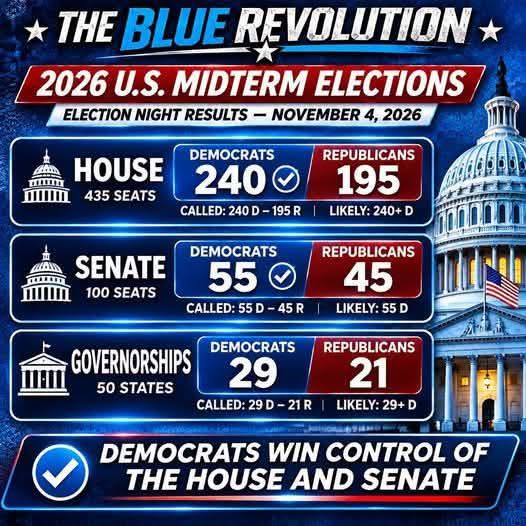
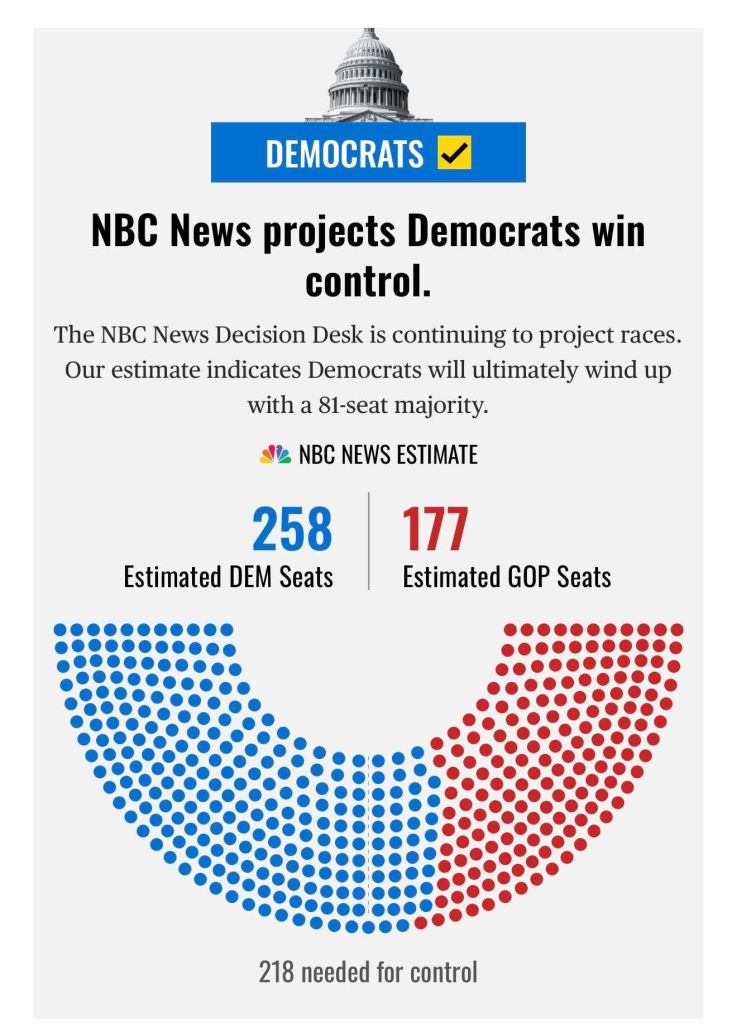
It took a while for reality to penetrate my emotional barriers and accept that the numbers I was watching were real. The defensive shields I had erected were, as one might expect, difficult to crack. But the trends were so convincing that even a cynic like myself could breathe again. The 218 figure for control of the House was achieved almost immediately. Then the Dem number of secured seats became 240 and, as late races are decided, it is speculated that this number might reach 258, a figure few, if anyone, had seriously contemplated.
Next, senate races in each contested election began to fall to the Dems … in Maine, South Carolina, Ohio, Michigan, Iowa, and even Texas where they had not elected a Dem to any statewide office in almost four decades. In Kansas, a Dem won a major statewide race (another Senate gain) for the first time in about a century. It was not just a wave, but a total rebuke of Trump, Trumpism, and the MAGA movement overall. I found myself giggling with relief.
Naturally, I had great interest in the Wisconsin results. The top contest here was for Governor where a young Black candidate from Milwaukee faced off against a well known U.S. Congressman, and hardened Trump supporter who came from a rural part of the state. It was a classic conservative rural versus liberal urban face- off.
Much seemed at stake since the GOP had a seemingly unshakable hold on the state’s Assembly and Senate. Retaking the governor’s chair would send Badger land hurtling again once again toward the ideological right.
The race was considered close, oft characterized as within the statistical margin of error. Deep inside, I wondered whether this swing state really could accept an African-American as chief executive. That question remained a critical question out beyond the state’s larger metropolitan areas. David Crowley, the African- American Dem, jumped to an early lead. Still, all depended on where those votes were located.
As in most states, partisan and ideological affinity depends on where one lives. The liberal strongholds are the major cities, Madison and Milwaukee. Most of the state, however, is rural and pastoral and conservative. In the end, over 520 thousand of the 1.4 million votes for the winner came from these two urban areas. In Dane County (Madison), turnout was high with an 80 plus percent advantage for the liberal candidate. Milwaukee, with a significant minority population, was not far behind, with 76 percent favoring Crowley, who had served as County Executive there. The key to victory, however, remained outstate and with largely white voters. Fortunately, support out there was good enough.
Like the nation, Wisconsin also achieved several firsts. Crowley became the first black candidate elected as Governor in this state. In addition, the first Latino candidate, JoCasta Zamarripa, was elected Wisconsin’s Secretary of State. And finally, the 1st Hmong candidate, Yee Leng Xiong, was elected as State Treasurer.
Such breakthroughs reflect the diversity among successful candidates found across the nation … the first black female governor of any state in Georgia, the first openly gay man elected U.S. senator in New Hampshire, the first female Native-American elected governor in New Mexico. The examples go on. It seemed, despite Trump’s and his minions’ efforts, that diversity was alive and well.
The cherry on the top of all this change, at least for me, came with a reshuffling of the power balance in the Badger state. Republicans had held firm control of the state’s Assembly and Senate since 2011. Over time, and with a favorable state Supreme Court (until recently), they went about pushing Wisconsin toward the extreme right including gerrymandering the state to seemingly ensure continued Republican hegemony for what they believed, or at least hoped, would be a few generations.
But that dream was smashed Tuesday. The Dems secured both elected bodies, 18 to 15 in the State Senate and 53 to 46 in the Assembly. With Dems now in control of the state’s Supreme Court, there is an opportunity to get Wisconsin back on track. For the first time in quite a while, Republican aegis over the levers of control has been smashed.
Why the fuss about just another election? Isn’t it a fact that political and ideological fortunes inevitably swing back and forth. Well, I don’t believe this was simply just another midterm election. The Trump movement had been sobered by their loss in 2020. They entered the 2024 cycle with a scheme (the 2025 Heritage Foundation plan) to solidify power permanently, even if that meant dismantling the essential institutions and basic protocols designed to protect our heritage, our democratic traditions.
Given this, Trump approached his 2nd go around quite differently from his first. He surrounded himself with obedient lackeys while pursuing tactics designed to legitimize continued access to power via both legal and extra-legal means. The steps he and his sycophants took were many, including weaponizing the legal bureaucracy (Justice and the FBI), creating an ersatz private army (ICE), reorienting our military to make them a pliable instrument for his political will, and systemically destroying the professionalism and integrity of the federal bureaucracy.
It is not hyperbole to note that many responsible observers felt that the administration would attempt to intervene in the conduct of the elections (e.g., voter intimidation or suppression) and, that failing, would refuse to accept the results.
I have a good friend who served as a poll watcher in a local Madison site where numerous Latinos voted. We joked about what she would do when the ICE squad arrived and began hassling voters. It didn’t happen but the concern was real.
I have oft thought about whether or not America’s independence has been substantially and similarly threatened in the past. When, and by whom, have our democratically ensured freedoms been truly endangered? As I have opined before, the Trump years are the first and most profound threat I have seen in my lifetime. The Fascist threat from Europe had little chance of success. The Soviet threat through the cold war years might have resulted in a nuclear holocaust but could never have controlled our government with any success. The so-called Islamic terrorists could only create mischief, not threaten our basic sovereignty.
No, our greatest threat could only come from within. That real internal enemy was a long time in the making … starting at least with the Reagan revolution, then picking up speed with the Gingrich revolution, followed by the arrival of billionaire oligarchs who could buy the necessary institutional supports (e g., media outlets), and culminating with the autocratic role model represented by Trump who appealed to at least a third of America with a raw, visceral attractiveness based on fear, hate, and division. He had nurtured a cult-like following on these base emotions.
If we had a doomsday clock calibrating how close we were to losing the final vestiges of our democratic way of life, Trump’s 2nd term would have our nation at least approaching, if not actually striking, the midnight hour. I tried not to panic. Still, if the electorate failed to reject where we were headed, the game, I feared, would be over.
With all this in mind, I sat down to watch Tuesday night’s results with considerable trepidation. Would I be witnessing the twilight of the American dream. Yes, I did feel that the apocalypse was that close. If Trumpism prevailed, with all we knew about it, perhaps there was no road back. Just perhaps, we would have tumbled over the edge of the abyss.
Instead, with growing relief, it appeared that we took a few steps back from the precipice. Importantly, the numbers rejecting the status quo were so substantial and convincing that not even Trump, in his wildest delusions, apparently felt capable of summoning the tools he had erected to challenge the results, at least not yet.

Perhaps, just perhaps, dream of the oligarchs to take full control of America has been delayed, at least for the time being. Some even are talking as if this is a generational shift in our thinking and in our politics.
Such talk is wildly premature. The results are too raw to be fully understood. For example, it is hard to accept that the oligarchs will abandon their quest for ultimate control. There is too much at stake for them. In addition, the shift leftward must deliver on its rhetoric and its elevated hopes. Finally, perhaps the long expected economic crisis will hit at the worst moment, or some other less anticipated disruption will occur. And when results fall short of hopes, some disenchantment is to be expected.
In this hour, though, it appears we have peered into the abyss and taken a step back. We all know the ancient Chinese proverb… a thousand mile journey starts with the first step. Perhaps Tuesday was our first step. Only time will tell. I will be satisfied with that for the time being.


One response to “A step back from the abyss?”
This week we celebrate.🎉🎉🎉👏🏻 Next week we get back to work!
LikeLike