Not long ago, I came across the following quote.
“I do not want to see the Republican Party ride to victory on the four horses of calumny … fear, ignorance, bigotry, and smear. I doubt if the Republican Party could do so, simply because I do not believe the American people will uphold any political party that puts political exploitation above national interest. Surely, we Republicans are not that desperate for victory.”
Margaret Chase Smith
U.S. Senator from Maine
Margaret was a pioneer of sorts. In 1948, she was the first female to be elected to the U.S. Senate without having first been appointed to fill out a husband’s term. That is, she made it (as well as winning a prior House seat) entirely on her own. Apparently, the Republican Party was not quite as misogynistic back then, nor did they axiomatically put party before country.
Her quote above came in a speech attacking a fellow Republican Senator, Joseph McCarthy of Wisconsin. ‘Tail gunner’ Joe, a sobriquet he falsely claimed while running for office in the post WWII era, desperately clung to power by wildly attacking the first amendment to the Constitution. He made utterly unsubstantiated accusations about Commies in our national government, in our military, in the entertainment industry, and in the media.
As a result, a frison of fear and paranoia settled over the country. Citizens were forced to appear before Congress and testify to the disloyalty of friends, family, and associates simply to save their own skins. This was America grossly mimicking the worst of our totalitarian enemies … an exercise in brutish authoritarian cruelty.
Margaret was one of the few to stand up to McCarthy and to what became known as McCarthyism. A few others did the right thing, iconic journalist Edward R. Murrow being one of the more notable exceptions. But most were silent, intimidated by the fear and divisiveness that crossed over the land like an insidious cancer.
Even Republican President ‘Ike’ Eisenhower seemed cowed into silent complicity. His failure to respond struck me as particularly distasteful, given that he had handled other primadonnas while serving as head of the allied forces in the European theater during WWII. It also is surprising given that his own political instincts were surprisingly progressive. He would be deemed a radical socialist, perhaps even a traitor, by the standards of today’s Republican leaders.
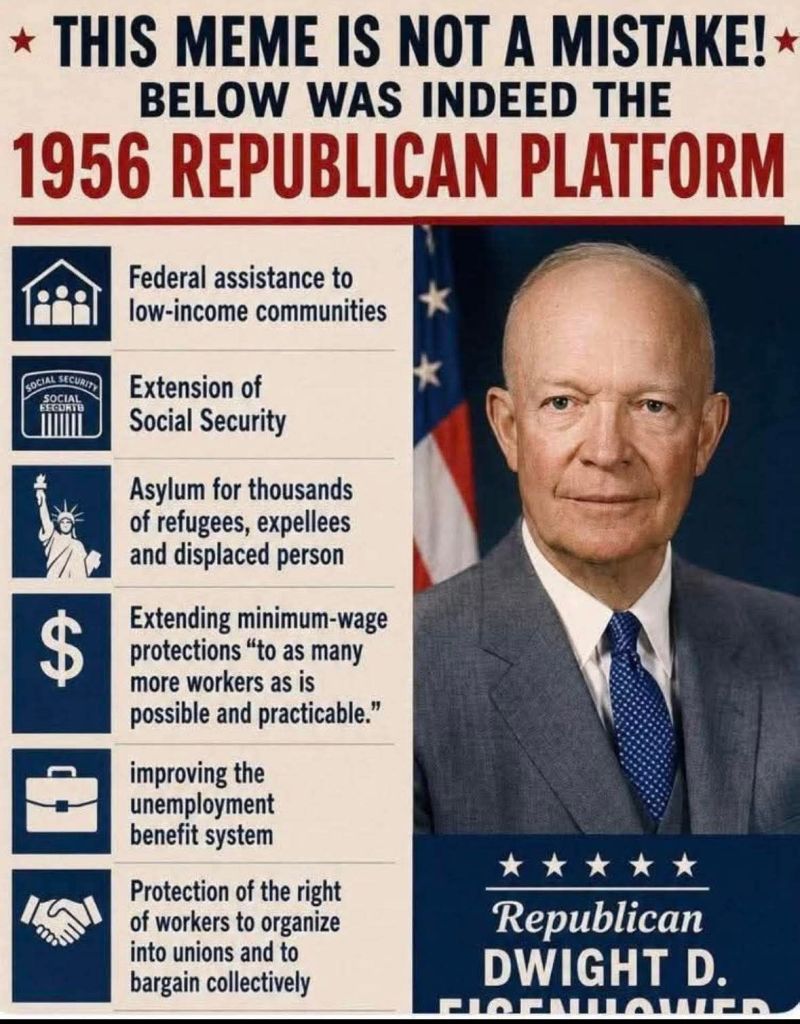
Fast forward to today. How many GOP stalwarts have exhibited the courage necessary to stand up to our current wannabe autocrat who resides in the now gaudi, gold-plated White House. Where are today’s Senator Smiths? Where are the standard bearers for a free and independent press that Ed Murrow exemplified in my youth?
There are remarkably few risk- takers today, though a couple of names come to mind. Former House members Liz Cheney and Adam Kinsiger did speak out. They visibly decried Trump’s frantic efforts to suborn the Constitution when he encouraged a rabid mob to disrupt the orderly transfer of power after the 2020 election.
Both were quickly silenced with Liz being driven from political life by MAGA devotees. Just how did we get to the position where undiluted power could be exercised absent any substantive complaint from the leadership of one of our two major political powers? Where are the checks and balances our forefathers thought they had instituted to prevent executive abuse?
Partisan politics through time.
Many astute observers assert that America first became a living or functioning democracy in 1801, not in 1776 (when independence was declared) nor 1788 (when the Constitution was ratified). In 1801, President John Adams quietly retreated to Boston after realizing he had lost his reelection bid to Thomas Jefferson, his bitter political rival.
Though the founding fathers had hoped to avoid the creation of competing political factions, nascent political groups quickly emerged in full partisan fury even before George Washington indicated that he would step down voluntarily as chief executive.
Adams defeat was the first opportunity to test our written Constitution at a time when normative partisan positions were hardening. Not all were convinced that power would transfer smoothly. Somewhat surpisingly, it did!
The northern states generally had gravitated toward Washington, Adams, and Hamilton in what became known the Federalist Party. Jefferson, Monroe, and Madison (and those from the more rural south) rallied to a separate vision of what America should be. Their distinct aspirations focused mostly on agricultural interests, that favored a more slave-based economic culture, and that embraced a decentralized version of governance. These political actors gathered under the confusing banner called the Democratic- Republican Party.
These two factions quickly evolved into passionate partisan duels and, at times, personal conflict. Adams and Jefferson fell out for many years. They renewed a correspondence late in their lives before each passed on the same day, July 4th of 1826, the exact 50th anniversary of the Declaration of Independence. What are the odds of that happening?
The early parties organized about fundamentally distinct visions. Jefferson’s party disavowed forms of centralized control, stressed the importance of individual sovereignty, acceded to a hierarchical view of societal order, embraced limited government, and disavowed any reliance upon strong federal institutions. For example, they wanted no national bank. They also tended to be Francophiles, if not outright Anglophobes.
The Federalists embraced opposite foundational principles, at least in theory. They wanted a central bank and a more powerful federal government. They generally were appalled by slavery or any rigid hierarchical structure of social status. They were less hostile toward social mobility and embraced permeable class boundaries.
After all, Alexander Hamilton was a self made man, the bastard son of a bankrupt speculator in the Carribean. Most of all, they sought a world in which government might proactively foster fuller social and economic opportunities for all. And, despite our recent conflict with George III, they hoped to maintain friendly relations with England.
The 1801 election, and future battles for power, was more than a competition between two men. They became conflicts over core principles, over wildly different perceptions of what constituted the good society. Thus, they became the existential conflicts of those times.
Adams’s quiet recognition of the peoples will, or at least the will of the minority who could vote back then, was a most significant moment in a still maturing democracy. It proved the Constitution was more than a piece of paper. No matter how powerful a politician was, or thought he was, the rule of law would prevail. That moment marked the American experiment as relatively unique … principles above power.
Fast forward some 200 plus years and one still can detect the basic conflicts underlying America’s first competitive election. In recent decades, the Republican party (until Trump) had come to resemble Jefferson’s vision of limited government, of state’s rights, and of a hierarchical perspective on society’s natural structure. That is, some are inherently born to rule.
By the early 1990s, when an aggressive Republican named Newt Gingrich took control of Congress through his Contract with America, any residual cross party collaboration in Washington was finished for good. No longer would a liberal Speaker like Tip O’Neil be able to work with a conservative like Ronald Reagan for the public good. You might recall that, over drinks, these two Irishmen from diametrically opposed partisan positions agreed to compromises that extended the solvency of the Social Security system for over half a century.
Their Democratic foes embraced an oppositional view on these and other dimensions of society. Today’s elections once again seemed to invoke existential battles over core normative perceptions of good and evil.
However, one cannot draw a straight line between then and now. Over time, beliefs evolved and parties switched sides, often in confounding and perplexing ways. And now, of course, we have Trump who has thrown out all apparent rules and principles in the pursuit of selfish treasure, complete power, and obsequious adoration from the masses.
There can be no more serious threat to the visions of the founding fathers, no matter their differences back then, than is found in what Trump and the MAGA cultists have thrust upon us in our own day.
A tortured history.
This got me wondering. Political parties obviously are not fixed entities. They evolve over time in response to endogenous and exogenous challenges. While there was some continuity in the underlying principles of each party in their beginnings, our two main partisan clans (along with their ethical and normative perspectives) did not fully form until the 1850s. The great issue of the day, slavery, drove political choices and demanded further clarification on where people stood. Just what did each party represent?
In 1854, the Republican Party purportedly was created in a small white school house in Ripon Wisconsin. It was not created out of whole cloth. The founders borrowed heavily from the dying Whig party which earlier had more or less succeeded the Federalist party. Those political activists seeking a more proactive government, and one that had a more abiding faith in democratic principles, kept searching for a competitive formula for success. Now, such success was being demanded. In that moment, America trembled on the very edge of dissolution. Old approaches were insufficient. It was decided that a new party was needed.
On the other hand, Jefferson’s original cabal was recreated in the image of a populist party that had been renewed and reinvigorated through the charismatic leadership of Andrew Jackson. This vision of the good society glorified the common (white) man while justifying slavery and endorsing the genocide of Native Americans. It was an odd mix of contradictory beliefs, granting the common man an elevated status while adhering to a notion that some were born inherently gifted and thus entitled to rule over others.
Some 165 years ago, just before our horrendous civil conflict, we finally had the two parties that would battle for the soul of the nation. In fact, the election of the first Republican to our highest office sparked a wave of secessionary fever across our southern states. Though numerous 3rd parties had brief shelf lives, these two major foes would come to represent the essential philosophical divisions about what America should be.
In doing so, however, each would evolve, swap foundational principles, and sometimes engage in perplexing changes of purpose and character. History affirms that politics do, on occasion and for idiosyncratic reasons, create some very strange bedfellows.
Consider the following. In the time of Lincoln, the new Republican Party were that era’s liberals. They were against the extension of slavery in the West as that frontier developed. They also would strengthen the institutional framework of the federal goverment, a spectre of control Democrats fundamentally feared might reduce the sovereignty inherent in the local authorities that they felt were a sacrosanct party value.
Those early Republicans were proactive. They invested in infrastructure (for example the intercontinental railroad) and education (e.g. land grant universities) as ways to promote economic growth. They hoped to stimulate industry and finance in ways that rural agrarian interests distrusted.
The Democrats, on the other hand, defended slavery as critical to their agrarian way of life. They also recognized that ending that so- called peculiar institution (slavery) would dramatically reduce their wealth. In that matter, they were correct. Some 4 million slaves, when monetized, were worth more than all the railroads and industry in the North combined.
Challenging Southern culture, in turn, would threaten their preferred approach to governing public affairs… one that favored rule by a landed aristocracy. They favored limited suffrage (by wealthy landed male gentry), exhibiting little interest in the very democratic system that they also proudly claimed had been originated in America. In a way, that Democratic Party harkened back to almost a feudal model of society.
What exactly were they defending in the civil conflict they initiated? They wanted to defend a system of oligarchic control vested in large plantation owners. As noted, the south held much of the country’s wealth in 1860. England depended on Southern cotton. Even New York profitted from the extensive ongoing trade in this commodity as did the embryonic weaving industries popping up in various New England towns where rushing rivers drove looms into action. Ironically, the very Civil War they initiated to presumably preserve their advantages would initiate a seismic shift of economic hegemony from the South to the North.
In 1858, a Southern senator (James Hammond from South Carolina) gave his famous Mudsills speech. It outlined the Democratic (Southern) party perspective on the ideal social order for those times.
White gentility was born to rule. Blacks (and poor whites) needed to accept that reality for their own good and for societal progress. The poor and enslaved were the mudsills (foundational supports) of society. White plantation landowners had the proper breeding and genetic advantages that prepared them for command. This was the hierarchical order established by God. To oppose that social structure was tantamount to sin.
The South never accepted military defeat, finding alternative ways of extending autocratic control over minorities and the landless poor. For another century, the South would remain devoted to the banner of the Democratic Party, an anomaly that would grow increasingly bizarre as the two parties evolved in distinctly divergent directions.
In the early decades of the 20th century, southern voters began to describe themselves as yellow dog Democrats. They simply could not vote for a candidate from the party of Lincoln. To do so would make them little better than a rabid dog.
I once chatted with the late William Winters, one of the last Democratic governors of Mississippi. He told me he was a relic of a dying breed, a liberal Democrat who only prevailed because racist voters simply could not vote for a hated Republican, the Party that had destroyed their past utopia. He had me in stitches with his tales of being a liberal in Jackson Mississippi.
The two parties change colors.
Let me summarize quickly the evolutionary paths taken by each party as succinctly as possible. The Republican Party soon abandoned their early support for the poor and vulnerable … especially when such principles became inconvenient.
For example, they abandoned the Freedmen’s Bureau by the 1876 presidential election simply to get a Republican back into the White House. When that disputed election was thrown to Congress, Democrat Samuel Tilden appeared to have an electoral college victory. But all the disputed votes were given to Republican Rutherford Hayes when the GOP party promised to end southern reconstruction, recall remaining federal troops from the South, and desist from any further protection of Black rights in Dixie. The Jim Crow era had begun.
In subsequent elections, the Republican Party bosses realized that New York State was key to their success in the electoral college. Key to winning that state was support from the moneyed classes of New York City. Quickly, the economic interests favored by the elite took center stage in internal party debates and in policy decisions.
By the time William McKinley was nominated late in the 19th century, financial interests were driving policy choices and controlling the soul of the party. Allegedly, suitcases of money from the likes of J. P. Morgan could be depended upon before election day. Money would become even more important a century later, when the Citizens United and Fairness Act decisions turned politics into a furious cash raising competition.
At the same time, the Democrats slowly embraced the more vulnerable sectors of society that the Republicans had, at least for a short time, once represented. They attracted newcomers among urban immigrants and smaller landowners in the Midwest and West. These groups felt exploited by the big- money interests.
Within the Democratic party core, a populist message gained ground, especially in the plain states. The enemy of the common man were the moneyed interests back East. Those finance tycoons favored a strong dollar backed by gold. That, however, dried up credit and favored lenders over borrowers. Like today, the game favored the owners of capital over those who worked for a living.
As industry grew in the late 19th century, workers fought against capitalists. Workers generally found some willing ears among northern Dems. That interest in the plight of the exploited seldom had enough legs to win national contests. The cause of labor and small farmers needed a voice. A few, like William Jennings Bryan, heeded that call.
Progressive legislation more likely succeeded when Maverick Republicans gained power. Teddy Roosevelt, an accidental President when McKinley was assassinated, helped initiate the progressive era of reform in the early part of the 20th century. In Wisconsin, ‘fighting’ Bob Lafollete (a progressive Republican) fought against the moneyed interests (the railroads and the logging barons) in support of the common man.
Wisconsin became known as the laboratory for democracy, a state famous for the Wisconsin Idea where the state and the university would cooperate for the benefit of all. For example, Wisconsin pioneered a university proposal to create a public legislative arm that would assist lawmakers in drafting legislation. Before that, elected officials often turned to corporate lawyers for technical help. No conflicts of interest there 😀.
Among other things, the great global depression of the 1930s and WWII further disrupted business as usual. Even with racist Jim Crow restrictions, the New Deal programs of FDR began to positively impact the wellbeing of minority populations. Eleanor Roosevelt, in particular, was seen as a champion of the poor and the racially dispossessed.
Then, Roosevelt’s successor (Democrat Harry S. Truman) surprisingly ended segregation in the military. He did so despite all his advisors telling him it would end any chance he had for reelection. He went ahead anyway and still beat Dewey in a shocking upset.
Why is all this significant? Well, virtually all Blacks had been devoted Republicans which traditionally had been thought of as the Party of Lincoln, the great emancipator. Slowly, northern Democrats seemed to offer more hope. If anything, the two parties looked like patchwork creations of competing interests held together more by tradition than common aspirations.
The post WWII era is looked upon as the heyday of bipartisan cooperation. But that might be explained as the great historical accident of national party politics. Southern racists held on to their fidelity to the old party that had supported slavery including the subsequent control of whites over blacks during the Jim Crow era. Over time, they were joined by northern liberals who were taken by the popular policies of FDR, Truman, Kennedy, and Johnson. It was an unholy alliance that could not last. Think about it. You had southern racists like Richard Russell and northern radical liberals like Hubert Humphrey trying to survive within the same Democratic tent. Not surprisingly, it didn’t last much longer.
Southern revolts against the national party started in 1948 (the Dixiecrat convention walkout) and simmered over the next two decades. The ‘coup de grace’ of bipartisanship was dealt by the Civil Rights acts of the mid 1960s. Southern Democrats began to repudiate their historic affinity to the Democratic Party. Richard Nixon embraced this revolt of party allegiance as part of the Republican party’s Southern Strategy (as popularized by Kevin Phillips).
The core of this realignment was a reordering of the moral basis for each party’s appeal. Republicans argued that they had returned to time-honored and traditional virtues even if such were a bit tarnished by overt discrimination against minorities and militaristic adventurism abroad.
The Democrats emphasized their concern for more abstract values of social justice and fairness for all. When they could work with liberal Republicans across the aisle, they were freer to pursue a more progressive agenda.
The great spate of legislation during the 86th Congress (civil rights, poverty legislation, medical care expansion) were the last gasp of that old bipartisan world. Liberal northern Democrats collaborated with progressive Republicans to enact ground some breaking legislation.
There was a downside to this, however. Passage of the civil rights legislation, in particular, marked the end of most inter- party collaborations and the start of a journey toward more internally coherent, perhaps rigid, Party frameworks.
Such differences in the core message of each party had a differential impact on the political choices of various groups. In the graph below, one can see the choices made by conservative, mostly white evangelical voters. They saw poverty and vulnerability as personal failures, not systemic issues that government might rectify. They began to flock to the Republican standard. Within a few years, the Democratic South merely was an historical artifact.
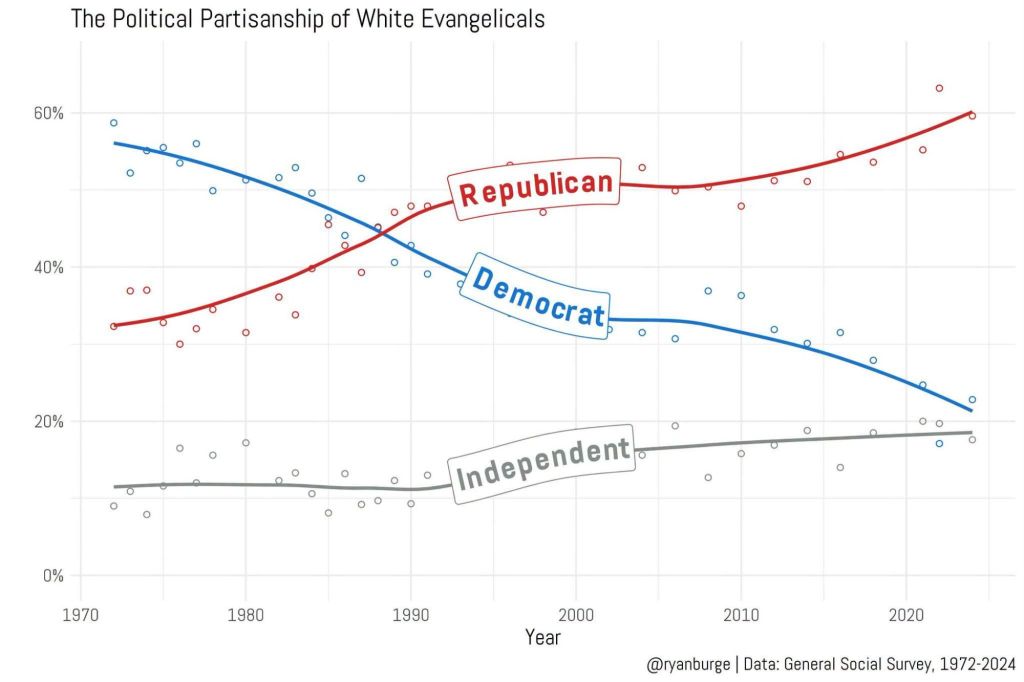
Conservative Democrats went Republican at the same time that liberal Republicans in the north and far west slowly migrated to the democratic fold. This was the great political realignment of the mid 20th century. With the old partisan accident finally shattered, the path toward hyper- partisanship was assured.
Reagan furthered this shift by starting his 1980 Presidential campaign in the heart of the old confederacy. The message was clear. Republicans were now the standard bearer of aristocracy. They would protect the continued hegemony of a privileged white ruling class.
A Republican friend of mine who worked in D.C on the Hill (as they say) once told me his insider views on Gingrich. Newt, my friend confided, saw himself as a take no prisoners revolutionary. He had little interest in governing well. He was more interested in bending the Republican Party to his will. So, he instituted strict rules governing party loyalty. There would be no future straying from party orthodoxy.
We now have had over three decades of conflict (including virtually total non-cooperation) between the major parties. I recall one time when Newt Gingrich actually betrayed his cardinal rule against any collaboration with the enemy. Despite his own rules, he supported President Clinton on NAFTA, the free trade agreement. Gingrich subsequently tied himself into a knot defending his own violation of the new, inviolate Republican mantra. It was hysterical watching him squirm.
By the start of Barak Obama’s tenure as chief executive (2008), the political split was complete and seemingly unassailable. Mitch McConnell stated clearly that his party would never cooperate with the demonic Democratic administration … on anything. Their only purpose was to make our first African- American chief executive a one term President. Governing no longer mattered. Seizing and keeping power was now the exclusive name of the game in Washington.
Looking back, we probably enjoyed far more effective governance when the parties were less coherent and more diverse in terms of values. That is not such a mystery when you think about it. It was likely due to greater flexibility afforded individual members of each party. They were not fully controlled by party leadership as has been the case at least since the early 1990s, if not a decade earlier.
In the early 1990s, I recall a high level Republican House staff member telling me about their new internal control mechanisms. For example, the GOP had drifted further and further to the right from the 1970s onward. By the early 1990s, protecting the interests of the wealthy had emerged as the party’s primary (perhaps only) purpose, much as it had been a century earlier.
That goal was reflected in the GOP’s fight to eliminate the estate tax, a change favored by the uber- affluent. To reflect their support of the wealthy, the party leadership established a rule by which their elected members were fined if they did not refer to the estate tax as the death tax. Facts and data meant nothing. Image and emotions ruled all in the Republican fold, a lesson the Dems were slow to follow.
The Republican party was now all about capturing the political narrative, making their vision the default position in American politics. They saw political campaigns as continuing struggles over which normative foundation and characterization of society would prevail. In that struggle, reason and evidence was far less impactful than emotion. Capture their fears and hearts, not their minds. This has been another hard lesson for liberals.
The winning narrative had a coherent core. And it was simple. Like the Democratic party of the 19th century, some were born to lead. You knew who they were by virtue of existing evidence of success (accumulated wealth), by ethnic pedigree, and even by skin color. Society was hierarchical and status within it came from mostly ascribed attributes, perhaps only occasionally a few attained by actual individual effort.
In addition, aggression (a strong military, ownership of guns) was encouraged since enemies were ubiquitous and omnipresent. And, in these dark times, leadership was key. Who could protect you in a dangerous world? A firm leader, but only if obedience to that authority was premised on shared (i.e., conservative) values.
The Republican party’s success in capturing the dominant narrative among voters has had profound consequences. The RAND corporation estimated in 2020 that some $47 trillion had been redistributed over the past three decades from working class Americans to a tiny financial elite at the top of the distribution. It seems that this redistributional trend has exploded in past few years. RAND recently upped that figure to almost $80 trillion.
Amazingly, Republicans once lambasted redistribution as a political sin. But that was when the flow was downward, from the well off to those struggling near the bottom. Apparently, it is no longer a sin. It has become a virtue as the flow goes in the opposite direction. Last year, workers earned $3.9 trillion less than what they would have earned if the income distribution prevalent in the 1970s had prevailed. Back in the 1970s, workers captured 68% of our economy’s created value. Now, their share is down to 52%. Owners of capital had become the clear winners. Not a peep from the Republicans about this.
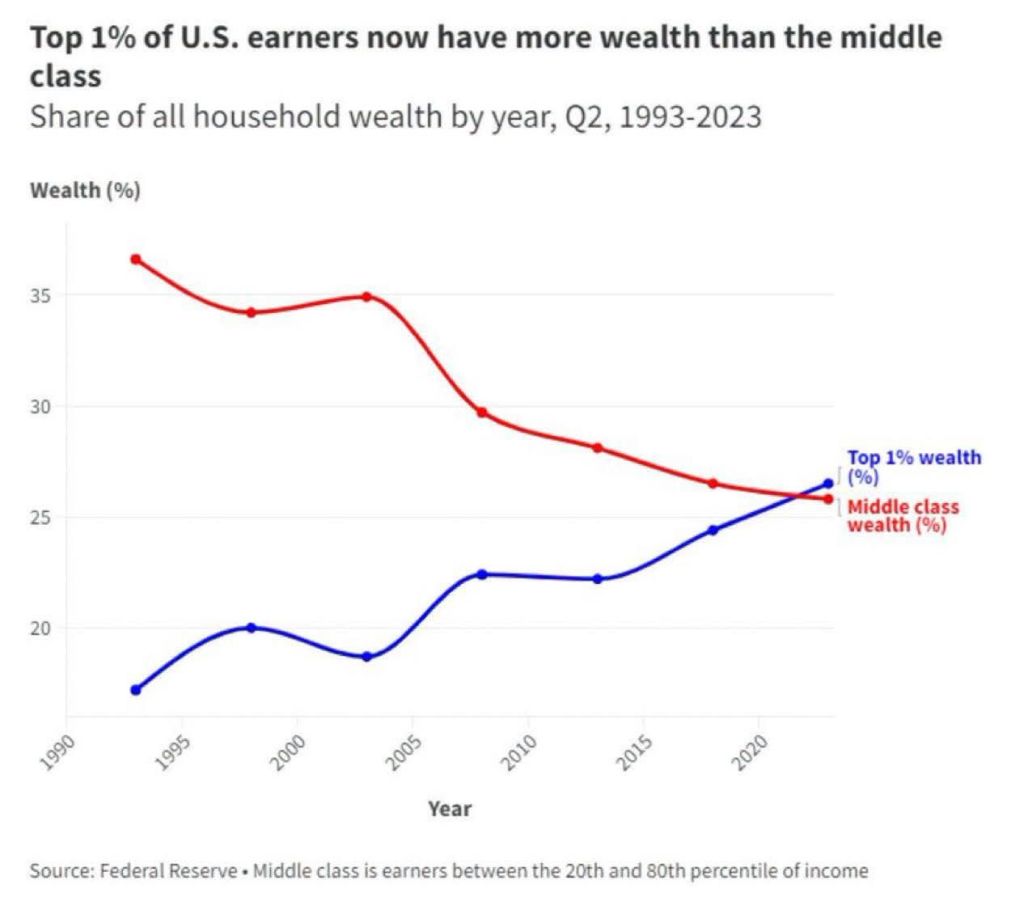
As the above graphic shows, the fortunes of the elite have improved significantly. At the same time, those of average Americans have fallen substantially. Somehow, the Republican Party convinced at least half of the country that this outcome is fair. They have convince much of the electorate that it is fine if a few dozen multi-billionaires possess as much wealth as the lower half of the entire population. It is merely a free market at work, an updated version of Senator Hammond’s distribution of social goodies according to some divine law.
Our neoliberal friends in today’s Republican party characterize all those struggling to get by as parasitical losers who are entirely responsibly for their own failed situation. That timeless trope has sold well, enabling them to enact policies to further enrich the favored few while savaging what remains of our pathetically inadequate social safety net.
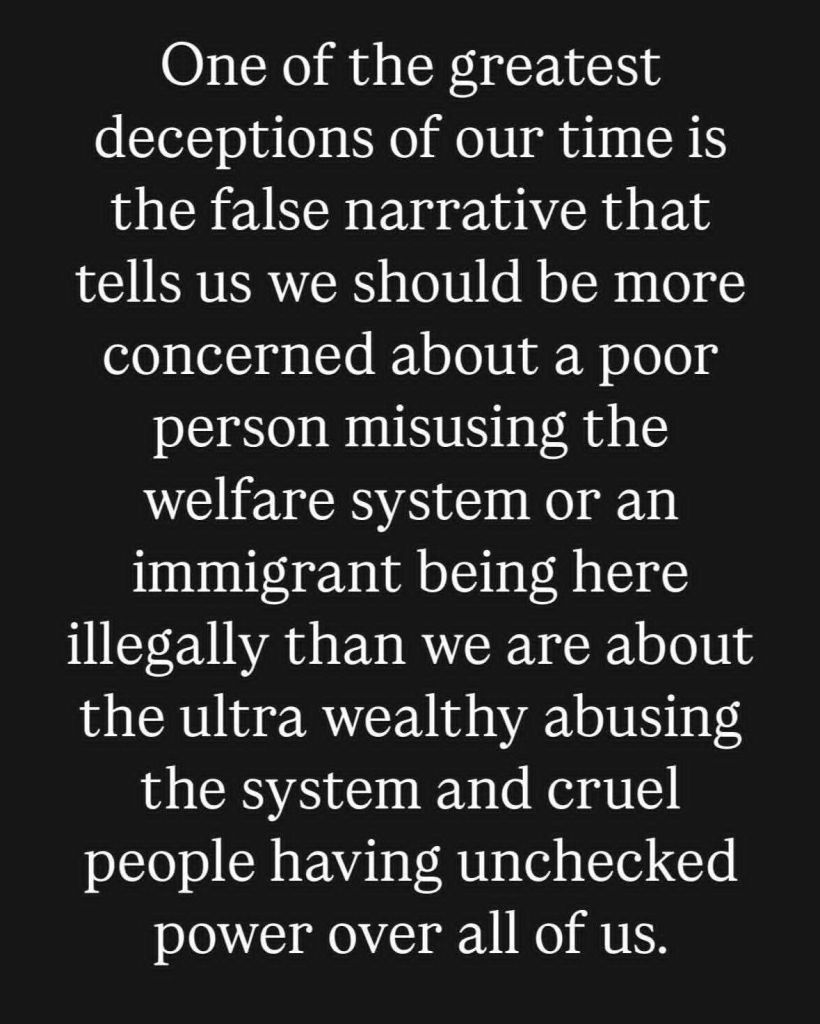
As our two parties struggle over competing narratives and political hegemony, who is minding the store? Who is steering the ship of state. It would seem no one. The Democrats have had only fleeting control over all levels of power since the Reagan revolution of 1980 when they seized power. In general, Republicans have enjoyed outright control or effective veto power for several decades, as we will see later.
How many significant pieces of legislation have the Dems managed since Jimmie Carter. Clinton did bring spending under control, even ran several surpluses while in office. Obama managed to save the economy wrecked by the housing crisis under Bush, the son. Biden did the same after Trump mismanaged the Covid crisis.
These actions generally helped stave off the worst consequences of Republican mismanagement, but could not reverse the damage being done. The one proactive measure I recall is the passage of Obamacare. And how did the Republicans respond? They fought it with undiminished fury. They did so despite America spending way more on health care than anyone else while delivering, on average, mediocre health outcomes. They did so even after most Americans came to support the act. They cannot tolerate any effort that helps the common man, even if it is popular, especially if it is popular. The rest of the world cannot comprehend how such a rich nation fails to deliver health care as a right, like all other advanced nations have managed to do. How venal can our leaders be?
Apparently, they can be deadly venal. Conservatives have sold America on the myth that we are the greatest country on earth. As the next meme shows, that is far from true.
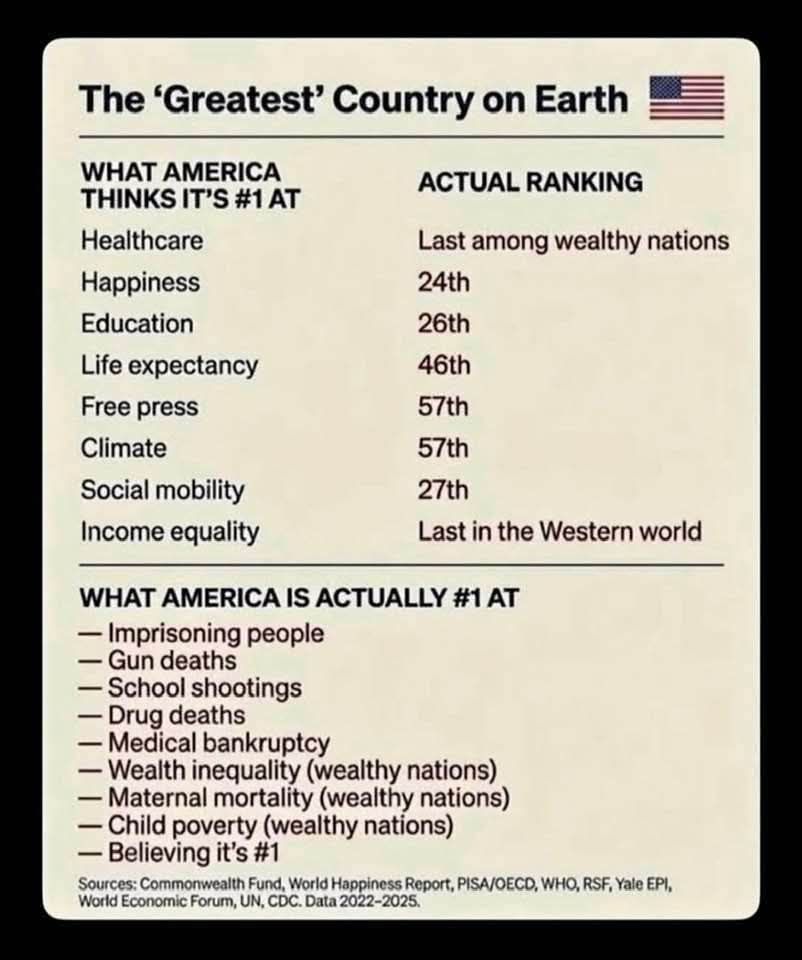
What accounts for the discrepancy between facts and fancy, between America’s reality and its mythical narrative. Well, Republicans have had a plan for over 50 years now. It involves having access to unlimited money 💰 that William McKinley could only dream about in his day. And it involves control over key institutions like those involving education, the courts, the core federal bureaucracies (Justice, security forces like the military, the courts, etc.), and especially the media. You have these levers of power, and you can control the political narrative, or at least you should. In fact you can convince people that up is down, truth is false, war is peace, and all the other dichotomous falsehoods George Orwell wrote about in his fictional dystopian world.
Controlling the narrative.
Political parties are inherently conservative. They are motivated by the fear of not making mistakes. This has particularly been true in the Democratic party. But the Republican alternative had a successful revolt from within. Starting with Barry Goldwater in 1964, internal revolutionaries fought the old guard from the inside.
In the end, the revolutionaries won. Slowly, they purified the party, driving out those interested in governing. They rid themselves of all reasonable Republicans by primarying their centrists and those capable of independent thought or by making them feel marginalized in the national party. John McCain, Mitt Romney, Liz Cheney, and Adam Kinziger were the final examples of the old breed.
One could see it coming. As the drift of the party to the hard right continued, prognoses by so- called pundits had the Republican party imploding, perhaps shrinking to a marginalized, regional party. Such predictions proved wrong. In the end, the underlying narrative of the neo-liberal vision for society had legs.
Oddly enough, as more Americans saw their middle class world slipping away, the oldest misdirection tactic in the pkaybook worked even better than ever. Give the losers someone to blame … like immigrants or woke eggheads or coastal liberals. Worked for Hitler after all, though he used Jews.
It was a vision that continued to further flourish in the Trump years. It proved successful with a populace that was too frightened and confused to think for themselves. Playing to their fears, it proved easy for a lifetime grifter to play to a crowd’s uncertainties, to create additional mass neurosis, and to turn widespread anxieties into fawning adoration.
In an ironic twist, the drift of the Republican Party toward traditional authoritarianism ultimately led to the demise of GOP party itself. The conventional party apparatus proved less than useful in an authoritarian world. Party functionaries had been replaced by an autocratic leader … a pathological narcissist and sociopathic degenerate named Donald Trump.
His new totalitarian vision for America was spawned in the very think tanks (e.g., the Heritage Foundation) that have been thinking about and planning for how democracy might be replaced for over half a century now. The strategic vision to enact that revolution came from people like Lewis Powell (future Supreme Court judge). He laid out a strategy plan in 1971, an approach by which the hard right would take gradual control over key societal levers.
It took time but they succeeded. Creating conservative think tanks (like the Heritage Foundation) was part of that plan. In anticipating Trump’s 2nd term, the 2025 plan of the Heritage Foundation was designed (updated) to ensure that control would remain in their hands. Once achieved, power would be retained by any means possible. Democracy, in permitting the will of the people to prevail, is far too uncertain. It has to be ended.
Even if Trump were to succumb to age, to his obvious mental health issues, or to his own personal excesses, those behind the throne would not permit a return to our former, even if less than perfect, democracy. More likely, another wannabe dictator would be placed on the throne or some form of plutocracy might be instituted. Already, steps to discredit the upcoming mid-term elections are being taken. Behind the scenes, frantic efforts to politicize and militarized essential police, military, and security forces are underway. Election officials already have been fired.
When the time comes, a cabal of the supremely wealthy would assume control either overtly or indirectly. In doing so, they would pursue policies that would ensure their continued hegemony. The irony is that, in such a world, political parties would no longer be necessary. After all, appealing to the will of the people would only prove inconvenient to those who know exactly what they want.
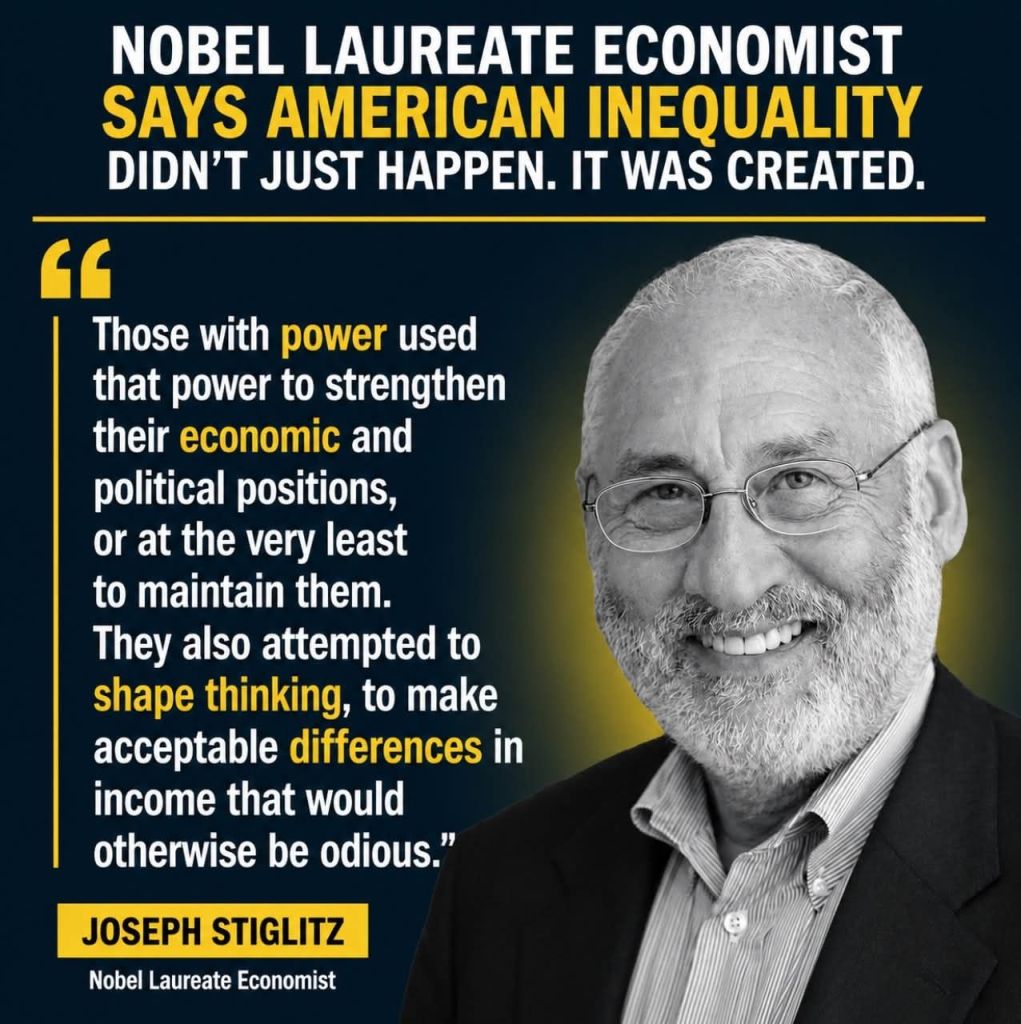
This was a fate long feared by our founders. When Ben Franklin was asked what kind of government had been hammered out during the Constitutional convention, he replied ‘a republic, if you can keep it. ‘
Ben was a wise and learned man. Perhaps he was thinking of Cicero’s warning as he replied to that query.
“A nation can survive its fools and even the ambitious. But it cannot survive treason from within. For the traitor appears not (to be) a traitor. He speaks in the accents familiar to his victims, and he appeals to the baseness that lies deep in the hearts of all men. He rots the soul of a nation … a murderer is less to be feared “
Cicero
Roman Statesman
Postscript…
As is my wont, I typically start these blogs with one thought in mind and end up somewhere quite different. That is why these are called musings and not essays. It also is why they turn out longer than intended, sometimes much longer. Perhaps a summary of this long meander through my fecund imagination is in order.
Despite the seemingly endless words, my basic story line is rather simple. For much of our history, two dominate political parties struggled for an identity, for a coherent narrative, and for a modicum of sustained success. However, it wasn’t until the latter half of the 20th century that the parties achieved a reasonable level of internal coherence and something close to a well defined message, a consensus narrative.
Think about it. In the first half of the 20th century, Republicans embraced both diehard conservatives and outright progressives. The Dems included staunch racists and radical reformers. Toward the end of that century, that confusion clearly diminished. The GOP finally achieved a clear narrative largely because they began to focus on a single group’s interests … the uber wealthy. That made their task of achieving political dominance much, much easier.
Their consensus narrative was amplified by an emotionally charged propoganda boost. Though a distasteful message to intelligent and sensitive listeners, the Republican pitch proved highly successful to the less sophisticated when delivered by agenda- driven media outlets (e.g., Fox News) that dominated our informational- distribution systems by the 1990s. That narrative became the default (or go-to) cognitive and emotional place for the average American.
When you take a broad overview, one can see broad epochs of dominance (in terms of articulating the favored go-to political narrative) by one party clan or the other. I see it this way. The southern-based Dems held sway in ante-bellum America (extorting the nation with periodic threats of secession). Forgetting the Civil War and the subsequent reconstruction period, Republicanism held sway from the gilded age (essentially post reconstruction) through the roaring twenties. Then, the Dems assumed dominance once again from the great depression through the 1970s. Since then, neoliberal conservatives have been in charge. Will the pendulum now swing back to the Dems?
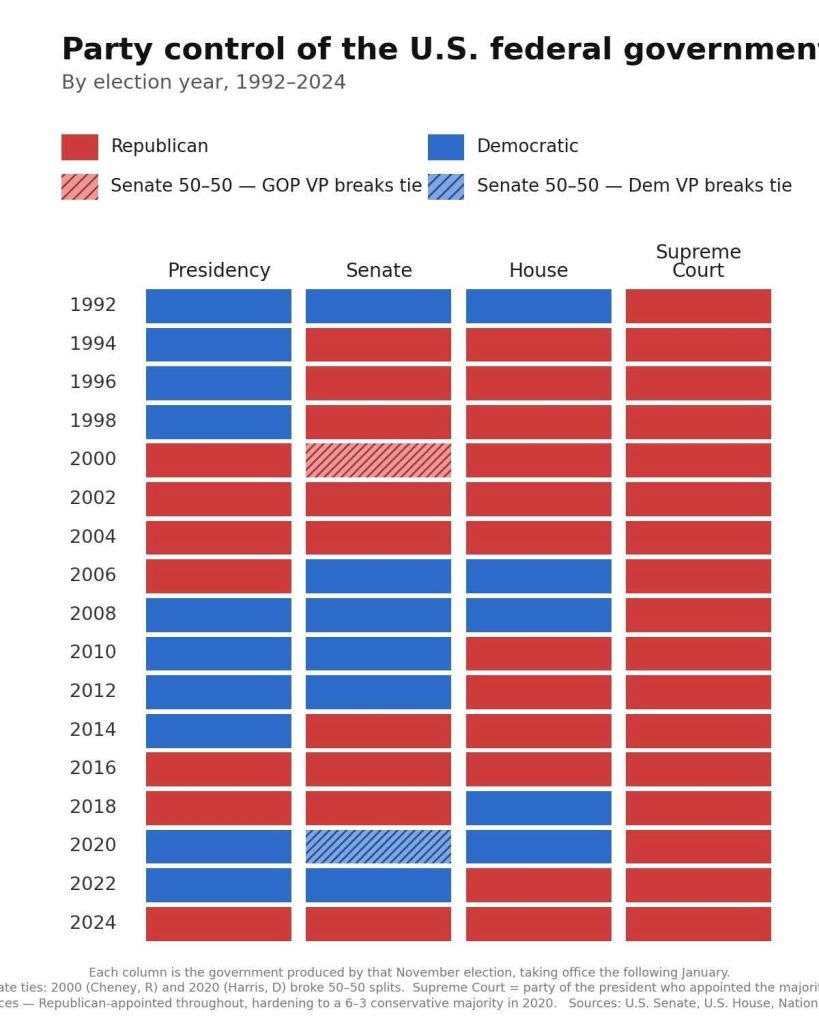
As I noted above, the Dems have not held all four levers of national power (see previous meme) for some time. They have held three critical levers briefly only twice in recent decades, at the beginnings of the Clinton and Obama terms. Those were short term periods in which little could be achieved. Obamacare did represent a signal piece of legislation. Still, the neo-liberal narrative has prevailed since the 1980s.The resulting damage to this nation has been incalculable.
I could feel the larger shifts in my own voting patterns. Early on, I disdained bring associated with an organized party. I preferred being thought of as a smart, independent thinker … my own man. Besides, party affiliation often told me little about a candidate’s values or normative inclinations.
In college, for example, I admired U.S. Senator Ed Brooke from Massachusetts. He was thoughtful and very intelligent. He was the first black to serve in the Senate since reconstruction. And he was a Republican. He was a candidate I could readily support though I don’t recall having that chance.
By the early 1990s, there would be no place in the Republican party for a public servant like Ed Brooke. By then, both the beliefs and the behaviors of party members were strictly controlled. You no longer were voting for individuals. You were voting to support the dominant belief systems underling a party’s foundational narrative. Anyone could fill the seat since they were not permitted to think nor act on their own.
Above all, the emergence of a single strong, internally coherent, political party on the right has led to an unforseen, potentially catastrophic consequence. The narrative pushed by the emergent hard- right Republican Party enabled a virtual dictator to assume power nationally. The party apparatus, the other levers of power (e.g., Congress, the free press, the Supreme Court) have been substantialy emasculated in the process. We just might be looking at our post- democracy era.
Those who historically have disliked political parties, like our founding fathers, probably would be appalled at seeing what has happened when one of the major parties failed to exercise control over its worst actors. In achieving nominal success by the usual standards applied to political factions … they prevailed in the normative debate about which vision of America should prevail. At the same time, they may well have sacrificed their future utility and any meaningful role in our electoral dynamics. A rather Faustian bargain indeed!
One should always remember the old admonition… be careful what you wish for. Stalwarts among the Republican faithful long hoped to prevail in the conflict over our governing ideals and ideas. And they did, starting with the so-called Reagan revolution. In doing so, have they sacrificed their own role, and legitimacy, in the process.
In our times, the passing of Trump is not likely to end this existential threat to our experiment in democracy. If the normative pendulum is, however, poised to swing again, what will replace the recent Republican ascendancy? A new Dem – inspired era perhaps? Or might it be a post political era dominated by a super-wealthy plutocracy?
One can hope for the best but …
PS: I might take a break for a bit 😬!

