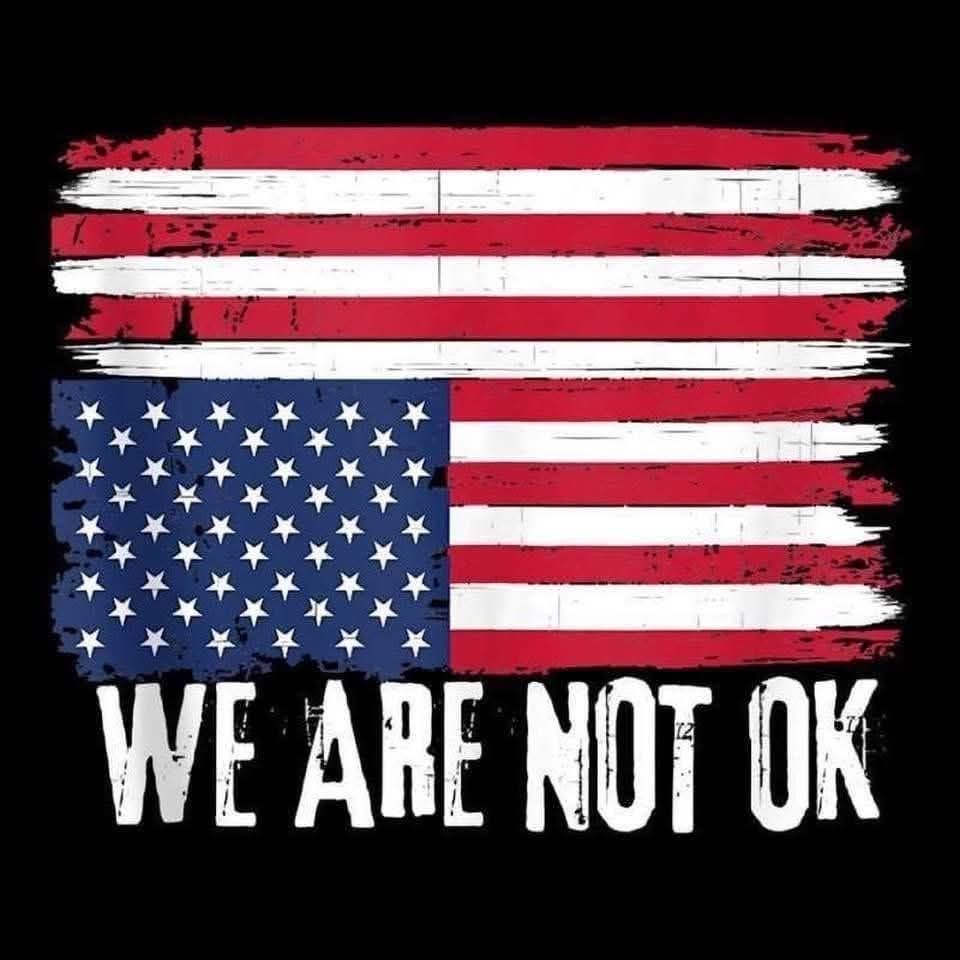
Our so-called national birthday is upon us. By way of a celebration, let me touch upon one concern of mine (among many) … our sinking reputation across the globe. This declining global status reflects, one might argue, a sense that our domestic political integrity has deteriorated significanctly. I might also add that a fear is emerging in which social tensions might be pulling apart our binding cultural foundations.
Yet, let us put these greater concerns aside for a moment. I want to first focus on our global image. On this, I am recently motivated by watching a number of Trump devotees being interviewed, always a bad idea.
Several of these brainiacs referred to the Donald with unrestrained adoration. They gushed about how he has brought us together, how he has renewed American purpose across the globe, and how he has again established respect for America among all nations of the world.
Really, I thought to myself, Donald did all this? Are we talking about the same Donald I have seen insulting our long standing allies, the one sucking up to the worst strongmen currently strutting across the international scene, and that same character who has assiduously dismantled the Western alliance that has maintained some sense of global security (admittedly not perfectly) for the past 80 or so years. I then began to bang out a response to such ridiculous assertions.
Soon, I caught myself. To keep this manageable, I start with how America (and our current so-called administration) are perceived elsewhere in the world. In doing so, I could not ignore just a few notions that might be contributing to our declining reputation. I touch on them later.
Of course, this is not the first moment in which America has come under negative scrutiny. I can recall way back in the post- WWII era when ‘Americans Go Home‘ slogans seemed ubiquitous, even in lands we had just helped liberate from Fascism.
Perhaps such sentiments might reasonably be attributable to envy. We had emerged from a global conflict in an envious position, even as we projected an irritating, oft overbearing hubris toward others. There was some truth to the notion of the Ugly American back then.
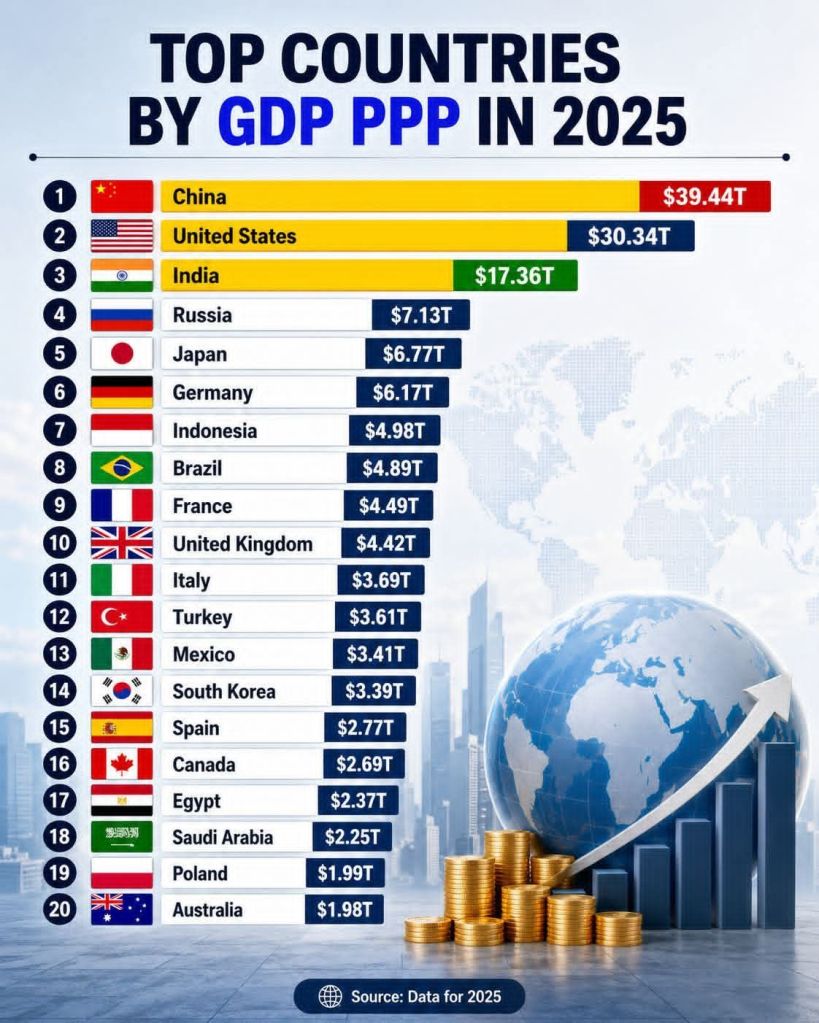
Now, to the present. We still have the largest economy in the world, with a GDP approaching $40 trillion. When nominal GDP is adjusted by each nation’s purchasing power (price differerentials), however, the U.S. falls into 2nd place (see next graph). And who replaces us as no. 1 … China!!!
China, it turns out, is an instructive story. A half century ago, during the crippling period known as Chairman Mao’s cultural revolution (1966-76), as many as 2 million citizens perished from internal ideological zeal as that nation’s autocratic leaders attempted to shift blame for other recent failures.
Just a few years earlier, during Mao’s Great Leap Forward (late 1950s to early 60’s), anywhere from 20 to 40 million had perished from breakdowns in agricultural production and commodity distribution. Perhaps there is a warning here … beware of regimes and leaders that are congenitally incapable of admitting fault or accepting personal responsibility.
Eventually, those autocrats passed from the scene while their successors learned from earlier errors. In a little more than a single generation, starting in about 1990, China has made enormous investments in infrastructure, communications, renewable energy sources, general technology, and education. Let’s simply look at China’s emergance as a global research leader.
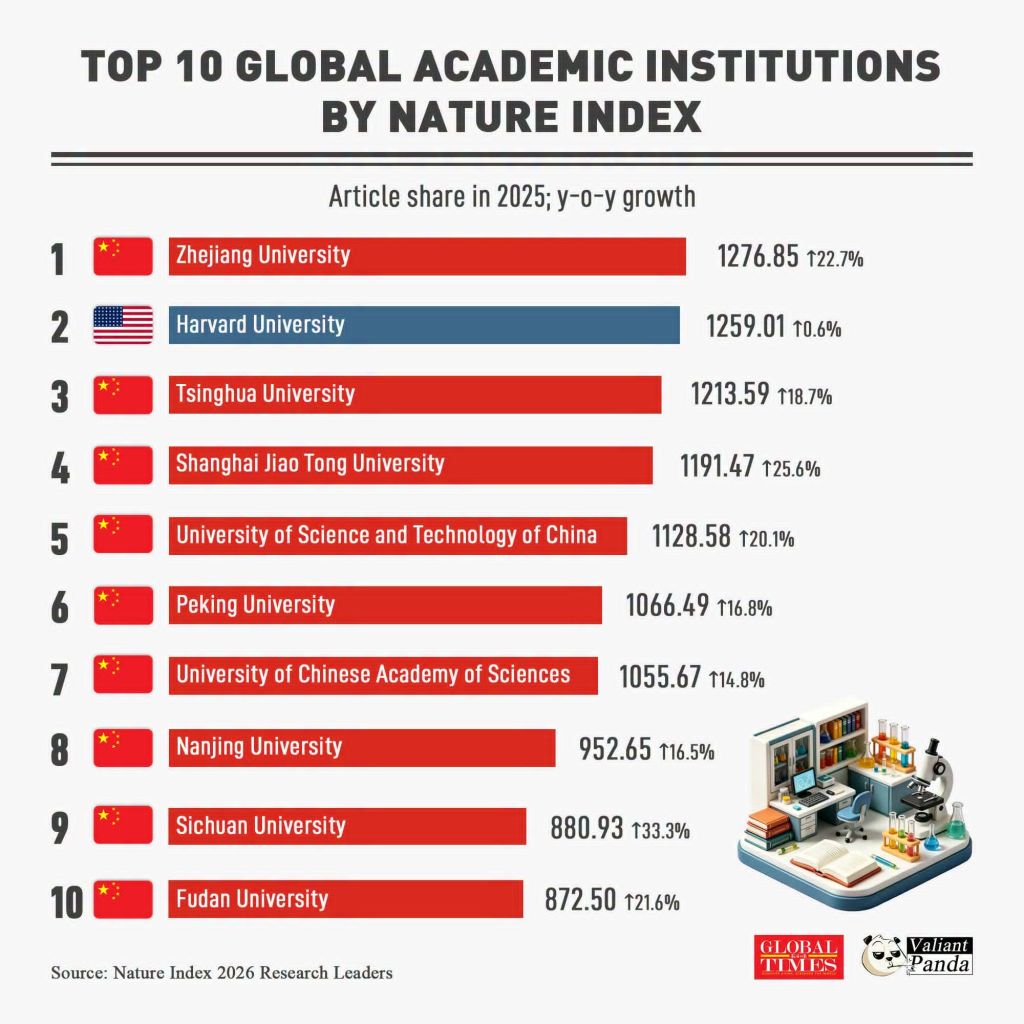
At least one source lists a number of Chinese universities among the fastest growing and most prestigious in the world (see above graph). For years, Asian students would migrate to American universities for advanced training. I personally witnessed how the math oriented kids from the East began to dominate the doctoral programs in economics and other disciplines at the University of Wisconsin. That pipeline is now evaporating as Trump clamps down on immigration and harrases our top schools. He is engaging in such counter- productive behaviors at the same time that alternative (even better) opportunities open up to Asian students closer to home.
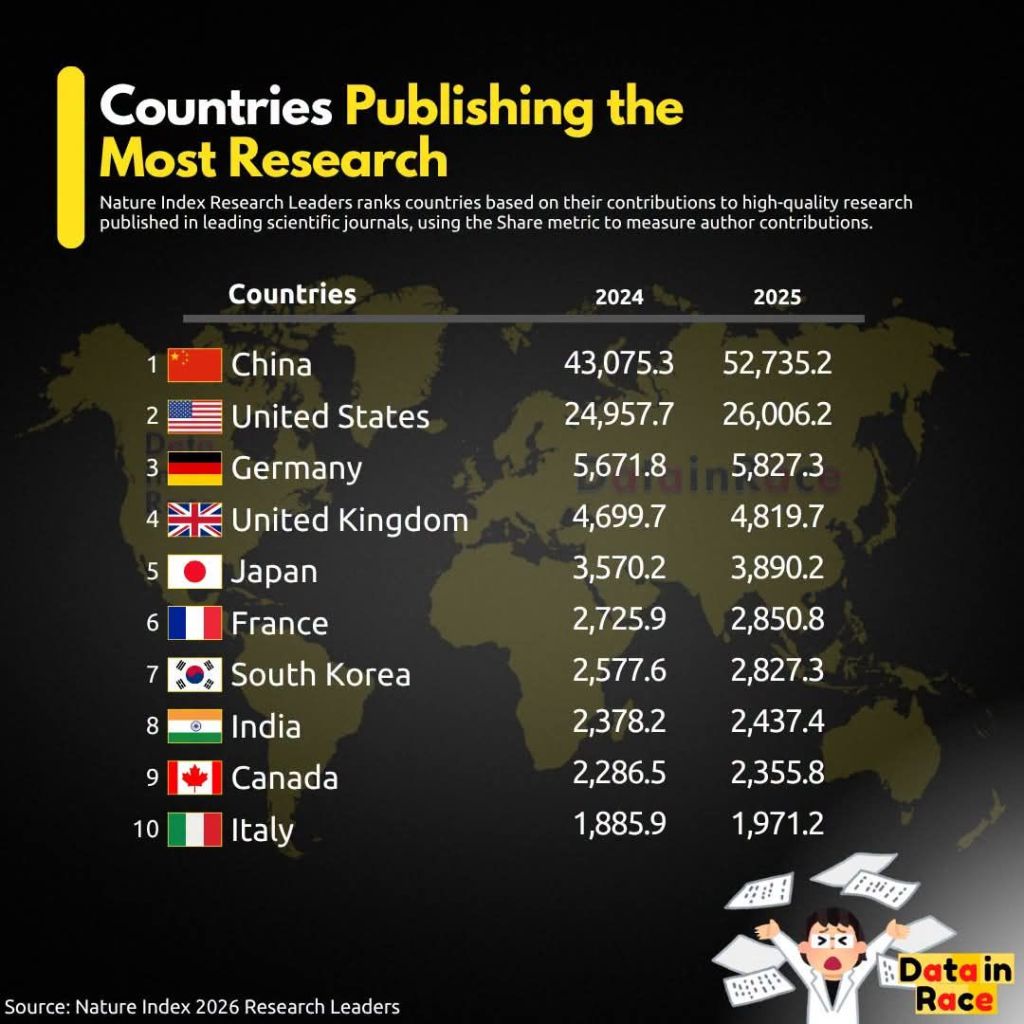
The trends are unmistakable. At the turn of the millennium, China was producing about one quality research paper for every five being churned out in the U.S., then the undisputed scientific leader in the world. Today, our Asian rival for global hegemony is producing twice that number emerging from America’s vaunted academic institutions (see graph below). While China is investing in the future, the Trump clown show has been attacking our top schools. Talk about being short sighted.
Then, again, is this not a common pattern among authoritarian regimes? Perhaps an analogous historical moment is instructive here. Between 1900 and 1930, about one-third of all Nobel prizes in the hard sciences went to researchers based in Germany. When Robert Oppenheimer, father of the atomic bomb, wished to explore the emerging mysteries of quantum physics, he matriculated at a German institution of higher learning.
Then the Nazi’s took over. The persecution of independent science began, along with anything considered as being Jewish science. Germany never fully recovered its preeminent position as a scientific leader.
But I risk digressing from my primary point. Autocratic regimes lose their way as they attempt to bully and coerce their oft delusional worlds into unwavering compliance and obedience.
In what ways have we regressed so dramatically? The next graphic may provide a clue. Respondents in 36 countries were surveyed. According to the results, some 57 percent conveyed a negative perception of the U.S. In fact, the Donald himself fared worse with some 76% of respondent harboring negative views of the man.
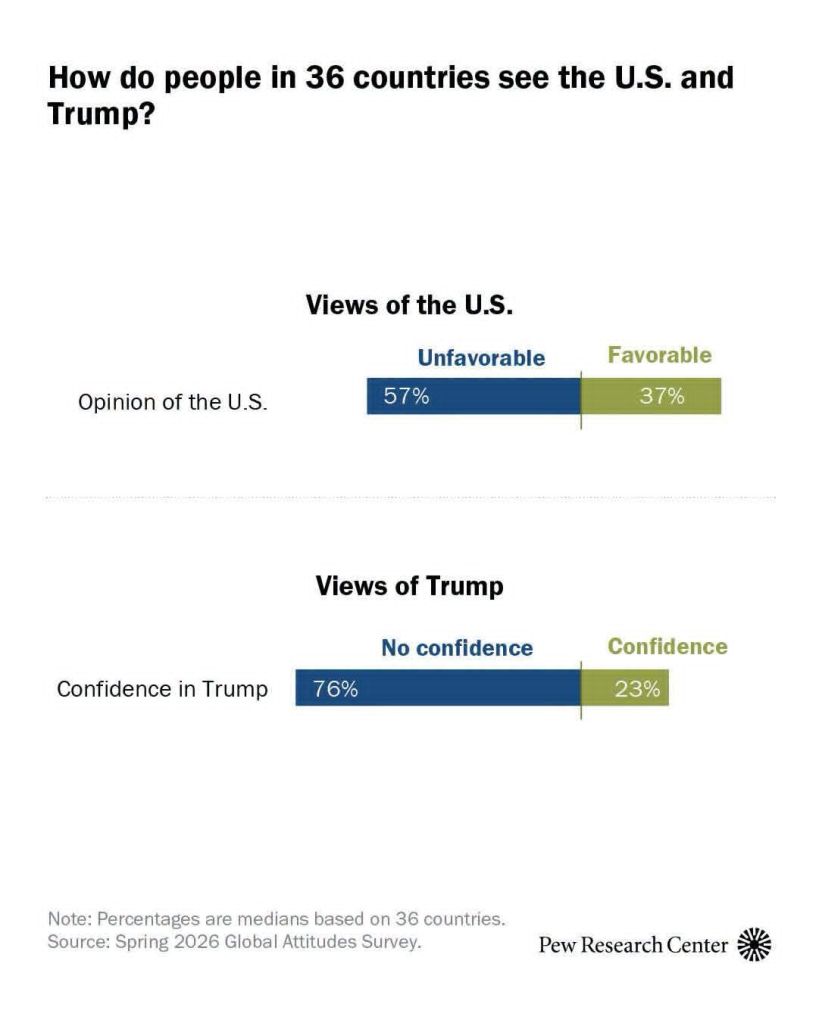
His reelection to a second term tanked our national reputation. Foreign observers apparently saw Trump for what he was, a reality that eluded way too many domestic voters, a number of whom are hooked on Fox news
Trump’s posturing to Make America Great Again sounds all too familiar to the boasts and rants of past autocrats. His military adventures in Venezuala and Iran evoke unpleasant comparisons with earlier dictatorships such as Mussolini in Abyssinia and Tojo in Manchuria.
His verbal aggression toward Canada, Greenland, Iceland, and others has America’s allies shaking their heads in disbelief. Worse yet, substantially abandoning NATO to seemingly favor Russia’s naked aggression in the Ukraine may be a bridge too far for any decent ally to swallow. How would you react if you had been an ally to America in the past and were now witnessing what she was becoming?
So, just how have the antics of our wannabe dictator been reflected in our overall comparative global position? That is, how is the U.S. now being seen by others. Looking at the next graphic, the answer is rather clear … we have fallen far from grace.
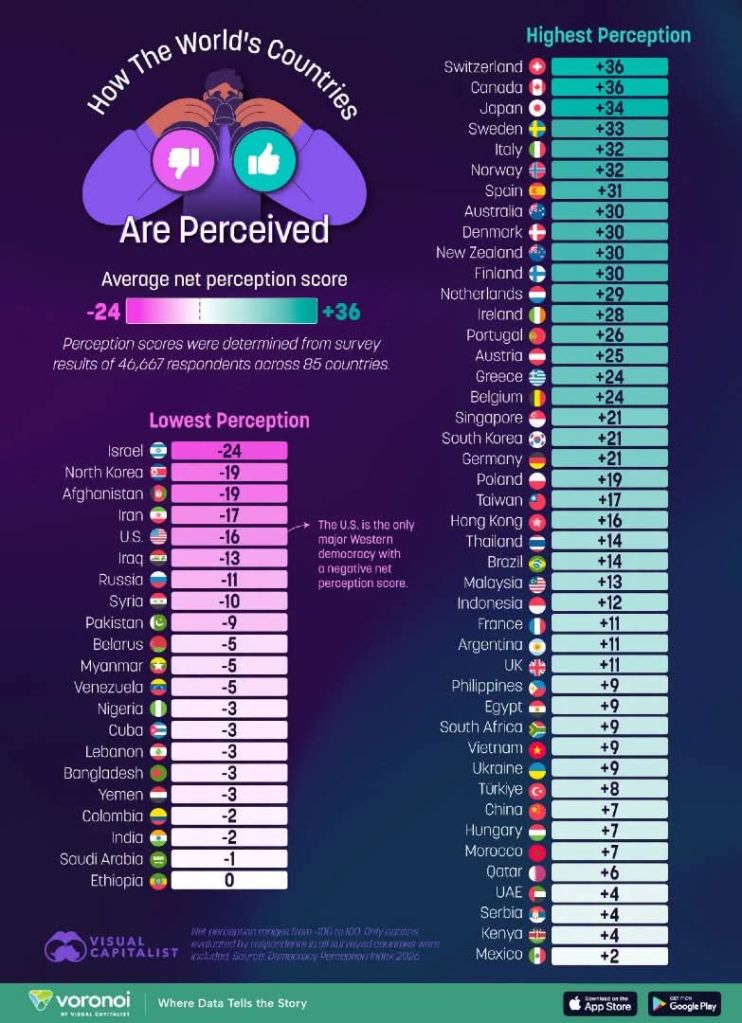
Only 4 nations, (Israel, N. Korea, Afghanistan, and Iran) suffer from more negative reputations, at least on this particular ranking. Admittedly, opinions can be notoriously fickle and survey data always can be questioned. Still, America’s apparent fall from grace arguably has been swift and dramatic. Let’s delve more closely into this seeming decline.
Let’s start with several global survey’s carried out by the well-respected Pew Research Center. In the first graph they report out responses to three key questions. Do people see America as a reliable partner? Second, do others see us as a peer that is contributing to overall peace and stability in the world? Finally, do others see Uncle Sam as taking the interests and concerns of others into account when making critical decisions?
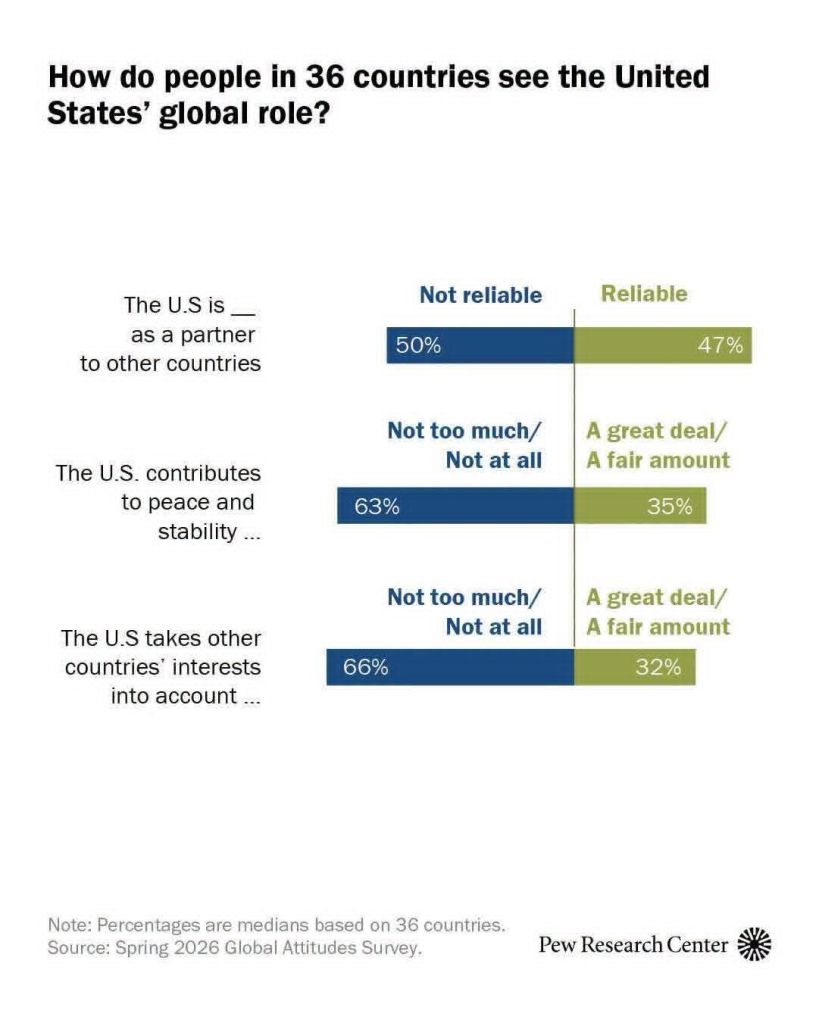
The answer is no. Less than half (47%) currently see us as a reliable partner. Over three-in- five respondents do not see us as contributing to peace and stability across the globe. And two-thirds of respondents now feel that the U. S. fails to take the feelings and interests of others into account when making crucial decisions on the international stage. The once champion of Western values, the former leader of the free world, has fallen far from a position of eminence.
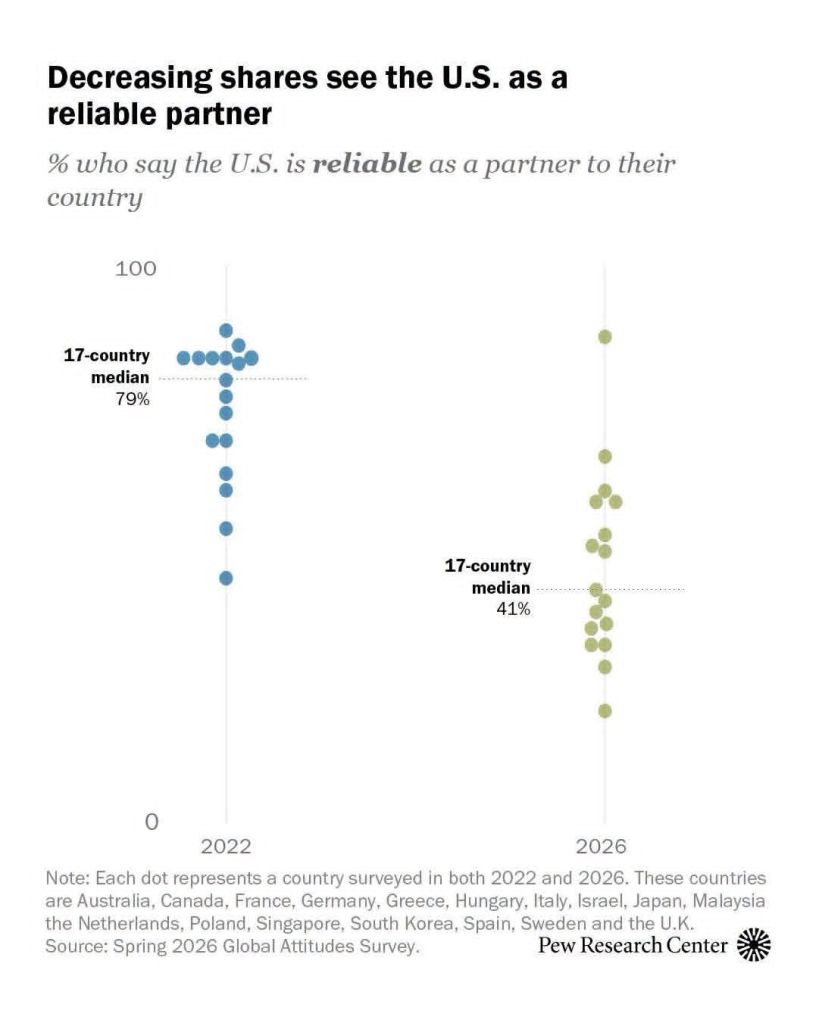
Now, lets take a look at how others see our reliability as a partner when negotiating the uncertainties of international waters. The next graph examines such sentiments by surveying people in 17 countries. Between 2022 and 2025, the national median response across these nations fell from 71 percent favorable rate to a 41 percent rate in a short time. That is a swift and dramatic decline of some 30 percentage points. What happened between over that relatively short period. For one thing, Trump returned to power.
These negative perceptions of America amongst our peers seem to have spilled over into domestic policy. The graph below is based on respondents from thirteen nations. Between 2021 and 2026, there was a significant drop in the views among foreign observers in whether our own leaders respect the constitutional freedoms presumably guaranteed to our own citizens. This taps into whether we are seen by others to be a functioning democracy. This is reflected in the U.S. being downgraded in status from being considered a full fledged democracy by international groups who monitor such things.
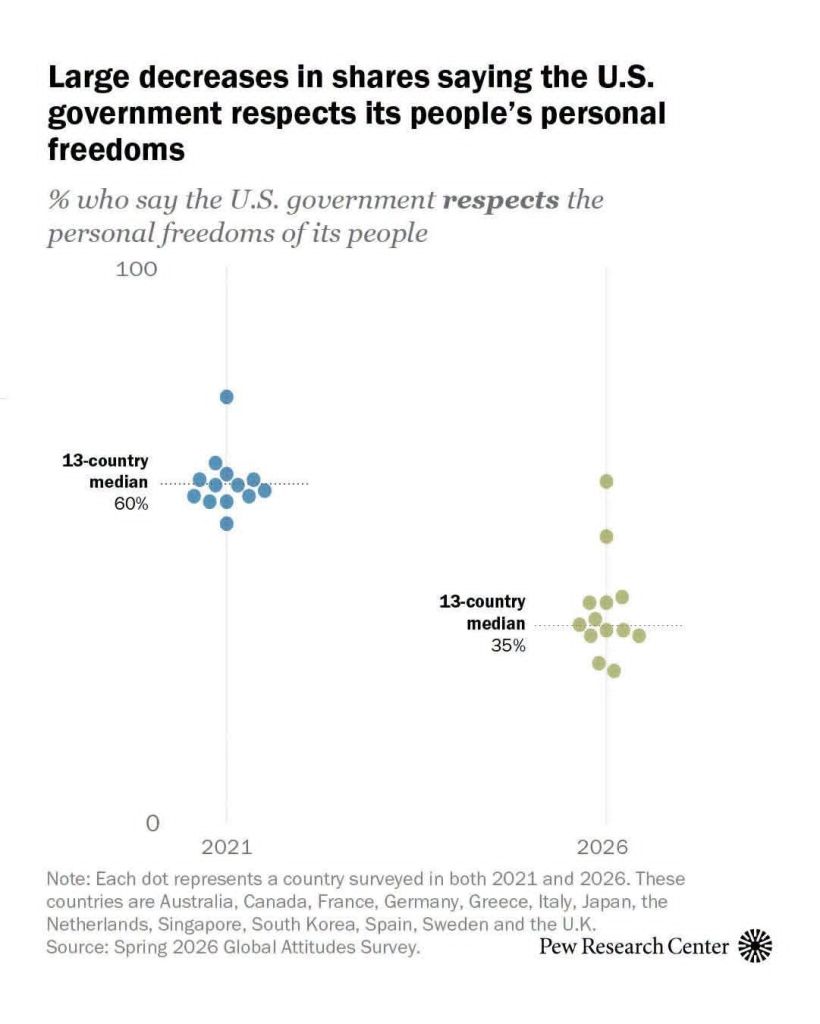
Perhaps we are no longer the beacon of freedom we once presumed ourselves to be. Can the world be casting about for another to fill that role? The EU, for example, seems to be assuming a leadership role on their own. And yet, Trump rants about being abandoned by traditional allies after attacking Iran, and then declaring total victory … which he has done some thirty-eight times.
This decline of America’s once preferred status has been abrupt, as illustrated in the next graphic. It suggests in a somewhat exaggerated fashion that the whole world has turned against us … especially since Trump entered the scene for a second go at becoming a kind of Napoleanic emperor. Though I wouldn’t take this depiction too seriously, the trend suggested cannot be summarily dismissed.
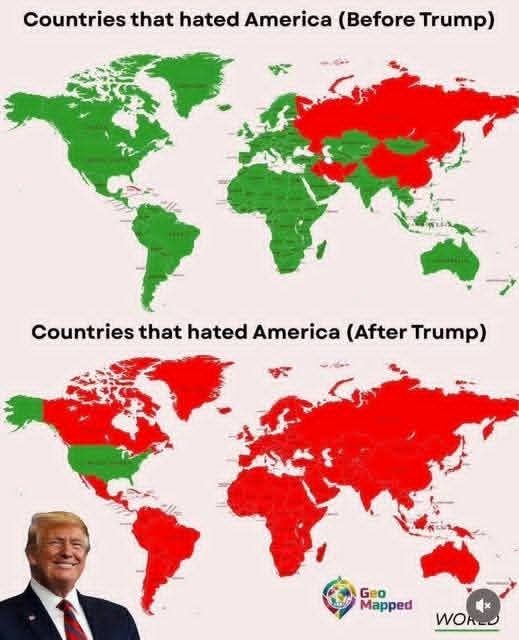
America’s fall from grace is profound and disturbing. Moreover, it may be based on more than mere opinion. Some twenty-three metrics were examined by researchers, measures that assessed personal security, levels of domestic conflict, and evidence of national militarism. Blending the data, the analysts ranked countries from the most peaceful to the least peaceful. Definitions are, sadly, inherently subjective. Perhaps a better way to describe their scale is countries in which you would like to live versus those you wouldn’t.
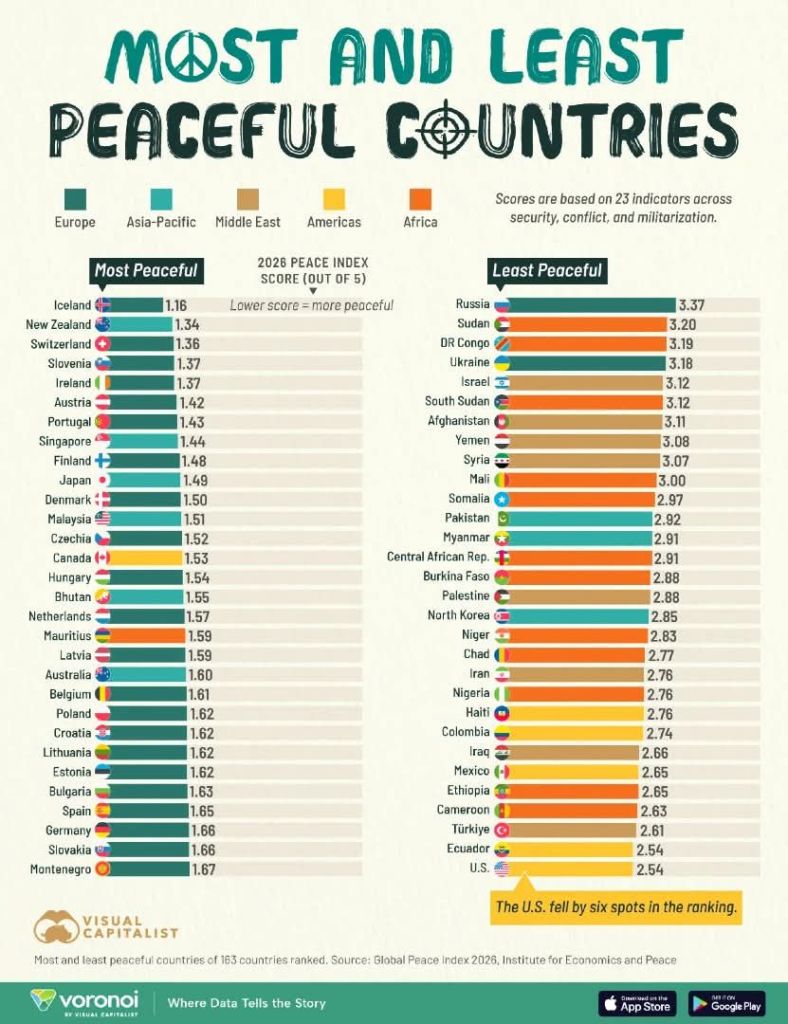
Guess what, the U.S. fell some six spots in the last year alone. It can now be found among the least peaceful jurisdictions or perhaps among those you probably would not select as paradise. No wonder some countries, upon Trump’s reelection, began to warn their tourists about the dangers of vacationing in the States. America’s widespread gun-related violence and huge incarceration rate (highest by far among advanced nations) speak eloquently to our underlying social tensions and to our lack of cultural comity.
Yet, when asked, most Americans assume that the trope about our national dominance (e.g., American exceptionalism) is an actual reality. Supporters of Trump point out that he is the kind of leader that this country needs. According to MAGA cult members, his strength brings the country together through a coherent national vision, a purposeful message, and disciplined (if a bit forceful) leadership.
Unfortunately, what they see as executive clarity emerges as top-down, unilateral executive rule. This form of unitary executive leadership is the very hallmark of autocratic rule. It is a centralized form of dominant governance that essentially violates the checks and balances painfully crafted by our founding fathers. Our constitution was dedicated to the distribution of power across independent branches in a way essential to sustaining a Republican form of governance. What they feared most was a demagogue like Trump who aspired to monarchical glory and to the uncontrolled mob rule we saw during the storming of the Capitol at the end of Trump’s first term.
As Winston Churchill once remarked, democracy is the worst form of government imaginable ‘except for all the others.’ It is slow, messy, and frustrating. At the same time, it avoids the seductive pitfalls associated with autocratic regimes.
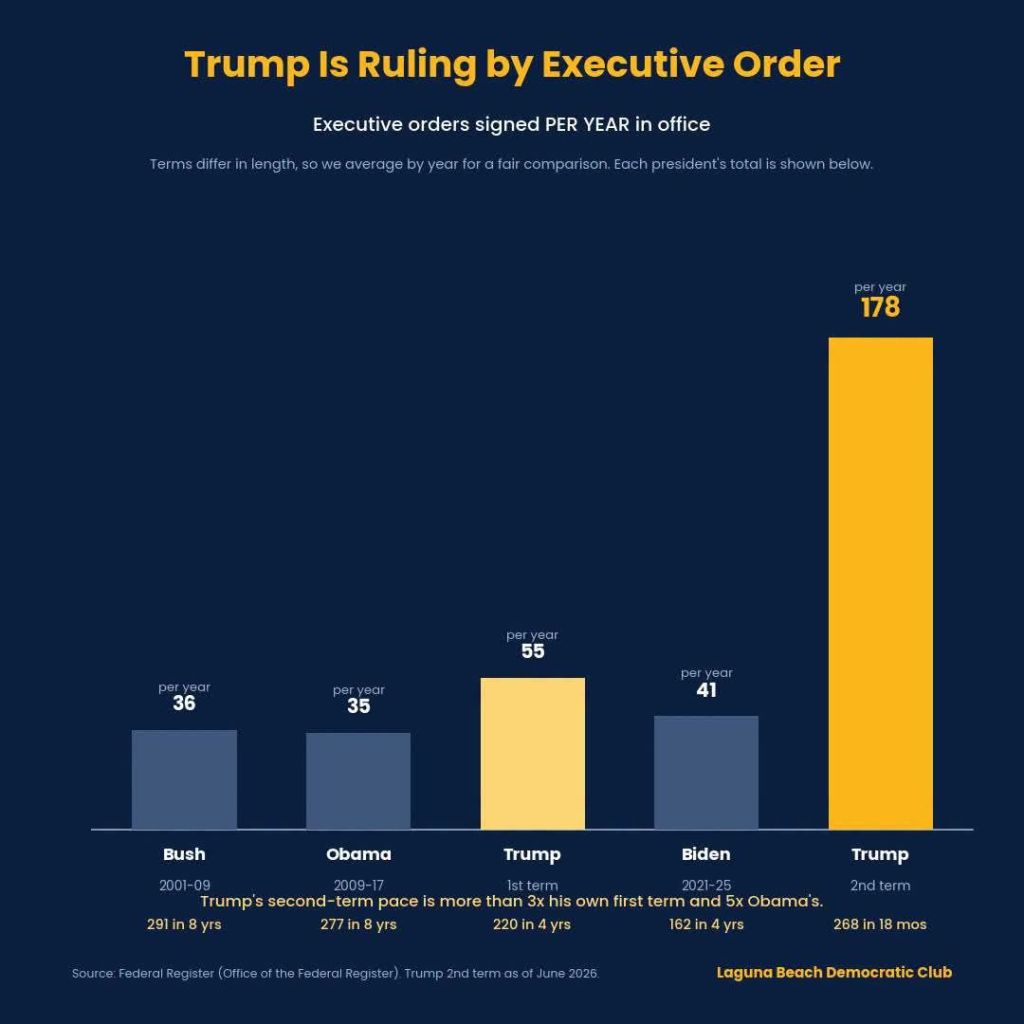
It should come as no surprise, then, when neutral observers are not impressed with the manner in which the United States is currently run. From the above graph, we can see that Trump has ruled disproportionately via executive orders in his second term. He does so even though his party controls all levers of power.
The man (or boy masquerading as an adult) learned one lesson from his first administration … only surround himself with boot- licking lackeys. That is a recipe for failure, but he could care less. As a pathological- narcissist, what matters to him is continuous, gratuitous adoration. In this vein, he repeats the excesses we saw in Roman emperors after the fall of the Republic. Some of the worst claimed a divine status … literally being Gods on earth. Then, again, hadn’t the Donald sent pictures of himself out on social media representing himself as the Christ figure.
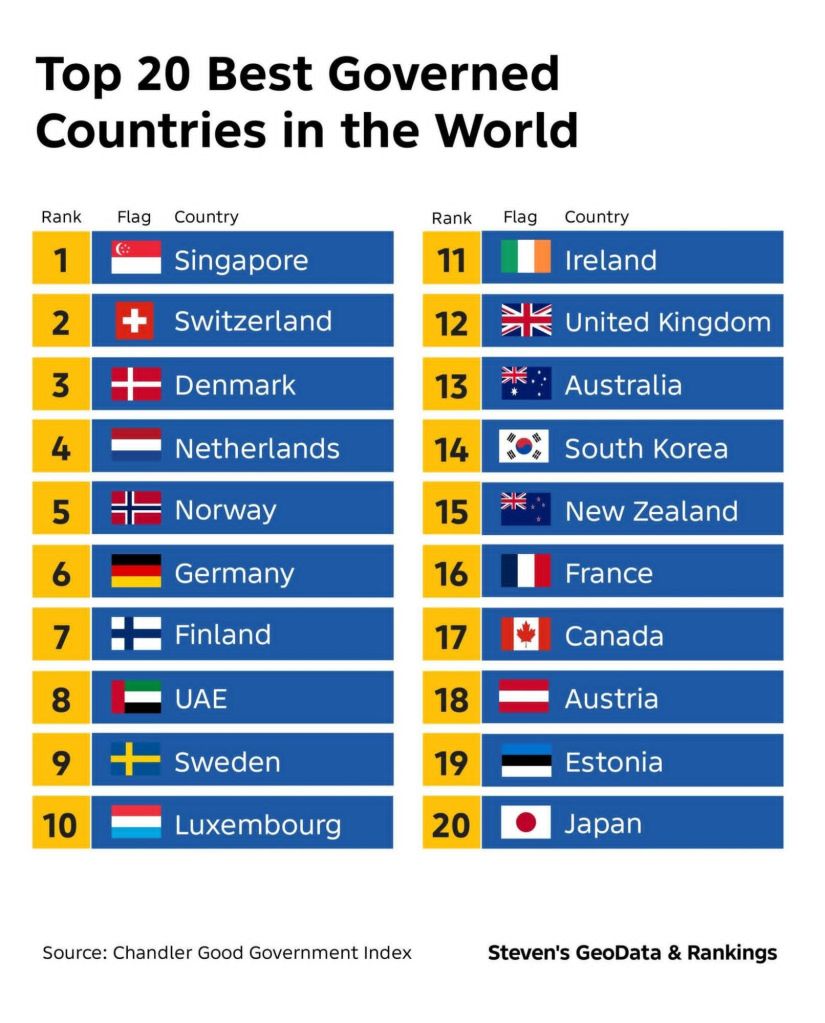
Not surprisingly, according to the Chandler Good Government Index, the U.S. no longer cracks the top-twenty of best run nations. If I recall correctly, Rome began its decline as such delusional aspirations became more common among it’s leaders
The hyper-partisanship in Washington, a staple since the Gingrich Congressional revolution of the early 1990s, has destroyed virtually all bipartisan work for the common good. The well-being of people, or the Republic, or the world for that matter, is an occasional after thought. Two ideologically divided political power bases strive and struggle for hegemony and control. Little else appears to matter. I get dozens and dozens of political messages daily. Few talk about policy and vision. All ask for money.
Evidence of America’s decline is all about us. The data is clear, if not overwhelming. Documenting it all would extend this modest rant well beyond any consumable length. In consequence, let’s briefly examine the comparison between the U.S. and the closest we have to a set of peer jurisdictions … the European Union or EU.
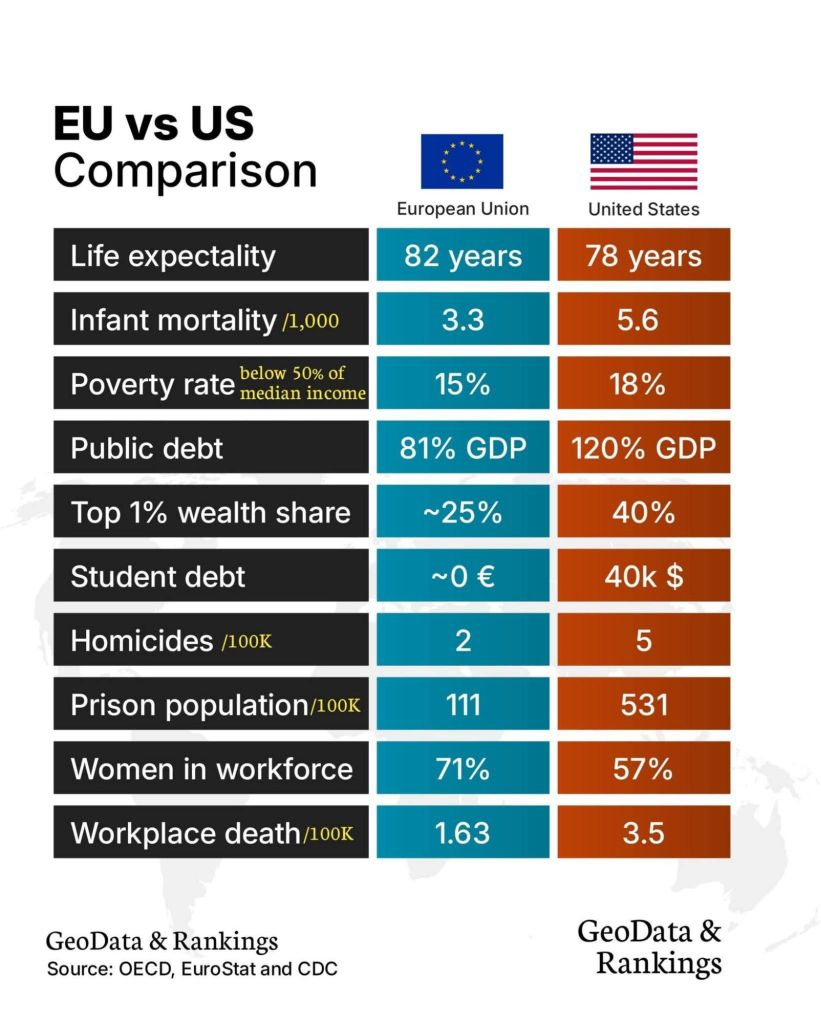
Across the board, from life expectancy, to poverty, to inequality, to social violence, to public debt, and to female labor market participation, we fall comparatively short. And other than infant mortality, this particular comparison ignores some of the more egregious examples in which we fail. For example, we spend up to twice as much on health care per- capita for outcomes that are middling at best.
As for the touted American dream, generally defined as upward social mobility. Most EU countries, especially in northern Europe, evidence much greater upward mobility than we have here. It helps when higher education is virtually free (no student debt).
The comparison between America and Norway is instructive in one particular way. Our Viking peer nation is characterized by many in the U. S. as being a socialist nation. As such, it has no lessons for us. It is to be ignored. In fact, it is to be feared since our youth night succumb to insidious propaganda spewed out by left-wing woke types.
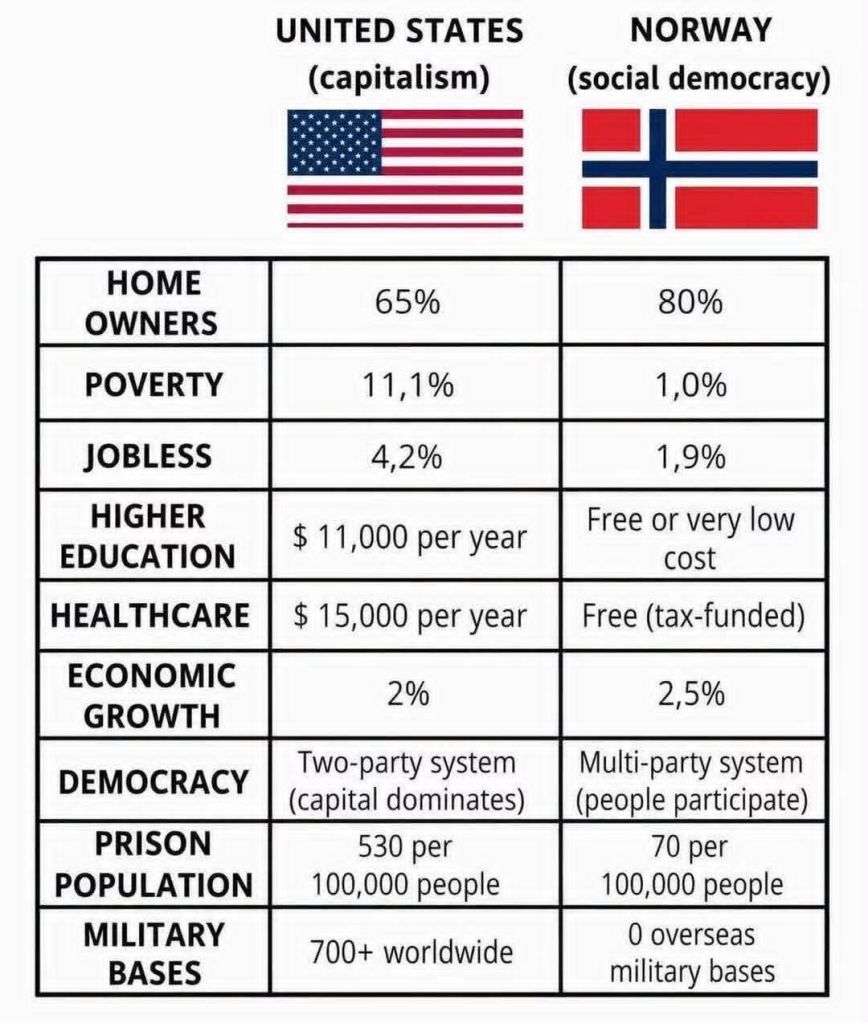
Yet, today’s contemporary Vikings seem to be doing very well indeed, at least on a comparative basis. Methinks that the casual use of the socialist label is a crude tactic by the hard right to discredit a very successful example of good government.
Conservatives repeatedly point out Norway’s high tax burden. And it is true, they collect more to support a robust system of public services than we do, or virtually any other nation for that matter.
At the same time, however, they are among the happier people in the world, at least according to international hedonic surveys (in data released this past March, Norway ranks 6th). On the other hand, America is well down on that list, ranking 23rd and generally on a downward trend. What our right fails to note is that strong support for the public good has enormous benefits for average folk. People will pay taxes if they know what they are getting for their investment.
The slow and steady decline of America started well before Trump. He is merely the latest, and most egregious version of a slide that began with the triumph of neoliberalism during the Reagan years. Our national plight reminds me of the toad and the pot of water. Throw the poor thing into boiling water and it leaps right out. Put him into tepid liquid and slowly heat it up. He just might not anticipate the inevitable end until it is too late.
As the hard right assumed greater control, and money became concentrated in the hands of a few, it has become increasingly difficult to reverse trends. There never was any overt coup, just an incremetal shift in power and control. Individual laws are passed. Specific media outlets are absorbed by the ‘right’ people. Conservative justices assume lifetime positions. Nothing screams revolution. But a silent revolution it is. Then, one day, you realize there exists an Agenda 2025. You begin to understand, the water is coming to a boil.
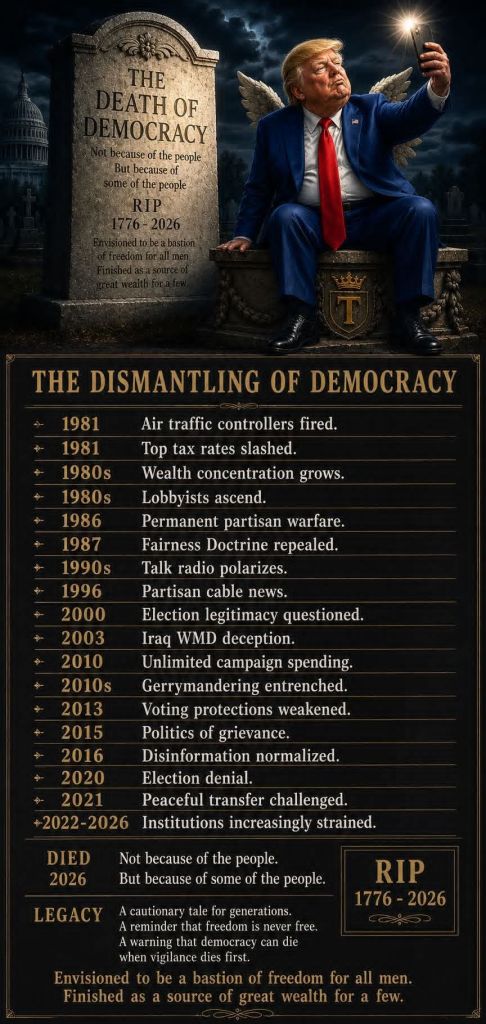
Seldom has Congress, the courts, and the executive all been in Democratic hands since 1980. Now that the key media outlets are also concentrated in the hands of a few wealthy autocrats, reversing the trend toward autocratic, self-serving rule (for the elite at least) has become more difficult to challenge. Some days, it seems impossible. The graph above marked a few of the key steps in our march toward a kleptocracy (rule by an economic elite for their own selfish ends).
Let me end with a couple of illustrative graphs that reflect the macro-economic trends in the post-WWII period. The blue line captures the proportion of wealth commanded by the social elite, the infamous top 1 percent. The red line Taps what the bottom 90 percent command. Think of these as capturing both the most successful in contrast to your typical American families who might earn paychecks and not get by through selling stocks short in the equity markets.
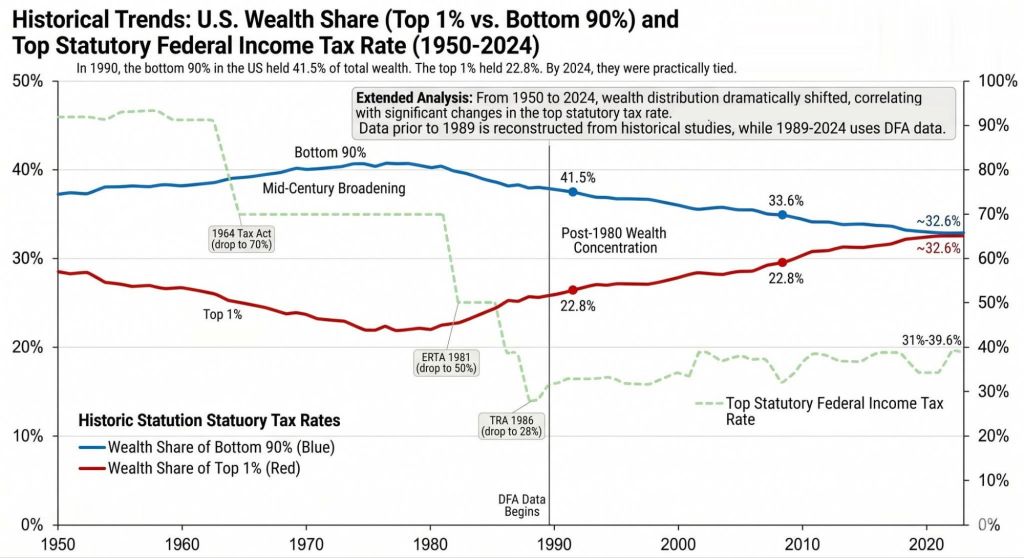
From the 1950s through the 1970s, we see a widening between these two lines. This encompasses what economists call the great compression. It was that period in U.S. history in which neo-keynsian thought prevailed. It was colloquially termed the New Deal in common parlance. High income tax rates, strong unions, and public investments in infrastructure and education and research stimulated economic growth. It was the era when every quintile in the distribution enjoyed real earnings gains, when income and wealth inequality fell, and when the middle class grew.
But the elite were never happy with this outcome. For them, it represented a loss of social hegemony and political control. Many define the substantive start of the conservative counter- revolution as the strategic memo authored by future Supreme Court justice Lewis Powell to the U.S. Chamber of Commerce at the beginning of the 1970s. He outlined the strategic tactics by which the right might regain control of the political narrative. His assault called for the systemic usurpation of key institutional levers (courts, media, education) and amassing a huge war chest from corporate sources for that purpose. Within a decade, his vision took root with Reagan’s success in the 1980s. It has been fully realized in the Trump era as income and wealth inequality approach levels not before seen.
But the neo-conservative’s success breeds a set of internal tensions and social challenges. For example, the k-shaped economy graphic illustrates one danger sign. As wages gave been disconnected from productivity and compensation for work has shifted from earnings to returns on investments, both income and wealth has become increasingly concentrated in the hands of a few. The tech-bros who attended Trump’s second inauguration command as much resources as the bottom 90 percent of the population. Elon Musk became a trillionaire with his latest stock IPO.
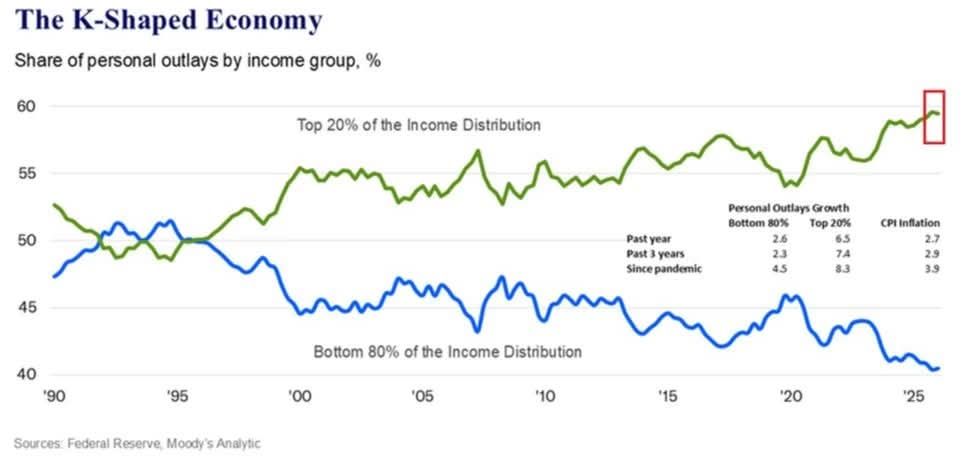
As the previous graph highlights, the top 20 percent of the income distribution accounts for an increasing share of consumer spendimg and thus overall economic activity. The elite are the one class who are prospering in the new economy. The young are struggling with student debt, changing labor markets, and prohibitive entry costs into the middle and upper classes. Now, with AGI becoming a reality, their future is indeed further clouded. They face the kind of uncertainty that never crossed my mind at the beginning of my career.
Is the American era over as the world’s preeminent power? Have things reached a point where the American experience cannot be salvaged. There are several factors that suggest such a dystopian future cannot be avoided. Thus, it is very easy to sink into a sense of fatalism and cynicism.
Then again, nothing is certain in life. I once gave up on ny childhood dream of seeing the Boston Red Sox win the World Series. Then they came back from being down three games to none in the playoffs to beat the hated Yankees before sweeping the Cardinals to finally win it all. Miracles do happen.
Perhaps more realistic examples are in order. At the height of the gilded age, it likely was very hard to imagine how such concentrated wealth might be challenged. Yet, the progressive era did occur when monopolies were broken up and laws protective of real people were passed. A generation later, when political power once again was entangled with economic privilege during the roaring 20s, a global depression reordered our economic understandings, at least for a while. The New Deal created opportunities that seemed out of reach a few years earlier.
The coming midterms are an opportunity to assess whether Anericans are finally emerging from their long political stupor. Perhaps they will finally stumble across their own self-interest … or not! In the meantime, don’t forget the dream.


One response to “A Troubled Nation Poised on the Edge … happy birthday?”
What a sad statement of affairs! There is no joy in America today!
LikeLike