A while back, I recall writing a blog on President Kennedy’s iconic program, the Peace Corps. Of course, having served as a member of India-44 in the late 1960s, I tend to focus disproportionate attention on that program and to the fortunes of the world’s largest (by population) democracy … India.
Recently, however, I heard something disturbing. HR 8595, the FY27 National Security, Department of State, and Related Programs appropriation bill was making its way through Congress. If enacted in its current form, the Peace Corps experiment, based on what I heard, would be gutted. This possibility, though perhaps remote, hit me hard since, given the Trump fiasco in Washington, any insane possibility might come to pass. But gutting the Peace Corps! Really?
Peace Corps has survived fairly well for some 65 years since its creation through an Executive Order by Kennedy on March 1, 1961. Back then, a few casual remarks by candidate Kennedy late one night at the Ann Arbor, Michigan airport sparked a tidal wave of interest among college students. Many desperately wanted to do something for their country. Thus, this program of service overseas became one of Kennedy’s first substantive actions as President.
Over time, some 240,000 mostly young men and women have served as volunteers across the globe. Even today, some 7,000 volunteers still are working in about 60 nations, compared to around 16,000 in the prehistorical era during which I served. It is clear that the program could expand if additional resources were available.
The program might not possess the same cache and swagger it did during the 1960s, but the work now provided might be more useful. I believe they eventually got it right through trial and error. By virtue of closely vetting vocational interests and prior experiences, today’s volunteers are better matched to the technical needs of the host countries in which they serve. In my day, the program was arrogant enough to believe that we could contribute anywhere and on whatever challenge was posed to us. We volunteers did not necessarily agree with such hubris, but we soldiered on.
Let me assert that Peace Corps service was never easy. On that, we in India-44 did fully agree. There was an early program advertisement which said it would be ‘The hardest job you will ever love.’ From the lived experience of those who served in my group, our tenure abroad was hard … very hard indeed.
As I noted in an earlier blog, we endured primitive living conditions, cultural challenges, isolation, disease, loneliness, and concerns about our preparation to carry out our assigned tasks. Yet, based on our group gatherings almost five decades later, we fully agreed that our service remained an irreplaceable part of our lives. Arguably, it helped shape whom we became in later life.
Nor have those who served done so absent personal cost. In our program (India-44), we all suffered from various afflictions, dysentery being the most common. I also recall having ring worm, and a case of giardia that dropped my weight to less than 150 lbs. This was not terribly adequate given my 6′ 1″ inch frame. A decade after my return, I was diagnosed with tuberculosis, the specific viral strain likely first contracted on the subcontinent but which remained dormant for a decade.
And I was a lucky one. Unlike a number of my peers, I never spent any time in a hospital, nor was I required to leave India early for medical reasons. What are termed medical separations account for the estmated third of all volunteers who do not complete their service. In effect, perhaps one in ten serving volunteers are sent home do to disease or accidents. In rare cases, the ultimate price has been paid. Some 310 volunteers have perished as a consequence of their service.
One argument for gutting Peace Corps is that we need the money for other purposes. The U.S. annually takes in a little over $5 trillion in revenue but spends about $7 trillion. Each year, that now leaves almost $2 trillion to be added to a debt that is approaching $40 trillion in total. Getting our fiscal house in order makes sense but Peace Corps seems like an odd place to start.
In FY 2020, the PC budget allocation was $410 million. While seeming like real money, that figure represented less than 2 tenths of 1 percent of the Department of Defense’s weapons procurement request for that same fiscal year. Putting the cost of PC in context, one basic F-35 fighter plane costs $80 million to acquire while a single hi-tech Stealth Bomber sets the taxpayers back a cool $2.1 billion (sufficient to fund Peace Corps for five full years). Rather odd that we easily find money for war and death while resources to support life-affirming purposes remain so damn hard to locate.
The question might be asked … has Peace Corps justified its existence on a rigorous benefit-cost basis? Since the expected benefits are difficult to define across so many host nations, that kind of metric for tapping success remains elusive. The fact that, after 65 years, so many countries yet want volunteers (60 at current count if you have forgotten) does tell us something on that matter.
There are hints about the positive impact that Peace Corps has had back in the States. Survey data indicates that fully one-quarter of returnees have started businesses, many of which are demonstrably successful. The program appears to motivate risk taking, resilience, and innovative thinking among its’ participants. These are life- affirming attributes. After all, my India-44 group was dropped into remote villages in the Rajasthani desert 🏜 and expected to make do.
There is little question that former volunteers remain active in public life. Some 86 percent continue to be involved in their communities, a rate well above any expected figure. As I sit here, I can recall a recent Wisconsin governor and a recent Chancellor at the University of Wisconsin who were volunteers in their youths.
Finally, the program is not that expensive, at least compared to other initiatives designed to enhance America’s image oversees. At about $56,000 per volunteer per year (total cost), this figure is half of what is spent on Fulbright Scholarships and other such related programs. Besides, just think what it costs for the personnel manning one of those $2 billion dollar bombers.
Of course, I sometimes reflect on what the members of India-44 might have accomplished during our tour. Our group was split between public health and rural development initiatives. One aspect of the public health initiatives was helping local governments extend their birth control message as well as their efforts combating diseases that adversely impact rural youth.
Think about the following. In 1950, the fertility rate in India was about 6.0 children per female. Having many children then made sense given that at least a quarter of all toddlers would perish before their 5th birthday. Surviving to adulthood was far from a sure thing. The population then stood at 360 million. Given the high birth rate (and falling youth death rate), it would almost double by the time we arrived.
By the time we did arrive, public health efforts were achieving additional success. The child death rate, one of the foci of half our group that was assigned to the state of Maharasthra, was clearly declining. Indian officials now were motivated by the fear of an impending apocalypse where more children survived to adilthood while women continued to have many children.
Reality had run ahead of perceptions. Rural folk assumed that a good number of their children would, in fact, not survive. But they now were, in fact, reaching adulthood. Worse, the small farms owned by the parents could not be further divided among their surviving male offspring. How could society accommodate what looked like an impending population-driven disaster?
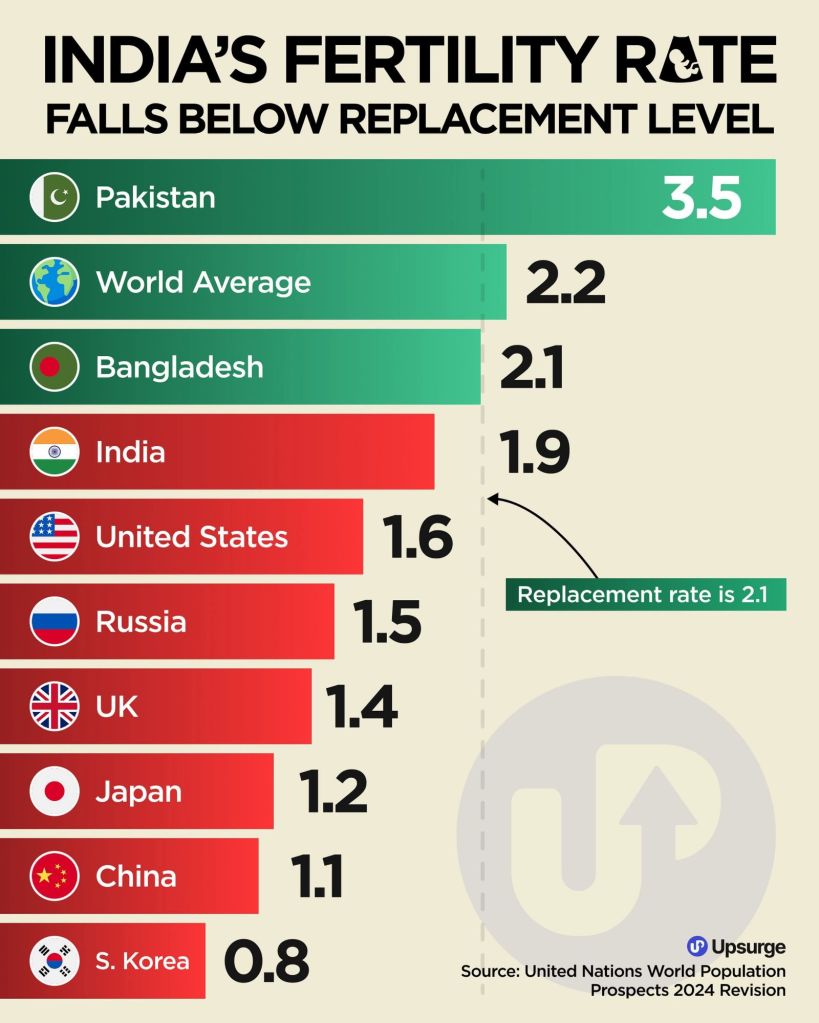
The feared collapse obviously never occurred. Amazingly (or not), the birth rate in India started to plummet soon after our departure. As seen in the graph below, their fertility rate now is 1.9, somewhat below the consensus 2.1 rate necessary to replace the current population. This is occurring just in time since India passed China in total population in 2023, now having some 1.6 billion souls residing within its borders. Absent any change, it won’t be long before that country’s total population begins to decline.
My side of India-44 focused on rural development, mostly agriculture. But some of us did other things like get schools built, blast wells for farmers, erect demo chicken coops and gardens, and various other endeavors. Mostly, however, we organized demonstration plots that highlighted the use of hybrid seeds … the type that greatly enhances the yields of primary grain crops. This was part of the green revolution initiated by Norman Borlaug.
As with their population crisis at that time, India was in the midst of a food production crisis. Failed monsoons and inefficient farming practices led to the situation where the country had to import grains just to keep their own people from starving. Members of India-44 recall village women laboring in the hot sun breaking rocks (to assist road building) for a few rupees per day just to stave off starvation. They literally were being saved by local public works initiatives.
Shockingly (or not), India was exporting grain again shortly after we completed our tour. In recent years, she has been exporting 25 million tons of rice annually. And another 5 million tons of wheat. Members of our group who have returned in recent decades report a country that would be unrecognizable to the rest of us. India now enjoys one of the most robust economic growth rates in the world, though they disappointedly have drifted toward a semi-autocratic form of governance.
Okay, I know what you are thinking. India-44 did not bring about such changes, nor did the Peace Corps as a whole. Of course not! But we may have contributed a bit to the communities in which we served. That is all we might expect from our meager efforts. But one never knows. Peɓbles dropped into a body of water create ripples. Enough of them and the prospect for real change becomes palpable.
On a more serious note, the raisin-detre of Peace Corps has never been about macro- changes. The contributions of individual volunteers, if any, are local in scale. They are often about individual relationships focused on cross-cultural interactions and modest community effects. But still, small ripples eventually can result in larger circles and broader effects. Beyond all else, the locals get to know the volunteers on a personal basis. A little good will can’t hurt.
We in India-44 saw larger impacts in how the program impacted us as individuals. I have often commented on how much our group contributed to the world as adults. Reflecting at the moment, I can recall my PC associates going on to work for the United Nations, for the State Department, for the Federal Reserve, for national unions, and as university professors. And this was just among the rather small number of male volunteers who completed their tour (around 14 or 15) in my half of India-44.
The exacting selection and vetting processes (or self-selection process in which the more talented apply for Peace Corps service) might explain the exemplary achievements of our group as adults. Even today, only about one-third of those initiating the application process might be successful. Back in my day, the proportion ultimately going over seas relative to the initial applicant pool was much lower.
Yet, my PC peers would argue that there is something undeniably unique to the experience itself. We enjoyed a value added dimension as a consequence of our service. As I’ve asserted elsewhere, the core cross- cultural experiences and the ongoing hardships helped shape us for the future as few other alternatives could.
Perhaps this is one reason that many argue for some form of universal mandatory experience for young adults. Perhaps all of our youth might profit from experiences grounded in service to others that stretches them and helps them mature. We used to have the military draft for males but think how much essential environmental and infrastructure work needs to be done here and elsewhere.
Think about this. Will the next generation be better off by continuing to stare at their cell phones for endless hours. Or would they benefit from immersing themselves in challenging tasks that takes them out of their comfort zones. No, I think gutting programs like the Peace Corps would be short- sighted and foolish. The again, perhaps that is the very reason the Trump crowd loves the idea.
PS: A couple I knew professionally had served in the Peace Corps in South America, perhaps a couple of years after my service. They once told me about an amazing experience they had upon returning to their village some years after their service ended. The wife had worked in education while there. Upon their return visit, they found the local school they had helped improve had subsequently been named after her. Adults approached her telling how her work altered their lives and the lives of their children.
You never forget experiences like that. Little else in life can match them.

