“… an oligarchy is taking shape in America of extreme wealth, power, and influence that literally threatens our entire democracy.”
President Joseph Biden, Jan. 2025
Outgoing Presidents have long issued warnings to the country. Our first chief executive, George Washington, told us to beware of ‘foreign entanglements.’ Dwight Eisenhower pointed to the emergance of the ‘military industrial complex’ as a matter for national concern. I wonder what Abe Lincoln might have said had he not been struck down suddenly by an assassin’s bullet. He might have returned to his admonitionment about the fragility of ‘houses that are divided cannot stand,‘ a prognosis that would have much applicability to our current fractured American polity.
I read an opinion piece this morning by Dave Zweiful. Now 84, he is the editor-emeritus of the Capitol Times. For decades, he waxed eloquently on the public issues of the day for this Madison, Wisconsin based media outlet. He was the classic avuncular wise man who represented calm and reason when passions had been riled. Yet, on the eve of Trump’s second inauguration, he lamented that never in his long life of both observing and commenting on public affairs had he ever conceived that so base and disgusting a man as Trump would rise to the top position in America. He shared my perspective in that we were all raised to believe that our leaders had to be smart, competent, and (at least somewhat) ethical … all the attributes distinctly missing in the Donald. How could such a thing happen?
I look out across our social and political landscape and what comes to mind is a pot of boiling water. The liquid has been driven to a froth from which escapes steam eager to speparate from the liquid mass left behind. At times, distinct bubbles can be seen. Yet, what is most certain is that our original societal metaphor of a melting pot is no more. We now longer merge together but quickly are flying apart.
Let us look at my evolving analogy a bit more closely. The droplets escaping the liquid’s mass are individuals seeking refuge from what they perceive as a world in turmoil. If you listened to Trump’s inaugural address earlier today, you might believe we were minutes away from the apocalypse. It is the ancient Fascist tactic of scaring the crap out of people while offering them solace in a savior … the new leader.
On the other hand, the distinct bubbles we begin to see are groups of like-minded persons who aggregate around salient themes. For example, we have the ultra nationalists who focused on ethnic identity; the religious fanatics who focused on cultural passions such as abortion and gay marriage; the economic elite who obsess about the public good as being a plot to impede their ability to acquire even more wealth; the extreme ‘rights’ oriented types who see an ever increasing array of social wrongs to be addresses. The list of issues and challenges around which to structure a group identity appears somewhat limitless.
Now, these interests have always been with us. But there is a difference today. Our methods for disseminating information has disintegrated into a fractal mess. No longer do we have a common source of nightly news that is delivered in sober and relatively neutral terms. In recent decades, we have dozens of conventional and boutique social media platforms designed to curate and deliver targeted messages to specific audiences. In addition, individuals aggressively seek out affinity groups in cyber space that support their specific, if sometimes bizarre, world views.
The bottom line is that many of us live in such bubbles. These individualized worlds are separated from the population as a whole and other bubbles floating freely out there. They are self-contained in terms of possessing a coherent philosophy even if that internal world seems bizarre to outsiders. These worlds are supported and reinforced by a stream of continuous messaging that emotionally inflame the recipients and keep them bonded to their illusions. Meanwhile, communication across bubbles becomes more difficult over time, since each bubble can choose its own highly selective information sources.
As a result, belief systems increasingly are divorced from reality. The MAGA crowd really believes that Biden was a disaster for the economy as President, even as we remain the envy of the outside world. Alas, it would appear that the ties between reality and belief are irrevocably broken.
In point of fact, only 25 percent of all respondents asserted that Biden was a good or excellent chief executive. Even Trump earned a 36 percent approval rate (around the top of similar approval rates for hard-right officials across other countries) while Obama received a 52 percent up vote. Obama did bring us out of the depths of the terrible 2008-9 housing crash but, by the numbers, his economy was not nearly as good as the one Biden is leaving Trump. In addition, our most recent WH occupant leaves office without major foreign wars and a nation with a host of excellent social measures of well-bring (e.g., lower crime rates, higher rates of health coverage).
The Wisconsin experience is a case in point for this reality-belief gap, the essence of our new bubble reality. Wisconsin is a classic swing state. Biden won here by 11,000 votes in the previous election while Harris lost here by about twice as many total votes last fall. From a variety of surveys, voter sentiment was negative around the time of the November election. The prevailing negativity focused on a bad economy. The Dems, many asserted, had abandoned working people. Inflation was out-of-control. You would expect to see people starving in the streets.
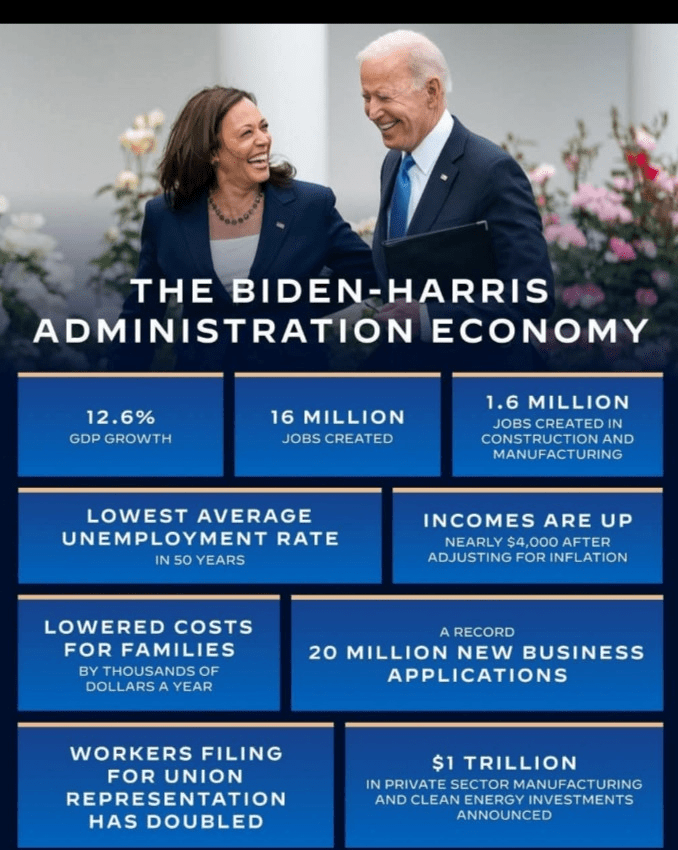
The reality, of course, was radically different. Nationally, the national GDP (a measure of overall income) was growing at a robust 3.1 percent in the 3rd quarter of 2024. Unemployment was 4 percent, a rate considered frictional by economists. (A frictional rate is one where virtually all seeking employment can find jobs). Consumer spending continued to be robust. And inflation had settled back to a 2.5 percent annual rate, close to the target rate set by Federal Reserve governors. As I oft repeat, our economy remained a primary driving behind global growth.
Despite widespread and erroneous beliefs among the body politic, the Wisconsin economy also was going gangbusters. The state unemployment rate was less than 3 percent last fall, well below the national rate. While Wisconsin had lost almost 84,000 jobs during the Trump administration, it had gained 186,000 during the Biden years. And the Dems did much to offset hardship during their tenure. Some 300,000 Wisconsin Medicare recipients are saving $475 per year in lower drug costs after passage of one Biden initiative. The Department of Education projects that 62,000 Wisconsonites will enjoy some $2.4 billion in relief from canceled student loan debt obligations. And Federal pandemic relief funds allowed Wisconsin Democratic Governor Tony Evers to shore up schools, infrastructure, child care, and health care even as State Republicans aggressively fought all of these investments in the public good despite a large $4 billion dollar budget surplus curtousy of a robust economy.
Now, what will the champion of the common man, our Donald Trump, do after he assumes the reins of government today. His nominee for Treasury Secretary, Scott Bessent, said the following during his hearing in Congress. Extending the 2017 Trump tax cuts is “the single most important economic issue of the day.” Those tax cuts, and the previous Republican cuts favoring the elite are primarily responsible for our national debt approaching $35 trillion dollars and the $50 trillion redistribution from the working classes to the top of the economic pyramid. Trump and the MAGA crowd are not the heroes of the working folk. They will continue the rape of those poor folk through regressive policies that began during the Reagan years.
While I struggle against blaming voters for their inability to see what is happening, they must bear some responsibility. Still, the newer communication technologies are evolving faster than the average person can comprehend. We only become aware of how deeply we are impacted until long after the fact. I remain pessimistic. Given our bubble-dominated world, I don’t see how we easily escape our private, group supported world views. I cannot see how we can claw our way back to a world based in something closer to a broader consensus about what is happening out there.
I will admit, however. I, too, am in my own personal bubble. I now belong to bluesky.com (having quit X and Facebook). Those I follow on this platform have similar leftist views to mine. My friends and followers here in Madison (and elsewhere) are highly educated (at top universities) professionals (doctors, lawyers, engineers, elite academics, etc.) who see the world through evidence and reason. We support one anothers values and perspectives. The materials we read, the observations we share, and general information we absorb tend to be filtered in ways that weed out contradictory input. Like all bubbles, ours is becoming less permeable over time, and perhaps more isolated. Moreover, it becomes more and more difficult to escape our private spheres. We look to it, and to one another, for comfort and support in a tempestuous world. As outgoing President Biden remarked, an oligarchy seems on the verge of taking over our political apparatus. But most of us remain impervious to that threat. Do our bubbles inure us to existential threats? Are we beyond reach?
I wish I had an answer to all this. I don’t. I’m afraid the insert below is all too true. As I keep saying. I’m so glad I’m old while the world about me spins out of control.

 Tom's Musings
5 responses to “Boiling Bubbles … a metaphor.”
I did not turn
LikeLike
Meaning?
LikeLike
Sent from my iPad
LikeLike
Tried replying. It did not go through. Not important. I think we can forget about it.JudySent from my iPad
LikeLike
I’ve been trying to send this but it’s not working.
Judy Sent from
>
LikeLike