What and Why We believe
At the core of the human predicament lies the question of faith … what do we accept as truth and why? With the emergence of Artificial Intelligence (AI) and enhanced digital techniques, not even our senses can be trusted. Science itself has become so. sophisticated that we average humans must exercise trust in those who bring us the latest advancements. Thus, faith is key, even fundamental to how we formulate our world view and, more critically, our moral center.

For eons, truth lay in religious teachings, whether articulated by recognized institutions or cultural lore. One did not have to think, or at least not very hard, to understand the world. Truth merely had to be accepted and embraced even when interpreting truth was clouded in ambiguity and obscurity.
Scholars of the bygone eras attempted to decipher the meanings lying within surprisingly vague and opaque religious teachings. You would think a Supreme Being might be more specific or at least less ambiguous. But no, spiritual teachings unfortunately left much undecided, if not contradictory.

Take the Bible for example, all manner of bad behaviors including butchery, polygamy, infanticide, slavery (and much more) are both condoned and condemned depending on where you look among the thicket of God’s so-called teachings. The various authors wrote parts of the Bible over several centuries as the concept of a Supreme Being evolved. Thus, consistency proved impossible. Earlier versions of a Supreme Being seemed to possess most of our basic human attributes (envy, jealousy, possessiveness) though coupled with an enhanced capacity to shape their desired outcomes.
Confounding the extent to which we can rely upon ancient texts for modern guidance is the reality that they are, in fact, so ancient. As I recall noting elsewhere, the various parts of the Bible were originally put down in Aramaic (or other languages of the time). They subsequently were translated into Greek, later Latin, and then English and other modern languages.
Each translation often occurred in the midst of political disputes regarding whose version of truth should prevail. William Tyndale translated the Bible into English around 1526, about the time the Vatican was first being challenged. This facilitated the Protestant Reformation and helped spread English as a more uniform and national language. Over time, each successive translation introduced ever more deviations from what had been set down in the first instance.
And poor William, he was executed for heresy some 10 years later despite his contributions to the English tongue and in making religious teachings more available to the common man. The point being this … we have no idea whether what we see as God’s word bears any resemblance to what was set down in the first instance. There were too many changes over time and across the myriad of translations. In addition, the selection about which ancient writings were to be included was made by a committee … a committee for crying out loud! Not much of a divinely inspired process.
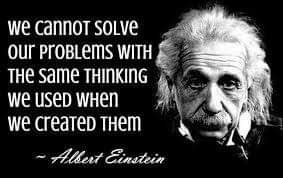
Up until the early 17th century, we relied upon revealed truth and deductive reasoning from first principles to ascertain truth and understanding. Certain premises were taken as givens, and all flowed from these immutable truths by the rules of logic. Wisdom was presumed to have reached a zenith in the Hellenic golden age. We looked back in time to the ancients for inspiration. The world was immutable … static and hierarchical.
Francis Bacon is oft credited with introducing the principles of inductive reasoning, the foundation of modern science, in the early 1600s. Apparently, he was a busy man. Some argue that he, not Shakespeare, wrote the greatest classics of English literature. In addition, he held high posts in the administration of King James the 1st.
At its core, inductive reasoning rests on empirical observation and moving from careful measurement of the real world to the formulation of testable hypotheses. Truth was no longer given but something discoverable through observation and rational consideration. Modern science was being born. Of course, Bacon wasn’t the first to stumble on such thoughts. Thinkers in Baghdad during the Islamic Golden Age (circa 600 to 1200 CE) had similar insights. But Bacon’s rediscovery had legs, as they say.
Early on, say for three centuries, science competed with religious truths for supremacy. Witness Galileo’s problems with the Vatican. As late as the 1950s, the great Jesuit thinker Pierre Teilhard de Chardin struggled with his superiors as he tried to integrate evolutionary thought with Catholic dogma. These two worlds (faith and reason) kept colliding.

Today, we believe that science has prevailed, though I question that at times when I witness the nonsense being issued by MAGA devotees. Can we really be certain that today’s Republicans once again won’t start burning academics and scientists at the stake for heresy. 🤔 Perhaps they will settle for lengthy jail sentences starting with Anthony Fauci (an eminent doctor and scientist who devoted his life fighting infectious diseases through modern medicine).
Science has created the world around us … everything from wonder-drugs to the miracles of modern communications to the technologies probing distant galaxies. Such miracles come from the techniques and discipline of the insights launched by Bacon’s revolution. Yet, there is a black hole quality to much of science today.
What do I mean by that? The gap between science (scientists) and the common man is growing. In the late 19th century, it was widely accepted that an undergraduate degree is all an educated man needed. The first graduate degrees were not created until Johns Hopkins (1870s) and Clark University (1880s) decided that additional years of study were necessary to master certain disciplines.
Today, every discipline has multiple sub-specialties. Scholars focus on tiny topics and dig deep into them. The language of science has become increasingly technical and unavailable to even well-educated persons. I have doctorate but cannot fathom the work being done in many other disciplines. Ever peruse the math through which physicists communicate with one another. It is like trying to comprehend the Bible in the original Aramaic.

The academic culture, unfortunately, reflects and supports the chasm between modern sciences and people. Scholars who try to bring their work to larger audiences are derided and marginalized. At the extreme, they are the William Tyndale’s of the modern world.
We need a better marriage between knowledge creators and knowledge producers. My UW colleague, Karen Bogenscneider, and I have written much on this topic including two volumes on Evidence Based Policymaking. Accepting science should not remain an act of faith, like religious truth. Researchers and scientists have an obligation to discover new knowledge and also bring their understandings to the wider world.
 Tom's Musings
One response to “Conundrum to Ponder #4”
A fine entry, most educational. Until you cannot resist utterly biased crap statements like”…witness the nonsense being issued by MAGA devotees.” Or,”Can we really be certain that today’s Republicans once again won’t start burning academics and scientists at the stake for heresy.” Pu-lease. In keeping with your scholarly tone, opt for neutrality: “…witness the nonsense issued by political extremists disguised as secular dogma.” Let your audience, left, right, and confused draw their own conclusions. “Even in your most liberal reflections you certainly realize the right has no monopoly on insanity and evil intent.
Unless you consider your public writings fully declare your politics in every subsequent instance, clearly identify fact as fact and opinion and political hyperbole as exactly that. Not doing so, arguing what you feel a just cause with eloquence, incredibly biased fabrications raise audience eyebrows in a way completely contrary to your plan. Not fair to your audience, and especially not fair to solid arguments which otherwise would effectively proselytize.
LikeLike