Space-time … our newest deity.
Is there a God? I am humble enough to admit I don’t have a clue. As suggested in the previous blog, I don’t believe there is a personal deity who is imbued with human attributes and seemingly afflicted with rather ordinary emotions and concerns. I can not accept as proof of such a personable deity the existence of ancient writings of questionable provence that are replete with mind-bending contradictions and impossible assertions. Heaven help us, excuse my use of this phrase, if the extreme religious fanatics lurking in today’s Republican Party take control and replace our Constitution with the Bible. Look at Iran or Afghanistan to see what happens when popular versions of so-called religious truths replace secular law.
Yet, we can see out there a cosmic majesty so improbable that we are left humbled and, in my case, frankly curious. How could something like this exist? Why does it exist? Where is it all going which, in truth, is a bit like asking what does it all mean?

Imagine our long ago ancestors peering up into the night sky in wonder. They could only see a tiny portion of what lay out there and see only the Cosmos as it recently existed. Now, with our human ingenuity, we peer into the immensity of space and thus deep into our past. The distant images we now detect with our telescopes in deep space represent what existed billions of years ago. That is how long it takes for light to reach us from such unfathomable distances. We are looking into our deepest history. If our ancestors were impressed with the night sky, I am blown away by what is out there and by what contemporary science reveals to us.
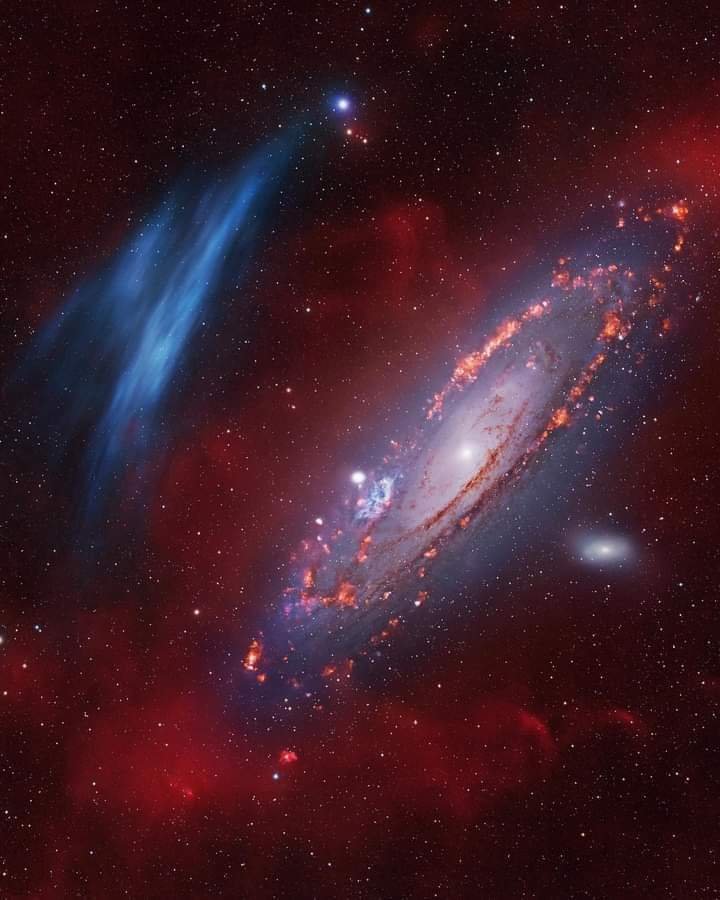
We all search for causes we can understand. Humans have conjured up mythical heroes, human like gods, or impressive deities like Yahwey or Allah or Brahma or he with no name. Such entities are credited with creating all we know for reasons that cannot be convincingly discerned. For virtually all of history, our creation narratives were a matter of faith since there were no other alternative explanations.
Contemporary science changes all that. Yet, it also contains an element of faith since I cannot comprehend the mathematics on which it is based nor the technologies employed to penetrate the mysteries of our universe. Still, there is a fundamental rigor and an empirical basis for how we see things through the lense of modern science. It is the best we got and rests on actual observation.
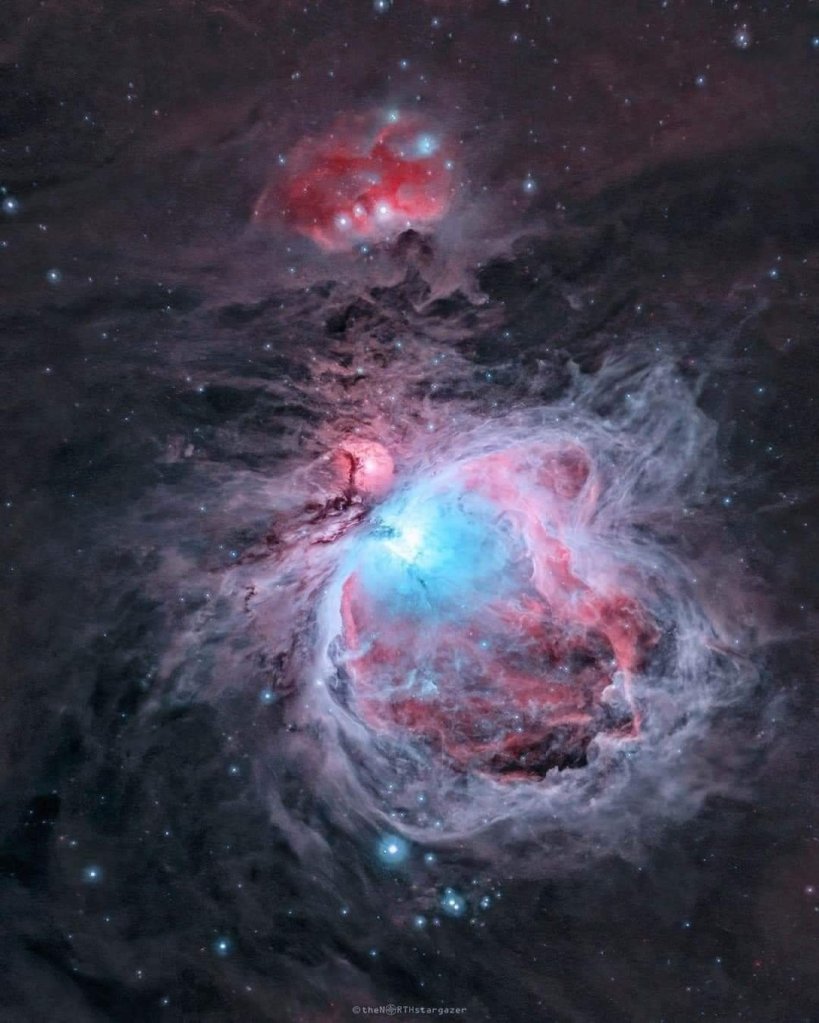
The current creation narration, based on science, goes something like this (an extremely simplistic overview). Some 13.8 billion years ago, there was a tiny speck of energy so small that neither time nor space (as we understand such things) existed. Then, for some reason, this tiny speck of unimaginable dense energy expanded at a rate inconceivable to us in what we call cosmic inflation, or the Big Bang. In this Big Bang, the universe went from literally nothing to a cosmos containing all the elemental ingredients essential to creating the universe we know today.
Suddenly, an immense field of particles and light existed. Yet, much more needed to happen before the known universe came into existence. Oddly enough, this theory was first formulated by a Catholic Priest and physicist … Georges Lemaitre about a century ago, soon to enjoy empirical support from the work of Edward Hubble. As with all radical interpretation of things, acceptance took time, and many mysteries remained.
Creating our known world we see about us took longer than six days, nor is it the product of divine choice as ordinarily understood. No, in the moments after the Big Bang this expansion of elementary materials (mostly hydrogen) there existed tiny imperfections in the cosmic expansion taking place. If those tiny fluctuations had not existed we would have a dull and uniform cosmos of evenly distributed hydrogen … no celestial bodies, no humans, no Space-Time phenomenon as we know it.
But these tiny variations in density did exist. In turn, such anomalies resulted in the emergence of local gravitational fields which, in turn, permitted the aggregation of swirling matter into clumps and, over time, increasingly more sophisticated and complex stars, planets, and various other celestial bodies.
The process took billions of years. As these bodies increased in size, they increased the gravitational fields around them. These fields in turn helped shape the architecture of the cosmos through endless and often violent collisions in space as bodies of increasing complexity were drawn to one another. Stars grew as they absorbed surrounding gases and matter. They became hotter, some of them exhausting their fusion based energy sources before exploding in galactic fireworks. In the process, the immense energy created and then thrust into the universe included all the heavier elements that had been forged in their cores. These extravagant explosions created the building blocks needed for the world we see around us today. We ourselves are stardust created by such ancient explosions.
Governing this chaotic birth and celestial development was the fundamental notion of Space-Time itself. This abstruse concept is considered by scientists as the fundamental architecture that connects everything in the known universe. From what we know, IT is responsible for the very character of the cosmos.
This mysterious entity also contravenes our usual perception of things. The two dimensions are intimately related to one another. That is why the two words (space and time) are inseparable. Moreover, the two dimensions act differently than our human apprehension permits. Space curves in the presence of solid objects. A straight line is not always the shortest difference between two points.
Time proceeds at different rates depending on the position one is in with respect to our space-time continuum. We will age faster if we lived our lives at the top of the Empire State Building than if we lived on the first floor. Gravity (the curvature of space) is stronger on the earth’s surface which, in turn, impacts time. The satellites orbiting above us off which our telephone signals bounce must continuously adjust their clocks to account for slight differences in the pace of time as measured on earth and in orbit. Without such corrections, our GPS based on those advanced orbiting systems would quickly lose their accuracy.
In some ways, this space-time phenomenon is the essential foundation for the architecture of the universe. It theoretically explains how all the stars, galaxies, solar systems, nebulae, black holes, and the other stuff came to be. From a rational perspective, this is the closest thing to a God-the-Creator we have. And yet, it remains a matter of faith for me.

When I ponder such notions, I feel like the ancients pondering the stars in the night sky. As with the excitement of each new day, I keep hoping for more understanding. But that is illusion. Such full understanding is beyond me. There remains so much we yet do not know at present. And I am too dull to appreciate most of it.
The Big Bang is not over. Our galaxies continue to rush away from one another at an accelerating pace. A mysterious entity called dark matter (which presumably constitutes 70 percent of the universe) may be responsible for this apparent fact of this increasing rate at which things are flying away from one another. Are we destined in a few billion years to see our magnificent universe die a slow death of ultimate entropy? Some believe that is to be the case.
Intriguing question … is it not! In the meantime, should we consider space-time (or this mysterious dark matter) to be the rational equivalent of God. Is this the creator we have sought so long. 🤔 Hmmm 😒!
The great thing about being a human is not that all the answers are given to us in the form of religious truths. No, our blessing is that we have an opportunity to reflect on our immense world in a rigorous manner. We can peel back our ignorance to reveal God (or reality) as it actually exists. How about that.
 Tom's Musings
4 responses to “Conundrums to Ponder #2.”
Thoroughly provoking read, touching all the incomprehensibles in one swell foop.
LikeLike
I try, though seldom succeed 😞.
LikeLiked by 1 person
This was extraordinary Tom. Thats exactly the way I see “God” but I have never been able to express it . It was simple ane eloquent. Thank you.
LikeLiked by 1 person
Well, I try to understand stuff.
LikeLike