up
As you know, I spent the bulk of my professional life at the Institute for Research on Poverty at the University of Wisconsin. It was an ideal place for an itinerant thinker and social philosopher like myself. It also was a place where I forged several irreplaceable associations. So, before I launch into the substance of the next several thematic blogs, a bit of context.
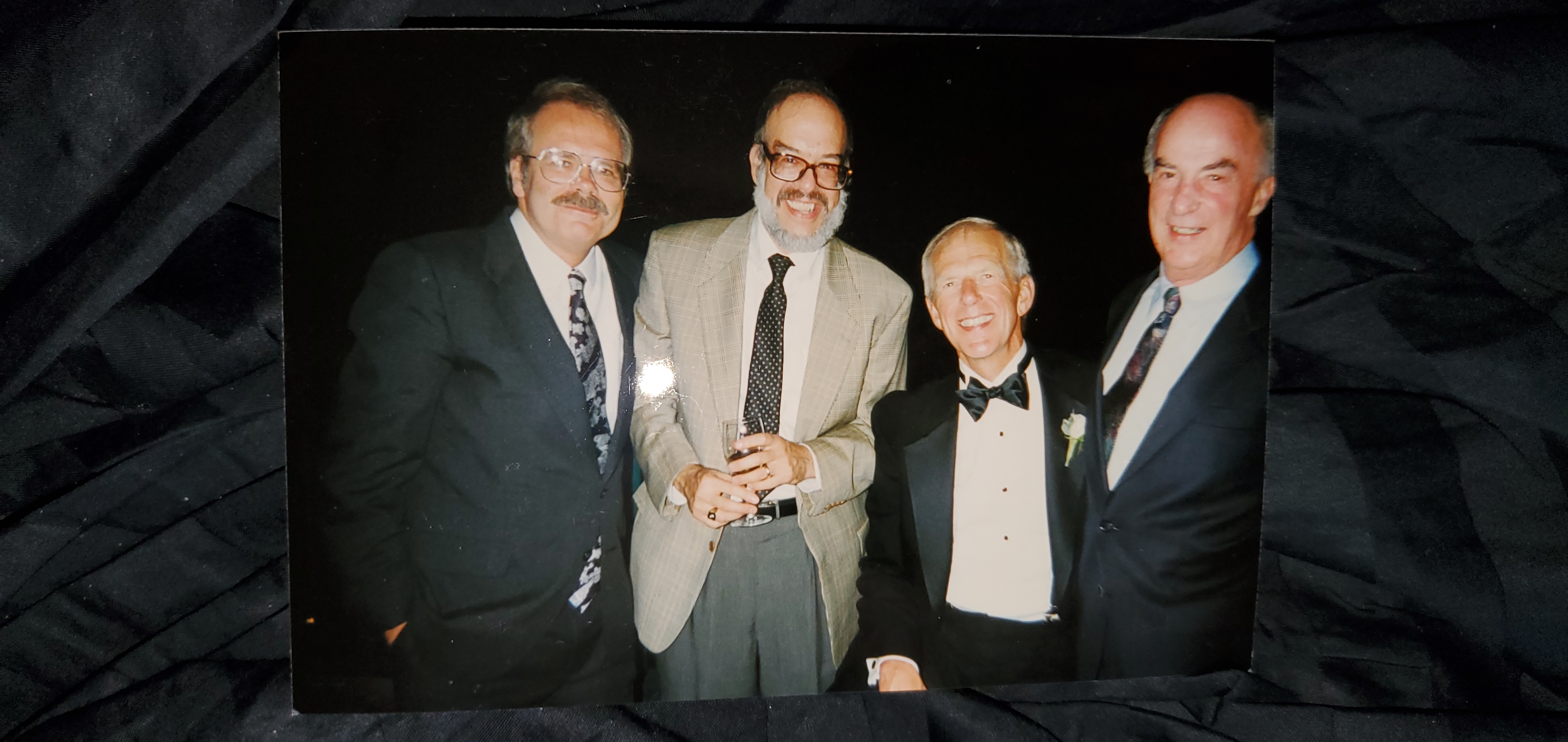
Over the next couple of weeks, I will be sharing the published version of my final talk given at an Institute function. Bob Haveman (2nd from right in the pic above which was taken at his stepdaughter’s wedding in New York) called me one day in 2013. He asked if I could quickly drum up a plenary talk on ‘poverty as a policy issue‘ since the invited speaker had fallen ill. I was retired at this point, but thought … why not? BTW … the others in the pic include Irv Piliavin (far right), Irv Garfinkle (2nd from left), and me (far left). That was quite a crew. I feel grateful to have known and worked with each of these fine scholars.
The talk I managed to drum up quickly was a hit. They were so impressed that I was next asked to turn my notes for that talk into an article, which I did. The resulting piece in FOCUS garnered much positive attention and comment. After that, I thought little about it until recently. I seldom dwelt on past works. However, a discussion with a good friend not long ago reminded me of this piece, though I can not retrieve why in the world it came up after all these years. Nevertheless, I retrieved the article and forwarded it to her. She, in turn, surprised me by suggesting that I serialize it for this blog.
I hesitated. Really? Who would care? But I did share it with a neighbor of mine who is a rather renowned infectious disease doc at the University of Wisconsin hospital and a man of extraordinary intellectual interests. He had mentioned wanting to know more about social policy (his curiosity about things is endless). He subsequently responded enthusiastically to the piece, suggesting that this gem should be published in several well- known outlets. That simply made me smile, but the notion of at least distributing it on this blog moved once again to the front burner.
So, here we are. These next several blogs are based on an article in the Institute for Research on Poverty’s primary publication, FOCUS (vol. 30, No. 2, Fall/Winter 2013-14. While I will remain faithful to the original, I likely will take some liberties. For example, I will excise some material for brevities sake and may add a few comments as needed. Still, poverty has not been a hot topic over the past decade or two. Yes, there is angst about inflation and an eroding American dream for too many, but income poverty does not generate the attention and political obsession it once did. When it is raised, the question is posed in terms of rising inequality, not absolute poverty.
Even with these possible modifications, what you will read is essentially what I first shared some 10 years ago. As the saying goes, the issue has legs. Moreover, much to my chagrin, I doubt there has been a great deal of ground-breaking research or innovative thought in the past decade. Poverty as an intellectual object of concern (or a political focus) has waxed and waned over time. We are in a trough at present.
When the Institute for Research on Poverty was created some 58 years ago as part of the Federal government’s War-On-Poverty, there was little research on the issue of poverty per se. The public mission of ending poverty (as expressed by President Johnson in 1965) spawned an avalanche of studies over the next several decades. Public interest in the issue was intense, and the political disputes surrounding the topic were of the ‘life and death’ variety. I speak from experience when I say that dipping one’s toes into the poverty and welfare swamp was not for the faint of heart. You risked offending someone no matter what you said. My favorite mantras from those years was that “I knew I was approaching the truth when no one agreed with me.”
All that changed about a decade after the 1996 law purportedly ‘ended welfare as we knew it’ was passed. When it became certain that the anticipated catastrophic predictions attached to that law had failed to materialize, interest in poverty faded from view. It was as if someone hit an off button
So, I am reasonably confident that what I said in 2013 would hold up today. After all, one of my other favorite mantras I used during the height of the ‘welfare reform’ wars suggested that there really wasn’t anything new being proposed as a solution despite all the fanfare associated with each new political pronouncement. Governor Tommy Thompson’s (a politician known for his dramatic welfare innovations) announced his famous ‘Learnfare’ reform (conditioning welfare grants on school attendance) in the late 1980s as a bold new idea. In reality, it was little more than a regurgitation of practices that had routinely been employed in the 1930s through the 1960s by welfare workers to determine the worthiness of poor applicants for assistance. Still, the world greeted it as something fresh and new, thus putting him in the national spotlight for a while. Senator Patrick Moynihan, the welfare expert in Congress, referenced 18th century English Speenhamland laws when pushing his 1988 set of reforms. Of course, as an ex Harvard Professor, he was one of the few politicians conversant with history. For most, ancient history was anything that occurred before they were elected to office.
The bottom line is this. I remain confident that the The Rise and Fall of Poverty as a Policy Issue remains as relevant today as when these ideas were initially shared. By the way, in future blogs in this series, I will refer to each new publication as Poverty and Policy followed by a number and a label. It just may be that I will sneak a few traditional blogs into the mix. So, pay attention.
Watch for the first of the series (Poverty and Policy) over the next few days. Sometimes the magic works, sometimes it doesn’t. Let’s try it and see.
Finally, if you want more of my thinking on this topic (and who wouldn’t), track down two of my books … A Waward Academic: Reflections from the policy trenches and/or Confessions of an Accidental Scholar.
 Tom's Musings
One response to “American Poverty … an old and new story.”
I just got back from my PLATO class
LikeLike