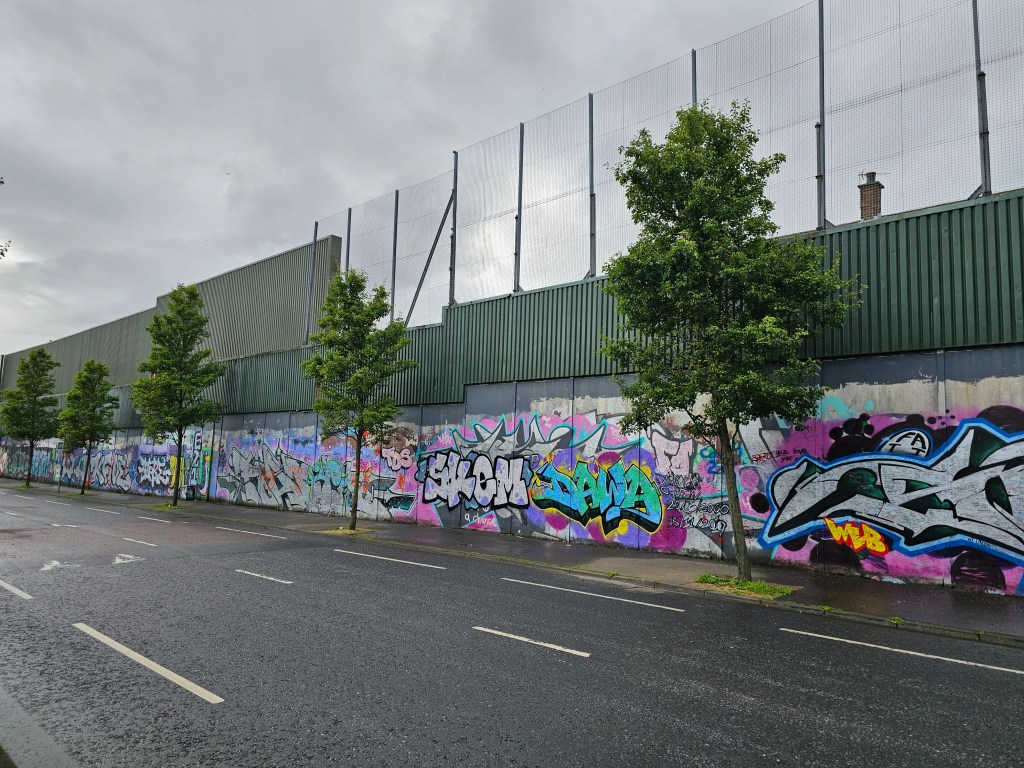
I have been brought back to my recent sojourn into Northern Ireland by a 5 part series on ‘the troubles’ shown on PBS. It ended last night. Hopefully, they will repeat the series. It is definitely worth a watch as it demonstrates the utter folly of sectarian hate as well as the compelling reasons why it is so prevalent.
There are plenty of scenes of street battles, firebombings, car bombings, burning buildings, devastated neighborhoods, and destroyed families. But the gut wrenching part of this documentary is found when now older men and women come to terms with their pasts.
It is a complex story. But right now what I can best do is relay small moments that captured my attention. The troubles started in 1969 in Derry (or Londonderry) where a Catholic majority was dominated by a Protestant minority through unfair voting rules … only property owners could vote and the Catholic population was, in general, too poor to own much. Their resentments simmered for many years until, inspired by the American Civil Rights movement, their anger and frustrations boiled over.
Constant street battles ensued until British Troops arrived. At first, both sides, the Republicans and the Unionists, brought the troops tea and biscuits. But the good feelings didn’t last. I was shocked to discover that the infamous Bloody Sunday massacre happened after the Catholic marchers had retreated back into the bogside (their area of Derry). British paratroopers ran after them and killed over a dozen, wounding many more. It would take almost 4 decades before the British Prime Minister (Cameron) admitted in Parliament that their military forces were totally in the wrong and formally apologized for the unwarranted slaughter.
That event proved totally counterproductive to the Brits. After this event, recruitment to the IRA soared. A lovely woman wearing a green dress for her interview related her own outrage and then mentioned how her 16 year old brother lied about his age to join the IRA. He died 4 years later … being shot by a British soldier. She remains angry to this day.
Another man told of joining the UDA, the Protestant paramilitary to defend his community. That force grew to a small army of 50,000. He was sent to plant an explosive device which went off prematurely. He survived but was sent to prison for 8 years. While there, he talked to another inmate who told him how he was ordered to kill a shop owner. None questioned orders so he did it. Then the man’s wife walked in the shop, so he killed her. Then the young daughter entered the establishment and he killed her. The unionists listening to this story returned to his cell vowing never to pick up a gun again.
They also touched on the story of Jean McConville, a Protestant mother of several children whose Catholic husband died early on from cancer. Through marriage, she yet lived in Catholic housing project in Belfast. One night, a British soldier was hit outside her door. She responded to his pleas for help. This outraged her neighbors. Several days later, local women came and took her away, telling the children that their mother would be back in half an hour. Her body wasn’t recovered for some 30 years. She was another tragic victim of the paranoia of the time, a suspected tout or snitch who had to pay the ultimate price. She was one of 17 who simply disappeared in the middle of the night.
Another woman relayed the story of being pregnant and in the hospital to give birth when the father of her baby gave her name (among others) to the British Security Branch. She went to jail. Through tear filled eyes, she related how her new born daughter was brought to the prison but she did not recognize the child as hers. Her shame at this resides within her to this day.
A then young Catholic lad shared the story of his father who, on hearing the news that several Protestant workers had been slain in an explosion as they came from work, prophecied to his son that innocent Catholics would soon die. This father, who had no role in the IRA or the troubles was soon gunned down in a retaliatory ambush. Tit for tat. An eye for an eye and soon, as Gandhi said, the whole world is blind.
By the early 1990s, the Unionists were killing more than were the IRA. It became clear that the British Security forces, including Special Branch, were colluding with the unionists paramilitary side in strikes against the Catholics. Paranoia ran rife … whom could you trust? Everyone was a potential traitor or tout.
International attention to the Troubles had peaked in the 1980s. The Provos (Provisional IRA) felt that Britain could care less if Irish killed other Irish. So, they brought the war to Britain itself, bombing targets in London and elsewhere. The IRA prisoner’s incarcerated in the Maze were suddenly stripped of their rights as political inmates or POWs. Now, they were treated just like ordinary criminals. In response, many of them first refused to wear prison clothes, or bathe, and smeared feces on their cell walls. Those futile gestures led to the hunger strike. Bobby Sands was the first to die after 66 days, only to be followed by another and another. Some 10 martyrs perished before the hard line Thatcher government silently accommodated many of their demands.
The war on Britain reached a crescendo when a resort hotel in Brighton Beach was bombed. The annual meeting of the Conservative Party was being held there, and the Iron Lady was the target of the attack. This came not all that long after Lord Mountbatten (and others) were blown up by an IRA bomb on his yacht during a holiday retreat off the coast of the Irish Republic (1979). Mountbatten had been a much loved member of the Royal family and held many positions including the being the last Viceroy to India.
Amidst all this horror were a few positive moments. The Harp Bar was a grungy place that catered to punk musicians. It was a place where both sides could congregate to listen to the music they loved. More than one interviewee mentioned first going there with hate in their hearts for those on the other side. But, to their amazement, they found that they all were more alike than they realized. Breaking down the extreme segregation each side had faced was critical to communication and ultimate acceptance of those on the other side.
One man recalls how his friends back in the day were sure they could spot Catholics by sight. In fact, they were certain that Catholics smelled different. When you live in a highly segregated world, you can so easily demonize the other. And when the killing starts, perceptions further harden. Some of those being interviewed for this documentary had set aside past hates, others not so much.
There is this. There are many, many other stories I’m glossing over. But how many does one need to hammer home the basic lesson that sectarian conflict is pure insanity. It rots your soul and deprives you of any remaining humanity. It is the ultimate folly.
Nevertheless, there are those in America calling for a civil war. They seem bent on hurting and killing and maiming those whom they have already demonized. The insurrectionists who rampaged through the nation’s Capitol looking to hang Pence and Pelosi for imaginary crimes are just the tip of the swirling anger out there.
One must ask, is this what the far right wants? Watch this documentary and point out one positive lesson from those years other than they ended with the Peace Agreement in 1998, after some 30 years of slaughter and carnage. I can’t find any.
 Tom's Musings
One response to “Detour back to the ‘Troubles’”
Thanks so much for this blog today. I’d like to recommend the excellent book, “Say Nothing: A True Story of Murder and Memory” by Patrick Raddon Keefe. To say that it is riveting is an understatement. It is the story of the death of Jean McConville that you mention in your blog. It tells about the troubles from both perspectives. The review in the Atlantic magazine states that there are no heroes in this story.
LikeLike