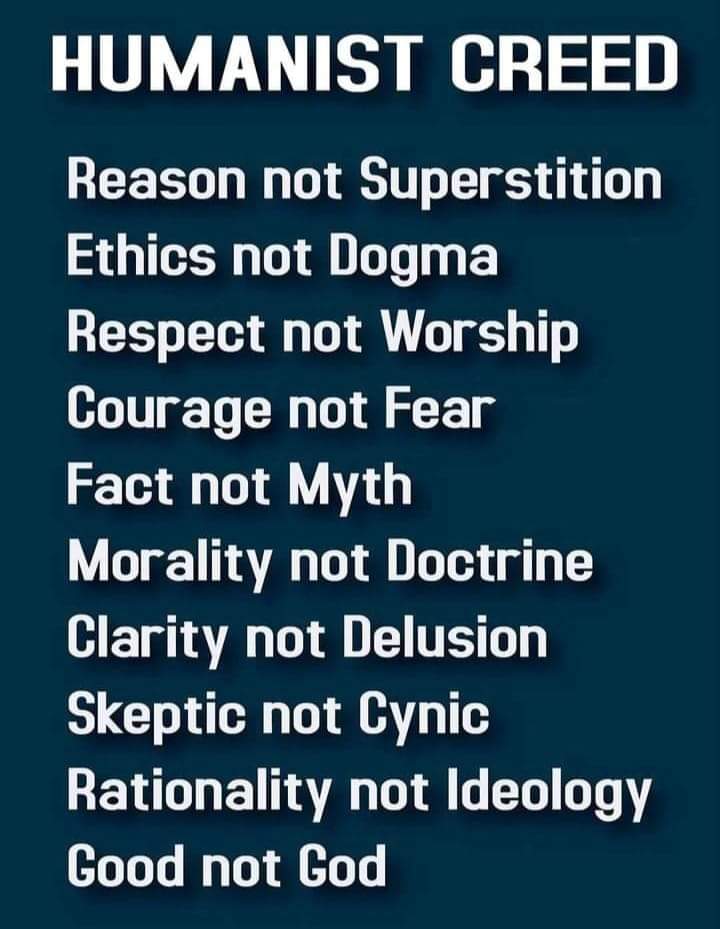
Recently, I waxed eloquent about the difficulties of articulating our core beliefs. At the time, I promised to give my own a try. Normally, I forget all my promises as soon as they are made but this is an exception. Here is my start on this one … my first modest effort at least. After all, articulating one’s world view is an iterative process, I am certain of that. It probably takes one’s entire life to get it right. Well, not right exactly … you just run out of time to finish the effort.
Overall, while I hate labels, being a ‘humanist’ is one tag with which I can live, for myself at least. Sure, it misses some of my more obvious attributes such as oneriness and boorishness (I think I’m funny even when I’m not) and stubborness (hey, I’m irish) but those are more personality traits than core beliefs and sentiments. See, this is hard.
No matter, I like this list (see above) of alleged Humanist attributes for the most part. They capture the sublety and nuanced approach to life toward which I’m drawn. Some will say that Humanism is centered too much on man (and woman) and does not encompass any higher being or power or entity. As such, it is too limited and does not inspire greater vision or ambition or even justice. After all, what is it about humans that would inspire respect, never mind adoration.
While that is a point well taken, here is how I see things. A traditional concept of God or Gods or some form of superior, even supreme, Deity can be seen as thwarting human endeavor in several elemental ways. How is that, you are undoubtedly asking (or maybe not)!
Consider the following. Divine truth obviates the need to seek a deeper knowledge about our world. For millenia, understanding was premised on first principles and sought through deductive reasoning. This led to a lot of circular reasoning and not many discoveries and breakthroughs. As a thinking species (homo sapiens) we stagnated for far too long. Second, a belief in a superior absolute also posited morality outside of the individual or tribe. It was set in stone (sometimes literally) in the form of a set of prescribed givens. Were not the Ten Commandments handed to the Jewish tribe. Perhaps it is better to generate community rules by considering what might constitute a civil and workable society. If you rely on a given set of ethics imposed from without, you had better trust the source implicitly. Goodness, when determined outside of one’s own conscience, typically is shaped and enforced by some form of punishment from a judgemental deity, the burn in Hell scenario. At the same time, some form of redemption is also available … confession, saying a perfect act of contrition, making a huge contribution to church leaders (whatever). This suggests that there always is a loophole for moral turpitude. You can sin at will as long as you repent in the correct manner, and in a timely fashion. Morality becomes a game to be played.
As I have related elsewhere, I only recall one lesson from my high school Freshman religion class (I think we had four years of such instruction but I blocked out most of it). Anyway, the good Xaverian brother (Simeon was his name I believe) told the following story. Tommy and Susie were chaste teens doing their best to follow God’s rules. One night, however, they let their passions get the better of them and went too far. He never explained what too far meant but we knew we had never been there. Suddenly, Tommy and Susie stopped, realizing they had committed a mortal sin. Fearing they might wind up in eternal flames were they not able to get to confession in time, they decided to say a ‘perfect act of contrition,’ a holy get out of jail free card for Catholics at least. Then, Brother Simeon threw in the kicker. At that very moment, a six-ton truck came over the hill, swerved into their car, and dispatched the unlucky couple into eternal Hell. It took me years before I was able to make out with a girl in a car without having a panic attack. 😦
I don’t have the time to recount all that I found objectionable in that story. Why I didn’t chuck Catholicism on the spot remains a mystery, other than the fact that dispensing with our cultural baggage ain’t easy. But I found his cautionary tale counterproductive. How could I respect a deity that would overlook a good life because of one transgression, especially one based on the chemistry He (or She) put in each of us. Or wouldn’t such a Deity accept their intent to seek forgiveness and not demand they actually say the magic words. That seems like total nit-picking to me. And just why would a just and loving deity create this species with so many weaknesses (like basing procreation which is a good thing on male lust which is deemed bad) and then expect these frail specimens to surmount all these arbitrary challenges. Was God bored one eon and decided to conjur up this experiment on earth for some form of amusement? In the long-ago moment, I was sure there were answers to my doubts and that maybe we would get them in senior year. Spoiler alert … we didn’t.
Eventually, it hit me that morality was less something imposed upon us and more something that we must arrive at on our own. To my mind the spirit of Humanism lies in the sense that we are responsible for our rules, how we observe those rules, and how we deal with violations or shortcomings. No one will punish you in the afterlife though you might suffer some consequences in this life according to commuity laws unless you are filthy rich and only abuse the common folk.
The burden and blessing of this Humanistic perspective is that each of us must articulate our own moral compass and, most of the time at least, build an internal rationale for following its strictures. Other than those other pesky humans around you, and perhaps the law as I mentioned, no one is looking over your shoulder, calculating your sins, or assessing your final punishment. It would be nice if there were such a system of ultimate justice (then we might be satisfied that Donald Trump would pay for his sins), but there is no proof of such.
I still remember as a child the milk bottle metaphor. I’ve asked many other Catholics if they recall this and very, very few (if any) have. Anyway, if your milk bottle was white, your soul was full of His (or Her) grace and God was pleased with you. If you had committed some venial sins, dark spots would appear in your bottle (i.e., soul) and there would be some price to pay for your transgressions … purgatory or limbo back in the day. If your bottle was empty, or dark, you were screwed for all eternity since you had committed at least one mortal sin (almost anything sexual fell into this category it seemed). As a horny teen, I wanted to complain to God about this one.
It took me decades to shed this irrational belief that somewhere at the center of my being was an empty or dark milk bottle. Given how I conducted my life, I could not imagine any milk remaining in the container. I sense my reasoning was flawed or, more likely, was counterproductive. I typically concluded that I already was screwed given how weak and pathetic I was. So, to my way of thinking, why change my ways now? No way I could refill my bottle with milk, I mean grace.
While the simple beliefs of my childhood fell away quickly in college, a process that clearly had started earlier (Freshman religion class likely) but which I had refused to acknowledge. In retrospect, my initial attraction to Humanism resonated with me before I knew what it was, probably because it reflected the lessons I took away from my early religious training. I was not here to adore and worship some invisible entity. Really, why would this ‘supreme being’ even care what I thought. Why, in heavens name, would such an onmiscient and all powerful entity seek my adiration or care about my fealty. Really!
No, if there was a center about which to organize my thoughts and moral sentiments, it would be rooted in how I promoted the well-being of my fellow travelers on this orbiting sphere found in the edge of a remote galaxy also spinning in the vastness of space. After all, we arguably are the most advanced species on earth and, as far as we know, alone in the universe until we get definitive proof otherwise. Perhaps we are the one creation in the cosmos capable of both understanding and shaping all about us in some larger sense … at least as we continue to evolve. Wow! Now that is a lonely and scary thought.
While it may leave one feeling isolated in some ontological sense, it eventually afforded me a sense of hope. If there were meaning in all this, it would not be handed to us in some creation narrative of apochryphal origins. It would be found somewhere in the future as we evolve toward ends we can barely imagine at present unless, of course, the cosmologists are right and we are destined in some absolute sense to wind down into a cold and dark and lifeless universe (the Big Freeze) or in a world where expansion reverses and all we see out there collapses into a tiny singularity (the Big Crunch) or in a world where exansion continues and accelerates (the Big Rip). However, let us not go to those unpleasant visions right now.
In the end, morality and ethics are not arrived at by reason alone. Emotions and baser sentiments are involved. I have little doubt that what I took away from my Catholic culture played a big role in who I am now. (I need to bblame someone.) It had nothing to do with the church as an institution, nor the litany, nor all the frivolous rules. No, it had to do with embracing what was handed down from the person of Christ as a teacher (or Rabbi). Who knows what the historical Jesus was like, or if he really existed. But the thrust of this message attributed to him, his new testament, was moving.
Forget the trivia, he apparently told his followers again and again. Focus on love, on service, on compassion for all, not just your own kind but for sinners and saints alike, for foreigners to you, and especially for those who are vulnerable and suffering. Christ’s esential message, it turns out, was the core teaching of most major movements but I didn’t know other spiritual traditions as a young man. I was exposed to this one and it made great emotional sense to me. Hell, I studied for the Priesthood for a while because of it.
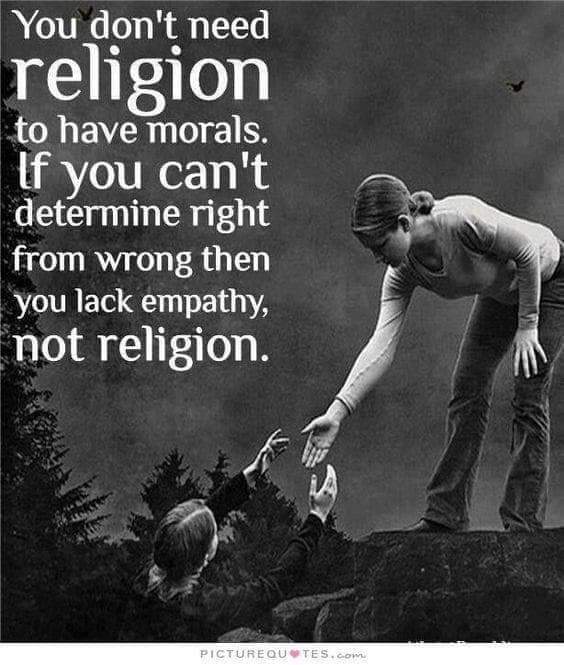
In short, I intuited that Christ was the first Humanist though I probably did not formally make that connection for a while. Really, if you skip over that image of Christ whipping the money changers in the Temple, what you see is a pacifist going around telling people to love one another as equals. He is encouraging his followers to look past differences in class and position and background and to accept all. Even more radical, he suggests they give up their worldly goods and follow him into a simple communal life. Let’s face it, the guy was the first Communist. Okay, either that or a cult leader, but not a crazy one.
Let me put a spin on what I took away from my early spiritual development, things I am sure would not have been approved by the parish Priest nor the good Xaverian Brothers who tried to educate me (and save my lost soul) in high school:
INTERNATIONALISM … I felt, even as a fairly young kid, that we were all part of one big tribe. Nation’s were arbitrary lines. Ethnicities and races were unimportant differences. We were all in this together and we had to reach ut and help one another. Isn’t that what Christ did in his examples? As a young man I could not understand why we did not do more to help feed the hungry and starving around the world. I even joined the World Federalist Society, or tried to, some one-world group that, I later wondered, had been a Commie front organization. No matter, their message seemed spot on to my young mind.
PACIFISM … Okay, I was not a total pacifist in my tender years. I felt we had to stop godless Communism and, if the Cuban Missile Crisis had blossomed into a full conflict, might well have signed on to fight. But my disgust with violence was always there. When friends had conflicts I always tried to bridge the differences and not take sides. Perhaps it was my parents arguing all the time but I had a deep aversion to conflict. Peace was embedded within me. Nevertheless, I did see some conflict as necessary. World War II was a moral conflict to stop Fascism. Perhaps, if the 40 plus percent of Americans who believe another Civil War here is inevitable in the next decade, I easily could see justification in taking up arms against MAGA extremists who would impose totolitarian rule in place of democracy and turn the U.S. into a backward and semi-feudal nation.
EQUALITY (OF OPPORTUNITY) … Fairness, I believe, has always been part of my ethical fabric. Okay, it is a vague concept, I get that. Many rich people feel it is unfair that they should pay proportionally more than someone who has little. While their is a surface plausibility in that postiton, I feel the opposite. Nor do I believe we can get everyone to equal outcomes in the race of life. It is even difficult to get all to relatively fair starting points in that marathon race. However, we can do better. There is something grinding to me that some win the genetics and wealth lottery (being born to rich parents for example) while others are born as crack babies. How can we assess the worth of others when the race is so unfair? More practically, how many contributions are lost simply because some have no chance at life?
RESPONSIBILITY OVER FREEDOM … The dominant American ethos or narrative centers around personal freedom. The ‘American dream’ posits unlimited opportunity to seek personal success and to acquire virtually unlimited material goods. Really, that’s it … you can get a bigger car or house than your neighbor. That is what it is all about? Beating the other guy is life’s most cherished goal? That’s what you might conclude by reading Forbes or the Wall Street Journal. If so, I will get off that merry-go-round, thank you very much. As a younger man, I recall a board game called ‘Life‘ I believe. If you successfully made your way around the board to the end, you would get a million dollars or something like that (the hypothetical payoff is likely higher now). I always thought … that’s it? That is what life is all about? How sad. Why isn’t the end all about helping others … saving a suffering child. How about making life a bit bearable for our fellow passengers on this perilous journey we share.
COLLABORATION OVER COMPETITION … The other part of the American narrative is the ‘lone wolf’ image. We are successes by our own efforts. The western pioneer who killed off the savages (a form of genocide) and created a homestead with the sweat of his brow has been our ideal. We still idolize the Bill Gates and Steve Jobs of the world, entrpreneurs who started out in garages or dorm rooms. In reality, most advancements have always been accomplished as collaboraitve efforts over time. Even Thomas Edison borrowed or stole much from others. I believe it was Isaac Newton (an egotist himself) who admitted that ‘he stood on the shoulders of prior giants.’ The big challenges in the future, like ‘climate change’ or dealing with the promise and perils of ‘Artificial Intelligence’ will demand unprecedented levels of collaboration and cooperation. Advanced classes at the top technical schools stress collaboration because the problems are beyond one man’s abilities. The solitary genius must give way to the team. Again, we are in this together.
EVOLUTIONISM … I’m not sure that is a real word but it reflects an important part of my world view and has been alluded to earlier. Meaning comes from where we are going, not where we have been nor where we are now. Possibility always has a future tense but is not guaranteed. Success for all (the species) requires many things discussed above like collaboration, opportunity, responsibility (for the planet) and so forth. I still recall the moment when, as a young student during a late night bull session, I swept my arm up as I waxed on about evolution and the prospect that we were in an era of transformational change that comes along once in a few millenia. I recall writing a master’s thesis on that theme back in the early 1970s.
That night and in that moment, though, I recall stopping and thinking wow … the cynic is gone and a hopeful clone who surely looks like Tom Corbett has taken hs place. My pessimism returns from time to time (things like the Trump disaster soured me). But I never have forgotten the hope embedded in the writings of Jesuit Priest and scientist Pierre Teihlard de Jardin who, while working in China, found such hope in an evolutionary perspective. Perhaps we, and all about us, were not created by a deity but the reverse. We, as evolving entities, are in the process of creating God. Just a thought.
This is just a start. Each point demands much more discussion. Each has internal challenges and contradictions. With time, I will return to these themes. Patience! You have not escaped from the twisted mind of Tom Corbett just yet.
 Tom's Musings
3 responses to “What I Believe (Maybe?)”
Talk about food for thought; you just served up a feast.
LikeLiked by 1 person
Good read. With only the most understandable snippets of biased rhetoric (frankly, I miss it) and a good deal of sincere (perhaps unintended) humor. Those reading who cannot recognize at least some of themselves in your explanation probably hail from the ranks of the religiously devout.
If Civil War comes, there’ll be Red, Blue and Grey “sides.” If Red and Blue hatred and deceit bring us that far, I’ll be steadfast in the ranks of the Grey. Which means I’ll be among the first casualties. That’s okay; my coupon is past due and Sleepy has not tussled with SCOTUS over my forgiveness. Yet.
After relating your early struggles with Xavierian Knights, you’re on the money with the religion/divinity thing. Many of my family and friends will see me carrying a ticket to hell for that declaration. You can guess my retort, and understand my oft-repeated line, “God has a fine sense of humor – look at the creation of man.”
Nothing you revealed surprises or even mildly offends me. I might go out on a limb with internationalism or the “world as one community” bit. We are not, and probably never will be, civil enough across the board that internationalism is a good idea. I fret some foreign power, maybe some ethnicity seeing Americans less vigilant against economic, political, military abuse and taking advantage to our extinction. For that reason, pacificism is intolerable. To me.
Keep coming at us, Tom. I’m following. And learning along the way.
LikeLiked by 1 person
Wow! I’ve tried to do this myself, and it ain’t easy getting down what I believe. So much to say and explore …
I always look forward to more from the mind of Tom Corbett.
LikeLiked by 1 person