When you are about to enter your 8th decade, a week away for me, you reflect more on what might have been. Were there moments back in the fog in one’s early years where, while poised in a fork in the road, you went one way and not the other. What might have happened had you made a different choice? Would your life now be better or worse? Would you be more fulfilled or bitter at the decision then made? Would things be different at all?
Like my most recent prior blog, this is an exercise in counterfactuals, possibilities we cannot know with any certainty unless, of course, there are an infinite number of universes out there as some Physicists suggest. Even if they are all these worlds available to us, there remains the issue of whether we can somehow experience these parallel worlds. All that strikes me as quite improbable.
I have remarkably few regrets in my life. I means, really, for a working class kid who showed no demonstrable skills and struggled even in elementary school, I managed to fool the world quite easily. I faked it as an academic and policy guru. Still, I’ve never escaped the thought that my success in the academy and (more to the point) in the public policy arena was all done with ‘smoke and mirrors.‘
I will engage in a bit of self-promotion here. The Provost at the University of Wisconsin is leaving to assume the Presidency of the University of Oregon. He and I have traded friendly insults for three decades now. He wrote the following to me recently as he prepared for his departure: “I truly loathe putting this in writing, but you are among a small number of my favorite people in the world. I learned a lot from observing the way you navigate life and professional relationships (Now I must add the the throwaway line, as it provided great guidance on what not to do … but that’s not true and not even funny!). I admire your writing and ‘public intellectual’ efforts and, darn it, you’re a wonderful human being.” This is from one of the few sensible economists (and fellow policy wonks) I know.
In truth, I never had a conventional career. I was lucky enough to somehow play at being a ‘faux‘ academic while doing what I most loved to do … stuggle with impossible conundrums and challenges. At the same time, I could spend time with students and help shape their lives as possible future change agents in the world. I recall sharing the following piece of wisdom when they threw me an impressive retirement party (they wanted to make sure I really laft): “I had the best freaking job in the world. I got to fly around the country to work with incredibly smart people on some of the (at the time) most pressing public domestic issues facing us … welfare reform, poverty amelioration, and the redesign of human service systems.”
What I didn’t say to the audience that day is my position as Associate Director of a major national academic research entity (The Institute for Research on Poverty or IRP) gave me instant credibility on the national stage and opened all kinds of doors to me. All these benefits, and I was barely able to squeek by my high school algebra class. That’s a neat trick if you can pull it off.
And yet, I’m not totally sure this is the life I was meant to lead. I suppose I’m reflecting on this question because my latest book is finally making it on to the Amazon site though it has been on Barnes and Noble for several weeks now (You can see the cover below). It is the latest in a series of works that take the reader on a multi-level journey through complex relational, political, and conceptual labyrinths as three familes intersect around momentous challenges in four countries (America, Canada, England, and Afghanistan). Best you check out my web site for details (www.booksbytomcorbett.com).

To my mind, these non-academic books represent a realization of a long deferred fantasy. As a kid, as my neighborhood friends dreamed of being cowboys or soldiers (post WWII) or athletes, I wanted to be an author. I have no real idea where this ambition came from other than the fact my father had a set of Reader’s Digest Condensed Books and almost all of the Perry Mason series authored by Earle Stanley Gardner. Perhaps that, and my library card, were all that was needed to light the spark. Once, I came across a newspaper article about my dad (after his death). It had been written when he was in High School and a member of the basketball team. When asked his future plans, he said he wanted to be a journalist. For a poor depression era Irish kid, that was a pipe dream and he wound up doing factory work. Yet perhaps there was some kind or literary gene within his makeup. After all, he was a great story teller. Who knows?
However, I was an indifferent student until I arrived at Clark University after an ill-conceived stop at a Catholic Seminary. It was there that my mind expanded, if not exploded, with curiosity and into a more encompassing world perspective. My time at Clark also rekindled my suppressed dream of being a writer. I majored in Psychology since that was the best department in the school. In truth, I had absolutely no plan in life, I went with the flow as was easy to do back then. One day, I was in a cafeteria line standing next to my English Lit professor. I loved such classes since they did not involve numbers. Since he was trapped, I mentioned that I harbored this hope of being a writer someday, expecting him to break out laughing. But he was kind and only asked me one question … Can you tell a good story?
I had no idea in the moment. There were moments in my young life when I sparkled a bit by revealing a tiny bit of talent. At the risk of repeating more old stories, I recall the time when we were asked to write a short story in high school. Such an assignment, not involving math, was in my wheelhouse. I let loose my imagination and, when volunteers were solicited in class, my hand shot up. The Brother in charge (a Catholic institution) looked at me in dismay. I could see it in his demeanor… not that dolt! Then, as I stood, all my hubris drained away. Would I would once again make a fool of myself?
Nevertheless, I read my story as it played out in my head and, when finished, looked up expectantly but decidedly anxiously. I expected a sea of smirking faces. But I was stunned. My classmates had been rather transfixed and impressed. This was likely a genuine reaction since this was many years before drugs were prevalent in schools. Even the Xaverian Brother, whose ename I now forget, looked amazed. Perhaps I could tell a good story. But it would take another five decades or so before I had a firm answer on that.
One thing was clear to me even as I approached adulthood and independence. It never dawned on me that writing could pay the bills. And, as much of a rebel as I was (in my own way), I did want to eat well and have a roof over my head. Much later in life, I was an FB friend (whom I never actually met) with an author who had some actual literary success. One of her books was selected by Oprah and rushed to the top of the best seller list. Several years later, from her posts, it was clear she had financial struggles. That was nothing I had to worry about in life though my career had its own form of debilitating stresses. Try getting involved in an issue like welfare reform. My favorite mantra was ‘I knew I was approaching the truth when absolutely no one agreed with me.’ That is a lonely place to be.
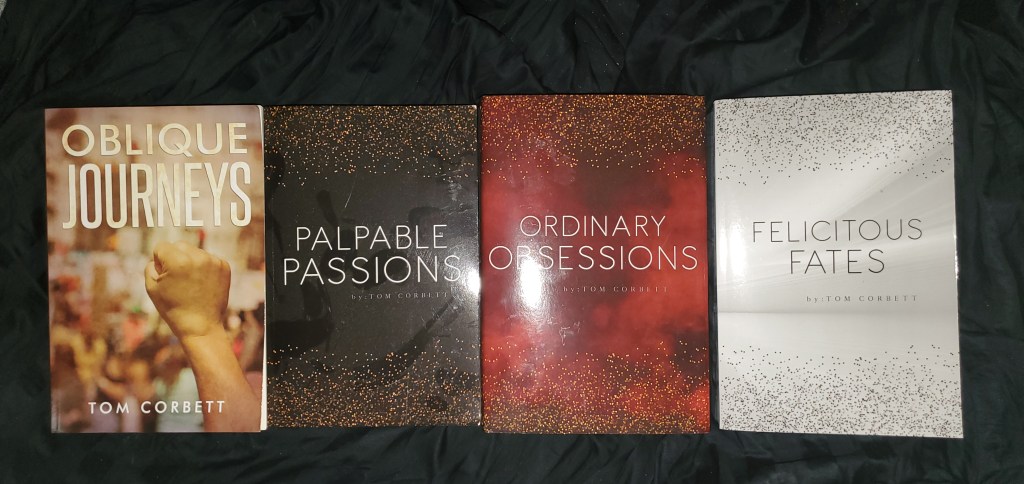
As some proof of my story-telling skills, I offer the the above series of compelling literary masterpieces. Perhaps, again with some likely undeserved hubris, the aggregate Amazon reader reviews are in the 4.6 out of 5 star range. That is as good as anyone gets. The feedback from those who share their reactions with me personally are very uplifting. This is critical. Let me be realistic. I might get sales in the hundreds of books, perhaps close to a thousand, but I will never reach a real audience, nor make any money with this avocation. The satisfaction has to come from within and perhaps the knowledge that you are touching a few others.
Even during my so-called academic career, it was clear that my written skill set was where my strength might be found. My academic home was in Social Work where I taught several policy courses. But mostly I hung around with the economists at Wisconsin and with those practitioners of the dismal science affililiated with IRP from Universities across the country. Economists, with a few exceptions, are a hard and difficult lot. Praise does not come easily to them. However, I noticed many would go out of their way to comment positively on my written works. That was not to be dismissed lightly.
For example, Robert Lampman was the economist often credited with writing a chapter for JFK’s economic report to the President that later inspired Lyndon Johnson’s War On Poverty. He stopped me one day early in my career at IRP to lavishly praise one of my first written pieces at IRP. I recall standing there thinking here is a man who is a virtual icon in poverty studies praising a schmuck like me. What is going on?
Much later, I wrote a piece called Child Poverty: Progress or Paralysis for IRP’s FOCUS, an outlet widely read in both the academic and policy communities. It came out just before I left to spend a year in D.C. to work on Clinton’s welfare reform legislation. When I got to D.C. I found it was a rage among the policy set. I later found out the GAO would hand it out whenever Congressional staff wanted information on poverty and welfare issues. It probably was one of the least academic pieces ever in FOCUS but, on the other hand, was insightful and written in an accessible and even humorous style. You don’t have to be dull to have an impact.
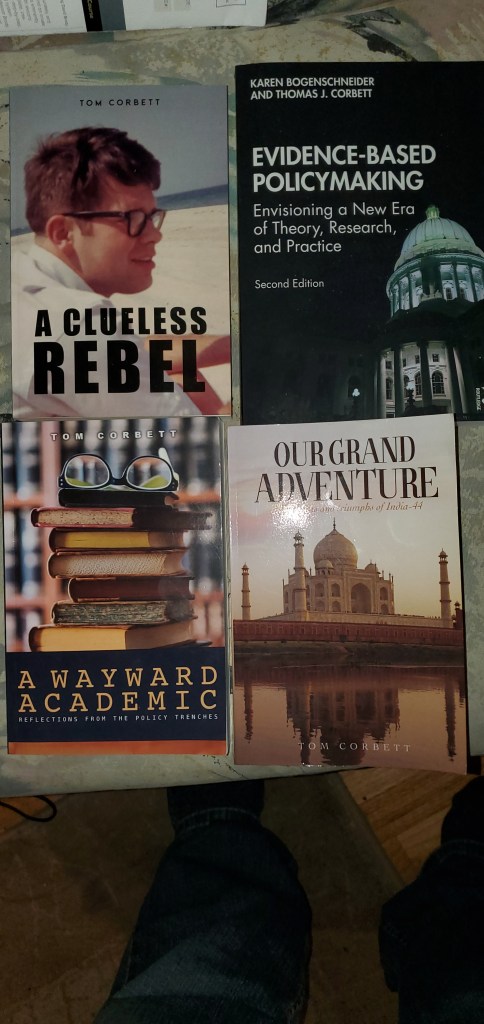
As you can see in the above insert, I have also published several memoirs and one recent co-authored academic work. The memoirs cover my early life, my policy career, and an hilarious remembering of my Peace Corps days in India-44. If, as several sages have pointed out, a life unexamined is a life not worth living, my life has been well worth living. I still wonder if my life has been as humorous as I make it out to be in my retelling of the story. Most likely, it was that fall-down funny since people have always referred to me as one big joke.
However, my professional life was a 24/7 obsession. Life at a research university, and as a player in the national public policy arena, doesn’t leave much room for a personal life. Surely, there was no time to indulge in that chidlish dream of being a writer. That would have to wait. It wasn’t until I went to the one and only reunion I ever attended, my old Peace Corps group some 40 years after we returned to the States, that circumstances gently led me back to my early dream. At the reunion, we decided to put together an edited volume of our experiences (Note: we eventually published two … The Other Side of the World and Return to the Other Side of the World.) Working on these was all it took (along with my spouses failing health which diminished our ability to travel) to motivate my literary fires once again.
Over the past decade or so, I’ve written a host of works, rewritten and republished many, and have had a marvelous time in the process. I’ve given up most other retiremement preoccupations like golf (at which I sucked anyways) and workouts at the gym (which was little more than self-abuse). I realized at some point that I really loved writing, and still do. It was always within me, sublimated in the academic and policy writing that occupied me for decades but there nonetheless. And so, many a day I would ponder … Did I make a mistake all those years ago by taking the safe route of getting a real job? Had I sold out on my real dream by ignoring my inner muse?
Who knows? After all, I experienced great joy as a policy wonk and as a university teacher, and was pretty good at raising money and keeping an important research entity aflout during some trying times. It was not exactly a life wasted by any means. But I’ve never quite been able to shake that sense of taking the wrong road early on. When I think on such matters, that early dream usually involves sitting around in Provincetown on Cape Cod having great discussions with Eugene O’Neill and exchanging corrspondance with William Faulkner. But that was in a time now lost to us … a moment when literature was less a business and more of an art form. It just might be impossible to ‘go home again.’
Nope, I will simply be grateful to have had two marvelous careers, for me at least since I cannot speak to any possible contributions to the world. One career was a paid vocation in the real world and the other, in retirement, has been mostly in the interior terrain of my imagination. While I cannot speak to what others experience in their private worlds, I have come to appreciate how rich and varied are the stories inside me. I can let myself relax and narratives and dialogues simply flow through my head. Or, I sit down to a morning blog, write one sentence, and the rest flows. I’ve often been frustrated that my fingers cannot work as fast as my mind. (That partially explains my many spelling and grammar errors.) It has always been such.
Bottom line, no regrets. After all, I might have gotten a real job and actually worked for a living simply to make money. Heaven help me if I had taken that road. I surely would have ended it all many decades ago. But, as of today, I still have things to say on paper and worlds to explore inside my head. How freaking marvelous is that!
By the way … I am motivate to keep blogging by the thought of organizing my daily mental masturbation into book form. But before that, I may rework another earlier work which I’m not satisfied with (after all, I write for myself and am my own judge and jury). See below for this next project that will involve substantial revisions to an earlier work.
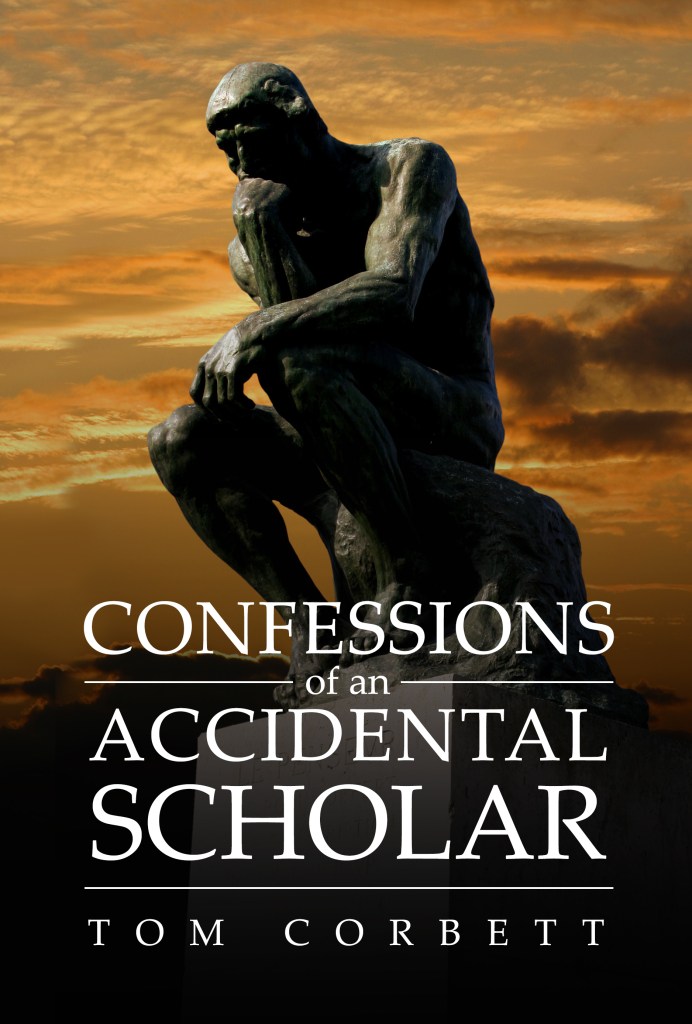
Watch out world! Lock up the women and children.
 Tom's Musings
One response to “Roads Not Taken!”
Argh! I thought I left a lengthy reply yesterday but it apparently vaporized…maybe another hint that I am not a writer. Again, tho, keep up the good work.
LikeLike