
Back in my old days, when I shared my versions of truth, justice, and the American way on Facebook to thousands of adoring followers, I would occasionally use my alter ego (Father Tom or Pastor Jim). It would take too long to explain why the different names but the allusion to a religious vocation is simple enough. On that day, usually a Sunday, I would be writing about ethical or spiritual or even religious matters. Guess what, that is what I am doing today.
Now, you may ask what right a depraved lech and morally bankrupt leftist like me has in expounding of such divine topics. My claim to expertise in these matters is decidedly weak but, in my mind al least, has some redeeming merit. I took my Catholic religion seriously growing up. This might have been a bit strange since my parents were more interested in having a good time than attending church which would have been more attractive to them had they served wine to the parishioners during Mass instead of wasting it on the Priest as part of the religious ceremony. No matter, for some reason now inexplicable, I was a good boy, an unforgivable transgression for which I made up later in life, or tried to at least.
Exploring why I developed a heightened sense of purpose as a young man is way beyond the scope of this blog though I would suggest my memoir (A Clueless Rebel) which explores my coming of age with great wit and occasional wisdom. Still, even as I drifted toward entering the Seminary, I would sit in my religious instruction at my Catholic boys high school and argue with the teacher in my head about Church doctrine. Even then, my innate rational side struggled with this strong desire to perfect some kind of ‘moral compass.’ What the hell is that, you ask? After all is said and done, a moral compass is the sense of right and wrong we carry about inside of us. It is the core from which our behaviors presumably arise.
Despite my prevailing doubts at the time, I entered the Maryknoll Seminary in 1962 (I spelled it wrong in a recent blog which people were kind enough to point out, though I now have your names in my book). That experiment lasted only a year and a half, during which time I labored toward at least one partial epiphany. It turned out I wanted to do good in the world even as I strayed further and further away from any sense that the Catholic Priesthood was the vehicle for doing so. My confusion as a boy graduating from High School was that, in my world, there were few avenues for expressing this internal sense of obligation or what I would come to label my moral compass. I would soon find that there were many such vehicles.
It took me a little longer to get to the core of my confusion. I was drawn to the essence of Christ’s teachings while finding the institutional trappings of formal religious institutions off-putting, if not ridiculous. Okay, I’ll admit that the reverance shown the clergy back then, and these mysterious powers assigned to Priests by the faithful (e.g., turning the Host used in the Mass into the body of Christ), was a further draw but not of sufficient power. Again, I always had my doubts. And back then, there were few public scandals respecting the clergy and I never saw any pedophelia or even heard a whisper about such or the other sins now associated with men of the cloth. Amazing how much we ignored, or refused to see, at the time.
Still, as I shed my affinity for the institutional trappings of religion including the exclusionary premises contained within each of these, and the silly rigidity of specific doctrines (really, how many fights can you have over the nature of the Trinity?), one thing remained to me. I found Christ’s core teachings, as I had embraced them as a kid, both instructive and compelling. Even today, I watch those who pretend to love Christ so much, and who invoke His name so frequently, behave in ways totally contradictory to the New Law he brought to his Jewish audiences at the time. His go-to message was, above all, that love and acceptance were all that counted. You didn’t have to sacrifice a goat, or pay attention to all the freaking rules the Rabbis and Pharisees of the time enforced. Reach out to everyone, no matter who or what they were, and do your best by them.

In the 1960s, I would watch these good Christian folk screaming at a 6 year old black girl who merely wanted to get a decent education. I would wonder what was in the hearts of such people whose venom and hate demanded that this girl be surrounded by Federal Marshals just to get into a freaking public school. What did the screaming mob hear in their Sunday services? It was nothing like the lessons I had absorbed, that was for sure. And soon I stumbled upon perhaps my most critical epiphany of those years … being a member of a formal church said nothing, nothing at all, about the character of your ‘moral compass.’
Well, when I escaped my cultural coccoon while attending Clark University, a secular local institutions known among Catholics in the area as a den of ‘Atheists and Communists,’ my mind exploded with new thoughts and ideas. THANK GOD! As I perused a broader array of thought, not necessarily for classes, and talked with my peers (few were now Catholic), I could put things into a more comprehensive perspective. Essentially, all major traditions, when you cut out all the collatoral nonsense, focused on a singular message (see below):
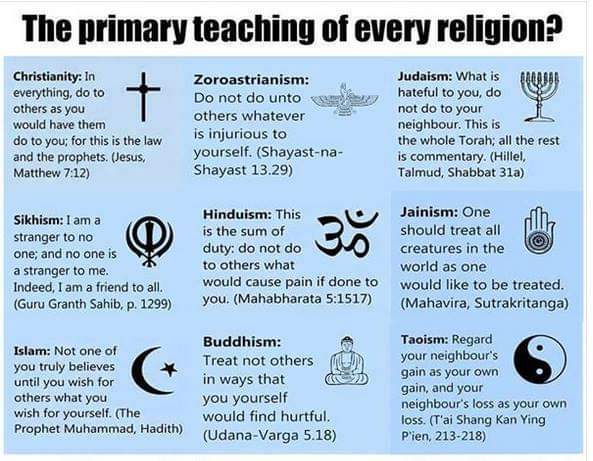
There you have it. You might call it the ‘golden rule’ or simple ‘common sense’ or a ‘biological imperative’ that motivated some of us to cooperate and collaborate, not hate and kill one another. These more positive tactics were better strategies for the survival of the species. In how many of Christ’s parables did the protagonist reach out to others, whether strangers or friends, sinners or saints, similar in appearance or very different in color or creed, and call them brother (or sister). Yet, how many who were indoctrinated in narrow and exclusionary creeds somehow managed to create contrary belief systems and behave in totally opposite manners. Of course, I do see individuals whose organized belief systems make then better people. It is just that I see no correlation bewteen belonging to a specific tradition and the quality of their internal moral compass, or at least not in their behaviors.
Perhaps some 15 years ago, my late wife wanted to connect with a church, mostly for the rites which she thought might be comforting. I agreed to the Unitarian-Universalist church in Tarpon Springs, Florida (where we Wintered) because the town in which it was located had great Greek food for the after-church stuffing of my mouth. But this sect proved to be fine. The minister was a graduate from Harvard Divinity School who, in my eyaes, came out of central casting. He was an avuncular presence, wise and thoughtful, who even made me think … not an easy task. More importantly, the Congregation accepted all, drew from all traditions, and focused on social justice and doing good for others. You could be devout or an atheist, it mattered not to them. Just be good and do good. Period.

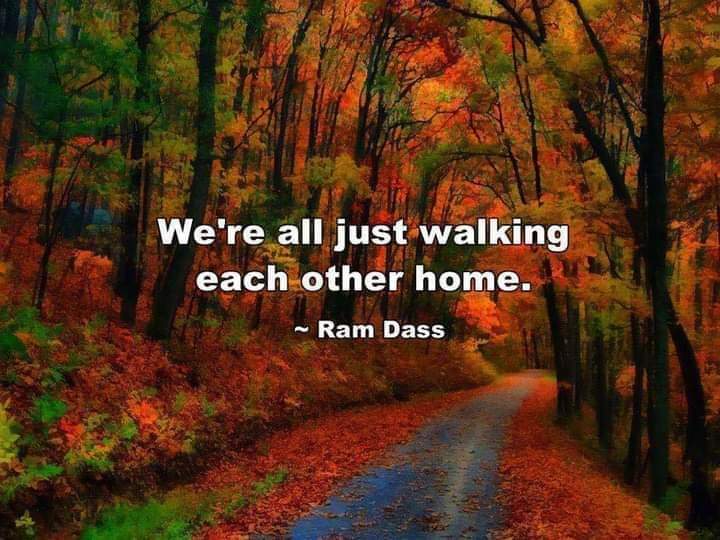
My spiritual journey, while I never assigned a label to my destination, probably led me to Humanism. It focuses on mankind, rationality, and hope (see above meme). It is not where we are now that counts but where we are headed, unless we screw things up. This reminds me of the one Catholic religious figure that had the most profound impact on me as a young man. He was Pierre Teilhard de Chardin. He was a Jesuit Priest, more philosopher than anything else, who spent his life in China (before the Communists took over) doing archeology while studying the past. This led him to articulate an evolutionary perspective that was immersed in spiritual meaning. His attachment to the theory of evolution had him constantly battling with Rome. In any case, he laid out exciting possibilities for the future of the species … perhaps even a God in the making perspective.
Now, I read him a long time ago, in high school, so what I recall may be touched with what I want to recall, not what he wrote. And his speculations may well not pass muster with today’s scientific community. But I loved my recall of his message. (Besides, I once experienced a very, very rare success in seducing a female when she learned I was a Chardin devotee. Who knew?)
Chardin convinced me that it is not where we are now but where we might be going. And all of us are on this journey together. So, let us walk down this path toward destinations we can barely envision as global brothers and sisters. To me, that is the most compelling moral code of all. Perhaps it is the only way we will get there, or anywhere that counts.
 Tom's Musings
One response to “A Moral Compass.”
Pierre who?? Ha, ha. I love that you capitalized Wintering. ❄️
LikeLike