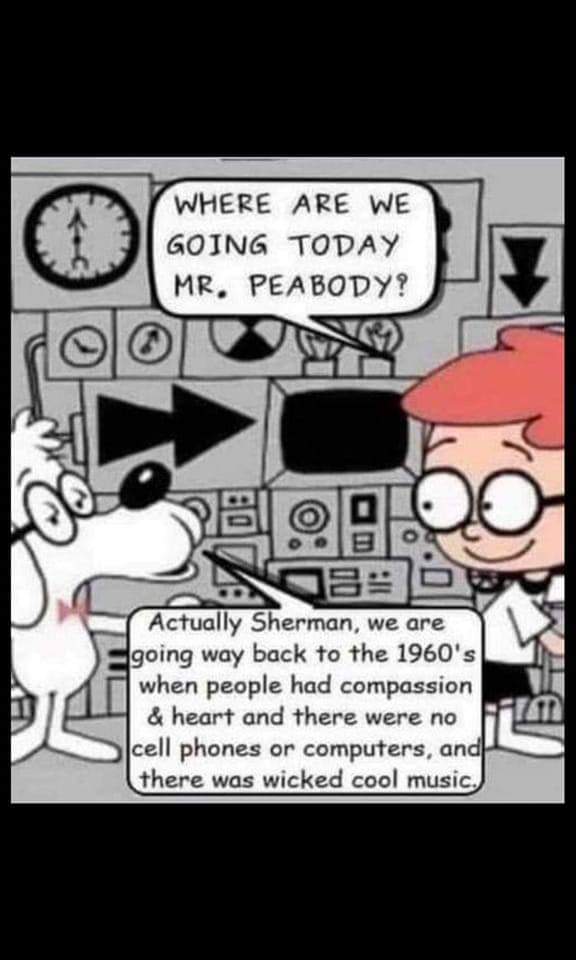
If you were to sit around with a bunch of old farts, as I did yesterday afternoon, you will find a lot of reminiscing about the ‘good old days.’ And there were no ‘old days’ better than the infamous decade of the 60s. It was a magical period of exuberance, experimentation, revolution, and hope, above all … hope. Somehow, we geezers look back on this magical time of drugs, sex, and rock and roll with unmitigated longing. But better than all that, we could watch the antics of Rocky and Bullwinkle on TV while learning so much from Peabody’s improbable history.
Mr. Peabody, a really smart dog, would take this doofus Sherman, a clueless boy, back into time (see cartoon above) where he would instruct his dim bulb of a student on the nuances of past historical periods. These instructive lessons turned me into a history buff, a love that has never diminsished yet will never be mastered.
Later in life, my spouse would catch me watching reruns of Rocky, and Gilligans Island, and the Beverly Hillbillies. I always tried to watch them on the down-low, like I did when sneaking a peak at some dirty magazine. Ah, but she was a sly woman … often catching me as I laughed out loud while viewing my favorite brain rot. “I can’t believe it,” she would huff. “You are so intelligent, how can you watch that junk.” (NOTE: I somehow fooled her into thinking I was smart.) I would grant that Gilligans Island and the others were geared for 6 year old minds but Rocky and Bullwinkle were way ahead of their times, and have yet to be equalled for sophisticated adult humor posing as a kid’s cartoon. Then she would sigh, roll her eyes, and mentioned ruefully something about the good catches she let get away.
I did get the last laugh one day. At some event we ran into Gary Sandefur and his spouse. Gary enjoyed a distinguished career as a professor of Sociology and later Dean of Letter and Sciences at UW before ending his career as Provost at Oklahoma State University, his home state. More importantly, he was a good guy whom Mary admired greatly. As we were chatting, Mary thought she could employ him as an ally in her ongoing (and futile) campaign to turn me into an adult. (Men are always amazed that women continue to tilt at this hopeless windmill.) So, she says confidently, “Gary, can you believe that Tom still watches Rocky and Bullwinkle. Really, what adult watches stuff like that.” Gary evidenced a crooked and slightly embarrassed smile while responding quietly “Mary, I just purchased a complete set of that series.” She was struck dumb by his words. Ah, sweet victory, so rarely experienced.
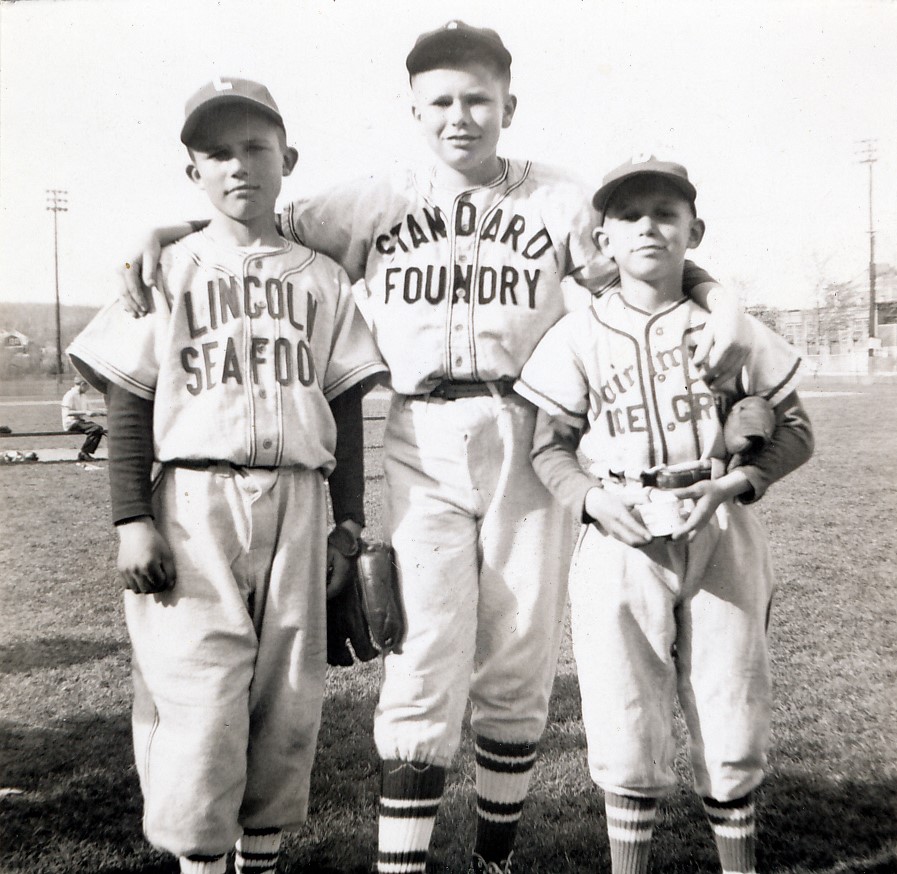
While Rocky (and his friends) helped me immensely during this ‘coming of age’ era, the times themselves seemed exceptional. It was as if our worlds tilted on their axes. I came out of the previous decade as a conventional Catholic, ethnic, working class kid. Here I am (the middle one) in the 1950s, an innocent kid playing little league baseball. The other two kids are my cousins, the one on the left eventually signed with the Los Angleles Angels and played in their minor league sysytem for a number of years. Aside from having a few unconventional ideas for my cultural environment, I was indistinguishable from all the other ruffians who would go on to live ordinary lives.
Then the 60s hit. Remember the movie ‘American Graffitti?’ It is about some high school kids graduating in 1962. They made different decisions and went in different directions and thus experienced radically different life trajectories. The underlying theme was that 1962 was a pivotal tipping point in our culture and history. So much was about to change after Kennedy’s assassination and the Vietnam War heated up. And so it did … the civil rights revolution, the anti-war movement, the feminist awakening, gay rights and native American rights and so much more. By the way, I graduated from high school in June of 1962.
I left the seminary in the fall of 1963 after realizing my lack of any conventional belief in a personal God made the priesthood a poor vocational choice and then matriculated at Clark University for the Spring semester of 1964. At that moment, I was still the conventional kid who grew up in a very ordinary way. By the time I went off to India in 1967, I was a totally different person. I had experienced every dimension and emotion of the turmoil that ravaged my belief structures and challenged my established world views. Most people never endure such a reclamation of their assumptions and their moral cores. Life for them is relatively linear. For me and many of my peers, it was the opposite. We examined and then reframed all that we thought we knew and believed. We recreated ourselves.

Here I was sitting at a beach on Cape Cod toward the end of my college years, musing about the world and my future. I don’t look different on the outside but the inside of me had been totally rebuilt. During my college years I went from a life unexamined to a world fully examined. While I may have learned a few things in classes, most of my education happened outside of class while spending endless hours debating the issues and challenges of the day.
I can still recall the moment I became an anti-war activist. I had an NSF grant to do original undergrad research (in psychology) and got into a debate with one of the other recipients (a kid who went on to Harvard for his doctorate). I was still hanging on to my conservative Catholic cultural beliefs (some of them at least) and tried to defend what we were doing there. He and I went at it for hours, no project research would be done that day. At the end of our personal debate, I knew I had lost that battle (though I could not admit it to him in the moment). Later that year, he sought me out in the cafeteria (I spent way more time there in dialiogue than in the library studying) to praise an anti-war article I had written for the college newspaper. He did not gloat at all, but his victory was in black and white.
That was a small vignette that was repeated endlessly as we rebuilt ourselves, at least as many of us did. Several decades ago, I recall reading an article that has stuck with me. It was by a State Supreme Court Justice in New York State. He talked about coming of age in the 1930s, another period when beliefs and world views were tested as the depression and an impending world war loomed. Like many of his intellectual college peers, he flirted with Communism and other utopian solutions to the looming problems surrounding them. He discarded the extreme remedies but, in the process of fully confrionting the most problematic challenges of his era, was required to rebuild his approach to life from the ground up. He felt that process made him a deeper and better thinker. He was so thankfull for the time in which he had the fortune to mature.
That same epiphany struck me as well. I joined the Students for a Democratic Society (SDS) before they went off the crazy end. The important thing is that I had to think hard and long about what I believed and why. That process was largely forced on me by events and the challenges of the time … would I cooperate with the draft or resist for example. I am struck by how most people wander through life without change or challenge. I would watch students toward the end of the Vietnam War protest era spouting slogans while realizing that they had little understanding as to what they were opposing or why. For many of them, it simply was the thing to do. I found that sad, and commiserated with their situation.
There is nothing more precious than having come to your own set of of values after being through a cauldron of doubt and examination. There are few things so disappointing as going through life without really seeing what is about you.
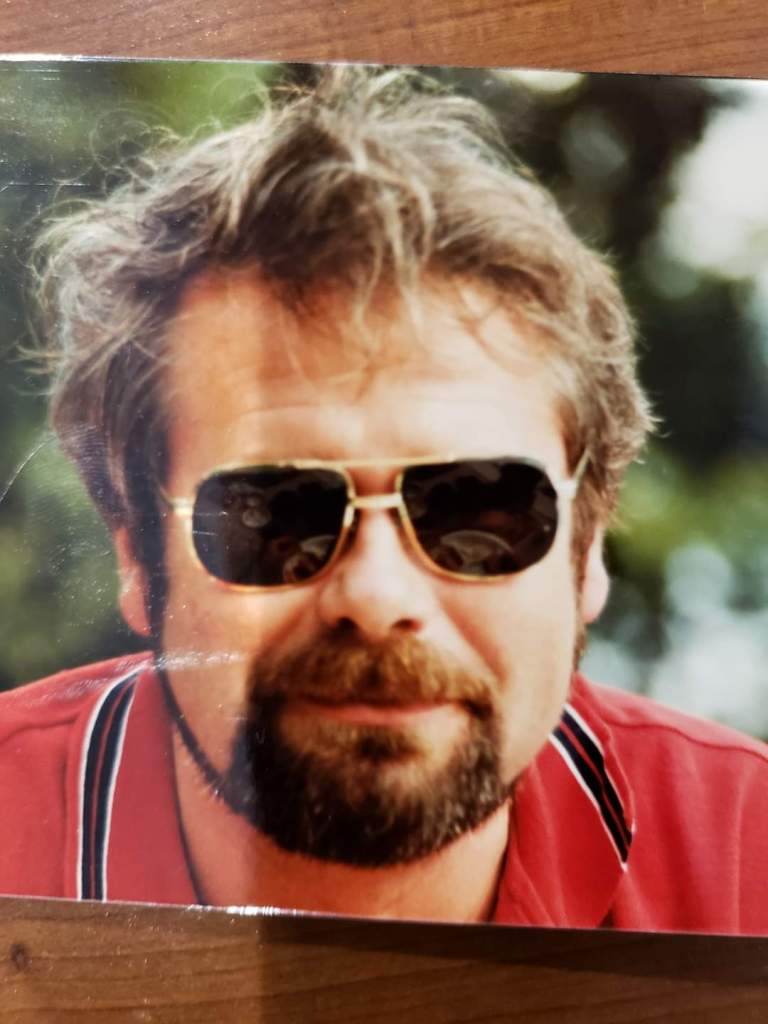
And here I am in the late 1970s, after several years wandering about trying to decide what I wanted to do when I grew up. By this time I’ve stumbled into the University of Wisconsin and was getting a doctorate in Social Welfare. Almost by accident I would become a pretty decent policy wonk who was lucky enough to be involved in some of the more important social questions of my era. It was a heady time and I felt like I was at the center of it all. I also worked with the brightest academic and policy minds of my generation as well as having the opportunity to pass on my thoughts and skills to the next generation in my policy courses. How much fun was that? It beat working for a living.
To be honest, I was never a great student myself and was never disposed to be a conventional scholar (I stayed in academia with smoke and mirrors). But I always felt I had one advantage. I had been a child of the 60s who used that period of turmoil to full advantage. I had rebuilt nyaself from the ground up. More importantly, I could think for myself and connect the dots in unconventional ways. I had developed a skill at doing lateral thinking. I retrospect, that gave me an advantage no matter what room I was in, and I often was among some pretty impressive heavyweights in many of those rooms. I am so thankful.
We were not omniscient by any means. There are no final answers to life’s challenges and no end to the sifting and winnowing process. And sometimes, I got things dead wrong. I remember saying many times in the 60s, “wait until we grow up and assume positions of power. We will right the world.” When my cohort did take full power, all we did was turn the country toward the ‘right.’ How diasppointing is that. Now we look to the next generation to bail us out from the Reagan and Trump revolutions that have turned America into a near banana republic.
My god, how did that happen? What did happen to Camelot?
PS: I have written extensively on the times and on these issues.
http://www.booksbytomcorbett.com

 Tom's Musings
3 responses to “What Happened to Camelot?”
What happened to Camelot? After the John Kennedy, Robert Kennedy, and Martin Luther King assassinations the Lady of the Lake came and took back Excalibur. But I now subscribe that the worst thing our cohort has done is not relinquish control in the 21st Century when there are plenty of younger and in a way wiser souls ready to lead.
LikeLike
I’m ready to hand the world over to them. I’m surprised they haven’t sued us for gross incompetence.
LikeLike
If we could sit in the morning over a couple cups of coffee. Or late evening after polishing-off two bone-in ribeyes nursing tall Irishes. I’m a bit behind you in the parade (or logjam) of years, and we seem shaded politically dissimilar, but the exchange of ideas and arguing would be worth the added cholesterol. I loved Rocky and Bullwinkle. Bullwinkle something of a savant. Peabody. Fractured Fairy Tales. Natasha and Boris. All superb writing, voicing. On par with Mad Magazine.
Me? Bought into and still cling to God, Mother, and apple pie, though many times logic and life did its best to have me understand otherwise. You are a damned good read. Thanks for the memories.
LikeLike