When I was in India back in the 60s, faking it as an farming expert, I had a bad feeling. All my life, my feelings have been on the dark side. As I keep pointing out, I’m irish. That’s what we do … see black clouds everywhere.
Here’s my point. I saw small farms in my backward, rural site that could barely support one family. Yet, there were many children in each family while health services and disease control had progressed to the point where most children were now surviving. Male family heads, however, still thought they needed many children to ensure male survivors.
Remember this. Global child mortality rates hovered at an estimated 50 percent throughout the history of our species. That began to fall precipitously as modern hygiene and public health measures kicked in. The global rate fell to about 1-4 by 1950 and less that 1-25 today. In Scandinavian countries, the rate approaches 0 though, as usual, the U.S. lags far behind more advanced nations.
Below is a pic of two volunteers I trained with who did public health work in Maharasthra. Unlike my pathetic agricultural efforts, these programs worked.

Now here is my point! What would happen to all these children who would now grow to adulthood. You could not divide up these postage size farms any further. India’s urban areas already seemed crammed with too many people scrapping to survive, and barely managing that. I can yet recall watching men carry cases of Coke up a steep mountain to a hill station where I was vacationing since that was cheaper than motoring the liquid up, and it gave them a job. I really was the ‘ugly American’ in those moments. I felt I was at ground zero of the ‘population bomb’ we all talked about back then. Within a generation, India would collapse, or so I predicted.
Fortunately, as my future spouse would repeatedly point out, I was wrong … again. India’s population continued to grow. Recent headlines announced that, at 1.4 billion souls, the population had surpassed China’s and placed her at the top of the list. Yet, no collapse. What happened? In point of fact, population growth has slowed and is projected to trend down not long in the future.
The obvious answer is that I’m a dumb shit but let’s put that possibility to the side for the moment. Normally, the solution to such difficult questions are multifaceted in character. There are few single and simple answers. It was not that India’s leaders were not trying hard to stem population growth even back then. A national birth control campaign started in 1952 with the slogan ‘hum do; hamare do’ or ‘we are two, and will have only two.’ {children}. Indira Gandhi, the PM in the 1960s, was very aggressive in getting men sterilized sometimes forcibly which generated considerable blowback.
I can recall sitting in a meeting where local officials explained the benefits of family planning (i.e., getting a vasectomy) to men, I don’t recall any women in the room. One grizzled man asked what would happen if he had this procedure and then his wife got pregnant … the room erupted in laughter. Even with the incentive of a promised cheap transistor radio, I doubt there were few takers that day.
Perhaps the answers can be found in an article I ran across a couple of days ago. It told the story of two provinces, Bihar in the far northeast of the country and Tamil Nadu located in the far southeast. They have had very different outcomes in dealing with India’s challenges. Let’s look:
Bihar is a conservative area, still steeped in the past and largely agricultural. You might consider this the Indian version of America’s south … stuck in tradition and rigid views. There, women still have a high (though not as high as in the past) birth rates … about 3 children per family. Education is lacking, with only 55 percent of the women being literate. And most married females remain in traditional roles. Only 19% are employed.
Tamil Nadu is like a different country. The birth rate is less than 2 (1.8), which is comparable to many western countries. The women are better educated with a female literacy rate of 84%. Finally, more married women function outside the home with a 46 % labor force participation rate. Bihar and Tamil Nadu have taken very different paths, not unlike the split we see in the States.
Tamil Nadu does some interesting things. As soon as a pregnancy is registered with local authorities, a ‘village nurse’ will start visits with prenatal care and health information. The birth will take place in an advanced medical facility where family planning counselors will work with the mother to determine what is best for her regarding future pregnancies. Depending on circumstances, cash incentives are available up to $240 U.S. dollars to cease producing children though all is voluntary. All family options are explored and made available at no cost. Later on, as girls transiton toward adulthood, an incentive of 1,000 Rupees is awarded those who stay in school and delay marriage. This campaign is far ahead of what you would find in Mississippi. Tamil Nadu got the simple fact that you work with the women if you want an effective family planning program.
But not everything is explained by what happens at the micro or individual level. India also had an economic rennaissance beginning in the 1980s. For 3 or 4 decades after achieving independence, economic growth was slow, hampered by too much bureaucracy and red tape. A campaign to remove many impediments worked in some areas. Tamil Nadu, for example, looks a lot like other booming East Asia countries with new industries flourishing and economic opportunities growing. The joke about the service technician calling himself ‘Steve from Wichita’ really being ‘Patel from Hyderabad’ is not a joke. Send in your tech problem and a highly educated technician on the other side of the world will work on it over night.
Local community development efforts undoubtedly also helped to avert the apocolypse … a possibility I did not see at the time.
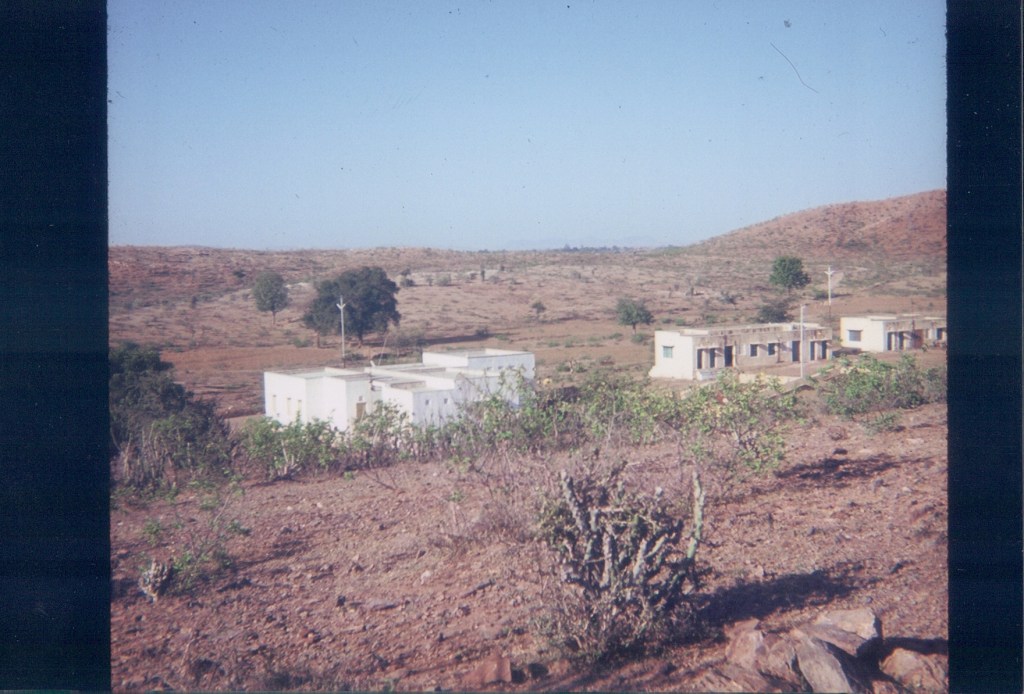
Below are two shots. The first, which I shared before, is my home during my glorious Peace Core experience. The surrounding ares was bleak and nothing but desert.
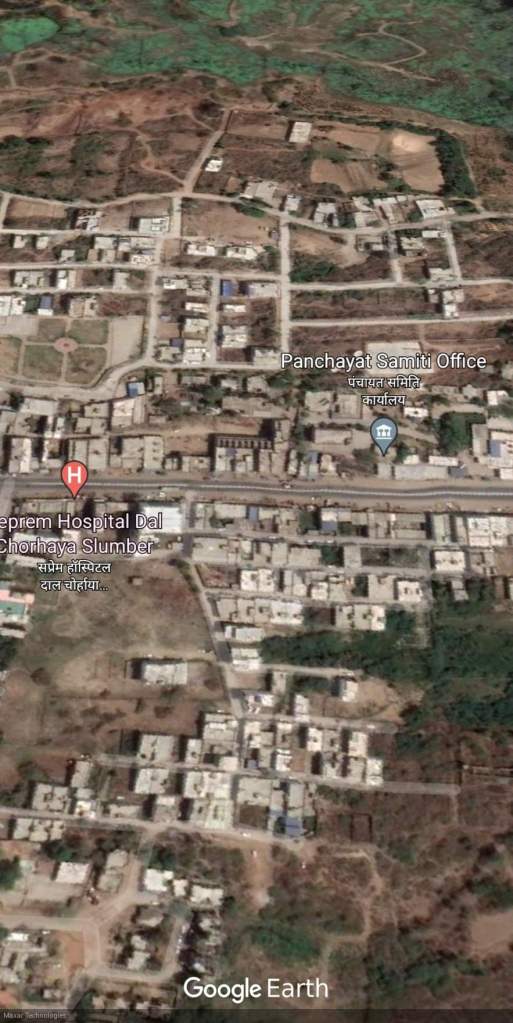
The next shot is the same location. It is developed, with agricultural work ongoing where only sand and dirt once dominated everything. I did not see such growth in the future. BTW … where it says Panchayet Samiti Office (or Community Development Center) is the exact location of my home in the first shot.
India still has many problems, the biggest of which is a conservative national government that appeals to Hindu Nationalism, a kind of Trumpian view of the world. However, at least it has not collapsed as I once feared.
My late wife was right … I am an idiot!
 Tom's Musings
5 responses to “What Happened to the Apocolypse?”
i.e. carrying Coke is cheaper than trucking it. The first time I visited Cambodia in 2004 I asked my driver in Siam Reap why they didn’t use street sweepers instead of women with brooms to clean the rural roads out to Angkor Wat. His answer: We could but then these women wouldn’t have jobs. Are thought processes don’t always apply when we are in another culture.
LikeLike
Another memory from that time involved women shoveling rocks at the side of the road. It was a public works project in response to a crisis when the monsoons failed for a couple of years. They had two women to each shovel, one working the end of the handle and the other tugging on a rope fastened near the spade end. They were trying to keep as many from starving as they could. I have no idea if the work had any utility.
LikeLike
I was notrl implying Judy would replace her programmers. It is my opinion she enjoys 12,000 folks coming to her town. She definitely enjoys building
Programmers replacement just seems logical to me. It was my logic. I am not the business woman Judy is
LikeLike
You are certainly right. On the other hand, she (or her successor) might not feel they have a choice if they are to stay competitive.
LikeLike
You are undoubtedly correct. But the impetus to replace costly human labor may be irresistible at some point.
LikeLike