Trump’s intervention into a foreign nation’s domestic affairs (Venezuela) raises serious questions for me. Their President, Nicolas Maduro, may well be the drug trafficker that Trump’s minions insist that he is. I have no inside information on that matter. Experts who focus on such things, however, generally state that Venezuela is more of a conduit for illicit drugs, not a major source for U.S. markets.
If so, why pick on this man, on this country? Might it be that Venezualan oil stood out as easy pickings for a voracious authoritarian hoping to use the American Presidency as a vehicle for self-enrichment? Might this be another transparent misdirection ploy to steer the public away from focusing on the Epstein Files? Or perhaps it is the latest step toward establishing full MAGA control over the military? This move might be critical as the far right contemplates maintaining permanent political hegemony through extra-constitutional means. They will need such control over the police, justice, and military apparati if democratic traditions are to be subverted aggressively in the near future.
Take your pick with respect to Trump’s real motivations. The bottom line is that we have taken yet another step toward becoming an authoritarian regime being run by a small oligarchy, or should I say kakistocracy (government by the incompetent). Trump himself has recently declared that he is under no obligation to follow any precepts of international law. His only constraints as President are to be found in his internal moral code. This is scary since he has no ethical vision other than to use his public office to punish enemies, further enrich his family, and remain in office by any means.
Americans generally want to believe that their country is a moral leader in the wotld. They want our leaders, despite flaws and mistakes, to at least try to do the right thing on the international stage. In a recent survey, some 61 percent of respondents affirmed that the country ought to act based on generally understood moral precepts, but only 39 percent believe it is doing so at present … a figure that has declined by over 20 percentage points in recent years. In general, we are no longer proud of our national behavior on the global arena.
When a country abandons its moral center, how should citizens respond? That question emerged with considerable clarity in the Senator Mark Kelly kerfuffle. The Democratic Senator from Arizona had a distinguished career as a Naval Officer and Astronaut before the attempted assassination of his spouse, a member of Congress at the time, pushed him into politics.
Last year, as Trump and his Secretary of War (Peter Hegseth) expanded civilian control over the nation’s military and police forces, Senator Kelly spoke out. He affirmed that anyone who takes an oath to the Constitution is obligated to ignore, or even resist, obeying unlawful orders. The Trump machine immediately responded, branding him a traitor. More recently, they have attempted to punish him by reducing his former military rank and his pension even though their legal standing to do such is shaky at best. These are the actions of a regime seeking total control, not the behavior of a Republic functioning within Constitutional limits and well established legal principles.
I was reminded of all this when I ran across the story of one Georg Duckwitz, a German diplomat stationed in Copenhagen during WWII. We have all heard of other individuals who acted with courage and integrity during the insanity of the Nazi holocaust.
Some of these names are quite familiar to us. Raoul Wallenberg was a Swedish diplomat assigned to Budapest during the war. He saved many Jews by issuing false passports and then hiding them in locations he deemed to be Swedish territory. Raoul paid for his heroism by disappearing into a Soviet prison after the war.
And there was (Sir) Nicolas Winton, a British businessman who, on vacation, came across the reality of Jewish persecution in Prague in the months before the outbreak of war. He set up a makeshift office and, through his own energy and connections, managed to save the lives of about 700 Jewish children simply because it was the right thing to do. His humanitarian work ended on September 1, 1939, when Germany attacked Poland. Sadly, his most recent train taking endangered children to freedom was intercepted on that very day; all subsequently lost their lives. He never spoke of his work until his wife stumbled across a notebook he had hidden away for almost four decades.
Oscar Schindler is a name we all know from the iconic movie, Schindler’s List. Oscar was not an official part of the Nazi war machine. He was primarily a war profiteer who also responded to suffering with profound human sensitivity. His story is well known through the Steven Spielberg movie documenting his exploits. Like the others, he also took enormous risks to save vulnerable lives in the midst of unreasoned insanity.
Georg Duckwitz was different in one important way. He was an actual government official functioning within the regime. He was a member of the Nazi government that had occupied Denmark during the war. It was his duty to follow orders. Still, when he was ordered to do something that he believed contradicted his moral code, he had an existential decision to make. In this instance, he chose the dictates of his conscience over the dictates of his official office.
As he sat in his Copenhagen office in 1942, he got word from Berlin that he should facilitate the rounding up of all remaining Jewish families in Denmark for transportation to concentration camps. He knew what that meant. He had a decision to make.
Georg immediately negotiated with Swedish officials to accept over 7,000 refugees. It was a request fraught with unknown consequences but they agreed. Then he contacted a Danish politician he thought might be sympathetic. Spread the word, he insisted, all Jewish families must leave immediately.
The word spread quietly and quickly from family to family. The clock was running out. At the same time, he and others rounded up scores of fishermen and others who waited on the coast to ferry these panicked families to safety in Sweden. They did so, not out of obligation or compensation, but also because it was the right thing to do. A day or so later, when the Gestapo and other military forces raided Jewish homes, they were astonished to find them empty. The anticipated victims were gone. Thousands had been saved because one man of conscience refused to follow orders.
This made a mockery of those Nazis who, during the 2046 Nuremberg trials, argued that they were innocent because they were just following orders. Such is the choice many of us may be required to make if America continues to slide into totalitarian rule. What will you do when required to support or facilitate actions you find unacceptable? Where would you draw your line in the sand? Senator Kelly merely confirmed a principle that already had long been enshrined in the Uniform Military Code of Justice. No one should obey an illegal order. Yet, the administration is hell-bent on making him pay a price.
Most of us, of course, are not in the military, or even ex-military. But the question remains. How should we act if we see ICE personnel acting as if they are contemporary versions of Gestapo agents? What do we do if the regime in Washington usurps ever more power while overtly dismantling Constitutional protections? Do we merely turn away? Or do we take a stand for what we believe is right?
I know what I would like to do. On the other hand, whether I possess the courage to do the right thing is unknowable to me. I do know one thing, however. The solicitations I get from right wing sources oft start with the salutation… Dear Patriot.
That makes me cringe. For them, patriotism is obedience. Leadership is something never to be questioned. That line of reasoning did not work in 1946 during the Nuremberg trial of Nazi war criminals. It should not work after the memory of Trump has been erased from our memories.
Do you spend more time thinking about the future or the past? Why?
In terms of the sheer quantity of reflection … I tend to focus on my past. The reason is self-evident, at least to me. I am an octogenerian. Bottom line, I have a lifetime of experiences on which to ponder. Most have been positive, a few negative. Most importantly, all have been instructive.
Eight decades gives one both perspective and the possibility of wisdom. An attentive observer would realize just how much they have absorbed in the time they have spent spinning through space on the periphery of a single galaxy among some two trillion other such collection of stars. That fact alone testifies to our insignificance. Yet, we realize that we may be relatively unique as a species in that we can appreciate our insignificance. That epiphany alone causes one to pause. We might be among the very few in our vast cosmos capable of pondering our role in the immense universe around us.
The past has blessed me with many insights and epipanies. Key among them is the recognition that human evolution is accelerating at an unsettling pace. I was born during world war at a time when most people suffered under right-wing or left-wing totalitarian governments. Compared to today, I grew up in primitive conditions. We had no TV, survived with a single party-line telephone shared with 3 other families, an icebox and not a refrigerator, no hot running water nor central heating, and no family car.
I watched in amazement as every personal convenience became available that rendered life simpler and more enjoyable. Today, everyone I know lives in a level of comfort that would make the highest royalty of former times blush with envy. Better yet, levels of conflict around our globe still exist but at remarkably diminished levels. Diseases that once ravaged communities and nations have been understood and constrained. Perhaps our most remarkable advancement has been in automation and the creation of our digital world. We have worlds of information that we carry about on our smart phones. In my youth, primitive computers were behemoths that filled up large rooms yet could do far less than hand-held devices today.
The sheer pace of change has been breathtaking. It threatens to be cognitively and socially destabilizing. When I was about 25 years old, I wrote a Masters thesis that argued our technological advancements might well presage an evolutionary transformation on par with the the transition from nomadic to agricultural societies, or the emergence to urban societies, or the shift from rigid belief systems to inductive and science-based understandings of life. In fact, we just might be in the midst of the most electrifying and consequential change ever.
That brings me to the other aspect of this question. I also think of the future. When I do, it is mostly with fear and concern. Though we have made so many remarkable technical advances, those breakthroughs have not been matched by corresponding enhancements in political or philosophical thinking. Our technology speeds ahead while we conduct our social interactions with outmoded concepts and irrational prejudices. That is a very dangerous imbalance.
Lately, I have said many times that I’m glad I am old. I look with trepidation at climate change, at a trend toward hyper-inequality that threatens social cohesion, and at emerging Artificial Intelligence innovations that will restructure society in profoundly fundamental ways. Each of these transformations could end society as we know it.
Then again, every evolutionary transformation introduces a sense of dread and threat. We have managed to survive and advance in the past. We might do the same once again. Perhaps, however, just perhaps our luck will run out this time. Time will tell, likely after I have passed from the scene.
A new year invites one to think about things … to reflect more deeply on those thoughts that daily crowd into my over taxed consciousness. Then again, musing is not difficult for me. I do it well, and often, usually at the sacrifice of tasks that ought to demand my attention … like cleaning up the toxic waste zone in which I live. Oh well, there is always next year for that. But first, some random musings!
……….
On starting this blog: How many blogs have I now written? 300 perhaps, even more? I have no idea. It all started when the good people at Facebook hit me with a third lifetime ban. The first banishment occurred when I had 30,000 followers, a number growing by about 100 newcomers each and every day at the time. I managed to get back on twice. Each time, though, I had to start over from scratch. I would quickly collect thousands of followers before being kicked off again. It had become a sinister pattern.
The final ban was, like the others, inexplicable. I posted a picture of Jesse Owens collecting one of his four gold medals at the 1936 Olympics in Berlin. It so happened that another medal winner was giving a Nazi salute in that pic. The post, and my comment, had nothing to do with this third person. But apparently his presence alone was employed as an excuse to ban me once again. There was no conceivable rationale for their action unless an American hero who embarrased Nazi racial purity on a global stage is now a threat to the powers that be, an explanation not to be summarily dismissed. The other, and very likely explanation, is that their community standards program was an exercise in total incompetence. You pick one. For me, I was done with Facebook.
But I was not done with writing. When my late wife was declining with dementia, I had much time on my hands. I dove into a childhood dream of mine, the fantasy of being an author. I was driven to satisfy a query from a college professor of mine back at Clark University (so long ago I still had hair) after I confessed my interest in a future literary career. He asked: Can you tell a good story? I hesitated: Could I?
Almost six decades later, I erupted with an impressive output of fictional and non-fictional work over several years during my so-called retirement era. Finally, I concluded that I had answered my professor’s challenge … I could craft a good story!
There seemed little need to continue once that conundrum was satisfied. Besides, self- publishing can be an expensive hobby. In addition, seeking traditional literary fame and fortune would consume too much time and effort at my advanced age. That’s a game for the young and foolish. Besides, I no longer needed all that.
But I still needed to write. Some folks need to exercise. Others need nature and the outdoors. Still others focus on music or similar forms of self-expression. The least fortunate among us remain fixated on the continued accumulation of treasure, a shallow and silly pursuit to my mind. My enduring focus remained on self-expression through words. I should note that my university colleagues oft lavished praise on my professional writings … including the hard-ass economists.
For me, there is a beauty and a kind of solace associated with self-reflection, a solitary ritual that gives rise to creating these occasional blogs. This is especially true in the age of Artificial Intelligence (AI) where critical and imaginative thinking might well be sacrificed on the alter of AI platforms. Why think when you get immediate answers from your phone.
With age, I must admit that one’s world becomes smaller. The audiences that one can access become fewer and less important. But my mind remains as fecund, eclectic, and active as ever. Even writing for a small audience that hardly extends beyond myself remains a source of pleasure. Hell, I would get pleasure simply writing for myself. Besides, I have never forgotten the wisdom of one of my early professors … you really don’t understand something until you can communicate it to others.
So, it is likely I will continue to write, perhaps less frequently, if only for myself. I consider it essential therapy. And we need all the therapy we can get in these troubled times.
……….
I ran across a piece recently which talked about the Trump administration going after something called the Catholic Charities- Rio Grande Valley organization. This religious – based initiative, managed by an activist group of Catholic nuns, has run afoul of the latest guardians of our national conscience … the MAGA movement. These Catholic sisters (and their volunteer helpers I presume) have the audacity to help migrant families crossing our southern borders … people who risk their lives to flee oppression or seek new opportunities. According to our leaders in Washington, such charitable impulses must be crushed.
That got me thinking. I was attracted to Catholicism as it existed in my youth. I even spent over a year in a seminary while training to be a missionary priest (the Maryknoll Society). I quickly realized that this vocation was prompted by a sense of responsibility to my fellow man (and woman), not by a belief in a divine presence. My motives were sound but my subsequent vocational choice proved personally misdirected.
Still, a spiritual career path made some sense at that time. The Catholic Church in the 1960s was a big tent that embraced a robust arm of leftist activists. A movement grounded in what was known as liberation theology held currency within the church during that period. There were iconic heroes such as Father Groppi (racial justice) and the Berrigan brothers (anti-war activism) among many others. The missionary priests in the Maryknoll order were known for supporting peasants in Central and South America, many of whom suffered in the face of right-wing oppression. Some members of the order lost their freedom (and even their lives) when they opposed oligarchic oppression and authoritarian regimes.
That was a time when parts of the church reflected the core teachings of Christ … take care of those suffering and the most vulnerable. Reach out to the stranger and love your neighbor even if he doesn’t look or believe as you do. At some point, however, much of organized Christianity returned to its insular and provincial instincts by neglecting the best of the church founder’s inspirational teachings. Evangelical White Christian nationalists took command of most Protestant narratives while a conservative male hierarchy assumed control over the prevailing Catholic narrative. The hard right subverted compassionate spiritual missions to turn religion into a transactional political tool.
In a way, this was a mini-version of the old Orwellian nightmare. The world was turned upside down where up became down, black became white, war became peace. Most importantly, religion became a weapon to rationalize greed and racial animus while villifying and even attacking the very victims of institutional oppression. I can find nothing supporting such a perspective in the New Testament.
This is not surprising. Thoughout history, the narratives that govern our essential institutions (religious organizations being important examples) have reflected entrenched paradigms supportive of existing political structures. Religious orthodoxy tends to reflect and justify extent imbalances of both power and treasure. And so, it is not surprising when religious leaders gather around the most depraved piece of human garbage to live in the White House in order to heap egregious praise on our chief pathological narcissist.
Conventional religious leaders, in the main, do well when they reinforce popular prejudices, not oppose them. That is business as usual. Still, I am appalled when those who evoke the name of Christ the most simultaneously reject his core message with such considered ease. Odd, is it not?
……….
Another recent event caught my attention. The new democratic- socialist mayor of New York was sworn in recently. During his inauguration, he revisited an assertion made by former Democratic President Bill Clinton during his 1996 State of the Union address. Bill asserted that ‘the era of big governmentis over.’ This reflected his preferment for what was known as the third-way approach to politics and to governance. Bill thought there might be areas of compromise with the opposition even as Newt Gingrich was seeking total power for Republicans in an increasingly hyper- partisan political world. He sought to appeal to those purported to reside in the middle of the political spectrum. It was a noble, if futile, gesture.
This got me thinking. One successful aspect of the default narrative governing political thought in recent decades runs like this … bigger government means inefficiency and, more critically, the loss of personal freedom. That assertion seems reasonable but is it axiomatically valid?
I don’t have time for a complete argument here. But I will make one observation. President Reagan reframed our American approach to government by asserting some 45 years ago that government is not the solution to our problems, it is the cause.
Arguably, his argument was questionable. After all, there were many things of which America could be proud at the time. Our public debt was reasonable. Poverty and inequality were at historic lows. Our education and other essential systems were the envy of the globe. Most importantly, upward social mobility was feasible. I am an example of that and, trust me, if I could move up the socio-economic ladder then literally anyone could. However, that would be true only if the public sector offered opportunity-sets conducive to personal mobility, as it did in my youth.
The new paradigm introduced by Reaganomics was a cyclical and devastating pattern of starving public resources, then eroding the quality of the public services supported by these resources. Then, conservatives would blame the victims themselves for what amounted to a systemic rape of our service systems. The dissatisfaction with starved public services inevitably would be blamed on excessive spending and government incompetence.
The solution was always the same … even less government and more spending cuts. At the top of the response list to any crisis was a conservative favorite … cut taxes, especially on the wealthy. Trump’s tax cuts and the DOGE fiasco at the start of his second circus a year ago are examples of the latest rounds of such insanity.
Back to the original question, is less government better? Forget all the global metrics showing America is now lagging far behind its peers in handling poverty and inequality, falling behind in health and education outcomes, and now lagging in our long- touted national claim to fame of upward social mobility. To be even-handed, I might note that all is not negative. Less government, in fact, is very good for some … the uber wealthy.
A quick analysis … the top 400 Americans were subject to an effective tax rate of less than 24 percent by the end of Trump’s first term. At the same time, the typical U.S. tax payer was subject to a 30 percent hit on their income (all taxes). In fact, the richest 400 families paid less taxes than fully half of all their fellow Americans. Warren Buffet was correct when he noted that he pays proportionally less in taxes than does his secretary.
The weirdness of our situation becomes more striking when only federal income taxes are examined. The top 400 get hit with a meager 8 percent tax bill, well below the 13 percent paid by working class stiffs. If the uber-wealthy paid just the rate we impose on working Americans, we would collect well over $500 billion in needed revenues, with some estimates approaching a trillion dollars. Think how we could reduce the national debt if we restored a progressive tax system. Think how much we could invest in science, in education, in health, in our infrastructure, in emerging technologies with these added revenues.
So, does the average Joe enjoy more freedom with less government. Think about that proposition for a moment. Fewer services and public oversight permits an oligarchy to run things. Inequality in the U.S. has never been higher. It would be foolish, if not dangerous, to assume that the new economic titans who command ever more control over the essential institutions (media, justice, education, health, etc.) will function in the interests of the common man. I know of no examples where this fantasy has been a reality. Do you?
……….
I have more random thoughts, quite a few more, but I will stop now. I hope to generate more succinct statements in the future, starting now. That won’t always be easy since I suffer from a well-known affliction … diarrhea of the brain and fingers. But my intentions are good 😌.
The easy answer is this Clark University (BA), the University of Wisconsin-Milwaukee (MA), and the University of Wisconsin- Madison (Ph.D.). It was not a direct route with Peace Corps service and public service in between degrees. But it reflected what was possible then … upward movement from a rather poor, working class upbringing to a career at an R-1 research university. I managed to sustain a thoroughly enjoyable career as a professor, consultant, and policy wonk using the University of Wisconsin as my professional base. Clark University transformed my life in the 1960s. Wisconsin gave me an ideal platform to do what I enjoyed. I feel so fortunate.
As a civilization, perhaps even a species, we currently face certain existential threats. The first is a return of an old curse … climate change. This is a challenge the earth (and its inhabitants) has experienced before. Still, not since the last ice age finally ended some 11,000 or so years ago has the species been so challenged by dramatic environmental change which, for the first time, is largely driven by human folly.
A second threat is associated with the emergence of Artificial Intelligence (AI). Technological change is always disruptive but this transition likely is on a wholly different scale. A dozen years ago, in my final official talk at the University, I warned the audience about the coming dislocation from a digitized, robotocized world on economic well-being and future opportunities. The ultimate impacts are yet incalculable but likely will reorder civilization in transformative ways. The very meaning of ‘work’ will be upended along with the core usefulness of human contributions to society. As a species, we risk becoming obsolete.
The third existential threat is one we might be inclined to overlook. Yet, it remains as potentially insidious as the other two. I am talking about the corrosive reality of a hyper-inequality based oligarchy on our civic and political culture. In short the egregious accumulation of wealth and power into the hands of a few risks the final extinction of the fledgling experiments in democracy, including our efforts to facilitate broad political inclusion. A mature democracy is something that we have gradually introduced and mostly cherished over the past two centuries or so. But it is not guaranteed to future generations. In short, money and power may well replace law and principles as the foundation of our public life.
A backward glance!
What is deceiving about this last threat is its seeming familiarity. Through most of history, elites have ruled over society, from Maharajahs in India, to the Samurai in Japan, to the Czars and Monarchs in Europe, to the Caliphates in Islamic nations and the religious potentates in meso-America. We easily think of the Pharoahs erecting huge pyramids in their memories as thousands of workers hauled tons of stone over the desert. Mansa Musa I, head of the Mali empire in the 14th century, oft has been considered the richest person in history … worth hundreds of billions when most lived in abject poverty. Wealth and power inequalities seemed the natural order of things.
But, toward the end of the 18th century, new thoughts challenged the encrusted assumptions of intrinsic social hierarchy and inequality. In the American colonies, and then in France, the first blushes of social and political equality took root. This revolution, fragile and incomplete at first, expanded in fits and starts. At its core, all white men (and later women and minority males) were equal before God and, more importantly, before the State. All (white males) would have an equal opportunity to succeed, at least in theory. Yet, finally having found fertile land in which to take root, could such ideas endure when entitled elites fought to regain hegemony?
The American experiment in self government was incomplete from the start. Women, indigenous peoples, slaves, and even most property-less males were excluded from political participation. Our southern states, in particular, pursued a neo- feudal model of society based on a plantation economy and rule by a small, entitled elite of wealthy patricians who controlled both land and enslaved humans. That model was smashed in the nation’s horrific civil conflict in the mid-19th century (though it would be largely reestablished by the 1890s through Jim Crow laws).
Entrenched notions of racial hierarchy were not the only threat to an inclusive society. The post-civil war era of industrial expansion reordered America’s economy in ways that aggregated the ever increasing national wealth from capital into the hands of a select few industrial and finance titans. President Grover Cleveland put it this way:
“As we view the achievements of aggregated capital, we discover the existence of trusts, combinations, and monopolies, while the citizen is struggling far in the rear or is trampled to death beneath iron-heel corporations, which should be the carefully restrained creatures of the law and the servants of the people, are fast becoming the people’s masters.”
The Gilded Age marked by unfettered capitalism saw the accumulation of great wealth by the few such as Rockefeller (oil), Carnegie (steel), Morgan (finance), Ford (autos), and Hill (railroads). When capital and labor fought for power, the state typically sided with those that had the most resources. As the old saying goes, he who possesses the gold, rules! President Teddy Roosevelt called these economic titans the “invisible government ” His 5th cousin and future President, Franklin Delano Roosevelt called them ‘economic royalists.’
Fast forward to the post World War II period in America when government regulation was high, when the rich finally paid their fair share for the public good, when poverty was declining rapidly, and when the vaunted American middle class was expanding rapidy. It was the brief period in time when a family could thrive on one paycheck and a working class kid like myself could easily obtain a first-class education (with only nominal debt).
Still, a Republican President, Dwight D. Eisenhower realized that public policy and economic well-being were intimately connected. Even in these halcyon days when each income quintile prospered as the nation’s productivity and wealth grew, Ike realized that future progress depended on which policy directions the country pursued. In 1953, he offered the following warning: “Every gun that is made, every warship launched, every rocket fired signifies, in the final sense, a theft from those who hunger and are not fed, those who are cold and not clothed.” These were strong sentiments coming from a man who spent most of his life in the military.
While a Republican President endorsed liberal ideas growing out of the depression’s New Deal agenda, a small group of conservative intellectuals began to strike back at their loss of political hegemony they saw coming out of the Great Depression. Richard Weaver, in a 1948 book entitled “Ideas Have Consequences,” helped generate an intellectual backlash to the postwar Keynsian, collective security consensus that prevailed at the time.
Weaver argued that long-standing truths would be ignored at our peril. He suggested that underlying any civic society stood natural laws that must be preserved … personal liberty and free markets being foremost among them. Slowly, other intellectuals joined the a growing chorus of dissent including William Buckley (the New Republic, 1955), Milton Friedman, Friedrick von Hayek, Ludwig von Mises, the Chicago School, and many more. They created pockets of doubt that the political consensus of the New Deal was sacrosanct. When President Richard Nixon declared that we are all Keynsians now, little did he realize he was playing taps over a movement that soon would be subject to a well coordinated and well funded conservative attack.
As many have noted, that attack was officially launched by future Supreme Court justice Lewis Powell. In 1971, he wrote a memo to the U.S. Chamber of Commerce titled “Attack on the American Free Enterprise System.” On one level, it was an anti- Communist screed that painted the New Deal legacy as little more than a quasi-Bolshevik plot. More importantly, it laid out a strategy by which the economic elite could once again wrest control of events in the political arena. The elite, or the next generation at least, that believed FDR had been a traitor to his class would seek their revenge.
To start, Powell called for major businesses to invest 10 percent of their advertising budgets in a propoganda campaign that would promote the ideals of free markets, lower taxes, and limited government. In addition, he laid out a framework for reassuming control over civic society’s essential institutions such as the media, the courts, the bureacracy, the educational system, the justice system, and so forth. In a few years, a variety of new Think Tanks were developed (Heritage Foundation, Cato Institute, the Business Roundtable, the Manhattan Institute, etc) which directly challenged the prevailing political and economic consensus. Within a decade, Goldwater’s dramatic Presidential defeat in 1964 had been turned into a resounding 1980 victory for Ronald Reagan, supply-side economics, and a new conservative movement.
By 1994, Newt Gingrich used his position as Speaker of the House to tear down the remaining glue that held America’s Constitution together … the unstated norms of mutual tolerance and institutional forbearance. These were consensus norms that ensured civility in the political arena and a reluctance to employ arbitrary power against one’s political opponents. Those norms which, except for the run-up to our Civil War, had generally prevailed were cast aside by the new Republican revolutionaries. As Gingrich told his fellow Republicans during his rise to power, “You’re fighting a war. It is a war for power.” The other side was the enemy. There would be no compromise considered, no quarter given.
The Gingrich revolution led to the era of hyper-polarization and political dysfunction we’ve seen for some three decades now. But, when you cast political conflict in terms of all out war, and then demonize the other side as hideous enemies in the process, you put yourself in a corner. Defeat can no longer be tolerated, your base will not accept such. Power, once secured, must be retained by any means imaginable. A final assault on what remained of our democratic protocols was necessary. U.S. politics had become an battle to the death.
That apocalyptic position come from Russell Vought and his colleagues at the Heritage Foundation. It was articulated in a document known as the 2025 Agenda which attempts the final assault on our democratic institutions first articulated in Powell’s 1971 memo. It is designed to perpetuate indefinitely one-party rule in America. When you erase traditional norms (mutual tolerance, institutional forbearance) you cannot permit the other side to regain power. The economic elite, those who thirst for power at least, must retain control no matter the consequences.
Concerns about the ‘new’ econic royalty.
Is hyper-inequality necessarily a bad thing? Or is it merely a reflection of natural outcomes in the marketplace, the legitimate outcome of talent and hard work? Does it necessarily lead to the pursuit of a kind of permanent usurpation of power we have seen during the Trump era? In part, yes. On the one hand, Warren Buffet and Bill Gates (as with many others) built their own fortunes and retained admirable personal values. They seem to be decent human beings, nor have they lost their better human sentiments.
For others, the issue is less clear. Mary Trump described Fred Trump Sr. (Donald’s father and the man who staked his heir to a $400 plus million start in life) as a “high functioning socio-path.” During his own era, he taught his son and protégé that there can be only one winner and everyone else is a loser. He taught that favored son, Donald, that kindness is a form of weakness. Mary’s assessment of her uncle, our President, is that Donald is an ‘insatiable black hole of need created by extreme childhood emotional deprivation.’ Since, professionally, she is a clinical psychologist, her assessment carries some weight.
The same might be said of Elon Musk. In those moments when he has reflected on his youth, he bitterly describes a tyrannical father who alternated between neglect and abuse, leaving his offspring with a great monetary treasure but a bankrupt psyche. Psychologists observe the frequency of this pattern and have created a label for it … the dark triad. Many hyper- successful parents bequeeth to their heirs three counter- productive traits: narcissism, Machiavellianism, and psychopathy.
The sons (and perhaps daughters) seek parental approval by replicating, if not surpassing, the glaring sins and deficiencies of their dominant parent. Ponder the following: what might happen if even a few of the economic elite start out as psychologically crippled while possessing unimaginable fortunes.
The negative possibilities are frightening.
A note on global inequality!
One thing we know for sure is that income and wealth are highly unequal in their distribution. Moreover, hyper-inequality is not just an American phenomenon. We see it worldwide 🌐. Globally, the richest 0.001% now own three times more wealth than the poorest half of humanity. That is, some 60,000 billionaires (or nearly so) possess a highly disproportionate share of the estimated $471 trillion in global wealth. The richest 10% around the globe own 75% of all this treasure.
Here is another way of looking at our unequal distribution of the economic pie. Globally, there are 2,900 true billionaires with total worth of $15.8 trillion. On the other hand, 3.7 billion (45%) live on less than $8.30 per day. Using Harvard’s John Rawl’s conceptual exercise, would you choose a world with such an unequal set of outcome probabilities if you didn’t know into which family you would be born? That is, would you prefer a more equitable world if you didn’t know whether you would be one of the few winners or, much more likely, one of the many losers.
Rare is the country where the bottom half command more than 5 percent of the total economic pie. Since the 1990s, billionaires and multi-millionaires have enjoyed 8% annual real gains. Recently, 1.6 percent of the total adilt population (3.8 billion) control almost half of the world’s treasure, about $230 trillion. On the other hand, 41% (1.6 billion) struggle to get by with net worths of less than $10,000, many of them laboring in negative figures.
American inequality … an example of perverse policies!
Inequality is not a happenstance outcome. While talent and effort can matter, so do the economic rules of society set by politicians. One of the key researchers studying inequality, Jayati Gosh, put it this way: “These patterns are not the accidents of markets. They reflect the legacy of history and the functioning of institutions, regulations, and policies… all of which are related to unequal power relations that have yet to be rebalanced.”
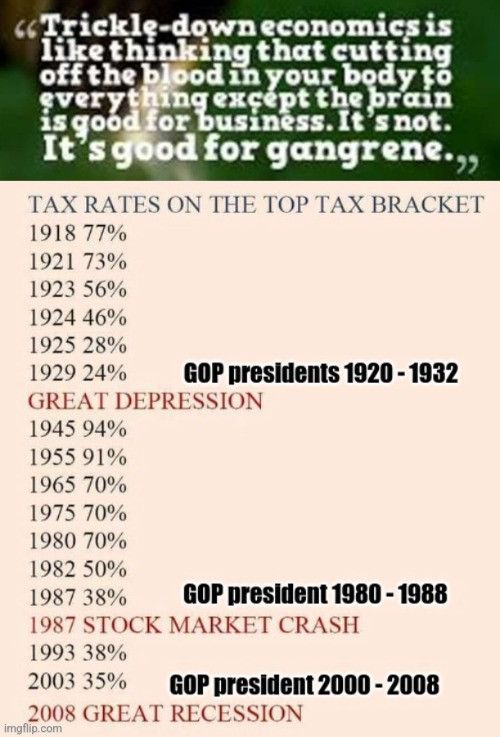
Let us take a crude look at U.S. tax policies over time. In 1918, to pay for WWI, the top marginal income tax rate on this relatively recent method (at that time) for paying our public expenses reached a high of 77%. Then came the ‘normalcy’ of the Republican- dominated roaring 1920s where top public officials asserted that the ‘business of America is business.’ Andrew Mellon, the wealthy Secretary of the Treasury during this decade, believed that government’s prime responsibility was to support the holders of capital while dismissing the concerns of labor.
The top tax rate fell to 24%, business and banking went unregulated. Equity markets were left to their own devices (and sins like buying stocks on margin). While some expressed concerns about equity prices that seemed divorced from underlying value, it was assumed that market forces always resulted in efficient prices. One savvy investor, Joseph Kennedy (father of President Kennedy) bailed out of the market just before the collapse. His epiphany that speculation had reached the tipping point came when the shoeshine boy working on his footwear started talking about his own investments. The experts claiming markets would continue to rise were wrong, tragically so. Eventually, greed and speculation met their expected end and it all crashed in October of 1929.
With an infusion of Keynsian economic concepts and a world war to equip and publicly finance, America climbed out of its economic abyss with a new perspective about the role of government in the affairs of the common man (and woman). The top tax rate was back up to 94% by the end of WWII. Banking would now be regulated with government taking a more active role in the general economy. Labor, for a change, was protected by law. For the next three decades, economic want diminished dramatically, the middle class grew, and inequality fell. For example, between 1947 and 1979 the real income of the bottom 5th (quintile) rose by 122%. This period later was labeled by economists as ‘the great compression,’ a period where inequality fell dramatically, where every quintile in the income distribution prospered.
In 1980, Reagonomics burst on the scene. The top marginal tax rate would be slashed from 70% to 38% in a mere seven years. The rules of the game were changed to favor those at the top of the pyramid. From 1980 to 2009, the income of top 1% rose by 270% while remaining relatively stagnant for most American workers. As productivity gains were reallocated from labor to capital, the historic link between working smarter (or harder) and worker pay was severed.
Top tax rates, of course, tell only part of the story. The tax system is rigged in so many other ways. For ecample, Tesla earned $10.8 billion recently and paid $48 million in U S. Federal taxes. That’s an 0.4% rate. The bottom half of all Americans, on the other hand, pay 3.8%. You might say that’s not much but they don’t have that much to begin with. Still, that is proportionally 10 times as much as some of our most profitable firms. Members of the economic royalty like Musk, Zuckerberg, and other titans often take $1 dollar in salary from the firms they control yet their net worth increases by billions annually due to improvements in their equity positions.
They don’t take salaries simply to avoid the taxes that their workers must pay. Rather, they borrow to meet living expenses, a resource that also is not taxed, using yheir equity positions as collateral. In effect, most high earners get paid in ways that are taxed at lower rates, like deferred interest payments and stock options, that are taxed at half the rate you and I would nominally pay, if that much. When conservatives argue that the top 1% pays 40% of all income taxes, they typically exclude the economic royalty who often can avoid taxable sources of income. On paper, those titans have low nominal salaries.
Between 1979 and 2020, real income gains of top 1% grew by 326% while the middle class saw their fortunes stagnate. The top 1% holds 31% of the wealth pie ($52 trillion) which recently increased by $4 trillion in 1 year. Meanwhile, the bottom half of all Americans enjoy a mere 2.5% of the wealth pie. The share of income going to the top one-percent was 24% in 1929, less than 10% in 1979, and back to about 25 % in 2019. America is back to that level of hyper- inequality that preceded the greatest economic crash in history.
In America, what might be considered our new economic royalty saw their wealth increase by 18% in just one year to $6.9 Trillion. Meanwhile, the median net worth of American families is stagnant at about $124,000. Is the growth of such unequal outcomes sustainable?
Why all this matters.
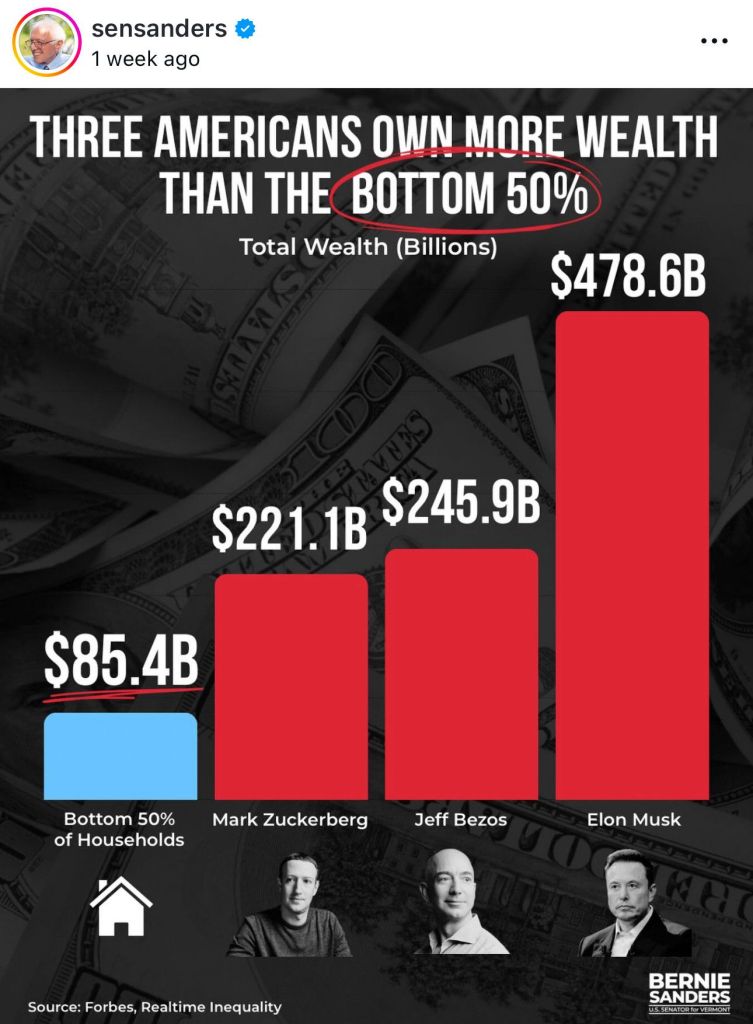
Musk ($480b); Ellison ($383b); Zuckerberg ($264b); and Bezos ($252 b) control wealth worth $1.38 trillion. The GDP of Spain is only $1.41 trillion. The bottom half of all Americans possess $85.4 billion. Again, he who has the gold rules. The question is, when power shifts to an incredibly wealthy oligarchy, how might they rule?
In general, power seeks to sustain their privileges. Why would it not when that is how one might control the rules of the economic game. Not surprisingly, political contributions from top 100 families have jumped some 140 times since the year 2000, with 1 in every 23 dollars coming from this billionaire class. They now own most of the media outlets and thus exercise an outsized role in framing the political narrative. The Citizens United Supreme Court ruling permits unlimited resources into our elections. And who controls most of the money, not you or me?
It is not merely the fact that inequality in America is back at levels not seen since the great crash of 1929. The greater fear is that these distortions in economic outcomes might be permanent. In the 1990s, Republicans pushed hard to overturn our inheritance tax laws, permitting the wealthy to pass on a disproportionate share of what they had accumulated. I recall a prominent D.C. based Republican telling me that GOP Congressional representatives were fined by their party if they did not refer to the hated inheritance tax as the ‘death tax.’ Greed and semantics were everything, not logic nor good public policy.
Not surprisingly, we now have what is called the greatwealthtransfer. In the U.S., some $2.8 trillion will be passed on to the next generation in the coming years. This has all the marks of creating a more or less permanent aristocracy. Think about who sat in the most favored seats at Trump’s 2025 inaugural … the economic titans in control of the wealth-generating technology sector.
We had such moments in our past. At the dawn of the 20th century, so-called robber barrons had amassed great personal wealth. There was no income tax nor any substantive inheritance taxes to inhibit or slow the future accumulation of treasure. But we then entered a period of reform … anti-trust legislation, early labor protections, a constitutional amendment to introduce an income tax. In Wisconsin, the state and the university collaborated on a number of reforms benefitting the common people … a notion that became known as ‘the Wisconsin idea.’
A generation later, the great depression facilitated another set of reforms that further redefined the relationship between the federal government and the people. It was known as ‘the New Deal.’ Fast forward another generation or so. We then had yet another flurry of progressive legislation. It was known as the ‘Great Society’ and aimed to eliminate poverty and open up opportunity to all Americans.
That proved to be the last substantive reform impulse. The Reagan revolution has persisted for two full generations now. It is possible, just possible, that those controlling the bulk of our economic treasure can both retain and, in fact, expand the reach of their oligarchic rule. What countervaling forces are strong enough to diminish their advantages.
Consider the following. The holders of capital have always needed labor. They could not generate profits without the efforts of workers. We are now on the cusp of that age where human labor is redundant, if not totally replaceable as the AI revolution matures. When workers no longer bring any significant utility to the workplace, what might be their fate? Aristocracies have not been kind to those they have ruled in the past. Read about the ‘clearings’ in 19th century Scotland where tens of thousands of tenant farmers were forced off their holdings when landowners discovered that raising sheep was more profitable. Or consider the fate of the millions of Irish that emigrated or perished during the potato famine. There were plenty of other crops being raised on the Emerald Isle. But the English landlords put them on ships for export to maximize profits as Irish peasants collapsed and died on country lanes. Why would today’s elite act differently now?
I once concerned myself with the issue of poverty. You might even say it was a personal obsession. After all, I was affiliated with the nationally renowned Institute for Research on Poverty (IRP) located at the University of Wisconsin. In fact, I served as the Institute’s Acting and Associate Director for about a decade before starting to gradually retire from my professional career in 2002.
I also taught social policy courses at the undergraduate and graduate levels while consulting with many states and localities across the U.S. and Canada. Much of this consulting work focused on the design and efficacy of their human services systems. I spent so much time in Washington that some federal officials joked that I really worked in our nation’s capital, and not at the UW in Madison. While my professional interests always remained eclectic, and my intellectual portfolio was very broad for a nominal academic, the issue of poverty was never far from my core interest.
Poverty … the lost issue.
I haven’t given the issue much thought, nor any attention, for some time now. Perhaps that is due to the realization that, in the U.S., poverty has virtually ceased to be a major public issue. The late UW economist Bob Lampman (whom I greatly admired), a scholar credited with writing the chapter in an economic report to then President Kennedy that inspired the subsequent national War on Poverty, once noted the following: ‘In the 1960s, public policies were subject to the following litmus test … what does it do for the poor?’ Such a perspective seems quaint, like lost ancient history, in today’s political world.
Our concern for the vulnerable and disadvantaged, a front- burner topic in the 1960s, faded with time. By the 1980s and 90s, President Johnson’s declared war on poverty (1965) had devolved into what many saw as a war on the poor. A so-called public ‘war’ yet raged but mostly around what to do with those dependent on public benefits. Conservatives had seized the policy narrative on this issue.
The welfare ‘reform’ battles during those decades were waged with unremitting ferocity. It became one of the primary fronts in the emerging and vitriolic political contest between the left and the right. This would be a contest where the sides would pull further and further apart with an ever widening ideological chasm separating the two camps and their competing perspectives. Poverty and welfare became part and parcel of the ferocious culture wars.
Today, I am taken with just how central the poverty and welfare debates were back when I was fully involved in state and national policy debates. Seldom did a week go by when I was not contacted by the national and local press to comment on the latest policy kerfuffle about the welfare crisis. The number of public engagements I received to talk about these issues seemed unending, the opportunities to consult with policy types unceasing, and the number of trips to DC never diminished (including one full year working on President Clinton’s reform efforts).
The intensity of the feelings on the part of policy combatants became increasingly entrenched and virulent. In short, the poverty and welfare questions were not for the weak of heart nor those seeking popularity. I once joked to the man in charge of Wisconsin’s welfare programs that I only sensed I was approaching the truth within this policy cauldron when no one else agreed with me. Still, for better or worse I found myself at the very center of it all.
And suddenly, it surely seemed sudden to me at least, the poverty-welfare question dropped from public view. After the entitlement to cash assistance for poor families largely ended when the 1996 federal reform law was signed into law (an Act where TANF or the Temporary Assistance for Needy Families program replaced the old AFDC system), observable interest in the poor gradually ebbed. The worst projections of what might happen to those families losing their entitlement to cash assistance never materialized. Within a decade, most no longer cared.
As we moved into the 21st century, less and less attention was paid to those at the bottom of society. Partially filling our attention gap were growing concerns about income and wealth inequality and the hollowing out of the middle class. These issues never quite enraged the public, nor politicians, as either the welfare question had in my day nor the poverty question during the 1960s. Still, the time when hyper-inequality becomes THE issue might be near. More on this later.
A startling new poverty line?
So, it was with interest that I read about the reaction to a piece published by investor Michael Green. The headline read that a family of four would need an income of $136,500 per year to escape want. This figure struck many as shocking. After all, the official poverty level for a family of four is pegged at $32,150 per-annum while the medium family income figure in the U.S. is $83,730. To make comparisons more appropriate, I should mention that the median income level for families with at least two kids recently has been estimated at $109,300. Green’s so-called poverty line is above all of these figures.
On first glance, it would appear that well more than half of all families with kids are ‘poor.’ But this clearly doesn’t pass the proverbial smell test. To make Green’s headline-grabbing figures work, certain assumptions are essential. For example, the family would need full-time, paid child care. According to his considered calculations, his hypothetical family of four would spend some $32,700 per year on childcare alone. On its own, this expenditure is slightly more than the official poverty line. Moreover, this child care outlay makes assumptions about the ages of children and whether alternatives to full time child care are available. Then again, one can quibble about the efficacy of any measure.
Overall, I would assess Green’s exercise as defining a ‘comfort’ level, more like a ‘living wage’ figure, than a poverty line. Nevertheless, it might well explain why families with solid, middle-class incomes feel anxious and insecure. And it might help us understand why so many feel that the economy is troubled despite low unemployment and near record equity prices.
In fact, other estimates of a hypothetical living wage come up with similar figures. An MIT estimate for a similar ‘living wage’ in a typical state (Maryland) is $129,600 while the Economic Policy Institute pegs the figure in the D.C. area at $139,500. In that sense, Green’s offering is not out of line, and far from outlandish.
But here is the rub, or one of them at least. Our metrics for assessing well-being have always been controversial. For instance, we really don’t have a consensus on what poverty is, nor how to measure it.
One of the many windmills toward which I tilted my reformist lance during my foolish youth was the officially designated poverty line, the income point that our federal government claimed separated the poor from the non-poor. It was formulated in the early 1960s by a middle level bureaucrat (Mollie Orshansky) who labored in the Social Security Administration at the beginning of the War on Poverty. This public war on want needed a measure and she was assigned the task. After all, you cannot wage a war on somethimg that has not been satisfactorily defined.
What did Mollie do? She took a Department of Agriculture study that monetized the cheapest food basket for a typical low-income family configuration. Then, she found another dated study which suggested that a lower-income American families spent one-third of their budget on food. So, Mollie multiplied the cost of her cheap basket of food goods by a factor of three. Next, an equivalency scale was developed (to account for different family sizes) and those figures were adjusted over time for inflation.
Viola! We had a national poverty measure, one on which many ancillary decisions were based, including how to distribute scarce federal dollars across states and localities. This measure was little more than a back of the envelope exercise. At the same time, it was far more than an intellectual, or casual, calculation. It had real policy consequences.
Even though she was long retired, Mollie attended some meetings in the 1990s at which I was present. She made it abundantly clear that she assumed what she had done would be a short-term expedient. Surely, a more sensitive and accurate measure would soon be developed. But, other than small, technical tinkering, none was. She remained shocked and saddened by that fact.
Certainly by the 1990s, no one defended the official measure any longer. The flaws in the measure were obvious and endless. By then, the cost of an essential basket of food stuffs would be multiplied by 6 or 7 times, not the factor of 3 that Mollie employed. With resources from the Casey and Mott Foundations, I and several of my colleagues at the Institute and in D.C. set about to improve the official poverty metric. It was a long, complicated process that, in the end, had mixed results.
The political head winds that prevailed by the time of the Gingrich Congressional revolution (1994) made any rational discussion of even the most technical issues quite infeasible. Despite our efforts, replacing the official poverty measure with something sensible proved impossible. That experience proved a prescient harbinger for where our once rational policy world was headed.
However, all was not in vain. The work we and others did resulted in the creation of a few supplemental measures that made several improvements. Among other things, they more accurately assessed the costs of living in poverty and in calculating the resources available to the poor, especially non-cash or cash-equivalent benefits. These supplemental measures never replaced the official standard but now are routinely employed by the press, academics, and others. Recently, the poverty level for a standard family is pegged at about $39,000 according to a widely used supplemental measure, some $7,000 above the official rate.
Still, it must be acknowledged that assessing poverty, and what it really means, will remain a subjective and contentious issue. In earlier meme (above), we see that most Americans are pessimistic about our economy even as equity markets approach historic highs and employment levels remain robust (for the moment). Basically, perception is everything.
An illusivemetric.
Not surprisingly, how one thinks about poverty varies dramatically. If you look beyond the U.S., you can find several alternative approaches, some not even based on cash resources. Remaining with income- based measures for the moment, we might consider the following:
Relative measures of poverty … many countries employ what are termed relative approaches. They set their poverty lines at either 50 or 44 percent of the jurisdictions median income figure. Such measures are more sensitive to the distribution of resources and how far one is from the typical or modal family.
Subjective measures … a few European countries explored poverty lines based on a consensus about the minimal income level a family like theirs would need to just get by. This survey-based approach assumes that respondents (real people) are the best arbiters of what poverty means.
Poverty gap measures … Rather than setting a line that separates the poor from the non poor, a gap approach calculates the distance each family is above or below said line. This makes it easier to measure extreme levels of poverty and family units who fall into the near poor category. Proponents argue that having income one dollar over or under an artificial line does an inadequate job of differentiating the poor from the non-poor.
Some argue that poverty is best measured by expenditures, not income. A family may not have observable sources of income yet have access to resources. Their capacity to purchase goods and services is what ultimately matters. Perhaps that should be our focus.
Asolute measures. This is the standard approach. You somehow calculate an amount a family needs to survive, as Ms. Orshansky did in the 1960s.
We also have non-income measures:
1. Social exclusion measures … Europeans, in particular, often discuss poverty in terms of social exclusion. Such measures tap an individual’s or a family’s isolation … a lack of access to the social capital required to fully participate in society. You are impoverished if you are not minimally integrated within society’s essential networks.
2. Human capital deficits … this concept focuses on measuring the hard and soft skills necessary to being an independent, productive worker and a contributing member of society. Hard skills are vocational in character. Soft skills focus of acceptable behaviors and interpersonal skills. If you haven’t got the skills, life will be challenging.
3. Specific resource deficits … here we focus on shortcomings in specific areas of life. For example, some measures focus on food insecurity or various metrics tapping the individual’s ability (or inability) to secure adequate nutrition and nourishment. Shelter insecurity focuses on homelessness or inadequate housing (overcrowding or unsafe abodes). Others are possible.
4. Social mobility measures deserve more attention than they typically receive. A hallmark of the American dream is that anyone can make it if they try. Yet, as inequality here has increased exponentially and the costs of education and other traditional tactics for success have become less accessible to many, social mobility in the U.S. has congealed. Recent research has indicated that inter-quintile movement (a measure of social mobility premised on the ease of moving up or down the income scale) is higher in many European nations than in the U.S. Want the traditional American dream today? Go to one of those socialist Scandinavian countries.
These various conceptual approaches capture our confusion about what it means to be poor. In any case, income measures remain the most popular despite their limitations and flaws. In the end, monetary measures simply are easier to calculate.
A matter of choice.
Poverty policy really is a matter of public will. In short, destitution is not inevitable, despite the biblical assertion that the poor we shall always have with us. Public budgets have long been seen as morality documents. How much we tax the winners in society and how much we spend on others are moral decisions. From the meme above, we can see that our willingness to pay for public purposes generally has diminished over time. Does this reflect a national moral failure? Is it not odd that policy debates oft focus on reducing public expenditures rather than demanding that the wealthy pay that share they once contributed to the public good as a matter of course? That question must be saved for another time.
Let’s start this section with the assertion that any single poverty number you might see in the press is what I term a ‘so what’ figure. For example, the most recent U.S. poverty rate is 11.1 percent, or 38.6 million citizens. But is that good or bad? As with most social indicators, we need comparative numbers to assign any real meaning. Three example comparisons that might be made are: 1) against a specified target; 2) progress over time; or 3) our position relative to selected peer nations.
1. Target-based assessments: One might establish a target or goal within some national or public effort. I don’t recall Lyndon Johnson stating that his war on destitution would eradicate poverty entirely, but he might have implied as much. At the time, however, one Nobel- winning economist (Robert Solow as I recall) did predict that U.S. poverty would be eliminated by our Bicentennial year, 1976. More recently, British PM Tony Blair set a national goal for eliminating child poverty in the U.K. within a generation. Against such an ambitious goal, a poverty rate of 11 percent, or any figure above zero, would be judged a policy failure. Then again, Tony knew he would no longer be PM in a generation’s time.
2. Temporal assessments: One might examine rates over time. Are we doing better or worse while using past performance as a baseline? After early progress against poverty in the 1950s and 60s, progress against poverty stalled in the U.S. When measured by the official rate, between 11 and 15 percent of the population have been designated as living below our poverty line over several decades, the rate for children consistently being higher. (Note: U.S. poverty did fall dramatically during the recent Covid pandemic when significant stimulus checks and other benefits were distributed to resuscitate the economy).
Similarly, the numbers of official poor has fluctuated between 35 and 50 million citizens without any singular trend in a given direction. In fact, today’s rate of 11.1 percent is the same as the rate measured in 1974. Viewed temporally, progress against poverty in the U.S. is difficult to find after our early successes.
3. Comparisons with peer nations: If we compare our performance against those of nations we consider our peers, the American performance decidedly suffers. Over the past several decades, the scorecard comparing the U.S. performance against virtually all advanced democracies positions us poorly among international scorecards. Scandinavian countries, in particular, do a much better job. During years when child poverty in the U.S. approached 20 percent, the child poverty rates in countries like Sweden and Denmark were well below 5 percent. The U.S. consistently places at or toward the bottom in such quasi-global rankings.
Another interesting story comes out of China. The World Bank estimates that 88 percent of all Chinese were considered destitute in 1978, just before their decision to deregulated much of their economy and invest in national growth. Today, that figure has fallen to less than 1 percent. The lesson … political will matters. Economic want can be lessened if the public demands such or government decides it is worth the effort. Progress becomes less likely when policy is viewed within a zero-sum framework. Then, the affluent see efforts to help the poor as inevitably resulting in losses to them.
Some big questions!
The poverty conundrum raises several big questions, for me at least:
A. Will redistribution issues replace absolute monetary deficits as the new basis for addressing poverty. I don’t see non-monetary metrics for assessing poverty (e.g., social exclusion or human capital deficits) replacing our customary measures. But I can see more attention being paid to distributional notions of well-being or how resources and opportunity are allocated across the society. Already, more attention is being paid to inequality (as opposed to conventional poverty) these days. Perhaps the gini-coefficient (a measure of income or wealth inequality) will become the new standard. It is hard to ignore reports of $50 plus trillion dollars bring redistributed from the bottom 90 percent to the top of the income pyramid in the U.S. Hyper- inequality also suggests a choking off of upward social mobility. Nothing will rile people up more than the loss of hope.
B. What happens when technology makes labor irrelevant? Will the less skilled (or even the more highly skilled) become little more than a burden in the future. Even now, we anticipate AI replacing untold millions of jobs over the next generation. I spoke about this issue in 2013 when I gave the plenary talk at an IRP conference to academics who teach university-based poverty courses around the country. I stressed that new digital and robotic technologies will utterly restructure our future labor markets, thus impacting our wellbeing in ways we could hardly imagine. That day is now upon us. As with earlier technological revolutions, perhaps new opportunities will emerge. But that is not certain. I fear what will happen to the displaced when they are no longer necessary. We don’t treat the poor well now even though we still need most of them. What will we do when we don’t?
3. What has been the legacy of our long ago War on Poverty? Most pundits, if they remember it at all, have doubts about its success. That sense of failure tends to discourage similar efforts or even any positive rhetoric. After all, poverty in the U.S. has seemed stagnate for the almost three generations since President Johnson declared our national war in 1965. This sense of failure persists despite the expenditures of considerable resources and energy.
Yet, there is another way to think about this last conundrum. Despite America’s fractured and under-resourced social safety net, perhaps our ‘war’ against poverty has been more successful than we imagined. Consider all the headwinds we have faced in recent decades. There have been changes in demographics (more single-adult families), in immigration (increases in lower-skilled workers), in technologies (worker displacement), and in global competition (more outsourcing of higher paying jobs to other nations), to name just a few exogenous trends. Absent our attempts to help the poor, as weak as they may have been, our situation may have been much worse. Perhaps we have not failed as much as some argue. It is something to consider.
Once again, I’ve probably gone on too long. I should end here. But I’m sure to return to this topic in the future. I bet you can’t wait 😏 !
Today, I want to ‘briefly’ (which I mean this time) expand on my thinking about the deeper sources of those normative dimensions that divide both Americans into opposing cultural camps as well as the citizens of numerous other societies. Cultural conflicts are not unique to either our nation nor our times. Ideological chasms have always existed, waxing and waning with changing external exigencies. They do, however, seem sharper and more visceral in our troubled era, a condition perhaps abetted by our fractured social networking platforms and/or an accelerating pace of social change.
In my last blog, I laid out the foundations of a two-dimensional conceptual framework. On the vertical axis, we had the We v. Me continuum. Those on the ‘We’ end of the spectrum possess a broader sense of tribal affiliation. They see themselves as belonging (or at least appreciating) more comprehensive affinity groups with whom they can identify, or at least associate. At the other end of the spectrum lies the ‘Me’ crowd. They embrace a narrower set of tribal affinity groups, especially when sensing threat. One’s position on this spectrum may in part be hard-wired (distinct brain structures) and partly the result of differential exposure and selective nurturing.
On the horizontal axis, we have a continuum that runs from the zero-sum folk at the top to what I call the elastic types at the bottom. The ‘zero-sum’ types see the world through a filter of finite resources where another’s gain on one of many potential metrics must result in their loss on that metric (e.g., fame, position, resources etc.). Think of this as a social form of the physics law of ‘conservation of energy.’ The aggregate amount of goodies in society never changes, they merely get redistributed in favor of one group (or individual) at the detriment to another.
The ‘elastic’ types tend toward interpretations of the world where collaboration often is viewed as better than competition … where individual success is not at the expense of the other. Resources can be elastic in the sense that they can expand when cooperative interactions prevail, at least theoretically. It is critical to remember that these ‘laws’ don’t have to be valid. They simply need to be believed as such. Individuals gravitate toward either an I win- you lose perspective or the one in which we can all do better by cooperatively expanding the pool of available goods.
While individuals can lie at any position alobg each continuum, I suspect we are being driven to the extremes, which I discuss in the time dimension below. As you may recall, this simple template gives us four quadrants Let me take a shot at labeling and describing each:
A. Upper Left …Competitive globalists or those who can identify with external groups (tribes) yet still see life as an ongoing struggle for scarce resources. Their default position can be broad respecting affinity groups on some socio-economic questions but only in limited circumstances.
B. Upper Right … Darwinian tribalists or those who likely reflect contemporary MAGA types. Under stress, they radically constrain their tribal affininities, largely to people like themselves while seeing the world in rather violent ‘survival of the fittest’ terms. They see threat everywhere. They seek solace within increasingly limited others with whom they closely identify. The other is the enemy.
C. Lower Right … Collaborative tribalists or those who have limited capacities for embracing those beyond their own world yet are capable of empathic behaviors and responses, at keast to some extent. While their inherent bigotry (e.g., restrictions in affinity groups) might be muted by unavoidable contact with other groups, their suspicions of the ‘other’ are never fully allayed. They tend toward independent political positions (like quadrant A).
D. Lower Left … Empathic globalists or those who instinctively seek to identify with broader concepts of humanity while simultaneously embracing empathic responses to human needs and social exigencies. While we all have those moments of selfish tribalism, their default position is to think in broad, compassionate terms. In other words, they are woke.
The Quadrants
A. B.
D. C.
A third dimension.
As suggested above, I’ve been thinking that we need to extend the framework with a time dimension. It is human nature to seek support or reinforcement for one’s position in this emotional palette. Thus, we seek reference groups, news outlets, support groups, and other reinforcements for our priors. Self-selecting or curated information sources leads to excessive confirmation-bias. We continually seek (or are exposed to via pre-set algorithms or constrained choices) inputs that affirm our initial positions on our ’emotional palettes.’ This results in additional feel-good dopamine hits that give us a kind of internal reward.
Over time, there is a tendency to seek greater reinforcements for our world view because of these positive hits. For example, we see people addicted to Fox News or those cultists who seek out Trump rallies. Those locked into a rigid world view constantly need new dopamine hits. (Note: a similar phenomenon exists for those in other quadrants, but I feel it is particularly strong in quadrant B.) The end results is a widening gap between those in one quadrant with those in the diagonally opposite quadrant, primarily B with D.
Through self reinforcing mechanisms, we continually seek people, input, and experiences that confirm our emotional priors. Confirmation bias not only serves the purpose of affirming core beliefs but provides us with ever increasing dopamine hits or feelings of satisfaction if not a new high. This is the very mechanism exploited by digital media algorithms to keep customers engaged on their sites. Anything that supercharges one emotionally will do the trick. Rage, for example, is a powerful narcotic.
Such insidious tactics lead believers deeper into the true believer’s self-destructive rabbit hole. All right- wing, authoritarian movements know they must keep their followers enraged and engaged. Thus, the push by any oligarchy is to take control of major news outlets and social media platforms, which is precisely what has happened in the U.S. You must simultaneously affirm the cultists belief set while upping the dopamine hits over time. Just consider how Trump and his minions keep the MAGA followers angry and distracted.
A note on terminology.
The concepts I’m struggling with here are not well defined. We are dealing with nuanced, intuitive response patterns to external stimuli. That is, we are talking about response probabilities, not cause and effect in any deterministic manner. Not surprisingly, such deeper and intuitive patterns are difficult to label.
I like the term emotional palette for the conceptual framework I’ve struggled to introduce in my last two blogs.The ‘W v. M’ framework is intended to capture visceral responses to the world, fast-thinking in Kanneman’s language and not his slow-thinking or cognitive (analytical) thought. We are talking about our emotional underbelly and not the cognitive abstractions emanating from our frontal lobes.
Given this, the word ‘palette’ works for me. Nominally, a palette describes a board on which an artists colors can be arranged and mixed. But it also can be used to describe hypothetical places where auditory tones or other dimensions of reality are stored, refined, and organized. So, why cannot this notion work as a label for our primal set of emotional responses.
And thus we have the arrived at the primordial struggle for our species. Homo sapiens can, on occasion, apply advanced cognitive abilities toward understanding the world about them. At the same time, we respond to life in equally primitive, irrational ways. We are capable of the most abstract, advanced thought along with equally primitive, emotive alternatives. We are caught halfway between being animals and angels.
The term palette describes for me those deeper, instinctive emotive patterns that have remained part of our makeup since the days we survived in primitive tribes while confronting existential threats on a daily basis. Our palette is composed of the scripted ways we filter and organize the world about us largely on a preconscious basis. It is our default strategy through which we managed to survive in the face of contemporary existential threats like accelerating social change or a perceived loss of societal hegemony. And being embedded deep within our makeup, our emotional palette often lies beyond easy understanding or control, or even our conscious awareness.
Are these constructs applicable!
This blog started with a meme featuring the late Charlie Kirk. In it, he attacks the the very concept of empathy. Moreover, he is Christian nationalist, someone whose reference group is narrow and whose litmus test for what counts is what does it do for me and mine. He was, in other words, a classic MAGA type belonging in quadrant B.
I must add he is not the first to do so, not by a long shot. In the 1990s, when welfare reform was a hot topic, denizens of the ‘right’ attacked the notion of charity as a concept. Giving to the poor made their situation worse was an oft repeated line. It was their form of the old argument that compassion sucks.
Those who worshipped Charlie, or his personal hero Trump, kept coming back to hear a message that oddly was quite orthogonal to what they said they believed. Most right-wing cultists (quadrant B types) posture a belief in Christ’s teachings. Yet, their core belief set is totally detached (largely opposed) to what Christ taught or, more accurately, what was ascribed to him by adherents later on. This is a remarkable case of cognitive dissonance which is less strange when you realize that their beliefs are largely defined by their emotional palette, not their analytically oriented frontal cortex.
When MAGA believers are confronted with contrary input, e.g., Trump is a depraved pedophile and rapist for example, they simply refuse to accept nor acknowledge any such input that contradicts their priors. They will bend the world about them rather than rearrange their essential ’emotional palette.’ Some of them do have high IQs which means they can rationalize emotionally driven positions more cleverly (see my post-decisionism discussion in my last blog).
Think about our national context. Members of quadrant B have enjoyed quite a run. Our revered system of laws has been dismantled to aggressively identify and remove ‘undesirables’ from our midsts. Our national identity is being redefined to accentuate a single tribal affinity group. Just how central has this been in our history? Very central. We have seen blacks, indigenous peoples, Chinese, the Irish and Catholics (my ancestors), slavs and southern Europeans, Latinos, the Japanese, and now immigrants in general serving as convenient scapegoats … the source of all our troubles. Clearly, the idealized American promise has been tarnished time and again by shifts toward the ‘Me’ end of the horizontal axis.
And we have our vertical access. How often is the question of national debt and the public good discussed in the context of we cannot afford to do more. This is a classic ‘zero-sum’ perspective. Seldom are our public policy questions discussed within the context of taxing the uber-wealthy more. Seldom is the fact that Elon Musk alone has more wealth than the bottom half of all Americans been portrayed as a national embarrassment. Actually, he enjoys 5 times what our bottom half has … $480 billion to $85.5 billion (more on this in my next blog). Yet our entitled oligarchs (most, not all) fiercely fight to further rig the economic game as if life were truly a zero-sum contest in which they cannot ever risk losing, not even marginally. That is a default, emotional response based on their twisted ’emotional palette.’
This is a work in progress. So, feel free to comment on concepts, structure, terminology or whatever. I like playing with ideas but realize there is nothing sacrosanct about my feeble efforts. And yes, I do need to get a life.
In my previous submission to Toms-Musings, I suggested (once again) that a deep divide exists in America, though one arguably evidenced from the very start of our Republic. At our beginning, this nation was patched together from a (slightly) more urban and industrial North which was fairly responsive to democratic impulses with a semi-feudal, more hierarchical, plantation-focused South increasingly dependent on enslaved labor. That cultural and political chasm festered for decades until exploding into the most horrific conflict witnessed on American soil. Though that basic divide has morphed along different, less precise, geographic lines, a similar cultural separation continues across today’s red and blue jurisdictions. The passions across those on each side of the divide oft appear as vitriolic and as entrenched as ever.
In my last piece, I labeled the essential character of the divide as US v. ME … where some focused on larger affinity groupings while others did so on smaller, more homogeneous, units (explained more fully later). On reflection, I have refined my thinking, now prefering a WE v. ME designation while adding a totally new 2nd conceptual attribute (stay tuned)!
Why WE-ME? It is catchier, with a simple inversion of the 1st letter, W to M.Yet, it still encompasses an extraordinary array of differences in world views that separate red from blue areas, conservative from progressive doctrines, and Republican from Democratic partisans in today’s fractured American social fabric. We have two nations, utterly separated by norms and aspirations yet occupying a single land. As Lincoln once observed, a house divided cannot stand. Our differences are, sadly, overly consequential in many basic ways. The chasm is so wide, in fact, that I despair of our national experiment surviving.
Moving on from my starting point.
A nominal reading of that prior blog defines the essential character of that chasm as one between the haves and the have nots. Surely, hyper-inequality remains a significant contributor to our existing political tensions. For the most part, the haves today command so many resources that they see themselves as fundamentally different, likely superior, to the remainder of society.
The top of the economic pyramid (the proverbial 1%) are the very definition of an affinity group, one that enjoys an incestuous and exclusive set of self-contained and mutually supportive socio-economic interactions. Nevertheless, it likely does not fully explain our national normative tensions with convincing clarity.
For one thing, too many of the ‘haves,’ though not a plurality, evidence empathic tendencies and liberal beliefs. True, Republican President Herbert Hoover, never confused with a leftist, was known to have said, “You know, the only problem with capitalism is the capitalists. They’re too damn greedy.” Nevertheless, while excessive wealth may corrupt or distort values, I don’t sense that it dictates them in any causal nor deterministic manner. Too many, after winning the acquisition game, then redistribute much of their treasure for the common good.
No, I feel the root causes of our existential divide go deeper. By deeper, I mean looking at those innate dispositions that precede, though often shape, life’s outcomes, especially in terms of one’s essential moral center.
It strikes me, for example, that whether one is a member of the economic elite surely can be independent of skill or effort. You can win the birth lottery (fortunate to have rich or connected family members) or the marital lottery (wed a rich spouse), or perhaps win the powerball lottery. In such cases, one’s personal agency respecting their position in the economic hierarchy can be unclear. Some rich are merely lucky. Others make it based upon exploitive, even sadistic, behaviors best left unexamined.
To be clear, cultural polarization within nations is not unique to the U.S. It is a somewhat universal phenomenon. Poland is split sharply between a liberal western side and a hidebound eastern half. Likewise, Italy can be divided between a progressive north and a more backward south. Many nations evidence a similar cultural split, often between urban and rural areas. The very universality of such political and social divides beg further exploration.
In addition, it has worried many that authoritarianism has made a comeback in past decade or so. After the dissolution of the Soviet Union around 1990, many assumed that liberal democracy was on the ascendancy at last. The most powerful authoritarian alternative had collapsed from its own internal tensions. Not so, apparently. In recent years, we have witnessed the rise of authoritarian regimes in several countries: Turkey (2013); India (2014); Poland (2015); and Brazil (2019), just to name a few. And, of course, who could ignore the United States in 2016 and again in 2024.
What explains all this?
I’ve begun seeking explanations for all this dramatic polarization in the primordial, or instinctive, premises and patterns we bring to the world. Preferably, we would like to ascribe our American political divide to some simple cause. If only Fox News or conservative talk radio had not emerged in the late 20th century, all would be okay. Or if we could reverse Citizen’s United and thus divorce big money from politics, then we would magically return to an imagined Camelot where we all would get along.
No, that’s too simple. It all goes deeper than that. I sense that our cultural differences are located in those intuitive responses that individuals employ to make sense of the vast array of inputs each of us faces on a daily basis … a condition worsened by an accelerating pace of technological and social change. The real explanation likely lies in deeply embedded emotional default responses that lie beyond the reach of conscious calculation. If true, just how do we make sense of our world?
A good question, indeed!
Some epistemological approaches to what we know (or believe we know) presume that humans start life with a blank slate, a tabula rasa, a philosophical perspective linked back to Aristotle, Ibn Siba, and more recently John Locke. What we become is totally dependent on our post-natal experiences and education.
Others, like Immanual Kant, believe we are born with predetermined innate patterns for organizing the chaotic world about us. I personally ascribe to the notion that some attributes we possess, and which contribute to the extremes across our cultural divide, are partially hard wired. We are born with them.
For example, some research has detected differences in the structures of brains among hard conservatives that render them more sensitive to seeing threat in the world. Difference, for them, is instinctively equated emotionally with danger. This response was prudent in our deep past when basic survival depended on fight or flight on a daily basis. Best not to relax around an irritated Mastodon if you wished to live another day. Today, cooperation and collaboration are keys to further evolution as a species. Yet, older response patterns remain dominant in some.
While some individual outcomes might be determined at birth, some combination of nature and nurture play a role for most. If our world views were totally determined at birth, we might see a more evenly distributed spatial arrangement of liberals and conservatives. But no, they cluster together. Proximity and socially shared values cannot be dismissed nor discounted.
Still, I cannot ignore a recent discussion with my childhood friend Ronnie, and his wife Mary. They cannot quite understand how one of their offspring turned out to be a Trump supporter. This happened despite growing up in progressive Massachusetts with liberal parents and attending Clark University (my Alma Mater), ranked as one of the more leftist colleges in New England. This one son seemed destined to be different from birth. (By the way, their predicament leads me thank my stars I was wise enough to forego having children. I could NEVER forgive myself for foisting a Trump supporter on society. )
At the core of the divide!
Let’s start with a definition. Jonathan Haidt defines our core moral systems as “… interlocking sets of values, virtues, norms, practices, identities, institutions, technologies, and evolved psychological mechanisms that work together to suppress or regulate self-interest and make cooperative societies possible.” Fair enough, but how do they emerge?
One way to think about the question is to remind ourself of two insights into how we poor humans function in a bewildering world. Daniel Kanneman introduced us to the importance of fast versus slow thinking. So-called fast thinking is more automatic, immediate, and intuitive.On the other hand, slow thinking is highly cognitive, analytical, and thoughtful. We like to think we have evolved beyond the former toward the latter but have we? Frankly, I see scant evidence of that.
A second insight comes from how some observers view the making of legal decisions. On paper, these are the products of classic slow-thinking processes. It often takes months of analysis and deliberation before higher courts (appellate and supreme court levels) make decisions and then publicly render their legal conclusions.
Insiders, on the other hand, often describe what more accurately is described as a post-decisionism approach. Jurists decide matters quickly and intuitively with the remainder of the deliberative process merely masking the effort to window- dress an instinctive, largely emotive or normatively based choice in fancy legalese. What has the appearance of objectivity enjoys little of that precious quality.
If judicial decisions were, in fact, one of evidence-based analytical thinking and applied stare decisis (legal precedent), one would not see $100 million being spent to sway the outcome of a single state Supreme Court race, as occurred not that long ago in Wisconsin.
My late wife was the Deputy Director for the Wisconsin court system during her career. I recall her once relating to me stories from a training exercise for the State’s judges she helped administer. The judicial attendees were given hypothetical legal and court situations and individually asked to decide how they would decide the issue from the bench or in their official capacity. She was amazed at how divided the responses were, many split evenly, and how heated the subsequent discussions could be.
Legal decision-making proved substantially distant from our prior in which judicial scholars applied some objective or widely shared set of norms and standards to complex situations. What is right can emerge from entrenched truths located in intrinsically held belief systems. Apparently, the embedded emotions and values one brings to the bench outway logic and the objectivity of the law more often than we would care to admit.
And here we have the crux of the situation. Each of us brings an individual palette of instinctual norms, emotions, and responsive default positions into daily life. These default positions constitute, or at least shape, our instinctive reactions to the outside world. They are the way we intuitively organize the inchoate external messages we continually confront on a daily basis. These instinctive reactions represent our visceral (primordial?) responses to select stimuli, especially those which evoke uncertainty, negativity, or outright fear.
Going back to Jonothan Haidt, he takes a shot at identifying the core organizing principles (palettes if you will) presumably found in conservative as opposed to liberal-oriented individuals. According to him, those on the right value such attributes as loyalty, authority, and sanctity. They seek stability, something bordering on rigidity, in society and in their personal lives.
Liberals, or progressives if you wish, gravitate toward such core attributes as caring, fairness, and personal liberty. They generally seem more empathic toward others, more sensitive to larger tribal affinity groups. They are more accepting of differences and, despite being labeled as snowflakes, are better able to deal with both the unexpected and the challenging.
Yet, it still strikes me that we have not gone deep enough into the fundamental distinctions that separate those that identify with the right and those desperately hanging on to what remains of American democracy and the rule of law. I’ve given the matter thought and, as is my wont, have come up with a half-baked insight of my own. Well, I presume it is mine but who knows. And, if history is any guide, it likely will last at least a week before I discard it as silly and sophmoric.
The core difference!
To separate the Trumpers from the people I respect, I’m envisioning a two-dimensional template. On the horizontal coordinate, we have a continuum that goes from our now familiar notation of WE on the left to ME on the right. Bisecting that flat line is a vertical continuum that is labeled the zero-sum perspective on the top end to an elastic perspective at the bottom.
The WE-ME horizontal continuum is nominally straightforward, one that we have touched on earlier. Those on the ‘WE’ end of the continuum tend to embrace larger affinity groups or a larger sense of referent tribes. They are capable of empathic relations and responses to larger populations that extend beyond their immediate world.
Those on the ‘ME’ end of the continuum instinctively favor smaller tribes as their go-to reference groups. At the extreme, their tribal identity seldom extends beyond those most like them (e.g., white Christians in their suburban neighborhood) and sometimes even just their own families. This may explain why rural folk tend to focus on rather limited affinity-group (tribal) world for social comfort and ideological confirmation. They might have self-selected to stay on the farm (as that population has shrunk) and simply have not had sufficient broadening experiences with the wider world.
Think about the following for a well-known, if extreme, example. Donald Trump would be located on the far right end of the ‘WE-ME’ continuum. In almost every situation, he thinks about how things impact HIM, and no one else. Basically, he has a referent (affinity) group of one. Everything is transactional where his needs are paramount and the wants-needs of all others totally irrelevant.
In fact, his sense of entitlement is so severe that it represents an affliction we would label as pathological narcissism. Though he lived in New York growing up, he might well have been raised in white, rural Nebraska. He evolved in a privileged bubble, seldom interacting with those beyond a small, entitled tribe with whom he shared rather provincial and distorted values.
I sense that I’m located on on the other side of the ‘WE-ME’ continuum. How so? Well, This is not to say that I sometimes associate, or respond to, a few definable and very conventional affinity groups. For example, I am emotionally tied to my Celtic ethnic tribe. I get weepy on my visits to Ireland. But I put such things aside when considering important matters. Then, I instinctively see things from a more global perspective. The very premis of the MAGA crowd, the so-called America-first perspective (really the affluent white Christian Americans first), strikes me as a dated, provincial, and primitive go-to position.
The vertical continuum strikes me as a critical addition to this conceptual frame. How so, you ask? Well, at the top we have those who seek the world in zero-sum terms. Basically, anything of value that goes to someone else is subtracted from my utility (economic-speak for well-being). Put conversely, my winning must be the other’s loss and vice-versa. At the bottom of the continuum we have those who seek the world in more elastic terms. By that, I mean the following. Resources are not always seen as finite. Anything of value going to one individual is not necessarily subtracted from another. In fact, collaboration can enhance the overall well-being of all. Again, these are not absolute calculations but emotional or primordial responses to the world about us. They represent how we instinctively act and react to situations and people.
Think of these two core attributes in terms of a two-dimensional conceptual framework where the horizontal WE-ME continuum is bi-sected in the middle by the zero-sum point down toan elastic point along the vertical continuum. If you can envision this, you readily see that we have four quadrants. It follows (or should at least) that the cult followers associated with the MAGA world generally would congregate in the upper-right quadrant since they score high on the ME and zero-sum continuums. That is, their primordial or instinctive sentiments jointly lie high on the ME and zero-sum ends of the respective continuums.
Progressive-liberals (the dreaded WOKE types) would, on the other hand, congregate in the bottom- left quadrant. They tend toward the WE and ELASTIC ends of both continua. Thus, they tend to instinctively drift toward broader affinity or reference groups while simultaneously sensing that collaborative efforts can enhance overall utility … that is, benefit the so-called common good.
As I have suggested throughout, these are primordial, mostly preconscious response patterns. Exceptions abound and no one is formulaicly predictable in all situations. Yet, this way of looking at things makes sense, if only from a personal point of view. As I’ve noted elsewhere, I embraced a global perspective as a very young man … wanting to join an organization that preached world unity years before I even hit puberty. As far back as I recall, I rejected the manner in which we divided up the world in terms of tribes and nations. When looking out at the vast cosmos, the narrow perspective of nation- states and ethnic identities intuitively struck me as highly primitive and utterly provincial.
As usual, this blog has gone on too long. I will try to fill in the loose ends in the future. Or, more likely, I will conclude that all this is total BS. At the moment, though, I find it useful. It helps explain why people can seemingly look at what appears to be similar events and yet arrive at wildly different conclusions.
In the end, we have different underlying emotional and conceptual palettes through which we filter and organize reality. One person might see another who speaks or believes differently as a ‘threat’ while another person responds to the same situation as an ‘opportunity’ to experience something new and positive. These are not formal, conscious choices. They are not easily understood through cognition and analysis. They likely lie deep within us as embedded, instinctual sentiments. That makes them difficult to remedy. Yet, understanding is the first step toward positive change, or so I’m told.
More next time or whenever. In the meantime, stay well. And congrats if you made it all the way to the end. You must really enjoy pain 😢.
Has the American experiment in pursuing a ‘mature‘ democracy finally come to an end? I say pursuing (not attained) because this nation never quite achieved anything close to full legal suffrage, at least not until the 1960s. Only slowly, and grudgingly, was sufferage expanded over time … to non-propertied white males, to northern black males, to women, to indigenous residents, and eventually to minorities living in apartheid-riven (southern) states.
Then, on the precipice of universal suffrage, neo- conservative forces soon began to systemically attack the voting rights of newly enfranchised minorities in particular and disfavored groups more generally. Where ‘rights’ could not be legally rescinded, access would be restricted with protocols being introduced to make the act of exercising one’s access to full citizenship difficult at best, impossible in the ideal.
At first, the tactics were indirect. The Nixon administration, for example, passed drug laws biased against minorities followed by the uneven administration of such laws to guarantee arbitrary and selective enforcement. Both the design and management of such narcotic rules were distorted in ways that penalized minority communities. Quickly, disproportionate numbers of black and latino youth had become ensnared in the legal system. In some communities, a fourth to a third of young black males had run afoul of the law before reaching adulthood. Felons, you might recall, generally were not permitted to vote. This systemically weakened civic participation by segments of the population typically shunned by conservatives.
In effect, the collapse of legal apartheid in the 1960s led to an insidious backdoor strategy for keeping undesirables from exercising their rights as citizens. Voter suppression has grown in ferocity and effectiveness in recent years as conservatives began losing the popular vote in national elections. Republicans have purged voting rolls, closed polling places in poor districts, enacted new access impediments at the polls, and imposed absurd gerrymandering practices. It was as if they were trying to recreate an earlier, more primitive version of democracy where only propertied white males would be granted suffrage.
Continued efforts to eviscerate full suffrage and participation in our political life should not come as a surprise. Preserving access to power for and by the elite has a long history in America. Perhaps that is why the Trump crowd wants to whitewash the historical record and prohibit our youth from understanding completely our unvarnished past.
Even at our beginning, despite the high-sounding rhetoric littered throughout our Constitution and related founding documents, the nation was founded by and for the select economic winners. For the most part, suffrage was confined to an acceptable elite … propertied white males. While three-fifths of each black resident would be counted in each state’s population rolls (important to determine each jurisdictions political clout), they could not vote. Also disenfranchised were women, Native Americans, and most males without fortune or property. Only the established white male elite were considered proper custodians of the nation’s future. After all, the rabble presumably did not possess the cognitive wherewithal nor the high moral values essential to the exercise of self-rule. Worse, they might choose to vote in there own self-interest, a frightening prospect given their numerical superiority.
At the end of 1787 Constitutional convention, Ben Franklin asserted that: “I agree to the Constitution with all its faults, if they are such, because I think the general government necessary for us, and there is no form of government but what may be a blessing to the people if well- administered, and I believe further that this is likely to be well- administered for a course of years … (but)… can only end in Despotism, as others have done before it, when the people shall become so corrupted as to need despotic government …”
Ben’s cautionary words reflected deep seated uncertainty regarding the future of this nascent Republic. Deep tensions had run through the consideration of a new Constitution in 1787. All knew that the loose alliance of the semi-independent colonies existing after the Treaty of Paris was signed in 1783 had been a disaster. Yet, fundamental tensions clouded the way forward to a more coherent nationhood.
A number of questions bedeviled those attending the 1787 constitutional convention. What to do about slavery which seemed inconsistent with nobler sentiments such as all men are created equal? How to balance power between larger and smaller states? Whether any extension of rights too broadly might invite a disastrous rule by the uneducated ‘mob.’ Could some necessary authority be centralized for the sake of stability without sinking eventually into tyranny? And finally, how could opportunity for individual advancement be fostered while preserving the presumed entitlements of the propertied classes? It should be noted that the famous phrase of ‘life, liberty, and the pursuit of happiness’ was almost written as ‘life, liberty, and the preservation of property.’
This last issue emerged over and over in early constitutional discussions. Delegates debating the Pennsylvania state Constitution put it this way “… and enormous proportion of property vested in a few individuals is dangerous to the rights, and destructive to the Common Happiness of Mankind, every free State hath a right by its laws to discourage the possession of such property.” Perhaps that early sentiment explains why Pennsylvania is known as a Commonwealth, not a State.
In short, what would become known as the American dream, a place where riches might be freely accrued, could go too far in the minds of some founders. They argued that hyper-inequality was a danger to the common good. At the same time, the opportunity to seek personal success and fortune separated the new America from a rigidly stratified old world. This indeed would prove a tough Gordon knot to unravel.
Fast forward to contemporary times, and not much has been resolved. We have witnessed endless cycles of growing inequality and the concentration of power among the economic elite followed by spurts of intense progressivism … the reforms of the early 20th century in response to the excesses of the gilded age; the New Deal of FDR in light of the great global depression of the early 1930s; the spurt of idealism in the 1960s (especially during the 87th Congress) after the complacency of the post World War II period.
Since 1980, with the initiation of the Reagan revolution and the full implementation of the strategy outlined by future Supreme Court Justice Lewis Powell (1971), the economic divide between the haves and have nots has widened without interruption. (Note: Powell’s memo laid out a long range plan for the political right to seize control of major institutions and thereby assume more or less permanent control of power).
Over the last four-plus decades, inequality of both opportunity and results has continued unabated. A vast array of data supports the decline of America as this presumed land of opportunity where hard work would be rewarded with personal achievement. Rather, the nation has evolved toward an oligarchy, a place increasingly ruled by an entrenched economic elite.
For example, 10 billionaires recently saw an $800 billion dollar increase in their wealth portfolios over the course of a single year. The top 0.1 percent of the population now commands fully one-quarter of the stock market which continues to rise as the economy wobbles for most Americans. The bottom half of the population command about 1 percent of wealth in the form of equities. Tesla shareholders recently voted to possibly make Elon Musk the first global trillionaire. If this wealth milestone is achieved, and it were considered as GDP (Gross Domestic Product), that sum would place him higher in total resources than all but 21 countries across the globe. That is obscene by any measure.
The concentration of wealth in the hands of the few cannot be divorced from the concentration of political power by the same. When untold billions (perhaps trillions?) are at stake, then why wouldn’t the elite buy politicians or subvert the political process to do their bidding. With unlimited resources at their disposal, combined with the clever use of wedge emotional issues (abortion, immigration, racial animus, loss of tribal identity) employed as classic misdirection ploys to confuse and then secure the support of working-class types, then those in power fully expect to enjoy disproportionate hegemony well above their proportionate numbers. They intend to create a permanent ruling class. If they don’t manipulate the system, the weight of countervailing democratic sentiments would certainly prevail over time. No wonder Elon Musk thought nothing of throwing some $20 plus million dollars into a single state Supreme Court race.
The steady drift to the hard right in recent decades alarmed older Republican stalwarts like John McCain, the last principled Republican to seek our highest office. While running for President in 2012, he experienced a seminal moment during a Minnesota town hall session. A woman in the audience attacked Barack Obama as an Arab and a Muslim. McCain gently took her microphone and said the following in an avuncular manner “… no ma’am. He’s a decent family man (and) a citizen that I just happen to have disagreements with on fundamental issues…”
Many in the Republican audience booed his conciliatory words. They would have preferred the hate and divisiveness that would soon be fully revealed in Donald Trump’s coming campaign four years later. At least since Newt Gingrich’s 1994 political coup in Congress, hyper-polarization had reached levels where civil communication across tribal political camps had largely ceased and collaborative action seemed virtually impossible.
John would be the final voice of reason in the once proud party of Lincoln. Toward the end of his life he expressed the following: “… they (his Senate colleagues) often had very serious disagreements about how best to serve the national interest. But they knew that however sharp and heartfelt their disputes, however keen their ambitions, they had an obligation to work collaboratively to ensure that the Senate discharged its constitutional responsibilitieseffectively.” In that vein, he voted to save Obamacare as he was dying of cancer. With immense sadness, he went on to note that … “Deliberations today … are more partisan, more tribal, more of the time than any other time that I remember.” (Note: McCain worked across the aisle, for example once collaborating with Dem. Senator Russ Feingold to limit money in politics.)
It was as if some political Rubicon had been crossed, thereby signaling that an older world where rules and civility prevailed no longer existed. Perhaps the pre-civil war era bore witness to such passions and irreconcilable differences. If so, it took a horrific civil conflict with some 700,000 deaths to restore order and a minimally functioning society.
John Adams once said the following: “A government without power is, at best, but a useless piece of machinery. Power without any restraint is Tyranny.” Trying to walk a tightrope between competing visions of what was right, the founders created a system based on compromise. It was creaky and inefficient, full of checks and balances. Yet, despite its imperfections, it lurched along without succumbing to the tyranny feared by those who launched this experiment with high hopes and many fears.
Now, we are witnessing the most existential and complete threat to this experiment in self rule that many of us can recall. All other issues pale by comparison, from the Epstein files to the state of the economy. Nothing is more important than the question of whether democracy can survive.
Time and again, Trump has promised an entrenched and permanent Republican rule. He promised it to his Evangelical supporters during his 2024 campaign. Vote for me and you won’t have to vote ever again. It was laid out in the Heritage Foundation’s 2025 Plan, the outline by which Trump would rule during his 2nd term. And he recently promised his Republican legislators in the Senate as much if they would employ the nuclear option by ending the traditional Senate filibuster. Then, Trump insinuated, he could reopen the federal government on his terms. (Note: In this instance, they did not acquiesce to his demand.)
Ending the filibuster additionally would serve another purpose. He could rule as a quasi-dictator thoughout the period leading up to the 2026 Congressional elections. Let us never forget that German President Hindenberg appointed Hitler as Chancellor on the assumption that more moderate politicians would keep this loose cannon under control… a form of checks and balances presumed to exist under the Weimar Republic. It took Hitler about 100 days to foment a fake emergency and assume near dictatorial powers from a compliant Reischtag. In the end, tens of millions would perish from the nihilistic, destructive path the Fuhrer subsequently embarked upon. Hitler, too, garnered the support of the industrialists and the money classes, men eager to use his initial popularity to pursue their short term goals. It would prove a Faustian bargain.
The recent elections swept by the Democats have given hope to the center-left. At the same time, ending the government shutdown was accomplished at a significant cost to working class Americans and (once again) to the benefit of the economic elite. The new oligarchs, including the tech brothers, have accumulated egregious wealth through their complicity with our aspiring dictator. They see a path to permanent hegemony, something to which previous elites might aspire but could not quite achieve. This time, they just might grab the brass ring.
There are many theories for why the vast numbers of ordinary Americans might willingly sacrifice self-rule in favor of some dictatorial and tyrannical alternative. On the surface, male working-class support for Trump doesn’t make a great deal of sense. It strikes us as counter-intuitive that any collective would vote for candidates that have never demonstrated any concern whatsoever for their economic or social well-being? This has been the question of the hour.
I do have some thoughts on this conundrum. The direction of my thinking on this question cuts through a complex set of explanations while moving beyond the simple divide between the economic privileged versus we real folk. Rather, it looks to a central aspect of human values … the simple US versus ME dichotomy that may lie at the core of our present political predicament.
This blog, however, is long enough already.. I will jump into my thinking on such esoteric matters in the next edition. So, stay tuned!