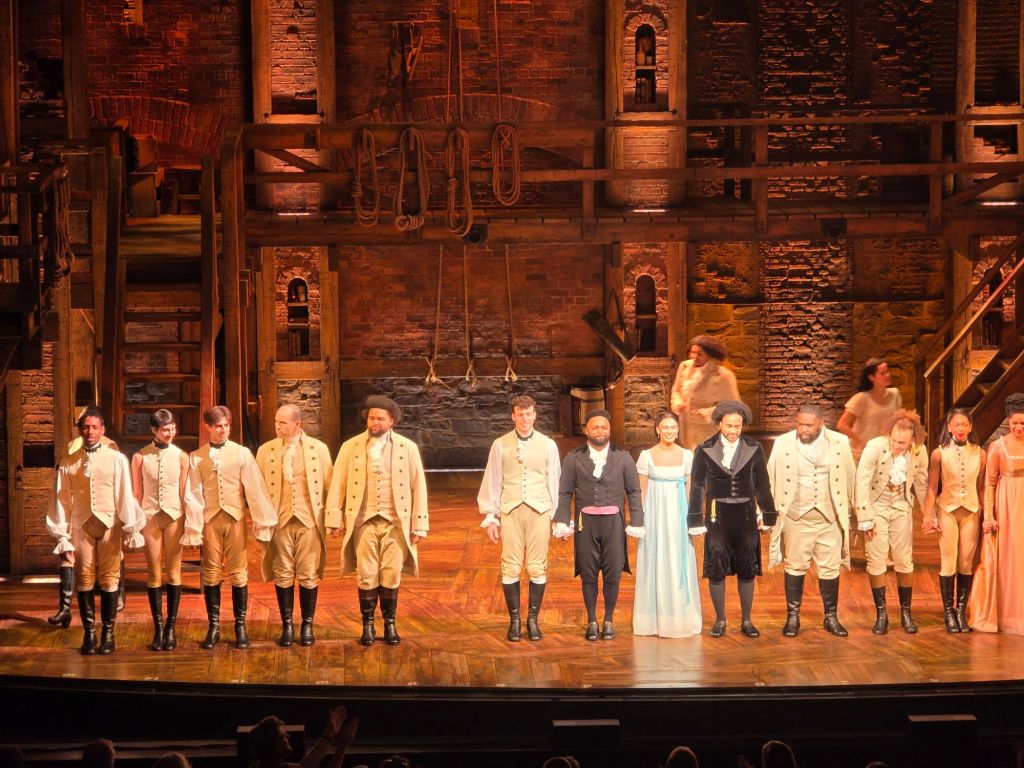
I am probably the last person in the Western hemisphere to see Hamilton, the eponymous hero of our nation’s founding. While I didn’t like it as much as Les Miz, (rap is not my thing) the production is energetic, ingenious, and remarkably accurate. I cannot imagine the gifts one must possess to turn an 18th century historical figure into musical entertainment, or turn Victor Hugo’s 19th century masterpiece into a stage play. I bow to their artistry and genius.
Yet, the play Hamilton is far more than a pleasing spectacle. It is a political statement for those paying attention. It even speaks to our current existential crisis in some important ways. For one thing, virtually all the major roles are played by black actors (in this touring production at least) except for George III, and he is one of the bad guys. As I watched this exceptional performance, I wondered how the many opponents of DEI now in power enjoyed their evening at the theater.
More importantly, the production managed to convey the deep schisms that have divided America and Americans even from its earliest days. The architects of this masterpiece used the ideological friction between Hamilton (plus G. Washington etc.) and Jefferson (plus J. Madison etc.) to highlight the deep political and cultural conflicts that bedevil America to this very day.
As humans, we tend to be myopic. We think our times are the best or, far more likely, the worst in history. How many times have we heard the refrain … this is the most consequential political race ever or we are now confronting the most existential threat to democracy and our way of life. Such hyperbole typically precedes a plea for more money. I know I’ve heard such assertions on many an occasion.
But the truth is that America has been deeply troubled from its earliest days. The founders were not embattled idealists with a clear and united vision of the future. Far from it. At best, they were confused about what they wanted and deeply suspicious of what democracy might come to mean. Worse, they oft had dark feelings about the motives and ambitions of each other. Passions often flared given the many uncertainties of the times and the stakes associated with failure.
At times, I can only smile at our ahistorical take on events. I recall the run-up to the 2016 Presidential election. The supporters of Bernie Sanders (whom I personally admired) reacted with outrage when senior Democratic party officials steered the nomination toward Hillary. Those offended accused the king makers (or queen makers in this instance) of disregarding the traditional practice of permitting voters to select a political party’s nominee. Nice sentiment but untrue. Party bosses selected nominees throughout most of our history with primaries only emerging as a decisive factor in the 1970s.
We tend to assume that the flaws we see today are relatively recent phenomena. That simply is not the case. I think Hamilton (the play) does a remarkably good job of exploring the historical roots of the current divide tearing America apart. Our cultural tensions, our house divided, is not new … not by a long shot. It certainly has not been created by the pathological narcissist currently occupying the White House. No, as suggested by this popular musical, it can be found in the very political DNA from which our nation sprung.
The men who created our nation after the original Articles of Confederation collapsed in confusion by 1787 desperately hoped that political factions would not form. Not surprisingly, they did of course. Virtually over night, nascent political groupings created ever- widening divisions across distinct ideological factions. Hamilton, Washington and Adams were considered Federalists. Jefferson, James Madison, and others were termed Democratic-Republicans. This later faction eventually morphed into the early Democratic party during the Jacksonian era.
The Federalists, stronger in the urban north, contrasted sharply with the nascent Democrats who found strength in the agricultural, slave-dominated southern states. Once George Washington retired to Mount Vernon, the venomous cultural and political chasms between the emerging parties broke out with vicious attacks being issued from newspapers clearly representing one side or the other. There was no fairness doctrine to be found in the elections of 1796 and 1800. Partisans on one side believed an election loss would doom the fledgling Republic. The separation was that stark, the passions that raw.
I believe, as do others, that the real birth of America happened in 1800 when John Adams was apprised of the electoral college vote that ultimately would give the Presidency to his political enemy (Jefferson). He simply got in his carriage and went back to Boston. He did not cry rigged election, nor call out the militia. The Constitution prevailed. (Note: Jefferson and Aaron Burr were tied in the electoral college that election. Hamilton’s influence resulted in Jefferson’s victory in 1800 which cemented the growing animosity between Hamilton and the man who would kill him in that infamous 1804 duel).
At the same time, the inherent tensions between these two factions were the seeds from which America’s enduring divide would germinate. Jefferson (who is portrayed as an effete dandy in the Hamilton production) represented a vision of America rooted in an aristocratic, hierarchical world where a white, propertied ruling class would govern by something close to divine right. That feudal form of society assumed that an entitled patrician class would (and should) reign over poor whites and minorities, those groups bereft of basic rights until the 1960s when the Civil rights movement finally challenged the existing semi- feudal power structure in the South with some success.
Hamilton’s Federalists first evolved into the Whig Party and then into the early version of a quite progressive Republican Party. They were for a stronger central government, free labor, public investments in infrastructure, and (gradually) the expansion of democratic suffrage. With the creation of the Republican party in the 1850s, this offshoot of the Federalists would become the anti-slavery party (though its principles as defender of all would be eroded in little more than a generation to support big businesses interests above all). The two parties fully exchanged normative positions (essentially switching perspectives) by the mid 1900s while strengthening the internal integrity of each.
By the late 20th century, that once progressive Republican Party had fully embraced the perspectives around which Jefferson had organized his followers in the late 1790s. A white, propertied, educated class would rule with non-whites and other lower- class persons assigned the menial tasks that supported a rigid social hierarchy. Ideally, a nativist- oriented social order would prevail to be supported by an authoritarian rule that would crush democratic sentiments and stall any broader partication in governance or power- sharing. In many ways, this was a view of society that glorified the antebellum social order in the plantation- based South.
One moment in Hamilton struck me as particularly moving. The French nobleman Lafayette is talking with Hamilton just before the final battle at Yorktown. Like the young Lafayette, Hamilton is also a recent immigrant to the colonies. Their exchange goes like this.
Lafayette: “Immigrants.”
Lafayette & Hamilton: “We get the job done.”
At that moment, the audience in Madision, Wisconsin broke out in a spontaneous cheer, likely in sympathy with those suffering in Minnesota from the oppressive Fascist tactics to massively deport many immigrants (non-white) from our country.
Hamilton: “So, what happens if we win.”
Lafayette: “I go back to France. I bring freedom to my people… if I’m given the chance.”
Hamilton: “We will be with you when you do.”
Hamilton (and his Party) envisioned an America that would embrace all. He had made it to the top after starting out as a poor, illegitimate, and neglected child born in the Carribean. His vision of the good society would enable anyone to make it, as he had, if they were not hindered by social or political barriers.
On the surface, Jefferson (and his followers) seemed pro-democracy. After all, he authored all those noble words about the virtues of a free Republic. He would spend time in France and apparently support the French Revolution. But that support strikes me as shallow. He viscerally disapproved of a monarchy but instinctively was drawn to a form of feudal, patrician governance. Individualism reigned supreme in his world view that, in the end, favored a few at the expense of the many. Slavery, the new nation’s original sin, seemed natural to him. Though extremely well read, he likely succumbed to feelings of inherent superiority. He was a patrician to his core.
That essential tension between a broad democracy supported by universal suffrage and a hierarchical, authoritarian structure catering to an entitled elite has remained with us from our founding days. Today, Trump is pursuing a doctrine of ethnic cleansing, voter suppression, and the establishment of plutocratic rule by an entitled elite of the wealthy. It is a vision first articulated by Jefferson and his ilk at the birth of the Republic, all the noble language about democracy notwithstanding.
A nation so divided at its core is one that often is held together by force. We have a long history of violence (a civil war, eras of labor strife, ethnic cleansing, and periods of extensive civil unrest). Even today we seem on the brink of widespread domestic conflict. But even during our periods of relative quiet, a steady stream of institutional violence has persisted. I ran across the data below recently.
Citizens killed by police: 2010–19.
Canada ……. 305. France ……. 232. Germany … 100. Australia … 53. The U.K. …. 22. The U.S. …. 15,008
This is a shocking testament to our acceptance of sanctioned violence. Today, our attention focuses on two martyrs who were murdered by ICE thugs in Minneapolis. But, in fact, America has been an obvious outlier when it comes to the scourge of sanctioned violence. We also incarcerate more of our citizens than any other country in the world. The U.S. locks-up about 600 per 100,000 citizens while our neighbor to the north imprisons 85 per 100,000, a more typical rate among advanced countries. Why? What is wrong with us?
There are likely many reasons, including an unconscionable surfeit of guns. But I do wonder if the lack of a consensus about what constitutes our basic organizing principles plays an outsized role in all this discord. The sad fact is that we are not a united nation. We have no common vision of who we are. We tend to embrace a Dickensian winner-take-all ethos with a weak social safety net. In fact, we rather distrust and dislike one another as did our founding fathers so long ago. In the end, however, violence cannot keep us together.
Even during the Cold War of my youth, I never believed we would by taken over by a foreign power. Our essential threats were always internal. Consider the following 2000 year old warning about Trump and the MAGA movement: “A nation can survive its fools, and even the ambitious. But it cannot survive treason from within. For the traitor appears not the traitor…he speaks in the accents familiar to his victims, and he appeals to the darkness that lies deep in the hearts of all men. He rots the soul of a nation … A murderer is less to be feared.” Cicero – Roman Statesman
In my head, I keep going back to Lincoln’s admonition in the late 1850s … a house divided against itself cannot stand. It has not escaped me that 1 in 3 colonists remained loyal to the monarchy during our revolunary war. And today, at least that same proportion (perhaps 40%) seem to prefer an authoritarian (fascist- oriented) form of governance. Nothing, apparently, seems to change with time. I just might need a new house.
I probably won’t write another blog until I’m in South America. Look forward to a travel story or two and not my usual rant. I can hear the cheers already. 😀
 Tom's Musings
One response to “Hamilton … and more random thoughts.”
Well said. Your musings atrocious profound. Thank you.
LikeLike