Today, I want to ‘briefly’ (which I mean this time) expand on my thinking about the deeper sources of those normative dimensions that divide both Americans into opposing cultural camps as well as the citizens of numerous other societies. Cultural conflicts are not unique to either our nation nor our times. Ideological chasms have always existed, waxing and waning with changing external exigencies. They do, however, seem sharper and more visceral in our troubled era, a condition perhaps abetted by our fractured social networking platforms and/or an accelerating pace of social change.
In my last blog, I laid out the foundations of a two-dimensional conceptual framework. On the vertical axis, we had the We v. Me continuum. Those on the ‘We’ end of the spectrum possess a broader sense of tribal affiliation. They see themselves as belonging (or at least appreciating) more comprehensive affinity groups with whom they can identify, or at least associate. At the other end of the spectrum lies the ‘Me’ crowd. They embrace a narrower set of tribal affinity groups, especially when sensing threat. One’s position on this spectrum may in part be hard-wired (distinct brain structures) and partly the result of differential exposure and selective nurturing.
On the horizontal axis, we have a continuum that runs from the zero-sum folk at the top to what I call the elastic types at the bottom. The ‘zero-sum’ types see the world through a filter of finite resources where another’s gain on one of many potential metrics must result in their loss on that metric (e.g., fame, position, resources etc.). Think of this as a social form of the physics law of ‘conservation of energy.’ The aggregate amount of goodies in society never changes, they merely get redistributed in favor of one group (or individual) at the detriment to another.
The ‘elastic’ types tend toward interpretations of the world where collaboration often is viewed as better than competition … where individual success is not at the expense of the other. Resources can be elastic in the sense that they can expand when cooperative interactions prevail, at least theoretically. It is critical to remember that these ‘laws’ don’t have to be valid. They simply need to be believed as such. Individuals gravitate toward either an I win- you lose perspective or the one in which we can all do better by cooperatively expanding the pool of available goods.
While individuals can lie at any position alobg each continuum, I suspect we are being driven to the extremes, which I discuss in the time dimension below. As you may recall, this simple template gives us four quadrants Let me take a shot at labeling and describing each:
A. Upper Left … Competitive globalists or those who can identify with external groups (tribes) yet still see life as an ongoing struggle for scarce resources. Their default position can be broad respecting affinity groups on some socio-economic questions but only in limited circumstances.
B. Upper Right … Darwinian tribalists or those who likely reflect contemporary MAGA types. Under stress, they radically constrain their tribal affininities, largely to people like themselves while seeing the world in rather violent ‘survival of the fittest’ terms. They see threat everywhere. They seek solace within increasingly limited others with whom they closely identify. The other is the enemy.
C. Lower Right … Collaborative tribalists or those who have limited capacities for embracing those beyond their own world yet are capable of empathic behaviors and responses, at keast to some extent. While their inherent bigotry (e.g., restrictions in affinity groups) might be muted by unavoidable contact with other groups, their suspicions of the ‘other’ are never fully allayed. They tend toward independent political positions (like quadrant A).
D. Lower Left … Empathic globalists or those who instinctively seek to identify with broader concepts of humanity while simultaneously embracing empathic responses to human needs and social exigencies. While we all have those moments of selfish tribalism, their default position is to think in broad, compassionate terms. In other words, they are woke.
The Quadrants
A. B.
D. C.
A third dimension.
As suggested above, I’ve been thinking that we need to extend the framework with a time dimension. It is human nature to seek support or reinforcement for one’s position in this emotional palette. Thus, we seek reference groups, news outlets, support groups, and other reinforcements for our priors. Self-selecting or curated information sources leads to excessive confirmation-bias. We continually seek (or are exposed to via pre-set algorithms or constrained choices) inputs that affirm our initial positions on our ’emotional palettes.’ This results in additional feel-good dopamine hits that give us a kind of internal reward.
Over time, there is a tendency to seek greater reinforcements for our world view because of these positive hits. For example, we see people addicted to Fox News or those cultists who seek out Trump rallies. Those locked into a rigid world view constantly need new dopamine hits. (Note: a similar phenomenon exists for those in other quadrants, but I feel it is particularly strong in quadrant B.) The end results is a widening gap between those in one quadrant with those in the diagonally opposite quadrant, primarily B with D.
Through self reinforcing mechanisms, we continually seek people, input, and experiences that confirm our emotional priors. Confirmation bias not only serves the purpose of affirming core beliefs but provides us with ever increasing dopamine hits or feelings of satisfaction if not a new high. This is the very mechanism exploited by digital media algorithms to keep customers engaged on their sites. Anything that supercharges one emotionally will do the trick. Rage, for example, is a powerful narcotic.
Such insidious tactics lead believers deeper into the true believer’s self-destructive rabbit hole. All right- wing, authoritarian movements know they must keep their followers enraged and engaged. Thus, the push by any oligarchy is to take control of major news outlets and social media platforms, which is precisely what has happened in the U.S. You must simultaneously affirm the cultists belief set while upping the dopamine hits over time. Just consider how Trump and his minions keep the MAGA followers angry and distracted.
A note on terminology.
The concepts I’m struggling with here are not well defined. We are dealing with nuanced, intuitive response patterns to external stimuli. That is, we are talking about response probabilities, not cause and effect in any deterministic manner. Not surprisingly, such deeper and intuitive patterns are difficult to label.
I like the term emotional palette for the conceptual framework I’ve struggled to introduce in my last two blogs. The ‘W v. M’ framework is intended to capture visceral responses to the world, fast-thinking in Kanneman’s language and not his slow-thinking or cognitive (analytical) thought. We are talking about our emotional underbelly and not the cognitive abstractions emanating from our frontal lobes.
Given this, the word ‘palette’ works for me. Nominally, a palette describes a board on which an artists colors can be arranged and mixed. But it also can be used to describe hypothetical places where auditory tones or other dimensions of reality are stored, refined, and organized. So, why cannot this notion work as a label for our primal set of emotional responses.
And thus we have the arrived at the primordial struggle for our species. Homo sapiens can, on occasion, apply advanced cognitive abilities toward understanding the world about them. At the same time, we respond to life in equally primitive, irrational ways. We are capable of the most abstract, advanced thought along with equally primitive, emotive alternatives. We are caught halfway between being animals and angels.
The term palette describes for me those deeper, instinctive emotive patterns that have remained part of our makeup since the days we survived in primitive tribes while confronting existential threats on a daily basis. Our palette is composed of the scripted ways we filter and organize the world about us largely on a preconscious basis. It is our default strategy through which we managed to survive in the face of contemporary existential threats like accelerating social change or a perceived loss of societal hegemony. And being embedded deep within our makeup, our emotional palette often lies beyond easy understanding or control, or even our conscious awareness.
Are these constructs applicable!
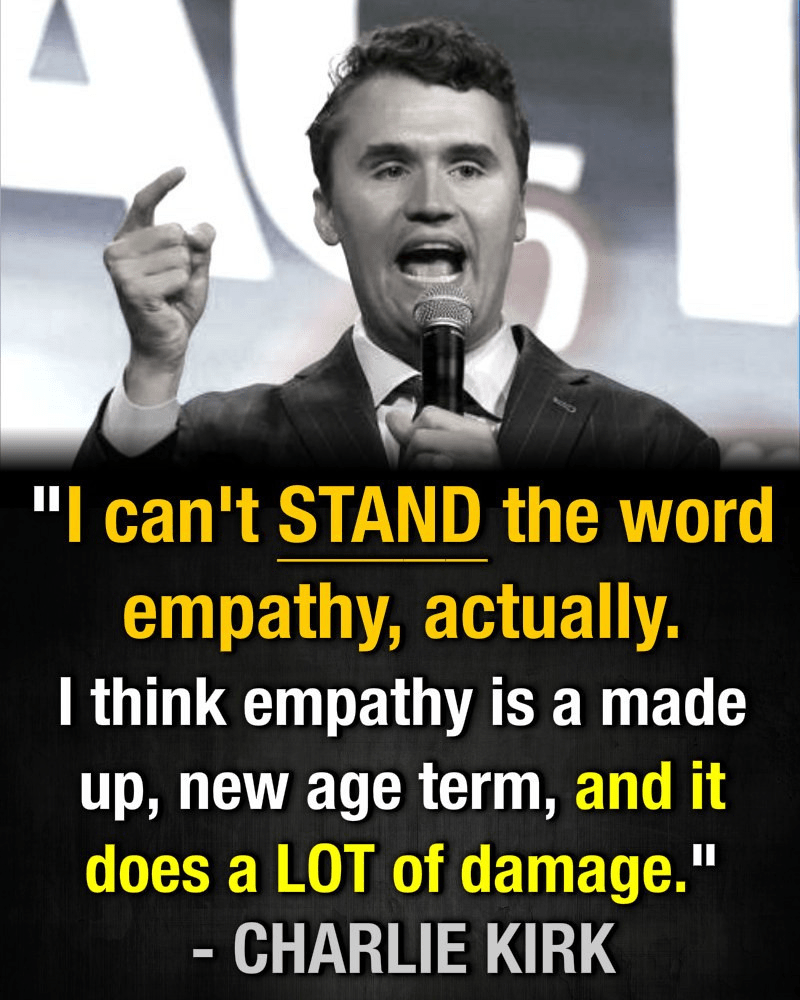
This blog started with a meme featuring the late Charlie Kirk. In it, he attacks the the very concept of empathy. Moreover, he is Christian nationalist, someone whose reference group is narrow and whose litmus test for what counts is what does it do for me and mine. He was, in other words, a classic MAGA type belonging in quadrant B.
I must add he is not the first to do so, not by a long shot. In the 1990s, when welfare reform was a hot topic, denizens of the ‘right’ attacked the notion of charity as a concept. Giving to the poor made their situation worse was an oft repeated line. It was their form of the old argument that compassion sucks.
Those who worshipped Charlie, or his personal hero Trump, kept coming back to hear a message that oddly was quite orthogonal to what they said they believed. Most right-wing cultists (quadrant B types) posture a belief in Christ’s teachings. Yet, their core belief set is totally detached (largely opposed) to what Christ taught or, more accurately, what was ascribed to him by adherents later on. This is a remarkable case of cognitive dissonance which is less strange when you realize that their beliefs are largely defined by their emotional palette, not their analytically oriented frontal cortex.
When MAGA believers are confronted with contrary input, e.g., Trump is a depraved pedophile and rapist for example, they simply refuse to accept nor acknowledge any such input that contradicts their priors. They will bend the world about them rather than rearrange their essential ’emotional palette.’ Some of them do have high IQs which means they can rationalize emotionally driven positions more cleverly (see my post-decisionism discussion in my last blog).
Think about our national context. Members of quadrant B have enjoyed quite a run. Our revered system of laws has been dismantled to aggressively identify and remove ‘undesirables’ from our midsts. Our national identity is being redefined to accentuate a single tribal affinity group. Just how central has this been in our history? Very central. We have seen blacks, indigenous peoples, Chinese, the Irish and Catholics (my ancestors), slavs and southern Europeans, Latinos, the Japanese, and now immigrants in general serving as convenient scapegoats … the source of all our troubles. Clearly, the idealized American promise has been tarnished time and again by shifts toward the ‘Me’ end of the horizontal axis.
And we have our vertical access. How often is the question of national debt and the public good discussed in the context of we cannot afford to do more. This is a classic ‘zero-sum’ perspective. Seldom are our public policy questions discussed within the context of taxing the uber-wealthy more. Seldom is the fact that Elon Musk alone has more wealth than the bottom half of all Americans been portrayed as a national embarrassment. Actually, he enjoys 5 times what our bottom half has … $480 billion to $85.5 billion (more on this in my next blog). Yet our entitled oligarchs (most, not all) fiercely fight to further rig the economic game as if life were truly a zero-sum contest in which they cannot ever risk losing, not even marginally. That is a default, emotional response based on their twisted ’emotional palette.’
This is a work in progress. So, feel free to comment on concepts, structure, terminology or whatever. I like playing with ideas but realize there is nothing sacrosanct about my feeble efforts. And yes, I do need to get a life.
 Tom's Musings