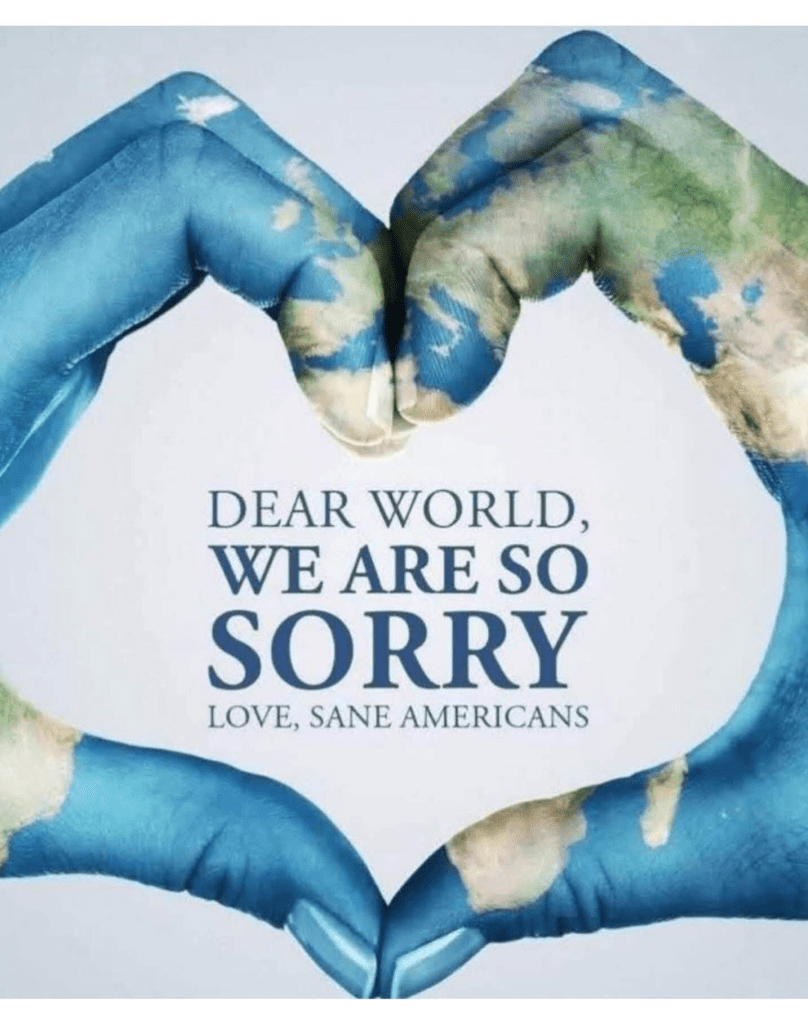
In my previous submission to Toms-Musings, I suggested (once again) that a deep divide exists in America, though one arguably evidenced from the very start of our Republic. At our beginning, this nation was patched together from a (slightly) more urban and industrial North which was fairly responsive to democratic impulses with a semi-feudal, more hierarchical, plantation-focused South increasingly dependent on enslaved labor. That cultural and political chasm festered for decades until exploding into the most horrific conflict witnessed on American soil. Though that basic divide has morphed along different, less precise, geographic lines, a similar cultural separation continues across today’s red and blue jurisdictions. The passions across those on each side of the divide oft appear as vitriolic and as entrenched as ever.
In my last piece, I labeled the essential character of the divide as US v. ME … where some focused on larger affinity groupings while others did so on smaller, more homogeneous, units (explained more fully later). On reflection, I have refined my thinking, now prefering a WE v. ME designation while adding a totally new 2nd conceptual attribute (stay tuned)!
Why WE-ME? It is catchier, with a simple inversion of the 1st letter, W to M. Yet, it still encompasses an extraordinary array of differences in world views that separate red from blue areas, conservative from progressive doctrines, and Republican from Democratic partisans in today’s fractured American social fabric. We have two nations, utterly separated by norms and aspirations yet occupying a single land. As Lincoln once observed, a house divided cannot stand. Our differences are, sadly, overly consequential in many basic ways. The chasm is so wide, in fact, that I despair of our national experiment surviving.
Moving on from my starting point.
A nominal reading of that prior blog defines the essential character of that chasm as one between the haves and the have nots. Surely, hyper-inequality remains a significant contributor to our existing political tensions. For the most part, the haves today command so many resources that they see themselves as fundamentally different, likely superior, to the remainder of society.
The top of the economic pyramid (the proverbial 1%) are the very definition of an affinity group, one that enjoys an incestuous and exclusive set of self-contained and mutually supportive socio-economic interactions. Nevertheless, it likely does not fully explain our national normative tensions with convincing clarity.
For one thing, too many of the ‘haves,’ though not a plurality, evidence empathic tendencies and liberal beliefs. True, Republican President Herbert Hoover, never confused with a leftist, was known to have said, “You know, the only problem with capitalism is the capitalists. They’re too damn greedy.” Nevertheless, while excessive wealth may corrupt or distort values, I don’t sense that it dictates them in any causal nor deterministic manner. Too many, after winning the acquisition game, then redistribute much of their treasure for the common good.
No, I feel the root causes of our existential divide go deeper. By deeper, I mean looking at those innate dispositions that precede, though often shape, life’s outcomes, especially in terms of one’s essential moral center.
It strikes me, for example, that whether one is a member of the economic elite surely can be independent of skill or effort. You can win the birth lottery (fortunate to have rich or connected family members) or the marital lottery (wed a rich spouse), or perhaps win the powerball lottery. In such cases, one’s personal agency respecting their position in the economic hierarchy can be unclear. Some rich are merely lucky. Others make it based upon exploitive, even sadistic, behaviors best left unexamined.
To be clear, cultural polarization within nations is not unique to the U.S. It is a somewhat universal phenomenon. Poland is split sharply between a liberal western side and a hidebound eastern half. Likewise, Italy can be divided between a progressive north and a more backward south. Many nations evidence a similar cultural split, often between urban and rural areas. The very universality of such political and social divides beg further exploration.
In addition, it has worried many that authoritarianism has made a comeback in past decade or so. After the dissolution of the Soviet Union around 1990, many assumed that liberal democracy was on the ascendancy at last. The most powerful authoritarian alternative had collapsed from its own internal tensions. Not so, apparently. In recent years, we have witnessed the rise of authoritarian regimes in several countries: Turkey (2013); India (2014); Poland (2015); and Brazil (2019), just to name a few. And, of course, who could ignore the United States in 2016 and again in 2024.
What explains all this?
I’ve begun seeking explanations for all this dramatic polarization in the primordial, or instinctive, premises and patterns we bring to the world. Preferably, we would like to ascribe our American political divide to some simple cause. If only Fox News or conservative talk radio had not emerged in the late 20th century, all would be okay. Or if we could reverse Citizen’s United and thus divorce big money from politics, then we would magically return to an imagined Camelot where we all would get along.
No, that’s too simple. It all goes deeper than that. I sense that our cultural differences are located in those intuitive responses that individuals employ to make sense of the vast array of inputs each of us faces on a daily basis … a condition worsened by an accelerating pace of technological and social change. The real explanation likely lies in deeply embedded emotional default responses that lie beyond the reach of conscious calculation. If true, just how do we make sense of our world?
A good question, indeed!
Some epistemological approaches to what we know (or believe we know) presume that humans start life with a blank slate, a tabula rasa, a philosophical perspective linked back to Aristotle, Ibn Siba, and more recently John Locke. What we become is totally dependent on our post-natal experiences and education.
Others, like Immanual Kant, believe we are born with predetermined innate patterns for organizing the chaotic world about us. I personally ascribe to the notion that some attributes we possess, and which contribute to the extremes across our cultural divide, are partially hard wired. We are born with them.
For example, some research has detected differences in the structures of brains among hard conservatives that render them more sensitive to seeing threat in the world. Difference, for them, is instinctively equated emotionally with danger. This response was prudent in our deep past when basic survival depended on fight or flight on a daily basis. Best not to relax around an irritated Mastodon if you wished to live another day. Today, cooperation and collaboration are keys to further evolution as a species. Yet, older response patterns remain dominant in some.
While some individual outcomes might be determined at birth, some combination of nature and nurture play a role for most. If our world views were totally determined at birth, we might see a more evenly distributed spatial arrangement of liberals and conservatives. But no, they cluster together. Proximity and socially shared values cannot be dismissed nor discounted.
Still, I cannot ignore a recent discussion with my childhood friend Ronnie, and his wife Mary. They cannot quite understand how one of their offspring turned out to be a Trump supporter. This happened despite growing up in progressive Massachusetts with liberal parents and attending Clark University (my Alma Mater), ranked as one of the more leftist colleges in New England. This one son seemed destined to be different from birth. (By the way, their predicament leads me thank my stars I was wise enough to forego having children. I could NEVER forgive myself for foisting a Trump supporter on society. )
At the core of the divide!
Let’s start with a definition. Jonathan Haidt defines our core moral systems as “… interlocking sets of values, virtues, norms, practices, identities, institutions, technologies, and evolved psychological mechanisms that work together to suppress or regulate self-interest and make cooperative societies possible.” Fair enough, but how do they emerge?
One way to think about the question is to remind ourself of two insights into how we poor humans function in a bewildering world. Daniel Kanneman introduced us to the importance of fast versus slow thinking. So-called fast thinking is more automatic, immediate, and intuitive. On the other hand, slow thinking is highly cognitive, analytical, and thoughtful. We like to think we have evolved beyond the former toward the latter but have we? Frankly, I see scant evidence of that.
A second insight comes from how some observers view the making of legal decisions. On paper, these are the products of classic slow-thinking processes. It often takes months of analysis and deliberation before higher courts (appellate and supreme court levels) make decisions and then publicly render their legal conclusions.
Insiders, on the other hand, often describe what more accurately is described as a post-decisionism approach. Jurists decide matters quickly and intuitively with the remainder of the deliberative process merely masking the effort to window- dress an instinctive, largely emotive or normatively based choice in fancy legalese. What has the appearance of objectivity enjoys little of that precious quality.
If judicial decisions were, in fact, one of evidence-based analytical thinking and applied stare decisis (legal precedent), one would not see $100 million being spent to sway the outcome of a single state Supreme Court race, as occurred not that long ago in Wisconsin.
My late wife was the Deputy Director for the Wisconsin court system during her career. I recall her once relating to me stories from a training exercise for the State’s judges she helped administer. The judicial attendees were given hypothetical legal and court situations and individually asked to decide how they would decide the issue from the bench or in their official capacity. She was amazed at how divided the responses were, many split evenly, and how heated the subsequent discussions could be.
Legal decision-making proved substantially distant from our prior in which judicial scholars applied some objective or widely shared set of norms and standards to complex situations. What is right can emerge from entrenched truths located in intrinsically held belief systems. Apparently, the embedded emotions and values one brings to the bench outway logic and the objectivity of the law more often than we would care to admit.
And here we have the crux of the situation. Each of us brings an individual palette of instinctual norms, emotions, and responsive default positions into daily life. These default positions constitute, or at least shape, our instinctive reactions to the outside world. They are the way we intuitively organize the inchoate external messages we continually confront on a daily basis. These instinctive reactions represent our visceral (primordial?) responses to select stimuli, especially those which evoke uncertainty, negativity, or outright fear.
Going back to Jonothan Haidt, he takes a shot at identifying the core organizing principles (palettes if you will) presumably found in conservative as opposed to liberal-oriented individuals. According to him, those on the right value such attributes as loyalty, authority, and sanctity. They seek stability, something bordering on rigidity, in society and in their personal lives.
Liberals, or progressives if you wish, gravitate toward such core attributes as caring, fairness, and personal liberty. They generally seem more empathic toward others, more sensitive to larger tribal affinity groups. They are more accepting of differences and, despite being labeled as snowflakes, are better able to deal with both the unexpected and the challenging.
Yet, it still strikes me that we have not gone deep enough into the fundamental distinctions that separate those that identify with the right and those desperately hanging on to what remains of American democracy and the rule of law. I’ve given the matter thought and, as is my wont, have come up with a half-baked insight of my own. Well, I presume it is mine but who knows. And, if history is any guide, it likely will last at least a week before I discard it as silly and sophmoric.
The core difference!
To separate the Trumpers from the people I respect, I’m envisioning a two-dimensional template. On the horizontal coordinate, we have a continuum that goes from our now familiar notation of WE on the left to ME on the right. Bisecting that flat line is a vertical continuum that is labeled the zero-sum perspective on the top end to an elastic perspective at the bottom.
The WE-ME horizontal continuum is nominally straightforward, one that we have touched on earlier. Those on the ‘WE’ end of the continuum tend to embrace larger affinity groups or a larger sense of referent tribes. They are capable of empathic relations and responses to larger populations that extend beyond their immediate world.
Those on the ‘ME’ end of the continuum instinctively favor smaller tribes as their go-to reference groups. At the extreme, their tribal identity seldom extends beyond those most like them (e.g., white Christians in their suburban neighborhood) and sometimes even just their own families. This may explain why rural folk tend to focus on rather limited affinity-group (tribal) world for social comfort and ideological confirmation. They might have self-selected to stay on the farm (as that population has shrunk) and simply have not had sufficient broadening experiences with the wider world.
Think about the following for a well-known, if extreme, example. Donald Trump would be located on the far right end of the ‘WE-ME’ continuum. In almost every situation, he thinks about how things impact HIM, and no one else. Basically, he has a referent (affinity) group of one. Everything is transactional where his needs are paramount and the wants-needs of all others totally irrelevant.
In fact, his sense of entitlement is so severe that it represents an affliction we would label as pathological narcissism. Though he lived in New York growing up, he might well have been raised in white, rural Nebraska. He evolved in a privileged bubble, seldom interacting with those beyond a small, entitled tribe with whom he shared rather provincial and distorted values.
I sense that I’m located on on the other side of the ‘WE-ME’ continuum. How so? Well, This is not to say that I sometimes associate, or respond to, a few definable and very conventional affinity groups. For example, I am emotionally tied to my Celtic ethnic tribe. I get weepy on my visits to Ireland. But I put such things aside when considering important matters. Then, I instinctively see things from a more global perspective. The very premis of the MAGA crowd, the so-called America-first perspective (really the affluent white Christian Americans first), strikes me as a dated, provincial, and primitive go-to position.
The vertical continuum strikes me as a critical addition to this conceptual frame. How so, you ask? Well, at the top we have those who seek the world in zero-sum terms. Basically, anything of value that goes to someone else is subtracted from my utility (economic-speak for well-being). Put conversely, my winning must be the other’s loss and vice-versa. At the bottom of the continuum we have those who seek the world in more elastic terms. By that, I mean the following. Resources are not always seen as finite. Anything of value going to one individual is not necessarily subtracted from another. In fact, collaboration can enhance the overall well-being of all. Again, these are not absolute calculations but emotional or primordial responses to the world about us. They represent how we instinctively act and react to situations and people.
Think of these two core attributes in terms of a two-dimensional conceptual framework where the horizontal WE-ME continuum is bi-sected in the middle by the zero-sum point down to an elastic point along the vertical continuum. If you can envision this, you readily see that we have four quadrants. It follows (or should at least) that the cult followers associated with the MAGA world generally would congregate in the upper-right quadrant since they score high on the ME and zero-sum continuums. That is, their primordial or instinctive sentiments jointly lie high on the ME and zero-sum ends of the respective continuums.
Progressive-liberals (the dreaded WOKE types) would, on the other hand, congregate in the bottom- left quadrant. They tend toward the WE and ELASTIC ends of both continua. Thus, they tend to instinctively drift toward broader affinity or reference groups while simultaneously sensing that collaborative efforts can enhance overall utility … that is, benefit the so-called common good.
As I have suggested throughout, these are primordial, mostly preconscious response patterns. Exceptions abound and no one is formulaicly predictable in all situations. Yet, this way of looking at things makes sense, if only from a personal point of view. As I’ve noted elsewhere, I embraced a global perspective as a very young man … wanting to join an organization that preached world unity years before I even hit puberty. As far back as I recall, I rejected the manner in which we divided up the world in terms of tribes and nations. When looking out at the vast cosmos, the narrow perspective of nation- states and ethnic identities intuitively struck me as highly primitive and utterly provincial.
As usual, this blog has gone on too long. I will try to fill in the loose ends in the future. Or, more likely, I will conclude that all this is total BS. At the moment, though, I find it useful. It helps explain why people can seemingly look at what appears to be similar events and yet arrive at wildly different conclusions.
In the end, we have different underlying emotional and conceptual palettes through which we filter and organize reality. One person might see another who speaks or believes differently as a ‘threat’ while another person responds to the same situation as an ‘opportunity’ to experience something new and positive. These are not formal, conscious choices. They are not easily understood through cognition and analysis. They likely lie deep within us as embedded, instinctual sentiments. That makes them difficult to remedy. Yet, understanding is the first step toward positive change, or so I’m told.
More next time or whenever. In the meantime, stay well. And congrats if you made it all the way to the end. You must really enjoy pain 😢.
 Tom's Musings