There is little doubt that I’ve become a grumpy curmudgeon in my advanced dotage. One issue that has irritated me of late concerns our national debt, an issue that arises with greater frequency in the Trump era. Essentially, are we on the brink of ruin and what shall we do about it?
Yes, it is true … I hang out with people who focus on politics and other arcane policy topics like the public debt as opposed to the antics of the Kardashians (whomever they are) or obsess on the latest sports rankings. Of course, I could get new friends … a possibility I should consider. Then again, I had much trouble getting the ones I have now. So, why bother.
Anyway, here is how several dialogues have gone of late. Oh my god, we have a national debt burden of some $36 trillion dollars! That observation might be followed up with a comment about how much we pay to service this debt (over $2 billion a day). Then, the conversation often drifts toward apocalyptic visions of various horrible consequences likely to occur. BTW … I generally agree with this part of the conventional dialogue. Even I’m concerned about the size of our public debt.
Our budgetary debt and continuing structural deficits, in all probability, are unsustainable. At some point, a federal government that spends close to $7 trillion per year while bringing in about $5 trillion in revenue will run into deep shit, if not something worse. Several pitfalls await. At some point, debt service payments become so large that other essential needs are sacrificed. The temptation to print money and aggravate inflation becomes overly attractive, if not downright seductive. Worse, the dollar may weaken and, given that fully one-third of our debt is owned by foreigners, these kind folk from other parts of the world may no longer be willing to buy our bonds much longer. That is, we will no longer look like a safe fiscal haven. Other issues might be noted but, for the sake of conciseness, won’t be.
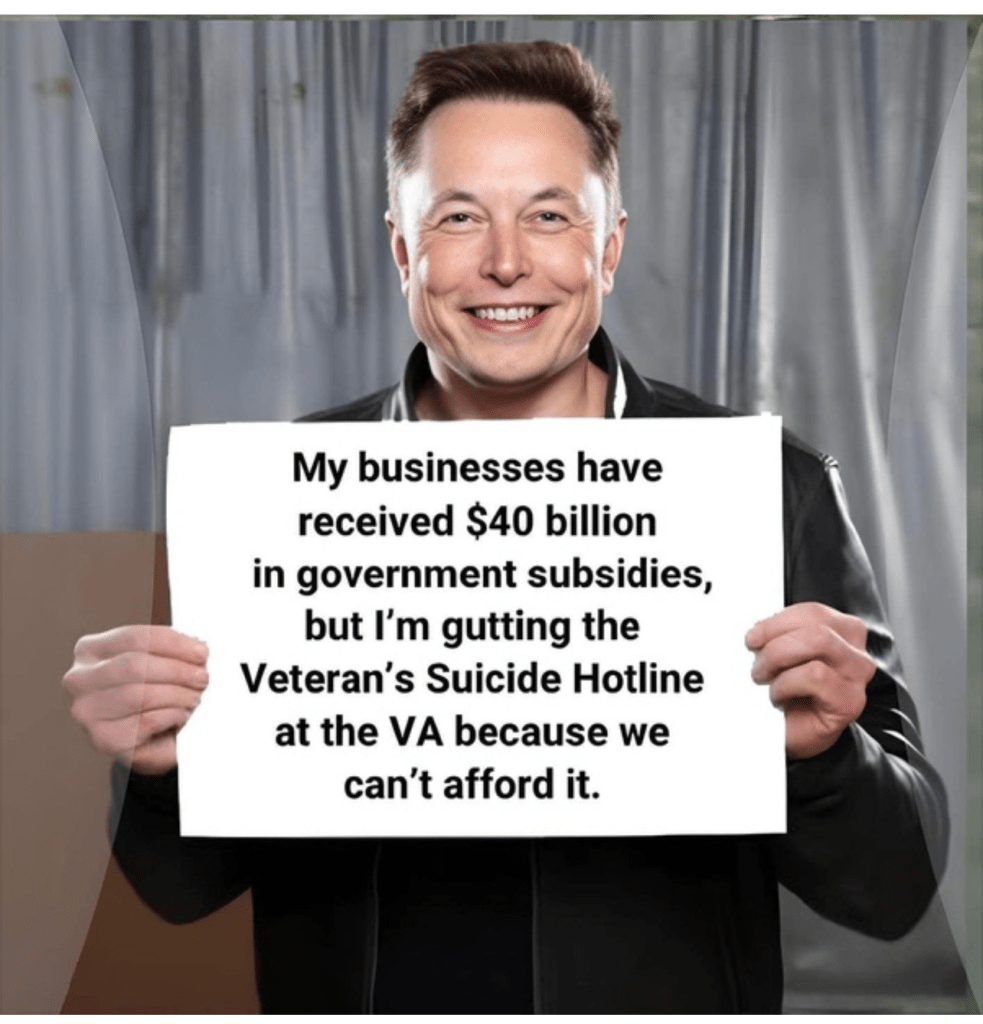
The conversation then typically takes a turn that gets me grinding my teeth. We need to cut spending. Or worse, I don’t like Trump, but maybe his DOGE initiative is on to something. First, let me say I’m all for prudent and responsible government. Trump’s (really Elon Musk’s) wild and impetuous cuts, however, are simply irresponsible and self-serving. For one thing, you don’t start by firing all the inspector-generals in the bureaucracy…the very people charged with rooting out waste and fraud. Second, it was clear from the onset that DOGE was an attempt to destroy remaining confidence in the public sector (thereby rationalizing more privatization where someone could make a buck at the taxpayer’s expense). More to the point, these broad cuts are designed to provide fiscal cover for the proposed $4.5 trillion dollar tax cut swimming through the Donald’s orange-covered, yet avaricious, dome.
If you wanted to cut government costs prudently, you might do what Bill Clinton did. He saw that Reagan had ballooned the national debt by $1.8 trillion and had left him with significant structural annual deficits. So, he put his VP in charge of looking at where cuts might be made based based on expert analysis and judicious thought. His team cut some 377,000 positions throughout the bureaucracy. That wasn’t enough to set our fiscal house in order. Bill also raised the top tax rates as Republicans screamed that Armageddon was upon us. He also expanded tax breaks for working class folk by increasing the EITC, which conservatives saw as waste in their self-serving world view.
Despite GOP claims that the sky would fall, the actual consequences were that the economy boomed and the stock market kept going up. Better still, Bill actually ran several annual budget surpluses, an event almost as rare as the Chicago Cubs winning the World Series. Amazingly, good government involved judicious cuts and revenue enhancements. Who would have thought?
Since then, subsequent Republican administrations went back to their mantra of regressive tax cuts and increased borrowing. After the Bush and early Trump tax giveaways, the debt Reagan left us looked like pocket change. Obama then did yeoman’s work in reducing annual deficits (while rebooting the economy after Bush’s housing speculation collapse). Biden did his best but was constrained by the Covid pandemic after effects. A crushed economy needed to be stimulated. He did what he could, but conservative opposition hemmed the Dems in, as they typically do. The GOP fought their efforts to put our fiscal house in order tooth and nail.
So, Trump arrives back on the scene with our finances in a $36 trillion dollar hole. What does he do … he promises even more regressive tax cuts. Really? How much sense does it make to slash revenues further when you are already swimming in debt? If Democrats had long been accused of being the spend and borrow crowd, then Republicans might well be thought of as the cut taxes and borrow gang. Either way, you wind up in the same dilemma … you aren’t paying your bills.
And yet, the knee-jerk reaction, even among many liberals, is that we need to cut spending. They decry that we want too much from government, that we are too dependent on Uncle Sam, that we simply spend too much. We need to be more independent, they say. But is that true?
Has the rhetoric influenced our collective behaviors and perspectives? Since the 1980s, we have seen wave after wave of tax cuts (most of which favor the wealthy) along with some modest belt tightening that generally squeezes programs designed to assist the working classes and the vulnerable. The net result has not been a return to fiscal sanity. Rather, we’ve seen a massive redistribution of income and wealth from the middle and bottom of the pyramid to those at the top. The 1 percenters have seen their share of the income pie rise from 10 percent in 1979 to about a quarter of the total in recent years … a tectonic change.
Even if we could squeeze the public sector more, where would we start? Should we cut the so-called out of control federal bureaucracy? In truth, the federal payroll has been stable for several decades even as the U.S. population has grown by some 70 percent. Besides, federal labor costs represent a remarkably small portion of the total budget. The aggregate cost of federal personnel last year amounted to some $336 billion. That may sound like a lot. However, that figure amounts to 1 percent of our GDP and less than 5 percent of the federal budget.
Im fact, you could fire them all and make very little headway. And believe me, there would be pain if the federal workforce was slashed indiscriminately. Remember when Newt Gingrich forced a shutdown of nonessential public services in the 1990s. The public went nuts when they couldn’t visit national parks or get passports renewed. Gingrich expected no one would notice. They did, and he soon caved.
Just where would you start if you were serious about our debt problem. The answer is not easy. Let’s look where we spend the big bucks … the programs you would have to savage to afford another tax break for the uber rich. Of the $6.8 trillion in outlays; $1.5 trillion goes for Social Security, another $1.5 trillion goes for major health programs (Medicare and Medicaid), about $1.3 trillion for national defense and $750 billion goes for servicing our existing debt. Soon, there is not much left. We spend a minor portion for all other services with surprisingly little on the programs most people despise… $70 billion on SNAP (Formerly Food Stamps) and TANF (formerly AFDC). Cutting these programs would get you little more than pocket change.
Attacking the big items, on the other hand, can quickly backfire. Will you go after the elderly and disabled? Not so good since they evoke public sympathy and, more importantly, they vote. How about eviscerating health care for the vulnerable and aged. Not good optics when people die or rural hospitals are starved out of business. Defense? How about getting rid of a few really expensive ships and planes. Not likely, since programs designed to kill people are the only ones Republicans passionately support. Perhaps renege on our debt obligations? You might try, but then it would then be a cold day in hell before we could borrow in the future.
The reality is that this sales pitch about financing another $4.5 trillion tax cut by eliminating waste and fraud is utter bullshit. Nor is it true that our spending is out of control, as we hear repeatedly. How many times have we heard the refrain … we can’t afford this or that program, no matter the merits.
Public expenditures in the U.S. amount to slightly more than 36 percent of our GDP. That may sound like a lot, but not when compared to our peer nations. In Canada, the equivalent rate is 42 percent, the U.K is 44 percent, Germany is 48 percent, and France is 57 percent. And take Denmark, they spend more than virtually all other countries and yet, shockingly, they have the happiest population according to repeated international hedonic surveys. The GOP is aghast at this, calling them socialists or worse. After all, how could taxes and happiness go together? The answer is simple … those people believe in the public good and are willing to pay taxes to minimize life’s uncertainties.
Nor is it true that we are overtaxed, or that our taxes are a drag on the economy. Our federal tax revenues amount to about 16.6 percent of our GDP (our federal spending approaches 20 percent). The average level of federal taxes in the European Union is close to 20 percent, higher in the more advanced nations. Our total revenues (fed, state, and local) hover around 30 percent of GDP, still well below our peer nations. Certainly, taxes have not slowed our economy, which has remained very robust, if not the envy of the world, until the recent election.
We’ve all heard several other political tropes. One favorite is why can’t the federal government be run like a family. The implications is that families pay their bills. Yeah, right. Private debt in the U.S. has reached $27 trillion, less than the federal debt level, but still a striking number. And if you sum up the total debt in the U. S., including all outstanding loans and debt securities from companies and households, while encompassing all levels of government, the total we have borrowed as a society has reaches $93.5 trillion. A trillion here and a trillion there and soon we are talking about real money.
I’m not arguing that debt is something to be ignored, not in the least. We are on an unsustainable course, both in the public and private sectors. In the public arena, however, I feel strongly that we can only do so much by reducing outlays. We simply are not out of line with our competitors. Besides, we still have major infrastructure and other compelling needs (science and education) to address.
Yet, everyone with whom I’ve chatted about this issue immediately goes to the expenditure side of the ledger. I believe we should start on the revenue side. In the immediate post WWII, our war-driven national debt exceeded our GDP for the first time in recent memory. The top personal tax rates were set at about 90 percent for top earners, a confiscatory rate that remained high throughout the Republican administration in the 1950s. However, the federal debt was substantially eliminated while our economy boomed, creating a robust middle class.
Inexorably, America’s anti-tax fetish took hold. Kennedy reduced the top rates to 70 percent, and the supply side advocates that rode into Washington with the neo-conservatives led by Ronald Reagan dropped the top rates into the low 30’s. Since then, the top rates have fluctuated within 33 to 39 percent range with a current top rate of 37 percent.
Again, is this an unsupportable rate? Will any increase destroy our economy and stifle work and innovation? We get a partial answer by comparing our top rate with our peer nations. It turns out that we tax income at comparatively low rates. The top rates average about 43% in OECD (the Organization of Economic and Cooperative Development) countries. However, in the more advanced OECD nations, we find higher top rates; around 55% in Denmark, France, and Austria. Of course, total taxation goes well beyond personal income taxes. Still, there is little evidence that we are overtaxed in the U.S.
We finally come to the bottom line. Debt is a problem. At some time, we will have to pay our bills, much like we did after WWII. While no one argues that some expenditure cuts are warranted, I would start on the revenue side. I could see some taxes eliminated, like corporate taxes. These largely enrich tax lawyers, while the tax burden falls on consumers and equity holders. On the other hand, we could do so much more on returning to a progressive tax system. That is where our flexibility lies.
As I’ve repeatedly argued, the uber wealthy have seen tectonic increases in their share of the economic pie over the past four-plus decades. As Warren Buffet, the Oracle of Omaha, has observed, it makes no sense that he pays a lower percentage of his income in taxes than the secretary who manages his schedule. One way we can restore a vibrant middle class (the share falling into the middle- class bracket has fallen from 60 percent to less than 50 percent) would be to once more use our tax system to offset the disequilibria that inevitably results from the dynamics of capitalism. Absent countervailing forces, the rich will keep getting richer.
This rant touches upon a point I stressed in my policy classes. The first step in addressing policy conundruns is to define the issue correctly. If that is not done, one’s prospects for solving the problem quickly evaporate. Yes, debt is an issue to be addressed. But let us not become myopic by only addressing the spending side of the ledger. The more promising route involves focusing on increasing revenues. For too long, the uber-wealthy have employed their wealth and power to curry additional favors for themselves. It is time to look at the elephant in the room. Those who have a disproportionate amount of the nation’s resources must pay their appropriate share of our bills.
 Tom's Musings