I’ve always been shocked at how illiterate most people are about historical patterns that are repeated over time, especially about what we might glean from our past. They imagine that what happens in the present is somehow unique in the annals of time. Certainly, some technological breakthroughs are legitimately new. We’ve never before had the instantaneous communications brought to us by the digital age and satellite technology. But human behaviors are repeatable and, in fact, are repeated quite often. Yet, we often act as if what we see about us is new, thus ignoring the lessons and insights available from history.
I was particularly aware of this tendency to ignore historical precedents while engaged in the nation’s obsession with welfare in the last decades of the 20th century. The press and most politicians reacted to each ‘new’ welfare reform concept as if no one had ever thought of such a thing before. Of course, virtually every idea had been conceived of in the past while most, in one form or another, had been tried previously. Even a rudimentary overview of history would have sobered exaggerated expectations and diminished the hyperbole surrounding each new initiative. One possible exception in the political welfare drama was Senator Daniel Patrick Moynihan of New York, the Harvard professor turned politician. In debate, he would reference earlier reform efforts, going back as far as the Elizabethan Speenhamland plan, when discussing contemporary reform concepts. But he was a distinct outlier.
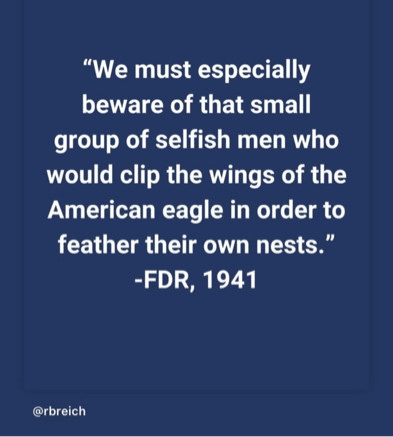
At the moment, I’m dwelling on how unique (or not) is the MAGA revolution. It probably is true that no previous administration has attempted to destroy our constitutional Republic in such an overt and obvious manner. Nor can I recall the American public accepting, even endorsing, these attacks to our very way of life. Can anyone recall so many cheering the (Jan. 6) insurrectionists who attacked our democratic principles and our sacred constitutional protections, with perhaps the KKK of the 1920s and various populist groups during the Great Depression being exceptions. Still, despite the generally sanguin response to Trump and Musk’s attacks on our institutions, there are signs that even the American electorate, dullards that they might be, are beginning to catch on to the existential fate facing the nation. Still, as of this writing, I retain little hope that the ongoing coup in Washington might be reversed.
In this musing, I focus on some small patterns. For example, many are likely to believe that a sitting President has never tried to bend the basic contours of our governing framework when frustrated by the opposition, at least not to the extent of our wanna-be dictator. Is Trump’s obvious wesponizing of the DOJ, the FBI, the Judiciary, the intelligence community, our military, etc. unique in our history. Not really! President James Polk manipulated our military and the State Department to find appropriate pretexts for expanding the U.S. dominion all the way to the Pacific Ocean, including starting a likely unjust war with our neighbors to the south. FDR considered expanding the number of Supreme Court justices when the existing members of the Court refused to cooperate with his efforts to jump start our economy during an utterly crippling global depression. Other examples surely can be cited.
But let’s focus on the modern American government which, in terms of scope and complexity, has only been around since World War II. Has any recent (prior) President attempted to weaponize the bureaucracy for personal and political purposes, as Trump seems to be doing. Why, yes! In 1971, Richard Nixon was captured on his office taping system as he outlined the qualities he wanted in the next chief of the Internal Revenue Setvices (IRS). “I want to be sure he is a ruthless son of a bitch … that he will do what he is told, that every income tax tax return I want to see I see, that he will go after our enemies and not our friends.” Nixon did not succeed in turning that institution into a personalized weapon. A surviving institutional affinity for the rule of law prevailed in the end, helped by the self-destructive behaviors of the President himself assisted by a residual support for core principles (e.g., seeing the country as a nation of laws) on which our constitution was founded.
Another moment from the not too distant past strikes me as analagous to our current political tragedy. First, however, let’s peruse a bit of context. Over the course of my lifetime, the distribution of values across the political parties shifted from a confusing allocation of ideological purity among the two major parties to a hyper polarization of beliefs … the GOP shifted to the hard right while the Dems drifted to the left. President Johnson’s civil rights victories in the mid-1960s corrected a political misalignment that remained intact for a century after the conclusion of our Civil War.
In my earlier years, the titular heads of the GOP included Thomas Dewey, Robert Taft, Dwight Eisenhower, Richard Nixon, Nelson Rockefeller, Barry Goldwater, and Gerald Ford. Only Taft, a descendent of President William Taft, and Goldwater would be considered Republicans by today’s standards. The remainder would fit easily within today’s Democratic Party, a few being considered true leftists. True Republicans (by today’s standards) in those days did not fare well. Taft was bullied aside in 1952 by the popularity of General Dwight D. Eisenhower, while Goldwater was buried in the 1964 presidential election. During the immediate post- WWII period, the GOP remained ideologically diverse and relatively sane. In fact, President Johnson’s civil rights breakthrough depended on strong GOP support.
A political inflection point emerged with the election of Ronald Reagan to the Presidency in 1980, a darling of the hard right since the Goldwater debacle back in the 60s. With his avuncular style and easy wit, the former B-level movie actor made extremism look relatively harmless. In truth, however, Reagan’s rhetoric was far more biting than his actual political decisions. While he did throw a few bones to the right wing of his party (smashing the power of labor unions for example and spending wildly on ill-considered defense systems), his overall record was mixed. He would first reduce taxes precipitously, then raise them again. And Reagan never cut spending in ways that could justify the tax cuts he wanted and then passed into law. He was a hard liner in the abstract but a softy when actual people were hurt. The result of his confusing reign was little inroads into federal spending while a substantive lessening of the progressivity of our tax laws. This resulted in an increase in the national debt of some $1.8 trillion and the start of a trend among the once fiscally sober GOP becoming the party of budgetary irresponsibility.
Key to understanding the Reagan years lies in the ideological battles around Reagan, a man of great charm but very limited intellectual abilities. That is, he could easily be persuaded by the people he trusted, and who had easy access to him. Two forces (groups) vied to control the White House agenda. There were the so-called ‘prags’ (or pragmatists) and the ‘wing-nuts’ (the hard-right contingent).’ The ‘prags’ were led by Jim Baker, a moderate conservative who served as ‘chief of staff’ and , most importantly of all, had Nancy Reagan’s trust. The ‘wing-nuts’ were led by Ed Meese, a man who was less polished than Baker but who likely was closer to Reagan’s emotional core. These main ideological forces spent as much time focused on one another as they fought to neutralize the other side than they did on actually governing the country.
This internal White House political struggle is important for at least one reason … it was a portent for the greater conservative struggle over the next several decades. The hard- right and the moderate wings of the GOP would battle continuously for supremacy in the coming years … with the more moderate elements generally prevailing at the national level … Bush (father and son), McCain, and Romney. At the Congressional and local level, the drift was decidedly toward the extremists wing of the party, Newt Gingrich being the prime example. A friend of mine at the time (a long- term Republican operative in Congress) described Gingrich to me ‘as a bomb-throwing revolutionary.’ Not that Newt would throw actual bombs but that he wanted to blow up the ‘business as usual’ way of governing. There would be no compromising with the other side no matter how much sense it made.
Of course, Trump’s emergence in 2015 marked a decided victory for the hard-right contingent of the Republican Party. Still, he was not prepared for victory. He was not expected to win. In truth, he was even less intellectually capable than Reagan (which takes some doing) and could not even approach the former actor’s charisma and charm. But the country had shifted to the right by this time, making a man who failed both in business and as a human being seem preferable, if not desirable, to almost half of the country. Importantly, someone like Trump spoke directly to the rage found within the Republican base, a set of passions long frustrated.
Even the Donald was surprised he won the first time around. Thus, he felt unprepared and assumed that he needed some actual adults in the room to run the country. As a consequence, he surrounded himself with the same two groups that Reagan had in his White House three decades earlier. You had the contemporary version of the ‘prags’ (e.g., V.P. Pence and General Milley) as well as the ‘wing-nuts‘ (e.g., Bannon and Miller). One group pushed him to the extreme while the other (if some of their written works are factual) spent an enormous amount of time stopping the President from unleashing ruinous havoc on the nation. Still, by the end of his tenure in office, many of the prags were gone or (in Donald’s so-called mind) discredited. Trump felt secure in pushing his more rabid followers toward an actual insurrection to remain in office even if he didn’t quite control all the levers of power to effectuate a complete coup.
For his second term, all is in place. All remaining moderate elements of the Republican Party have been purged … Cheney, Kinsinger, and Romney being the last of the RINO line of opposition. Donald has surrounded himself with sycophants and cultish followers. The extremists housed at the Heritage Institute had plenty of time to develop a detailed agenda and plan to institute a permanent political and institutional replacement of our democratic republican form of government. The long battle for the soul of one major party is finished. Shockingly, half the country has embraced this extreme vision of the future (even though it remains to be seen what might happen if inflation and unemployment spike). Finally, the legacy media is in disarray. Recently, Jeff Bezos, owner of the venerable Washington Post (which brought down Nixon over Watergate in 1974) issued a dictate proscribing liberal editorials. Only ‘freedom-oriented’ and ‘free-market’ opinions will be permitted. Meanwhile, the liberal network (MSNBC) is shedding its existing liberalish luminaries. We may soon have a one-state, Fascist propoganda feel to our media without total government censorship.
A hybrid form of an oligarchy and a kakistocracy now governs in Washington. Will the coup endure and become permanent? That is not certain. There is some resistance in the judiciary and (despite the recent purged in the Pentagon) the willingness of the military to follow blindly unconstitutional orders remains an unknown.
Within months, if not weeks, we might know our futures with much greater certainty. But right now, it doesn’t look good.

 Tom's Musings