I am moved to write a short (I hope) addendum to my recent treatise on America’s circular spiral into the toilet bowl of history. Thing is, I always start out believing these rants will be short and then find myself getting carried away.
President Lyndon Johnson is credited with capturing the essence of American politics back in the 1960s. Paraphrasing his actual words, his pithy observation goes something like this … tell a (white) man that he can look down on his black neighbor and he will let you rob him blind. In fact, he will open his pockets and give you everything he has. What Lyndon was describing is the oldest misdirection play in the book. Distract your target audience with an emotional side issue so that they will not notice what is going on right in front of them. Self-interest fades when you can misdirect the average Joe with something irrelevant but rage-inducing.
There are several momentous questions facing the American public … climate change, the mounting national debt, and the unknowns associated with the AI revolution to cite just a few. But let’s focus on a longer-term issue I have occasionally touched upon in the past … the redistribution of income and wealth to the top of the pyramid and the resulting hyper-inequality that threatens participatory democracy.
Normally, one might anticipate that the rape of the middle class for the benefit of the super-rich would evoke rage and a revolutionary fervor among the losers in our ongoing class war. But there has been hardly a peep within the ranks of working class America. If anything, they have drifted into the arms of those ripping them off. Shockingly, working class males voted for Trump in this last election. On the surface, that hardly makes sense. In fact, it borders on the absurd, sort of like Jews for Hitler.
The hollowing out of the middle class is a well-known story. Starting with the Reagan revolution, decades of progress toward a generally affluent and more inclusive society were reversed. The most quoted trend involves the share of income wealth going to those at the very top. The proportion of national income being captured by the top 1 percent grew from less than 10 percent in 1979 to almost one-quarter of the total pie in recent years. That, as economists would agree, is a galactic shift. Similar trends were found in wealth. The top decile (10 percent) of the population enjoy a typical nest egg of about $7 million dollars and (as a group) control two-thirds of all wealth. On the other hand, the bottom half of all households struggle along with an average nest egg of about $50 thousand while commanding a mere 2.5 percent of the national pie.
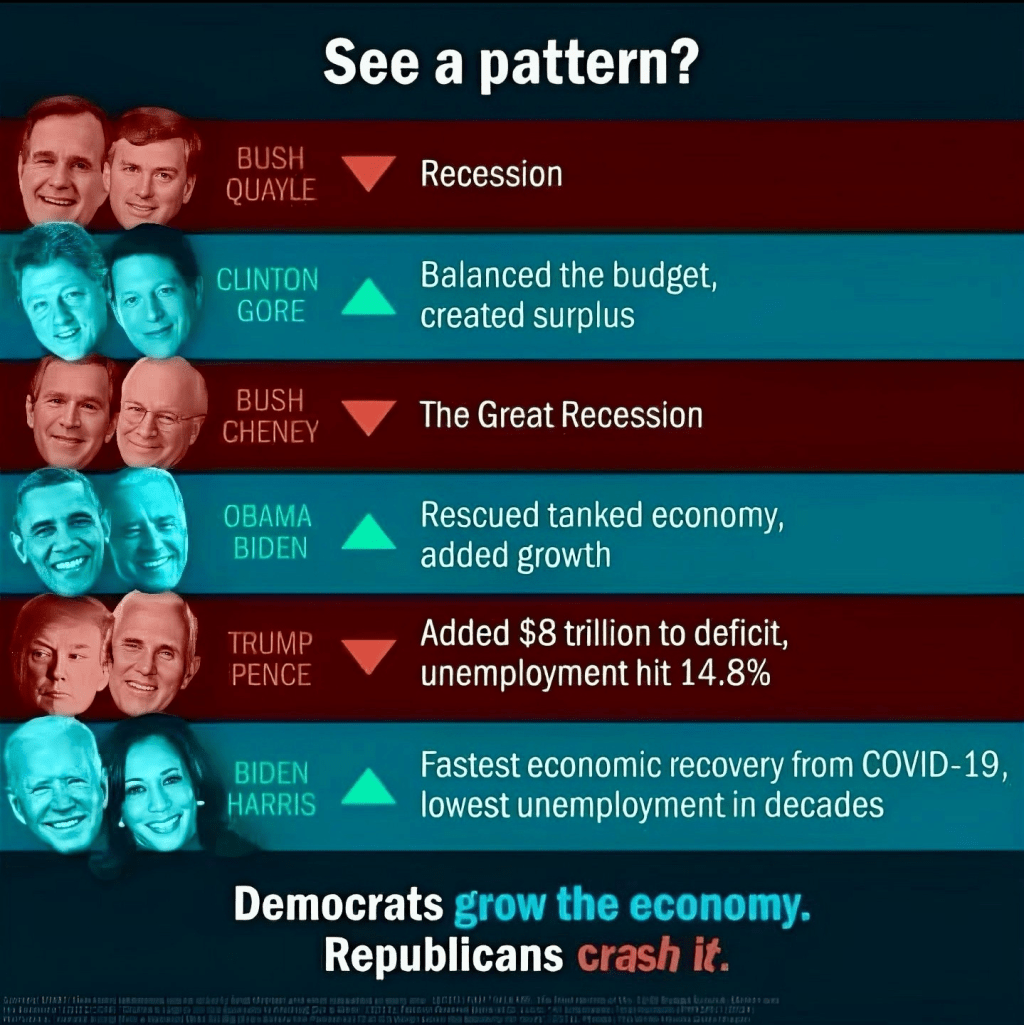
Through a variety of tactics (regressive tax changes, a restrictive safety net, attacks on labor, etc), I noted in my last post that some $50 trillion dollars has been transferred from average and struggling Americans to the uber-wealthy in recent decades. Democratic administrations attempted to reverse these trends in some marginal ways, but the default position in American politics has become a kind of Darwinian struggle where the winners are permitted to take as much as they possibly can. Despite a widespread consensus to the contrary, Democrats do a better job with the economy.
Between 1970 and 2018, the middle class saw their share of income drop from 62 percent of the total to 43 percent, a tectonic shift by historical standards. The share enjoyed by the upper crust grew from less than 30 percent to about half over the same period. Meanwhile, the CEOs of top American corporations now often command 300 times what the average worker in their firm makes. That is dramatically higher than what top managers in overseas competitive firms make (in Japan, 5 example, top managers take home perhaps 15 to 20 times what workers make).
Even more egregiously, top executives often take much of their compensation in stock shares. They then can use that equity as collateral to take personal loans. Neither the stocks (unrealized income) nor the loans (considered debt) are taxed. Since any interest payments on a loan is much lower than any tax on ordinary income, the super wealthy wind up with an income stream that largely avoids paying their share for the public good. No wonder the wealth of business icons has exploded over the past two decades. With Trump and Musk running things, the rape of the working class will explode even more in the coming years.
So, here’s the question. Why aren’t average Americans outraged. Okay, Luigi Mangione gunned down an insurance executive in New York City. By any rational standard, that executive was a serial murderer, consigning untold thousands to suffering and avoidable deaths in the name of quarterly profits. However, law enforcement went into overdrive to capture the man responsible for meting out this form of rough justice. When Mangione did his perp walk the other day, even the Mayor of New York participated (presumably as a publicity stunt). The death of one rich man of highly dubious ethics sparks national outrage. But who speaks for the untold thousands and millions enduring anxiety and suffering due to our unconscionable health care system (which bankrupts hundreds of thousands annually).

Let me return to my original conundrum. Why are Americans willing, so eager, to ignore their obvious exploitation, even lending support to those who exploit them. Is it ignorance? Is that why Trump has said he loves the ‘less educated.’ We can say one thing for sure. The origins of this puzzle go far back in our past. In our catastrophic Civil War, most of the white South fought and died to preserve a social and economic system that benefited a small elite. Only 2 percent (at most) Southerners owned enough fellow humans to benefit economically from the ‘peculiar institution’ of slavery. The majority of people in the Confederacy were economically struggling whites who were disadvantaged by the prevailing system of free labor and an autocratic approach to governance in Southern states. Yet most white males willingly suffered and died to preserve this most recent version of exploitive serfdom. How odd?
One explanation is that core societal divisions (separation by skin color, nationality, culture) are deeply embedded in our psyches. As President Johnson realized three generations ago, any feeling of superiority will drive individuals to sacrifice economic self-interest to preserve traditional racial myths relying on inherent states of natural hierarchy. Some groups, it is argued, are demonstrably inferior. The mudsill theory prevalent in the mid-19th century suggested that some were destined to lead society and others to follow obediently while laboring in hard, dirty jobs … a caste system for America. That primal instinct is dramatically increased if supported by prevailing norms embedded in institutionalized belief systems.
In much of America, many sought guidance by asking ‘what would Jesus do?’ For tens of millions, Jesus apparently would do the very opposite of our conventional understanding of Christ’s message. He would sanction the exploitation and oppression of some people by others based on assigned attributes, which the individual can not always alter and sometimes can not easily mask. This is the bedrock assumption of Christian Nationalism, a plague that has infected our country.

Let us begin by noting that our understanding of Jesus (or any similar spiritual guru) grows out of our collective projection of what we want from a god-type figure. In short, we create our gods for good or bad. Historical analyses of early Christian communities reveal that there were many, many different views of the Jesus figure in the beginning. These disparate perceptions of a great teacher (though of somewhat apochryphal authenticity) were recorded in early writings and gospels, most of which have been lost to us (or consciously ignored by religious authorities).
By the 4th century (CE), church leaders moved to create a single, coherent version of Christ and his teachings, or at least come close. Many early gospels were branded heretical, their believers being considered heretics. Many of these were persecuted, if not killed in unspeakable ways. In 382, Pope Damasus I called together the Council of Rome to select and codify an agreed upon set of writings that were agreeable to the institutional church. Up to that time, Christ was depicted in wildly different ways. In one lost gospel by Thomas, the youthful Chist was far from the saintly figure that was ultimately chosen. He struck out, even slew, those who opposed him as a young man.
Who was this Jesus that found institutional approval. Essentially, he was the version about whom I was taught in my youth. This Jesus advocated love, acceptance of all no matter their background, and urged his followers to do good works and avoid the temptations of the world. This is the Jesus that drove the money changers from the temple and asserted that it would be easier to pass a camel through the eye of a needle than for a rich man to enter Heaven. In fact, Jesus asked his original followers to practice a form of communal poverty … what amounted to a primitive form of Communism. He was the total opposite of the Jesus associated with today’s version of the Gospel of Wealth. He was a Jesus I admired greatly, even entering a Catholic seminary to (somewhat briefly) study for the Priesthood.

This compassionate image of Jesus, however, was at odds with the emegance of a robust form of capitalism in the West, especially the United States. As is done with most deities, believers projected their wishes on to what they worshipped. For example, in 1926, a man named Bruce Barton wrote what became an influential book during an era when laissez-faire business dominated economic and political thinking. Titled The Man Nobody Knows: A discovery of the real Jesus, this work repositioned the great teacher of simplicity and sacrifice as a contemporary capitalist who glorified wealth and sanctioned personal success.
A whole series of subsequent religious authorities followed (e.g. Billie Graham, Jerry Fallwell, Jimmy Swaggert). They wrote and preached in ways that would wed God (or God’s presuned son) to mammon. Watch evangelist Joel Osteen one of these days. His preaching the Gospel of Wealth enables him to enjoy huge mansions, a fleet of private jets, and a lavish lifestyle.
The evangelical church of Osteen and others has become a key arm in the ever growing threat of a plutocratic theocracy. These religious charlatans essentially use a twisted image of Christ to keep typical believers enraged at misdirected emotional targets while the economic elite continues on their rapacious ways. Believe in Jesus and get rich, or so the faithful are told. Such bastardized religious beliefs (Evangelical slight of hand) keep lower educated voters preoccupied with abortion, aliens, transgenders and the like while additional schemes are enacted that permit the elite to take ever more and more of the national treasure as well as political power.
The other critical arm in this unholy alliance are some (not all) of the economic elite. George Soros and Warren Buffet (among others) recognize what is happening and speak out against growing injustices. On the other hand, take Elon Musk for example. (Please, take him anywhere)! His most recent actions are both illiminating and disturbing. He scared Republicans into turning down the proposed debt ceiling deal (thereby ending public borrowing and thus risking a government shutdown) by threatening to finance primary challenges to resistant Congressional Republicans when they ran again for office.
Did Elon want to shut the government down on principle? I doubt that. The more convincing argument is that he wanted to renegotiate the deal to eliminate certain provisions he didn’t like. Namely, there were restrictions on American investments in China that would hurt his economic position. Elon has companies frantically investing and building on cutting- edge Chinese technologies. His China interests (and wealth) were more important than America’s interest. So much for Making America Great Again.
Once again, my simple point has led to diarrhea of the brain. My apology. The original point, and my fundamental fear, is that an alliance between extreme wealth and evangelical manipulation make needed political and economic reforms nearly impossible. In the past, we had periods of self correction … the progressive era at the start of the 20th century, the New Deal after the Great Depression, and the Great Society in the 1960s. It is more difficult to see how we can reverse today’s trends. America is flirting with authoritarian rule under the guise of creating a theocratic plutocracy. The American experiment in participatory democracy is on shaky grounds, extremely shaky grounds.

While I remain cynical and pessimistic, perhaps two rays of hope exist. Religiosity is in decline in the U.S. In a recent pole, the majority of respondents told interviewers that they did not belong to a formal church, a first since such polling began. Does this foreshadow a decline in morality. Not in the least. It is most ironic that the message of Jesus is more prevalent in ordinary lives among those nations where formal religiosity has already declined the most. (Also, a host of metrics tapping social dysfunction are highest in the Bible Belt). What may disappear is the institutional bigotry embedded in too many rigid, authoritarian religions.
Second, we could see a major economic recession. The Biden economy has spurred a long period of growth. The claim that America is driving the global economy is not without merit. However, a positive future depends upon a mature handling of a complex economic system. Trump and his sycophants could easily wreck everything. Savaging public programs, initiating additional tax cuts skewed to the wealthy, imposing tarrifs on imported goods, and seeking enormous private gains through their public offices could quickly unravel our strong recovery from both the Bush housing collapse and Trump’s mismanagement of Covid. As in the 1930s, out of chaos and fear might come a realization that change is necessary.
But I have no crystal ball. Time to buckle up and wait. Just so glad I’m old.
I once again failed in one matter, though. I have been afflicted by yet another serious case of diarrhea of the brain and mouth (or the written word at least). Please forgive me.
 Tom's Musings