I can yet recall the political wars of my youth. They could be virulent and hard fought, but they seemed genteel in the light of today’s almost apocalyptic contests. Today, our politics seem more like the end days battles between good and evil, darkness and the light. We are not talking about minor disputes over the appropriate levels of taxation or seeking the correct balance between investments in private versus public goods. Those were the reasonable debates among principled combatants in the old days. No, today we struggle for the continued existence of a democratic Republic and the sustaining of our national unity while the world looks on in growing horror.
We’ve always had venomous anger in our politics. The sectional rage to preserve racial hegemony and apartheid, the rights movements of the 1960s (including deep frustrations and communal outbursts), and the anger vented by the young toward state-sponsored institutional violence in Southeast Asia and elsewhere as indigenous peoples sought their own forms of sovereignty are examples. At the core of governance, however, a certain set of common understandings prevailed. Enough decent people in government debated details within accepted frameworks of negotiation and compromise. We all accepted a Keynsian framework within which government would steer the ship of state. Extremes were avoided.
In many respects, politics today are different … visceral and raw. Disputes are based on emotion and premised on radically different views of reality. Even as late as the early 1990s, I can remember working with those of a Republican persuasion to work out compromises on welfare and human services issues. Sure, normative differences existed. But the dialogue was, for the most part, between sensible adults who referenced logic and evidence to advance differing opinions and perspectives. The Gingrich revolution of 1994 was a shot across the bow against that sensible world. For Newt, any compromise with the other side was treason. The reasonable Republicans from those days now just shake their heads in dismay … wondering what happened to their party.
The hyper-partisanship and polarization of today has many roots. The political realignment in the post Brown vs. The Board of Education world divided the political world into more homogeneous political entities. The Democratic Party drifted to the left and the Republican Party to the right (and then to the Hard Right). The GOP eventually purged almost all moderates from their ranks, though it took some time to achieve that goal. The political and normative divide gradually took on a geographic or spatial character. Conservatives reigned in southern states and the more rural states in the Western part of the country. The so-called progressives tended to be in highly populated, coastal areas. The areas of contention were reduced to several so-called swing states. Our antiquated electoral college (a residue of the Founding Fathers distrust of an untried concept of democracy and persistent fear of mob rule) shifted political battles away from a pure majority rule for deciding national elections. For over three decades, the Republican Party has garnered a national majority vote only in 2004.
I live in one of those swing states … Wisconsin. The spatial and cultural character of the political divide plays out here in a very clear way. The progressive vote is found in the more densely populated areas, while the MAGA vote is concentrated in the more rural and sparsely populated areas.
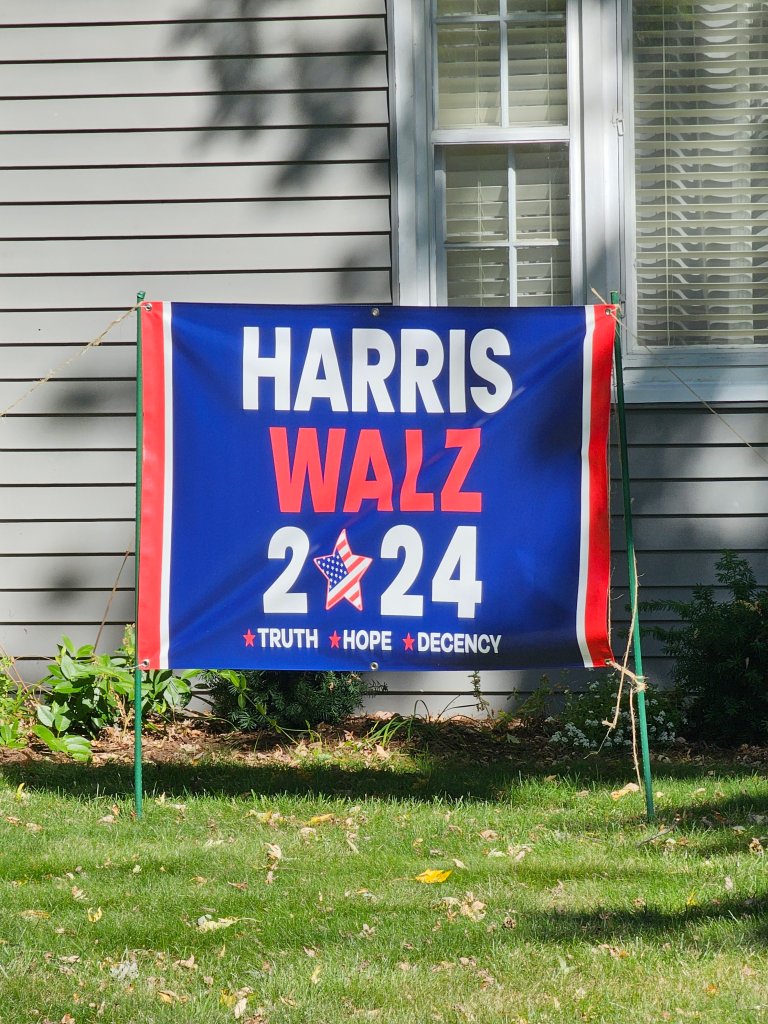
For example, if I were to drive around the State Capital, Madison, I would see a sea of signs like the one above. On the west side of the city, where I reside, nary a single Trump sign is found. Who lives in Madison? Well, it is a rapidly growing metropolis (about 300,000 in the city and 600,000 in the county) comprised of highly educated, professional types. The economic growth has been fueled by the prestigious University of Wisconsin and the spin-offs from the intellectual ferment of this bastion of research. Growing companies include such examples as Epic Systems (which controls the majority of medical data systems nationally and even abroad) and Exact Sciences and many other like hi-tech firms. They employ technically sophisticated people who think logically and function based on data and empirical research.
When you get out to the countryside, you see signs like the one below. Recently, my female friend and I drove up to her retreat on Green Lake about 75 miles northeast of Madison. As we drove though the bucolic countryside replete with dairy farms and corn crops, the dominant political preference was undeniable. All one could see were Trump signs, often large in size and brassy in their message.

Only when we drove through the smaller towns did we see sights like the one below … supporters of Harris. This was in Ripon Wisconsin, a town of less than 8,000 souls. Ripon happens to be the birthplace of the Republican Party (in 1854) when it was the upstart liberal entity replacing a dying Whig party. The new Republicans were the liberals … opposed to slavery and supportive of a stronger central government and more public investments in the common good.
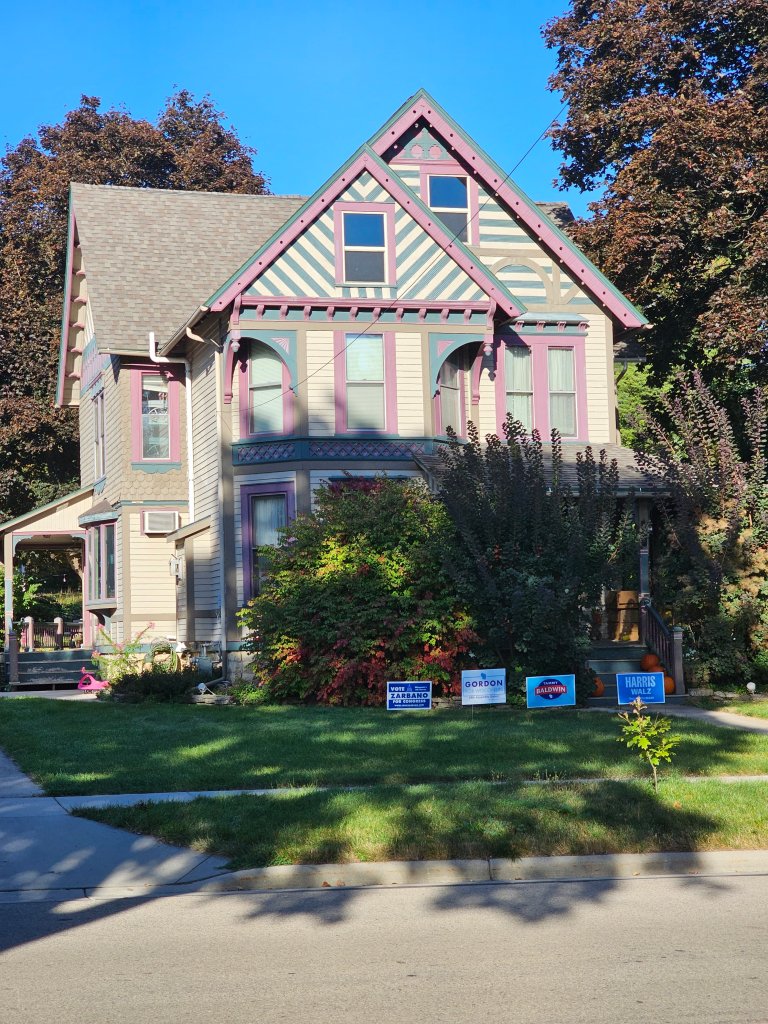
The spatial dimension of our current political and cultural divide could not be clearer. The Dems really dominate in those areas where the population is educated and more sophisticated. My neighbors in west Madison are, almost universally, professionals with advanced degrees from the best universities. They had professional careers as doctors, engineers, lawyers, and academics. They lived in worlds defined by numbers and clear thinking. It is not surprising that the last Republican Governor (Scott Walker) went after the University of Wisconsin. He reduced state support, attacked University governance, and even tried to eliminate the iconic Wisconsin Idea where the University would work to solve social issues. Now, Wisconsin ranks 43rd among all states in their financial support of higher education. Only aggressive solicitation of other sources af extramural resources (something I did when there) has sustained the University as a first-class R-1 research university on the global stage.
The Republicans really dominate in rural communities. These are almost universally white and culturally homogeneous worlds. Anything or anyone that is different is viewed with suspicion. One of my favorite stories involves my late wife. Many decades ago (the 1970s), she was in charge of a study of the role of women in state service. While doing interviews of public officials throughout the state, she was driving toward the courthouse in a somewhat rural county. She was pulled over by the police. The officer started interrogating her. Exasperated, she asked what she had done wrong. Nothing, the officer replied. But I saw your ‘support the equal rights amendment (for women)’ sticker on your bumper and knew you were not from around here. In these areas, threat and danger are found everywhere.
These two worlds (urban and rural) operate within very different universes. Frankly, I cannot even fathom how those out in our lovely Wisconsin countryside see the world. Theorists posit that these folks are driven by rural, white rage or perhaps it is a sense of lost cultural identity and a sense of diminished societal hegemony. A fear and resentment seems to stalk the countryside but, frankly, I know too little about that world to make sense of it. Apparently, they want a strongman to come along and make things right again which, I fear, means doing something vengeful to folk like me (though I’m too old to care). I fear that a similar set of resentments led the Germans to accept Hitler in the early 1930s.
When we were up at my female friends retreat on the lake, she had to stop by the business of the mechanic who winterized one of her boats. Knowing that I had a Harris-Walz sticker on my car, she suggested I park a distance away where he would not see it. While a good mechanic, his understanding of the broader world hardly exceeds that of a child. According to her, he really believes that a Communist government would be instituted if the Dems prevail in the upcoming election. No amount of reasoning with him is possible, she informed me. Unfortunately, he is not alone in his paranoid views..
I fear that our tribal bubbles are congealing, the surfaces that separate us are becoming less permeable. After all, we have our own individual sources of information and input. There no longer is a Walter Cronkite to bring us common news. We mostly talk to people who agree with our views. And our instantaneous access to the world’s information enables us to cherry pick that which reflects and supports our priors. We are, in short, retreating into our own insular tribes. I fear this is a very bad thing. The consequences of this degree of separation can hardly be imagined, but it will not be positive by any means.
 Tom's Musings