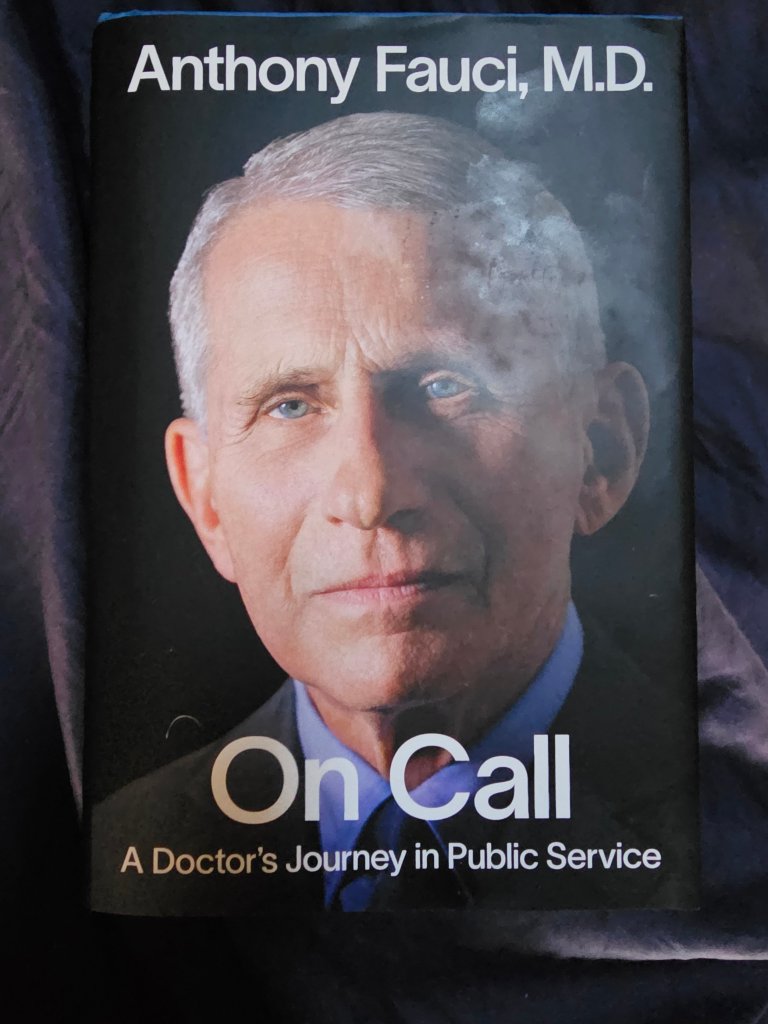
I just finished the excellent memoir by Dr. Anthony Fauci. Most will know whom I’m talking about, but not all. Tony, as his friends call him, was a top doc in charge of a key federal agency responsible for keeping us safe from viral and other biological threats. Though he achieved a certain amount of notoriety himself (especially during the Covid crisis), he is one of the (normally) unsung heroes who usually labor in obscurity to ensure our safety during uncertain times. Because of unique circumstances, though, he did become a celebrity.
Tony grew up in New York in an immigrant Italian family of very modest means but with strong values. As a kid, he loved both basketball and his studies with equal passion. He was intellectually prepared by the Jesuits in high school before leaving for the Jesuit run College of the Holy Cross in Worcester Mass since, according to him, it had a great pre-med curriculum and gave him an enticing scholarship. As an aside, I personally could see Holy Cross from my back porch as a youth, and would have gone their myself were it not for a detour into the Catholic Seminary after high school.
From there, Tony matriculated at the Cornell Medical School from which he graduated 1st in his class. My eye doc, who was on the University of Wisconsin medical school faculty, once told me that medical students were generally organized into thirds. The top third often went into research and teaching (combined with clinical practice). The middle third made the best clinicians (you want them as your own doc). The bottom third made the most money since that is what drew them into the field initially but whose skills and motives might be questioned.
Tony was the top of the top. Back then, most medical school graduates owed Uncle Sam some time (like patching up bodies in Vietnam). The brightest often were assigned to the Center for Disease Control (CDC) or the National Institutes for Health (NIH). My good neighbor (Dennis), like Tony, was at the top of his medical school class back in the 60s. He thought he might go onto surgery but was assigned to the CDC and that experience led him to become a top infectious disease doc. Dennis is still working long hours well into his 80s. He is utterly devoted to his craft.
Over some five decades, Tony remained on the front lines of the nation’s ongoing fight against various insidious medical threats. He was there when the AIDS epidemic burst on the scene in 1981 and still at his post four decades later when the Covid pandemic encircled the globe. In between, there were a series of real threats including SARS, ebola, anthrax, smallpox, and biological terrorism after 9-11 (among numerous other threats). The ongoing battle against a largely unseen and constantly mutating enemy composed of viral and bacterial foes never ends.
Tony, it must be said, was the kind of person whom I admired and who populated government back in the days when I first entered government service and later academia. They were people motivated, not by money, but rather by the ideal of service to others and to the public good. His talents were remarkable, and he rose quickly in the public service hierarchy. One day, President George Bush (the dad) called him into the White House to offer him the position of head of the National Institutes of Health (NIH). This is a pinnacle position for a scientist, one that most would give their right arm to get. Tony turned him down. Power and money held little charm for him. He wanted to stay involved with both the hands-on research and clinical experiences that he felt saved lives.
On exiting the Oval Office, Bush’s chief of staff muttered to Tony, ‘Why you son-of-a-bitch, no one says no to the President.’ But Tony did. Apparently, President Bush didn’t mind. Once, before a national audience, the President was asked whom he admired, who his role models were. After a couple of familiar names, he prefaced his next offering by noting that few would recognize the name of his next idol. Then he mentioned Dr. Anthony Fauci, who epitomized the ideals of public service for the President.
In his memoir, Tony spoke kindly of virtually all the Presidents under whom he served perhaps with the exception of Reagan (largely by ommission) and (of course) Trump, whom he called a complicated man to say the least. Tony tried to stay above partisan politics and always looked to the vital tasks before him. But things were going askew around him late in his career. He relates that Republicans began rejecting essential public health resources merely because the other side (Obama) asked for them, something that seldom happened in the past (though requests were sometimes revised downward for substantive reasons).
During the Trump years, government functions virtually ceased to exist despite the most glaring public health disaster since the 1918 Spanish Flu, a long-ago pandemic that killed more than died on the WWI battlefields. Science, however, came to the rescue since quality people like Tony remained at their posts. But they spent too much time fighting the worst possible politics where disinformation and outright dangerous actions took place for the most transactional partisan advantages. It was a nightmare for any principalled man. So many amenable deaths occurred due to political meddling and pure spite, an unacceptable outcome to public servants motivated by high ideals.
The cost to Tony and his family were enormous. Trump’s acolytes continously vilified and threatened him personally, his wife, and his offspring without mercy. They were subject to the most vicious attacks imaginable, including sexual threats to his spouse and daughters. He, himself, was called a ‘mass murderer’ and is still threatened with jail for specious allegations by Republican members of Congress. Their hate knows no bounds.
This raises a serious question. Why would anyone enter public service these days? Surely, Tony could have made loads of money being a top doc. He could have enjoyed a comfortable personal life. As an aside, I recall Joseph Califano saying the following after accepting the position of Secretary of the (then) U. S. Department of Health, Education, and Welfare back in the late 1970s … “I’ve taken a position that pays me a fraction of what I make as a private attorney and which leaves me no time for my family.” Like Califano, Tony devoted his life to doing what he thought was the right thing. His career was totally consuming, leaving no time for the pleasures typically associated with success. He was always working 14 to 16 hour days (or more) as he confronted one health emergency after another. He made such sacrifices for his love of healing and from a sense of duty … not for power or gold.
I can remember when the best and brightest went into public service as a matter of pride and patriotism. They wanted to make a difference. In my arena, social policy, the office of the Assistant Secretary for Planning and Evaluation (ASPE) in HHS once attracted top Ph.Ds in economics and related disciplines. The staff in the 1970s could compete with the intellectual firepower of a top research university, though they had other alternative career paths. When I spent a year at ASPE during the start of the Clinton administration (on leave from UW), they had some very smart people on staff but no longer could attract intellectual luminaries.
What happened? Conservatives had spent years denigrating civil servants with withering attacks. As partisanship and polarization increased, it became increasingly difficult to attract top talent. That became especially true when available alternatives paid a lot more money and offered less hassle. Why put up with the grief for so little reward?
Who wants to work around the clock for less money and be accused of atrocious crimes for their efforts. No one can make a firm estimate, but several Presidents (from both parties) have intimated that Tony’s professional work may well have saved millions of lives, not just with the big crises like global AIDS and Covid but by responding quickly to other emerging threats before they got out of control. His thanks at the end was a mix of much praise and honors along with the grossest villification imaginable, including threats to himself and his family.
We need people like Tony in government as we look to the future. We need smart young people to enter public service based on a desire to serve the common good as opposed to seeking private gain. If we attack such people, and demean their professional choices, where in God’s name will we find them? Who will step up to save us?
 Tom's Musings
2 responses to “Public Service … a declining ideal.”
Your usual sparkling, informative read, sir. Thank you.
LikeLiked by 1 person
And thank you, sir.
LikeLiked by 1 person