I’ve been focusing on political topics of late. Perhaps it is time to drift back to more personal musings. And no, I have not overlooked the exciting news in the Presidential race. I’ll just let that percolate for a few more days.
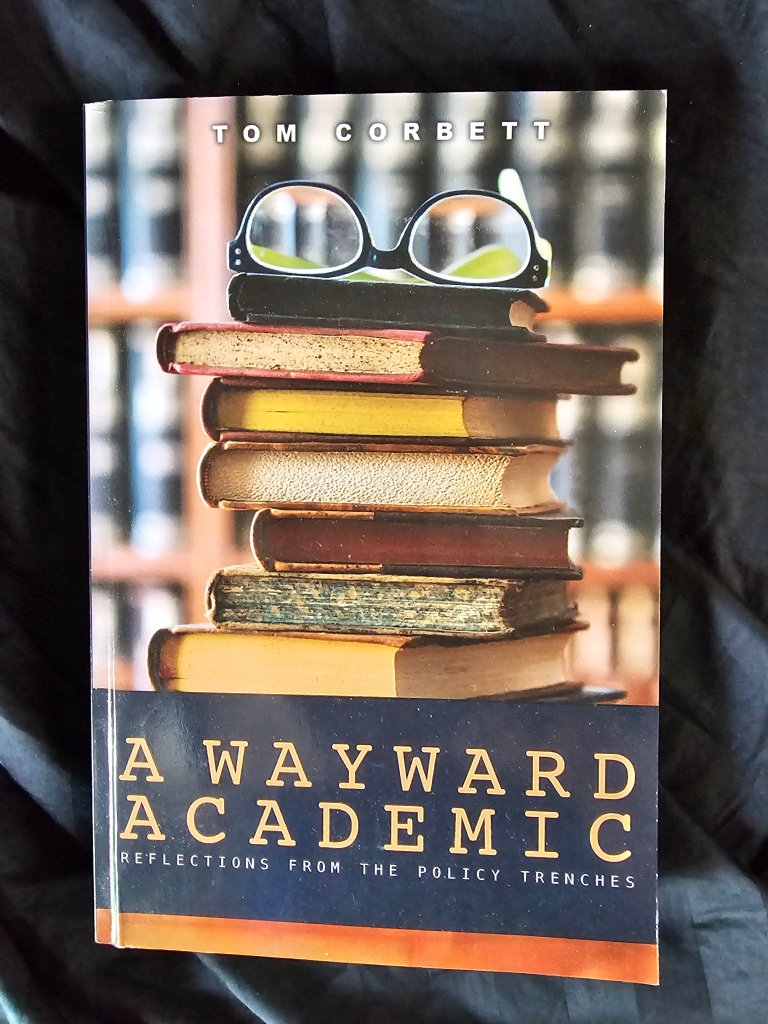
I noticed the book I wrote a number of years ago titled A Wayward Academic: Reflections from the policy trenches. It is a memoir about my professional career, mostly as a policy wonk and fake academic. When I noticed this page-turner lying on a coffee table strewn among a pile of my other great works, it got me musing about my past. To be totally honest, it doesn’t take much to activate a dialogue in my head, this hyper-active place where the discussions are so bright and stimulating … at least to me. Self-delusion is one of my enduring strengths.
In this instance, I was struck by a rather odd aspect of my life. I was, by conventional measures, a spectacular professional failure, at least according to the ordinary rules by which academics are evaluated. On the other hand, I believe I was a remarkable success by my own rather idiosyncratic standards as well as by the feedback from peers and colleagues in the social sciences. In some ways, I lived in a professional no-mans land by functioning as a policy wonk while remaining in a scholarly institutional setting even though most peers (especially the economists) really seemed to respect what I did in my job.
While never being naturally disposed to a scholarly life, I loved being in the academy. It gave me several inestimable gifts: the freedom to pursue what caught my interest, a ready made patina of respect and ersatz authority, an environment populated by super-bright people from across the country, an institutional framework devoid of ordinary hierarchy, ready access to experts and authorities in related institutions, and an opportunity to share my thoughts with the next generation of students as well as with the audience of greatest interests to me … the policy world. I often pinched myself at my good fortune.
Still, being in the academic world (but not of the academic world) took some finesse to negotiate and did incur some personal costs. It wasn’t always easy. This bifurcated sense of failure and success perhaps can be traced to a disconnect embedded within my internal wiring. I was a person who ostensibly played by the rules while stubbornly rejecting conventional norms.
As a young Catholic, working class kid, I both embraced my religion seriously (studying to be a priest for a while) while arguing internally against so much of the dogma which that religious institution fed to me. Later, I would be a college student who appeared buttoned down and conventional while organizing the left-wing organization on campus and (for a while) joining the more radical Students for a Democratic Society (SDS). Finally, as an adult, I functioned within the higher reaches of the academy (even managing a nationally renowned research entity at the respected University of Wisconsin) while never becoming a formal academic. At each stage, I appeared to conform while quietly rebelling, even doing things my way.
Irving Piliavin was a UW professor who recruited me from a state service job (my first professional position as a social services research analyst for the State of Wisconsin). He lured me to the University of Wisconsin’s Institute for Research on Poverty, the nationally recognized think tank on social policy questions created as part of President Johnsin’s War On Poverty. (He needed my knowledge of how government worked for his research.)
He liked me personally, but I know that I frustrated him terribly. He could never understand why I didn’t want to be a scholar like him. He would suggest topical areas in which I might become a recognized intellectual authority within the academy. Pick one substantive area? That very notion appalled me as stultifying. At one point, he told me that I had trouble with authority, with convention, and with the accepted rules. Perhaps, but my read was that I simply had to do things my own way.
I never started out to be so rebellious. I mostly thought of myself as someone who just wanted to get along and be liked. But there is this old saying … you can’t take out what God put in. Some elemental dispositions, I suspect, are wired into your DNA. I could never stop questioning the tenets of my culture and religion. I kept embracing thoughts (e.g., for racial justice and for a global government) at a time when NO ONE around me had such convictions. As a student, I was always asking questions and pushing my professors, a trait I finally realized could be irritating when, years later, I was in front of university classes over which I was in charge and exercised authority. When I entered the work world, I seldom just did my job but kept pushing the envelope. I was never satisfied with the concept that we’ve always done it this way.

Most of these early experiences are included in the memoir of my earlier years, titled A Clueless Rebel. Between this work and A Wayward Academic, all my skeletons are laid out in detail, and with considerable humor. If you can’t laugh at yourself (and the world about you), what is the point of living.
At the end of the day, my direction in life was driven by some rather simple ends, nothing really out of the ordinary. First, I wanted to make a contribution to the world about me. The same impulse that pushed me initially toward being a Catholic Priest remained with me after I left the Seminary. It always struck me that a person’s life cannot be worth much if he or she doesn’t at least try to leave the world a bit better in some way.
Second, I craved novelty. It turns out that I had the attention span of a gnat. I was always looking for a new issue or problem to attack. And over my career, I touched on just about every major social policy issue feasible. As I said in my professional memoir, my career was like playing in a policy candy store. I always wondered what delights were in the next aisle. Success in an academic culture, on the other hand, normally demands drilling deep into a given topical area. That would be intellectual death to me.
Third, I craved challenge. I responded to those issues that were inherently difficult. Not surprisingly, I became heavily involved in welfare reform and related social questions at a time when they were front page news and political hot buttons. I was always being called by the press and often in hot water with politicians. Great fun, but not for the weak of heart. It was oft said (back in my day) that welfare reform was the mideast of domestic policies, meaning that like mideastern foreign policy questions there were no easy answers. While many academic foci are technically difficult, the policy issues I engaged involved normative conflicts which rendered them especially problematic.
I was attracted to questions that were difficult partly because of my innate curiosity about how society worked. Another way of thinking about this is that I wanted to attack questions in ways that would lead to a deeper understanding of the world about me. This intellectual curiosity drove me through life. I felt blessed to be able to, as I oft said, fly about the country to work with the best and brightest on problems that appeared unsolvable. And better yet, I was paid to do this. Not much, to be sure, but enough to be comfortable. Besides, money never really mattered to me.
Finally, I hoped to do no harm. This was my greatest worry that, in trying to make things better, I would make them worse. I had few illusions that I would solve the bigger social issues of my day. But at least I might contribute something without imposing some net harm on society. That would be good enough.
What I discovered is that I could best balance these diverse goals by finding my own niche as a professional. I simply needed to find a way to remain within the academic world while not being trapped by the scholarly culture which was a bit mind-numbing to my tastes. Now, that is a tightrope that is difficult to traverse.
It turned out that I could do most of the expected academic tasks with relative ease. I was an excellent and popular teacher. I was good at raising research money (I was mostly self-supporting throughout my career). I was in demand as a consultant throughout the U.S. and in D.C. I was popular as a giver of talks and in serving on panels and at conferences. I was respected in the collateral worlds of my content area … with think tanks, the philanthropic institutions, with evaluation firms. And I was a damn good administrator who helped keep IRP alive during some dark days.
What I didn’t like doing was the very thing that academics were supposed to dedicate their lives toward…publishing peer reviewed research articles. Sure, I get the value of that process, the rigorous and anonymous reviews of research methods and content. Those protocols are invaluable to science. For me, though, they meant a kind of intellectual death. The process of focusing on peer reviewed publications, in my estimation, led one in the direction of narrow and provincial topics that were approached via overly quantitative methods (in a display of technical virtuosity) and written up in ritualistic and formulaic ways. Moreover, they were directed at an audience of lesser interest to me … other academics. That feature of the academic culture (impressing this narrow audience of peers) struck me as overly incestuous. I wanted to reach a broader audience.
Of course, I did publish in peer reviewed journals but almost always in co-authored works. I typically did so to help out a colleague. At the same time, I know I influenced thinking in my profession and in the policy world, which was always my primary audience. I did that through policy oriented outlets and through my many public talks. That gave me great satisfaction. What I wrote and talked about impacted not only my fellow colleagues but also the legions trying to solve our social problems. The cost of my professional choices … I never was fully admitted to the academic club.
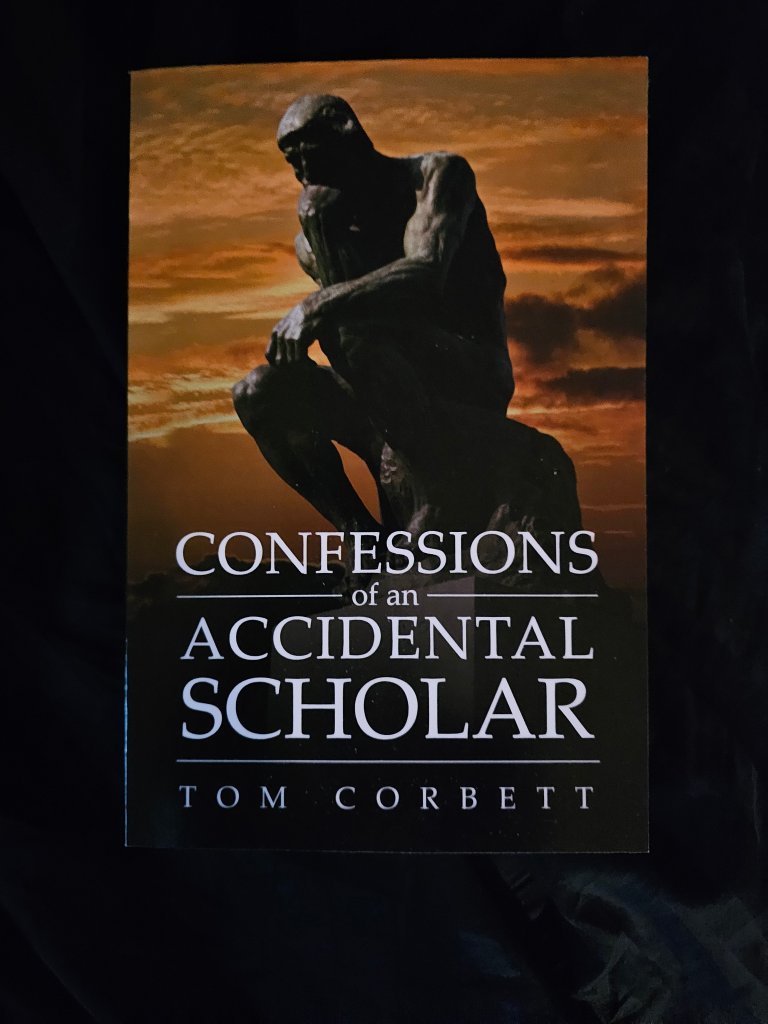
If you are interested, I did collect some of my thinking in one final collective work titled Confessions of an Accidental Scholar. Through my teaching, my consulting, writings for broader audiences, and my many talks, I left a small legacy. Better yet, I did little harm while having a great time. It is not really a job if you would do it for free.
 Tom's Musings