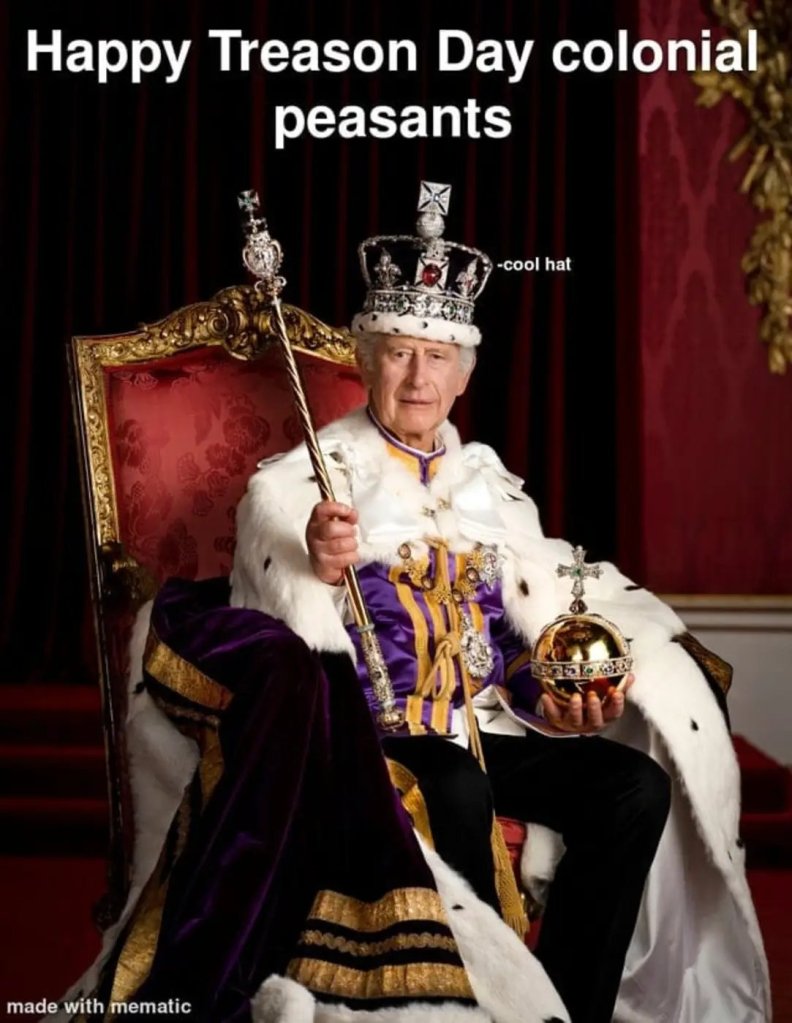
Roughly a week ago, we celebrated our independence from Britain. Of course, we screwed up the significance of that holiday … something we do with surprising regularity. At the time, John Adams predicted that future generations would celebrate our independence on July 2nd. It was on that day in 1776 that the colonial representatives gathered in Philadelphia voted to break with the mother country. That was considered the major event in the moment. The 4th was a relatively minor afterthought when the formality of affixing their signatures to the final version of the declaration of independence took place. But the vote two days earlier was the critical moment.
The motivations behind this revolution are murky and not always uplifting. We all have heard the ‘taxation without representation’ rationale. While there is some merit to this argument, the case is not compelling. After all, the Crown had emptied its treasury during the 7 Years War (aka The French and Indian War) to defend these (as it turned out) ungrateful colonists. This conflict preserved the colonists’ sovereignty over the Eastern seabord from incursions by the French and by Native Americans who now realized the enormity of the mistake they made by not pushing the first Europeans back into the sea. In effect, the Crown had made it possible for the early settlers to solidify their hold on the land and to develop lucrative trade and commerce relations.
The Native American story in New England was particularly sad. The first Europeans touched on these shores before 1620 but were easily run off by the indigenous tribes who had superior numbers. Still, physical contact had been made, a disastrous interaction for the original inhabitants of this land. Diseases for which they had no immunity spread quickly, reducing the coastal population in an extreme manner. Future probes along the New England shores by various explorers found largely depopulated villages along the coast with local tribes who could no longer effectively defend their lands.
Fast forward a century and a half, let us consider the situation in the 1760s from the British perspective. They thought, not without reason, that the British subjects living in North America ought to share in the costs of protecting the still vulnerable colonies from future external threats. But Parliaments efforts to impose even modest taxes were met with fierce opposition. This was to remain an American trait that still dominates our national character … we want public services but despise paying for them. We want a free ride.
This is a form of extreme selfishness, though it yet remains problematic to separate principles from profits. The Boston Tea Party has been sold as a noble measure of civil disobedience. At the same time, all this British tea waiting to flood the market would have depressed prices and cut into the profits enjoyed by rich merchants like John Hancock. Perhaps principle and profit are two sides of the same coin.
Still, the bravery of the early revolutionaries cannot be questioned. When the British marched out of Boston in April, 1775, they were looking for stored arms in Lexington and for several revolutionary agitators who might well have been hung as traitors. During the 8 year struggle, it was (until the defeat of Cornwallis in 1781) a close run thing. The top revolutionaries clearly had committed treason against the Crown. The first few battles (after Bunker Hill and the British evacuation of Boston) showed the colonists to be no match against the most powerful military in the world at that time.
America’s forces were first cornered in Brooklyn. Only a miraculous turn of weather enabled Washington to escape the vice like trap laid by the Brits. Brisk winds kept the fleet from sailing up the East River to close the ring around the beleaguered patriots. Then, a fog rolled in to enable Washington to escape to Manhatten during the night and eventually to get out of town. He was fleeing with the Brits close on his heels.
That reprieve was short-lived. By the end of that first year, the Continental Army had dwindled to a skeleton force with many enlistments ending on December 31st. It was then that our the so-called Father of our country pulled a rabbit out of the hat. His forces crossed the Delaware River at three points on the night of December 24 to attack the Hessians based at Trenton. The logistics were a nightmare, and many of his troops never got across. Moreover, it took longer than anticipated. Worse still, a Tory spy saw what was happening and raced to Trenton to tell the Hessian commander about what was unfolding. If the element of surprise was eliminated, Washington’s last gamble would have been doomed. They could not have defeated a prepared, professional Hessian force.
A note from the spy was delivered to the Hessian commander. Unfortunately, he was busy drinking and gambling in celebration of Christmas that night. He wasn’t concerned. After all, this ragtag American army was all but defeated. He put the warning in his pocket without looking at it, an act that would cost him his life a few hours later. Thus, it turned out to be a totally surprise attack and an astounding success. But it so easily could have turned out so different.
I have always thought that the most relevant example in my lifetime where a similar underdog came out on top was the Vietnamese nationalists. They fought longer than the Colonists, well over four decades, and suffered way more than did our ancestors. But one thing is the same, they took on some of the greatest military machines of their era against all odds. And they won! These nationalists, in turn, took on the Japanese, then the French, and then the Americans. Their odds of prevailing probably seemed about the same as the Colonists back in the early days of our revolution.
In similar fashion, the Colonists were sharply divided much like the Vietnamese were. Some estimates put the proportion seeking independence at no more than a third of the population, with another third remaining loyal to the Crown and the remainder indifferent. Benjamin Franklin’s own son remained a loyal Tory and British official, thus ending any positive relationship with his dad. My late wife’s ancestors (on her dad’s side) can trace their lineage to pre-revolutionary times in Massachusetts. However, they left the Boston area around that time. My guess? They had remained loyal to the Crown and were forced to move west. In about three generations, they settled for good in the Twin Cities
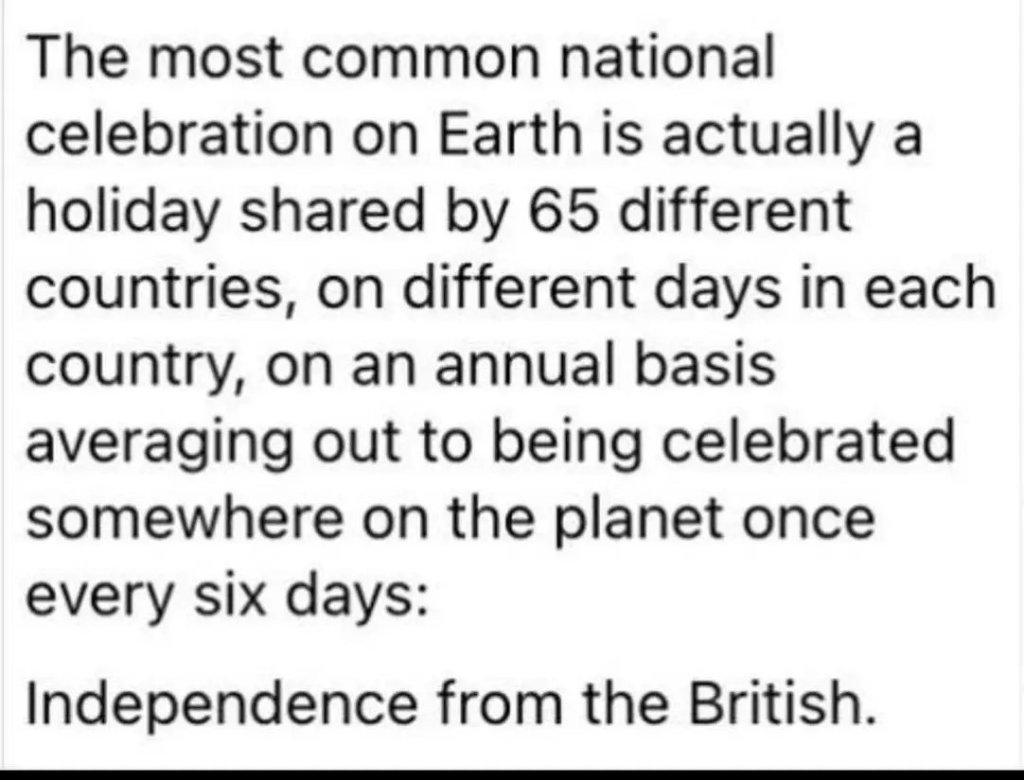
As we can see from the above insert, independence would have come in due course. Britain, at one time, exerted direct or indirect control over a quarter of the globe’s population. Truly, the sun never set on their empire by the latter part of Queen Victoria’s reign. Yet, slowly, it all fell away. The business model of extracting resources and rents from others through force proved unworkable (and too costly) in the end. America was the first to break away, but eventually, all the others followed.
Before ending these musings, let us revisit whether some uplifting principle might be found in America’s revolution. While mercenary motives cannot be discounted, I do find at least one uplifting purpose. It is the rejection of authoritarian rule. Enlightened thought was circulating among the intellectuals of Europe. Those ideas would seep into the thinking of the American founding fathers. These notions would, in turn, soon rebound back across the Atlantic to invigorate the French Revolution.
Ironically, that 1789 seismic rupture in the old world was a direct result of the American revolution. In 1777, after the Battle of Saratoga, France finally succumbed to the entreaties of Franklin and Adams to support the uprising of the colonies. This cost the French monarchy much treasure, eventually leading the king to call Parliament (the Estates Generale) into session in order to raise additional revenue. That proved to be an unwise move in the short rum. His reign and his life soon were forfeit.
These two intertwined revolutions, the one in America and the one in France, initiated the slow and uncertain evolution toward democracy and governing principles that embraced citizen participation and involvement in public decisions. Progress, however, was slow. It took America some 170 years to achieve more or less universal suffrage. France bounced back and forth between Republics and authoritarian rulers for many decades before a more Republican approach stuck.

Now, in 2024, where are we? France just underwent a troubling election where the hard right seemed on the verge of taking control. That had not happened since World War II when the Nazis installed a Vichy puppet government. And in America, most now believe that the electorate will hand over the reigns of power this November to a pathological narcissist and degenerate sociopath who vows to reinstate an authoritarian regime. There is no crisis demanding such a bold and dangerous action. It would appear that there are a sufficient number of Americsns fully prepared to cede control of government to a maniac who will dismantle the rule of law and our constitutional protections. Wow! Their cognitive processes defy logic.
I’ve noted this before. Some acute observers assert that the American experiment did not start with the Declaration of Independence (1776) nor the Treaty of Paris (1783) nor the ratification of the U.S. Constitution (1788). No, the real American revolution occurred in 1801. It happened when John Adams looked at the electoral results and realized that he had lost his bid for reelection against his bitter political rival (Thomas Jefferson). He did not call out the troops. He did not claim foul and refuse to leave the White House. When the time came, he merely got in his carriage and started the long ride back to Boston. His actions were light years away from Trump’s utterly narcissistic actions on January 6, 2021.
Is the experiment in American democracy over? Has all this been in vain? Time will tell, but I am not optimistic.
 Tom's Musings
2 responses to “Belated Independence Day musings.”
Charles I’s sneer in his portrait is remarkably like the resting bi**h face of the candidate who is not the incumbent this election.
LikeLike
Oh, you noticed :-). The real Vharles looked nothing like this.
LikeLike