What does it all mean?
There is one significant difference between faith-asserted beliefs AND hypotheses based on rational inquiry using the scientific method. The former typically are offered as invariant, even eternal, truths. The later are couched in modest, more humble, language. Knowledge and truth are merely what we know today. All is subject to additional examination and reformulation. Today’s consensus may be tomorrow’s discarded theory.
Of course, some physical laws appear certain. If they were not, we could never have explored space nor created many of the technical wonders that amaze us. The bigger and more meaningful the question, however, the more uncertain we are about the current state of our understandings. I recently talked about Dark Matter as a fundamental, though still mysterious, aspect of the universe, perhaps even being responsible for our universe accelerating toward an ultimate entropy state of cold emptiness.
But here’s the thing. We don’t know if dark matter is real. We cannot measure it directly, only through mysterious gravitational impacts seeking some kind of explanation. Some argue that, in the end, Dark Matter will be little more than an intriguing possibility that turns out to be false.
Science is not the final explanation. Rather, it is an approach toward making progress. One way of looking at God is that it (he or she) is truth being revealed … though slowly and with considerable pain. The fun of science is in the journey, though the potential destinations admittedly are alluring, if not enticing.
A second benefit of science, or technology, is that it permits us to perceive great wonders. With our naked eye, we see so little. With our newest technologies, a magnificent canvas embracing wonderous creations opens up to us. Rembrandt, Carravagio, Botticelli, and Reubens have nothing on the forces that created the art out there. Starting with the Hubble spacecraft and advanced telescopes, we have an inkling of just how poetic and beautiful is our universe.
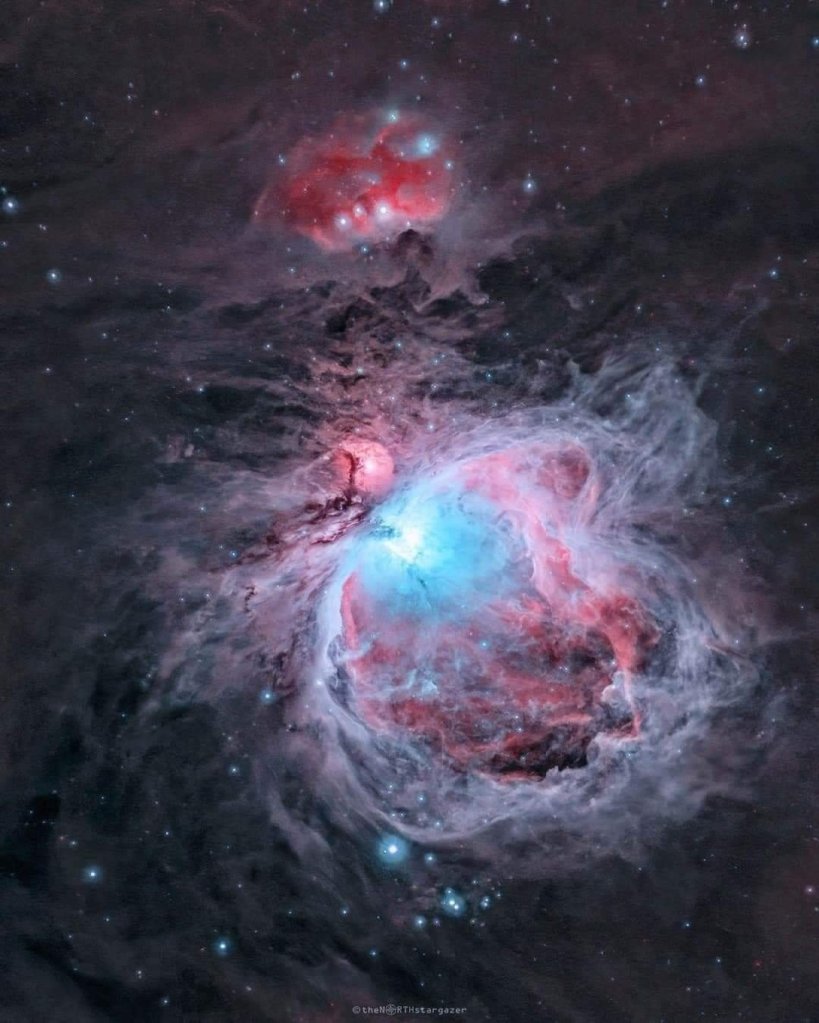
One ‘big mystery‘ stands out among our most basic or fundamental questions. Where is the universe headed? What might the end state look like? For me, that is like asking what does all this mean?
In the last century, we have entertained several versions of this ‘big’ question. First, we realized that the cosmos was not a static entity, fixed in time and space. It was alive with motion … expanding in fact. But we couldn’t quite figure out if the expansion was slowing or not. If it were, perhaps we were at the end of the initial cosmic expansion after our most recent big bang. All would soon (or eventually) begin to contract. Theoretically, all would return to the singularity that existed at the initiation of our last Big Bang. That, logically, would lead to the next expansion.
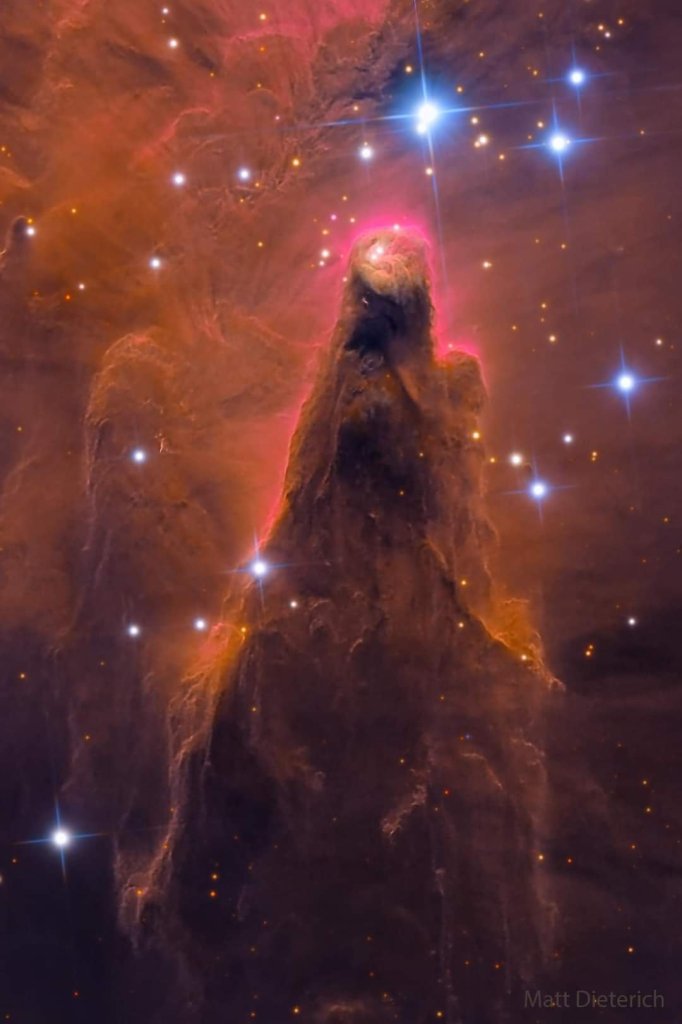
Recently, we have measured an increasing rate of cosmic expansion. This has led to a very different image of the end times (not to worry, a time billions of years in the future). The image presented by this latest revelation is not any more reassuring. All matter, all that we can measure out there, eventually would disperse and cool. All that complexity and magnificence out in the vastness of space would evolve into complete entropy … dark and empty void. A rather drab ending indeed.
Some astrophysicists argue for a more dramatic ending … the Big Rip. This image of the end times reminds me of the Rapture anticipated (with surprising glee) by many evangelicals. In the Biblical rapture a rather vengeful version of Christ would rip apart the non-believers (i. e., liberals like me) though why the Prince of Peace would do this is beyond my understanding. In this version of the cosmic end times, all matter would rip itself apart. The end, however, would still be that cold, empty, lifeless void
I’ve been partial to another possibility. There is that metaphorical scenario found in Hindu mythology. Brahma breathes in and out every 85 billion years or so (which leaves room for many reincarnations). Each exhale would represent a cosmic ‘big bang’ expansion while each inhale represents the resulting contraction. The new singularity would inevitably result in another expansion, thus repeating the cycle for eternity.

None of these scenarios sound promising 😒. So, I will exercise my imagination absent any empirical proof whatsoever. Imagine that the human species is a mere step in a larger evolutionary scheme. In fact, imagine that we are at the end of our run 😳. The very beginnings of the Artificial Intelligence (AI) phenomenon mark the transition to an intelligence and set of capacities we can not begin to imagine. This would be like apes looking at homo-sapiens in total wonder and admiration. Homo-sapiens would become the future apes, and sooner than you can imagine.
Think about what might be in the future as all knowledge becomes available and usable while the pace of evolution accelerates beyond what we thought feasible. In fact, don’t even try to imagine it. You can’t! It would be like European peasants struggling to survive during the dark ages attempting to imagine today’s technological world 😕. Not a chance!
Nevertheless, consider some future version of a really advanced entity capable of intergalactic communications who are able to command all knowledge in the universe. If possible, could such entities somehow shape cosmic evolution? Could the pointless ends we now envision be avoided … might some more meaningful future be consciously pursued.
I have no freaking idea. But it beats a cold, empty, lightless universe or endlessly repeated expansions and contractions. But consider this! If what we become can influence and shape cosmic outcomes, then we will have found God. Such a phenomenon would be us or, more accurately, what we become.
Surely something to ponder!
 Tom's Musings
One response to “Conundrum to Ponder # 3”
Well done.
LikeLike