As promised, a few words on selected fictional works.
First, some background. I’ve mentioned often that I had this fantasy of being a writer as a child. That was an odd ambition for a relatively poor, working-class kid whose parents had little education. I believe my mother dropped out of school after the 8th grade while my dad may have made it through high school, but I’m not totally sure about that. However, he did read Perry Mason detective books and received copies of Reader’s Digest condensed books, which I devoured. Somehow, I had been touched by the Celtic muse.
In high school, where I did not stand out at all academically, I received rare praise for a short story I wrote. You remember any praise when it is directed at you so infrequently. In college, I was a Psych major, the best department at Clark University. But I loved my English Lit courses the best. One day, I ran into my English prof in the cafeteria line. Since he was trapped, I mentioned my interest in becoming a writer one day. He didn’t laugh at me. He merely asked a question … could I tell a good story.
In the Peace Corps, with plenty of time on my hands as I baked under the desert sun in Rajasthan, I wrote a novel. I somehow convinced a few women to type the thing up (I was charming even though I very seldom got any action) and carried it with me for a long time. But I did not have nearly enough confidence to do anything with it. I did show it to the best prof in my Master’s program who highly praised the writing. Still, I stuffed it somewhere and did nothing. I had enough of a practical bent in me to somehow find my way into academia and a fascinating public policy career. After all, the prospect of starving as I tried to make it as an author had no appeal to me. I did enjoy 3 meals a day and having a roof over my head. Besides, being a respected policy wonk was a hoot and a half.
As explained in my previous post, I picked up my long dormant interest in writing after I retired, and after my spouse began her long descent into early onset Alzheimers. As during my my Peace Corps service, I had plenty of free time as I cared for her. It was time to answer the question that plagued me from my college days … could I tell a good story.
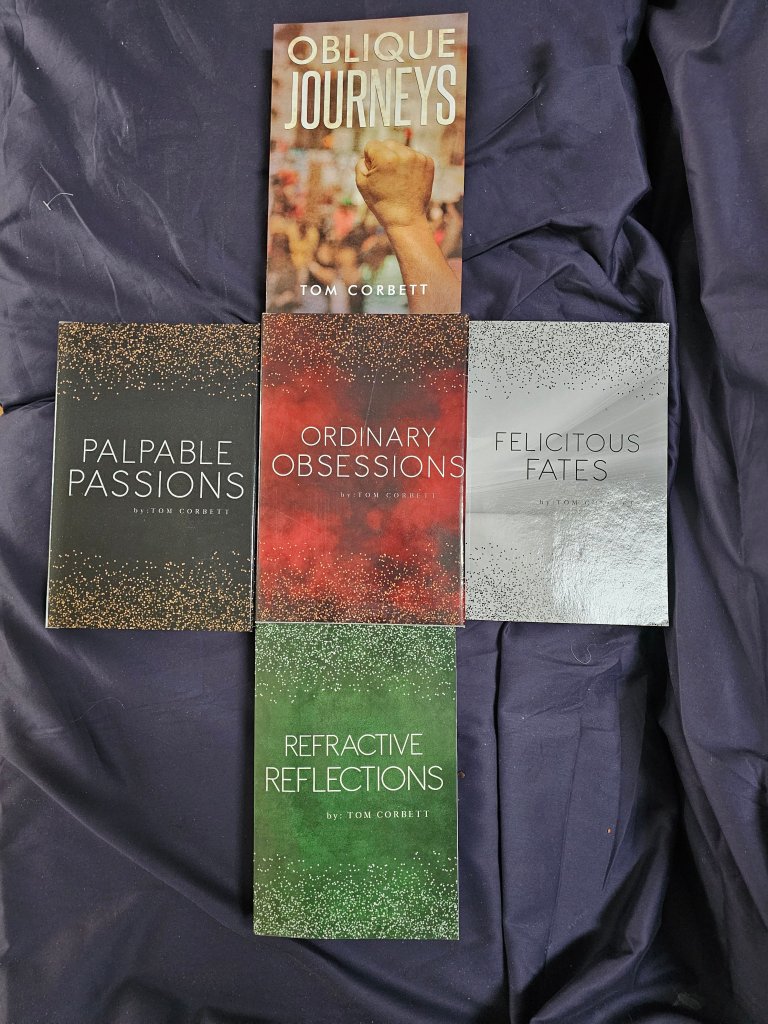
I am now satisfied that I can. Above are my fictional works. These are the final versions. Like Walt Witman (Leaves of Grass) or the essayist Michel de Montaigne, some of these efforts went through several iterations. Oblique Obsessions, for example, was first published as Tenuous Tendrils, then reworked and republished as Casual Choices. Then I reworked it one final time. Like Montaign’s constant revisions, each new iteration was longer. Words, it seems, poured from me effortlessly.
Let me try a brief overview of these works:
Oblique Obsession was the first. It is about a young man who gets caught up in the revolutionary fervor of the anti-Vietnam war movement. The bulk of the book takes place when he is retiring from the University of British Columbia after spending his life in exile. During his retirement week, his past catches up with him. Admittedly, I draw on a few of my own youthful experiences, but the major storyline is fictional. The narrative deals with how each of us creates our personal moral compass and then deals with the consequences.
Papable Passions started out as an image. Having been entranced by the bravery of Malala Yousafzai (the precocious Pakistani teen who was shot in the head by an Islamic fundamentalist for advocating education for girls), I wanted to explore the world of a bright young Afganisthani girl caught up in the cultural repression of the Taliban regime. I intended to contrast her story with an American family where the children rebel against the family patriarch’s extreme right-wing views. These two families would intersect.
Well, it turned out that one book was not enough. For one thing, I fell in love with my characters who, it turns out, take on a life of their own. Eventually, four were written. They cover two plus decades of the 21st century’s descent into madness in Afghanistan as well as America’s flirtation with authoritarian dictatorship and the embracing of Orwell’s dystopia laid out in his classic, 1984. The final work, Refractive Reflections, was inspired by the return of the Taliban after U.S. troops left at the conclusion of the longest military conflict in American history.
All of these works deal with universal themes … the power of culture, breaking away from crippling constraints, seeking a moral center, and living with the consequences of one’s choices. Amazon reader reviews ranged from 4.4 (out of 5) for Palpable Passions to 4.9 (out of 5) for Ordinary Obsessions. Reviewers consistently praised the structure of the narrative, the pace, and the fact that it made them think (which pleased me no end). Many observed that once they had started, they could not put the book down. They were swept up by the characters and by the intricate plot.
Again, more information can be found at:
 Tom's Musings