I started this blog for three reasons. First, I took a hiatus from writing (and then sometimes significantly rewriting) full-length books. I was stricken with a temporary delusion that I ought to consider getting a real life. How silly is that? Second, the Facebook (Meta) gestapo banned me from their platform … twice … presumably for life each time. The first exile happened when I had accumulated 30,000 followers. The second, initiated under a different name, was imposed when I had collected 7,000 followers. These were not temporary sentences to their jail which they did with regularity. No, I couldn’t even access their platform. I was considered a serious felon, worse than Trump. Third, several people who missed my FB posts actively encouraged me to start a blog. God knows why. You cannot go broke underestimating the judgment of most people.
Perhaps the most important reason for the blog is that I needed to do something that would get me in front of my laptop. In many respects, writing had come to dominate my life in these so-called golden years. Since 2011 or so, I have pushed out like a dozen big volumes. The exact number is fuzzy since some original works were rewritten and republished under different names and even publishers. Thus, the exact number depends on how to define an individual work. By any measure, it was a lot of writing and I needed a break from that frenetic pace.
I started this blog thing perhaps four months ago. For many weeks I was writing one a day. A neighbor of mine expressed amazement at my productivity, noting it would take him a week to write what I was putting out each and every day. Recently, I have eased back to about one every other day now that the total exceeds 100 blogs (is that what they are called?). My Facebook output also was seen by others as substantial, and apparently worth reading … thus the huge number of friends and followers for someone not known to the public. People would ask me how long I worked on it every day, believing it had to be many hours. In truth, it was surprisingly little time. I often picked the best material that crossed my news feed and passed it on, though some was original. At the time I was banned the first time I was adding something like 100 new followers each day. I had arrived.
I don’t quite know whether to lump my Facebook efforts as a legitimate literary endeavor though I feel it could be considered quite creative in some respects. (NOTE: After my latest (second) lifetime banishment I found another way to get back on as a new account though I am clueless as to how this was accomplished.) I am now cranking out jokes, insights, and leftish political comment at my usual pace. I’ve secured over 230 ‘friends’ in less than a week. There is considerable rejoicing among my old (or former) cyber acquaintances who have found the latest version of ‘Tom’ on that platform. Their glee is tempered by the legitimate expection that the heavy hand of the FB version of the KGB will strike again, and soon. Their gestapo seems to despise humor and original thinking. It is fine to make people hate, just not laugh or think.
Writing, even what passes for it on Meta (why did they change their name), has become my addiction. Over the past dozen years or so, I found myself drawn to my laptop (or even phone). If I wasn’t working each day on a book or some other writing project I would become jittery. I would not calm down until my fingers were flying over the keyboard, more like pecking at the keyboard. That sounds very much like an addiction to me. Either that or I am painfully aware that, if I am NOT pushing my creative instincts to the side, I would be forced to confront REALITY. Oh Lord, perish that thought! I might even have to tackle my disordered life, perhaps take on the cleaning of that hazardous waste site that passes for my domestic domicile. I believe death is a preferable fate.
Some Fictional Works

Sometimes, when I’m not gazing at my navel, I wonder about nonsense. For example, is this frantic writing just a convenient retirement hobby or something more fundamental to me as a person. If the latter, where does this impulse come from? I do know I started to seriously write non professional stuff (e.g., fictional works like those examples pictured above) when certain life changes happened in my late 60s, just as I was leaving my professional life behind. Even after partial retirement from the University, I remained somewhat active in a number projects. They were winding down by 2010 with the publication of my co-authored academic book on Evidence Based Policymaking. These remaining activities ended totally in 2015 after I had organized a week long conference to upgrade the skills for academics teaching poverty related courses around the country. I had co-managed this with the late economist Robert Haveman. In reality, though, I had left most of my professional life behind by 2011.
Around that time, my late spouse began to evidence symptoms of dementia which eventually was recognized as Alzheimers. Any one familiar with this affliction knows it better as ‘the long good-by.’ Your loved one slowly declines as the disease takes over more of their brain and slowly saps their cognitive abilities and then their motor functions. The process can go on for a decade or so on average. During this progression, the world the two of you enjoyed slowly becomes more constrained. There is no more travel, especially as you become a full time caretaker until institutional memory care becomes unavoidable. During this process, you find yourself more and more home bound, perfect for a writer. What else is there to do but sit on your fanny and let your mind and imagination loose upon the world.
All this makes it sound as if my personal writing frenzy was one of convenience. Nothing else to do so why not punch out some books. Not quite that simple! Anyone who has tried writing something like a book knows it is not as easy as it sounds. No indeed. It is more like a commitment, either that or something for which one should be committed. I now forget which. No, something else was afoot. So, let us look deeper.
I’ve reflected on this issue a number of times. One can always create, or recreate, one’s own history and biography. I’m well aware of that fact after being involved in several literary works focused on my Peace Corps group’s (India-44) experience as well as two more general memoirs, one professional and one personal. What I found is that it is most difficult to sort out reality from fanciful memory. But we can only do our best.
I can recall going through my dad’s effects, perhaps when he passed in 1987. I came across a clipping from a 1930’s newspaper on his high school basketball team. The reporter asked him what he wanted to do when he was an adult. His response took me back … be a journalist he replied. For some reason, that hit me hard. Really, he was just a poor Irish kid with no chance at college. After walking on the wild side a bit in his early years, he settled into factory work and a working class lifestyle. But I wondered if the Celtic muse lie somewhere within him.
He did have books in the house. I can recall a complete set of the Encyclopedia Britannica, the internet of its day; a whole set of Perry Mason mysteries by Earl Stanley Gardner, and the condensed books series from Reader’s Digest, a volume of which would arrive at the house on a predictable basis. I read everything I could get my hands on plus what I found at the local library, an institution not frequented much by my working class neighborhood friends. In fact, I kept my sojourns to that place a secret.
I also remember that he was a good story teller. He had that classic Irish wit and that dry sense of humor that I thankfully inherited, or so I like to claim. As he aged he would complain about my mother dragging him out to see people and socialize (he had become a bit of an introvert as I am). Yet, when he was in the public eye (so to speak), he would regale people with an innate charm and keep them laughing. Again, I would like to think I inherited such attributes which I see as core Celtic traits, along with some less desirable ones such as an excessive fondness for liquid spirits. We sons of Eire can be sociable, loquacious, and entertaining. Ah yes, self-delusion is a marvelous skill everyone should perfect.
As an only child, I probably spent more time alone than others of my cohort. With time, and fueled by books, I had an active imagination even early on. We kids all had dreams of what we would do as adults. Most of my buddies wanted to be athletes or cowboys or soldiers or something along those ridiculous lines … vocations related to the games we played in the streets and local parks. I, on the other hand, wanted to be an author. Of course, I never told my buddies. The scorn and teasing would have been intense and so humiliating, along with the physical beatings. I was slow but not totally stupid.
I can recall in high school. I was an average student at best (and that is stretching it), though I did attend in a good school. One day, the Xaverian brother who taught English gave us an assignment to write a short story. The others moaned while I beamed. I loved words, numbers not so much. That night I cranked out my masterpiece. It was a story that built up tension and drama as the story evolved. My brilliant stroke was not to reveal the actual context of the narrative until the final sentence. You thought you were reading about a dramatic and life-threatening moment until it was revealed that all the angst was about a harmless neighborhood basketball game. I was such a clever lad.
When the good Brother asked for a volunteer to read their story, all the others slunk deeper into their seats while my hand shot up. ‘Oh God,’ I could imagine him thinking, ‘not that idiot Corbett.‘ But he had to call on me since I was the only volunteer. As I finished my epic story, doubt seized me. I didn’t want to look up, afraid they were all laughing at me (a not uncommon event in those days). When I found the courage to peer around the class, I can still remember the looks on their faces. Mostly, they were shocked, and apparently impressed. The class idiot (one of them at least) had his moment in the sun. When you have so few, you remember them. I realized I just might have one talent amidst so much failure. It doesn’t take much to keep one going.
When I was in the Seminary, studying to be foreign missionary Catholic Priest, I had a course in something called Oral Interpretation. I think it had something to do with making you a better speaker. The Maryknoll Priest who taught the course had many contacts with the theater crowd in Chicago (the Seminary being located in a Windy City suburb), at least if the autographed pictures in his office were any indication. So, I assumed he knew a lot about the the creative process. One assignment was to pick a favorite literary passage of yours and read it to the class. I was into the playwright Eugene Oneil at the time and selected a passage from his classic, The Iceman Cometh. Again, I poured my interpretive juices into my rendition of an emotionally charged scene. When I looked up, I saw the same expressions of amazement I had seen in prep school. The teacher also looked amazed. I yet recall his words of praise … ‘Now that is oral interpretation.’
I left the seminary in my second year and transferred to Clark University in my home town of Worcester. It was a radical departure from my Catholic, working class roots. My mind exploded as I also found my intellectual (and somewhat radical) political roots. This so-called ‘den of atheism and communism’ (at least in the Catholic community) is just what I needed. Once again, I had a moment. While a psychology major (the best department at the university where Freud gave his only American lectures and the American Psychological Association was formed), I really loved my Literature classes. One day I ran into my Lit Prof while getting some food. Since he was trapped, I told him about my secret desire to be a writer, expecting him to laugh out loud. I got laughed at a lot.
He didn’t, which surprised me in the moment. It was not until I myself was a university teacher later on that I realized that you train yourself (most of us do at least) to respond to absurd student fantasies with a straight face. Charles Blinderman, that was his name, did so with me in that moment. But what he said next has stayed with me for something approaching six decades. It was a simple question. ‘Can you tell a good story?’
I didn’t know if I could, not really. So I don’t believe I responded at the time, standing there mute which is a state many have wished upon me but few have succeeded in achieving. My father could tell good stories (or perhaps that is a false memory) but, even if true, I was not sure that counted. Nor was I certain that it was an inheritable attribute. So, I took his words as a silent challenge. Alas, it would take decades before I seriously tried to answer him.
Even after college, I had no freaking idea what I wanted to do. There were no placements in the help-wanted ads looking for wanna-be authors. So I went to India in the Peace Corps. There, sitting in the harsh Rajasthan desert, I had a lot of time on my hands. So, in painstaking long hand, using the now extinct code of cursive script, I wrote a full novel. Those few who read it liked it, as did the women who volunteered to type parts of it up for me (I was such a charming lad), and as did my tough minded professor in my Master’s program in Milwaukee (after my return). And so I wondered, was this dream of being a writer possible. Could I? Had I answered Blinderman’s query.
The problem is that I liked eating on a daily basis. I also rather enjoyed having a roof over my head. I thought hard about trying to look for a publisher but, at the end of the day, I put the manuscript aside and went in another direction. By chance and serendipity, I wound up as something of a nationally respected policy wonk and a less respected academic at the University of Wisconsin where I found I had some administrative skills (including being good at raising money) and was a damn good consultant to govenrment agencies and assorted public bodies. In addition, I was a damn good teacher which, even at that level, is about imagination and story telling.
Amazingly, I discovered I had a few skills. I wasn’t as hopeless as I thought I was as a kid. This career of mine was all by accident, not by design. I never had a plan, certainly not one that would find me at a world class research university. One thing is for sure, I never intended to be a conventional scholar which required you to be overly narrow and (except for the most brilliant) constrained one’s imagination to keep a focus on a bunch of smaller, more technical, and (in my mind) trivial issues or questions.
So, I fell into a long career going between the academic and the policy worlds. I loved that. I could pick the topics on which I wanted to focus and approach them as I saw fit, as long as I could raise the money to support my intellectual interests which was surprisingly easy to do. Even better, I was not really responsible for any of the mayhem I created. It also turned out that being professionally located at a renowned research institute at this top-ranked university opened a lot of doors. People assumed I was smart and knew something. Go figure … the jokes on them!
When I retired, I told the audience at my final party that I had been so blessed. My only hope as a kid was that I would not end up doing manual labor later in life. I managed to avoid that, thank god. What I did do, as I told the audience that day, was to fly around the country addressing some of the most pressing social problems of our day while working with many of the best and brightest in the academy as well as in public service. And they even paid me to do this. I felt I had cheated life. It sure beat working for a living.
Of course, I had to put my writing dream on hold, or thought I did at least. The pace was brutal as I juggled so many roles … academic, teacher, administrator, money raiser, project administrator, consultant, and public speaker. But, in reflection, I realized that was not quite true. I did write, a lot. As a so-called academic, I did a lot of professional writing … reports, book chapters, articles, and so forth. I wrote more for outlets that would reach beyond an academic audience, thus was never respected very much as a scholar. The ONLY thing that counts in that culture are narrow and technical pieces published in provincial peer reviewed outlets read by a handful of scholars interested in your subject. I wanted to reach out to the world. You probably can see that my attitude would cause trouble. Still, I had this knack of keeping everyone laughing which permitted me to remain popular within my world and kept me involved as what I call ‘a player.’ I kept getting invited to be involved in the critical issues of the day.
Some Nonfiction Works
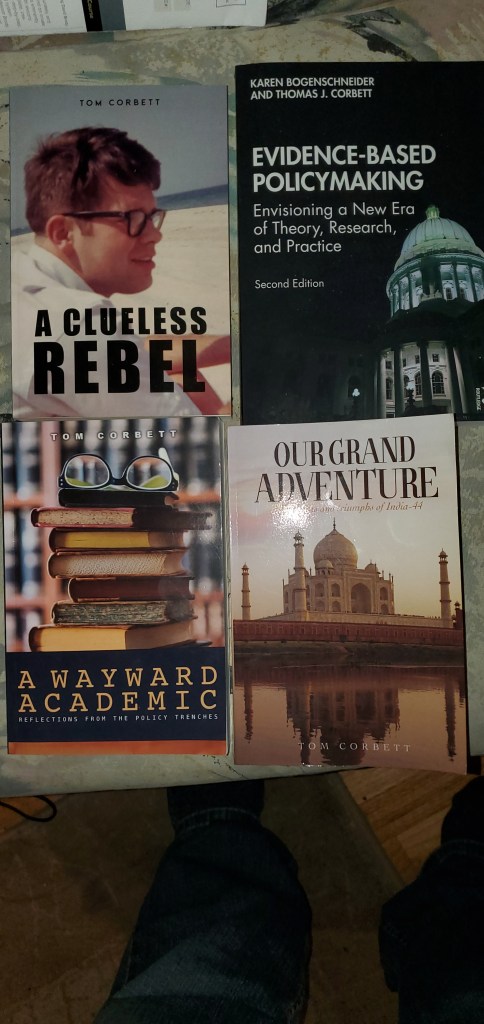
One thing was certain, I was highly respected as someone who could communicate with the written word, and give great public talks (or contribute to conferences and seminars) which I did endlessly. Over time, what really shocked me was my acceptance by the hard ass econometricians and other hi-tech scholars. As someone who had great difficulty with high school algebra, I should not have been where I ended up, especially in helping run a nationally known university-based research entity (my imposter syndrome often overtook me). Most surprisingly, I was embraced by many of the economists who dominated the Institute where I spent most of my time (I taught various policy courses in the School of Social Work but spent little time there).
Now, if you were to know economists, you would find them to be a disputatious and aggressive tribe. They surely do not accept those they deem fools with ease. And yet, I felt more accepted by these (what should I call them) hard-asses than I was by the softer social workers in the academy. My best guess is that my skill at cross-walking between several cultures (academia, government, the philanthropic world, think tanks, evaluation firms, public agencies, etc) and then integrating my observations into well crafted writings performed a service they admired. I gave them a window to the broader world. It certainly wasn’t my technical sophistication.
One vignette has remained with me. I was walking back to the Social Science building one day along the path that borders Lake Mendota. The campus is gorgeous. Anyway, this was early in my tenure at Wisconsin when I was less than nobody. Suddenly, I heard someone calling my name. It was Robert Lampman, a revered economist at Wisconsin. In the early 1960s, he served temporarily on the Council of Economic Advisors during the Kennedy years. During that service, he wrote a seminal chapter in the annual Economic Report to the President. This chapter was widely considered to be the intellectual basis for what later became the War on Poverty and for parts of the Great Society.
For the life of me, I could not figure out what this eminent man would want with a nobody like me. He then went on to praise something I had just written and put out within the Research Institute. It was likely the first thing I had written there. After exuberant praise that left me speechless, his last words before we went our separate ways were ‘Tom keep on writing.’ Those words also stayed with me. Bob was one of the finest men I ever met in the academy … I still cannot believe he was an economist.
I won’t bore everyone with more tedious vignettes but I can recall so many moments when I was the object of praise from my ‘hard-ass’ colleagues, or when I was asked to speak before rather distinguished audiences, or to be included in meetings at high levels including the Old Executive Wing of the White House. It was heady stuff for a working class boy from the mean streets of Worcester. I doubt all that happened because I was particularly bright. I never thought of myself as conventionally smart though I probably was imaginitive and clever in a way. I had a facility for seeing connections among seemingly disparate phenomena and for cutting through the fog to get to the core of any issue. Still, I think what gave me an edge at the end of the day was a command of language. I could speak and, more importantly, write well, even persuasively on occasion. I yet recall one colleague (trained as an economist) calling my writing style ‘Corbettese.’ It was not the style found in the academy.
So, my childhood dream of being a writer never came to pass. I put it on the back burner during my career, perhaps for reasons about which I am not proud. I lacked the courage to give my inner passion a full voice. Basically, at the end of the day, I didn’t want to starve to death. At the same time, it wasn’t as if I sacrificed all for some career that despised. That would have been a tragedy. There is little doubt that more money could have been made in other professions or avocations, but most of them would have driven me crazy. Besides, money is immaterial once the basics are ensured. Recently, I remember thinking about the young doctor who did my last colonoscopy procedure. For several reasons, there is a backlog in scheduling these invasive procedures, so it struck me that she might be doing them all day long. Undoubtedly, she is making good money but I could not help thinking … I would not last a month. I needed stimulation in life, new challenges, impossible problems to confront, and audiences (via talks and print) to share my observations and thoughts. And that is precisely the life into which I stumbled blindly. It was a good life.
Did I take the wrong road? Should I have pursued my passion with more vigor. Is a ‘good life’ enough? Who knows. What I can say is that I did employ that innate literary talent in the career I found, or rather which found me. That is something. More importantly, I have been given a second chance. I have time now, lots of it. While not wealthy by any means, I don’t worry about money. And when I am at my laptop stringing together words into images and thoughts and observations, I find myself lost in another world.
It turns out that I am comfortable in that world. On reflection, I think I will stay here for a while longer.
My Latest
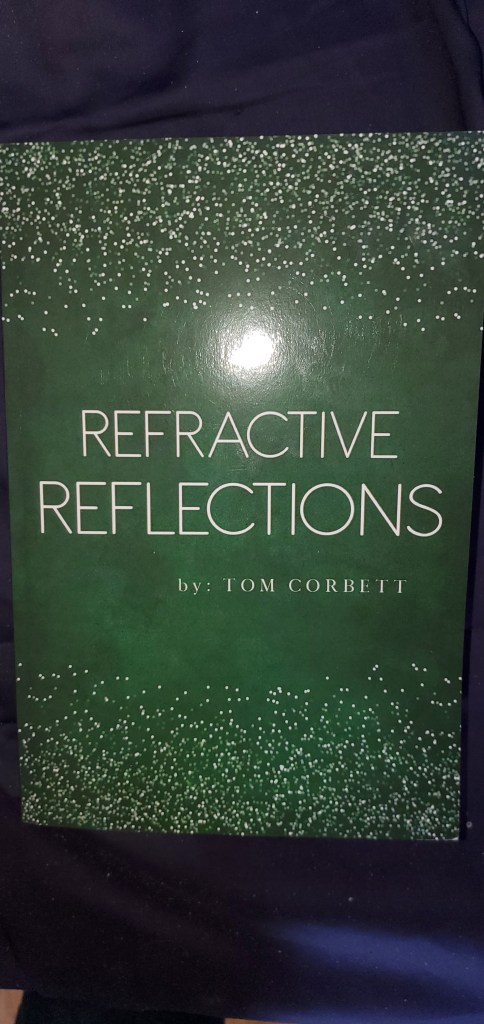
http://www.booksbytomcorbett.com
 Tom's Musings
2 responses to “A ROAD NOT TAKEN”
Good read, Mr. Corbett.
LikeLike
Thank you!
LikeLike