I think we all have them, though they are most difficult to discern in some folk. The ‘them’ in this instance is a system of beliefs, a moral center, an ethical compass, or whatever you want to call what you rely upon to determine what you believe, or at least want to believe, and thus accept as true and decent and right. I would conjecture that most of us, too many really, go through life without thinking about this most central aspect of our personhood … the what, how, and why of what makes each of us who we are. As some sage once said … ‘a life unexamined is a life not worth living.‘ This was clearly a sage with too much time on ther hands, much like me.
I sense that most people think they know what they believe and value … America, Capitalism, the Republican party or the Green party, Jesus as their savior or Mohammed as their Prophet, the Packers or (god forbid) the Chicago Bears, guns or peace, and the list can go on. When pressed, however, articulating a set of core beliefs, our embedded moral sentiments, is harder than it looks. Then again, seeking anything wothwhile is harder than it looks.
Jordon Klepper, a comedian on the Daily Show, would interview Trump true believers at the former President’s rallies. Each respondent started out totally sure of what they believe, at least until Jordon starts picking at the inconsistencies and absurdities within their positions, which he manages to do with considerable skill and ease. Within seconds, you see these people struggling to defend their iron clad world view. While I laugh at them, sometimes uproariously, I know I am subject to the same faults. Consistancy and coherence can be very difficult to maintain, or even locate in the first instance. I’m not sure I would do any better than these befuddled clowns.
I think of myself as a pacifist. Back in my youth, I probably would have tried the ‘conscientious objector’ route with respect to the military draft though that avenue probably was not open to me. In a recent book of mine, Oblique Journeys, I narrate a fictitious account of a young man of conviction who flees to Canada during the height of the Vietnam War and protests.
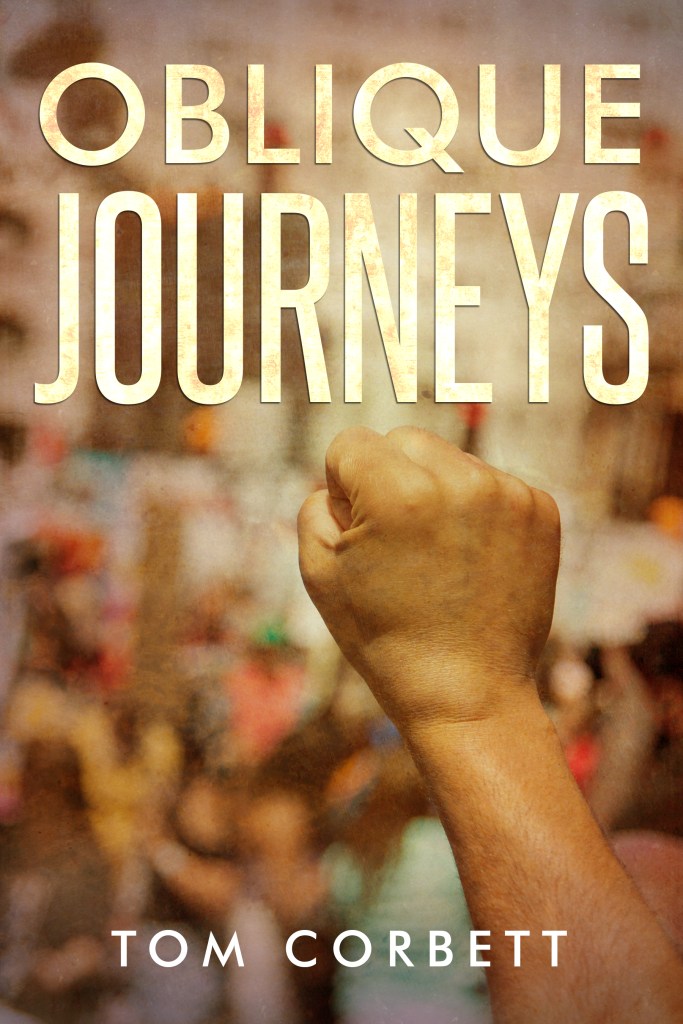
His personal hegira is as much a flight from his convictions (and his colleagues) as it is his unwillingness to kill others in what he sees as an ill-considered war. He could not face war nor could he accept the path toward violent protest toward which his beliefs were drawing him. Escape was his solution but, as detailed in the book, it took a long life which encompassed much nominal success to sort out his beliefs, his emotions, and his fractured relationships. To butcher one of Bill Clinton’s favorite mantras, if figuring out who we were easily done, we all would do it early in life.
I managed to slither and slide past the draft back in the late 60s and early 70s. But there were moments, too many, when I thought I might have to make one of those life-altering, or would it have been a belief-affirming, choices. Would I go to jail, or Canada, if there were no exit left? After all this time, and writing a whole freaking novel on this theme, I still have no idea.
I just finished a book titled Ahead of Her Time. It is the story of Abbey Kelley (Foster), an early abolitionist and then suffraget who sacrificed so much and worked so hard for what she believed. Starting out in the early 1830s, she worked tirelessly to end slavery and integrate Blacks into American society. She travelled constantly throughout New England, then New York, before moving through Pennsylvania, Ohio, and Michigan tirelessly preaching the cause, raising money, convening meetings and conferences, and publishing tracts and articles. Her devotion first demanded that she renounce her Quaker religious roots, which she thought too concerned with frivolous rules and not committed enough to core principles. In place of her formal religion, she instituted a core affirmation in abolition and embraced the universal rights of all men and women. Around those convictions she organized the rest of her life, never failing until her body gave out many decades in the future.
There was an extended period of time when she had no home of her own, existing off the good graces of those who admired her and her labors. And yet, in reading about her exemplary life of commitment and sacrifice, I was struck with her own internal battles. She preached the lessons of love and of embracing those who had been shunned by society and/or assigned to some form of marginal or second-class existence. Yet, her strong beliefs led her to reject so many around her, slave holders and slave apologists for sure, but also her own colleagues with whom she disputed with about either ends or tactics or both. That is an affliction common to many of those with strong beliefs … they strive for purity of belief and reject those who fall short by their strict standards.
And that insight brought me to another set of examples embedded in a movie about the trial of the Chicago Seven. You remember them, the sacrificial lambs placed on trial after the riots at the 1968 Democratic National Convention in Chicago. President Johnson’s outgoing Attorney General Ramsey Clark had refused to indict anyone after his internal investigation concluded that the police were responsible for the violence on the streets. Nixon’s Attorney General went ahead with these indictments presumably, if you believe the movie, because he felt disrespected by the outgong AG. Or perhaps it was just good political theater.
In the end, the trial was a fiasco and none of the defendents spent any material time in jail, except for contempt of court decisions handed down by the clownish and incompetent judge overseeing the proceedings. Well, the defendent’s lawyer, Willian Kunstler, did do some real time. Apparently, defending unpopular people has its risks … the bromide that everyone deserves a vigorous defense not being accepted by all.
In the end, though, the movie was much less about the riots, those charged with crimes, and the trial’s outcomes. It was far more about the character of the defendents, their differences with each other and how their callous mistreatment by the judicial system brought them closer together through their court ordeal. The defendents, in effect, were a microcosm of ‘the left’ at least as it emerged in the 1960s. Here is a quick review of the lineup:
The New Left … This was represented by Tom Hayden and Rennie Davis who were leaders of SDS (Students for a Democratic Society). The anthem for this movement was the Port Huron statement, a call to arms for college students written by Hayden in 1960 in (guess where) Port Huron Michigan (many attendees at this gathering were from the U. of Michigan). My take is that these activists were the traditional types reacting against what they see as societal failings and moral wrongs. They started out looking for a more meaningful role for their generation, soon got caught up in the anti-war movement and other causes. Their frustrations increased (with the body count in Nam) and they eventually splintered into a few even more radical groups with the Weathermen in particular sinking into a self-destructive nihilism. But Hayden remained true to the original meaning of the organization eventually becoming a long serving politician in California and the husband of Jane Fonda.
The Cultural Left … The Yippees were the brainchild of Abbie Hoffman and Jerry Rubin. In some ways, they moved beyond traditional politics to operate on cultural change. They were the more political Hippies who felt that real change came from altering how people saw and felt things on a more primal or cultural level, focusing on the absurdities of conventional society. Of course, that was way too abstract and nuanced for most and the movement became more one of outlandish theater than anything substantive. But it had its moments before fading from the scene. While Rubin eventually became a stock broker, Hoffman remained an activist until committing suicide in 1989. I marginally remember Abbie from my youth. He also was from Worcester and had managed a movie theater as a young man. He gave a talk at Clark (my alma mater) early in the war where he gave a devastating and brilliant attack on U.S. tactics and aims. At that time, he wore a suit and tie.
The Moral Left … I’m not sure this thread in the protest movement had a single name but it was represented by David Dellinger in the movie. David was older, a family man, and wore a suit. He had been a conscientious objector during World War II and had devoted his life to non-violence. Even before Martin Luther King, he had been a practitioner of non-violence, civil disobedience, and a believer in a strong moral code. Of all, he reminded me of the ante-bellum abolishionists like William Garrison and Stephen Foster (Abbey Kelley’s non-resister husband). In a moment in movie that touched me deeply, the viciousness of Judge Hoffman and the total lack of justice in the proceedings got to David and he struck a bailiff who was restraining him. The immediate pain on his face for what he had done spoke volumes. In a moment of anger, he had violated his core principle.
The Angry Left … this was represented by the Black Panthers and Bobby Seale. If the non-violence of Martin Luther King Jr. evolved from the precepts of Mahatma Gandhi and the moral left, the Black Panthers drew inspiration from the more forceful revolutionaries of the past, Nat Turner and John Brown. The force of oppression had to be met with equal force. That, unfortunately, would never be an equal fight and was doomed to fail from the start. Bobby’s good friend and Panther leader Fred Hampton, was killed in a police raid during this period. Virtually everyone believes he was assassinated by the Chicago police. There was a lot to be angry about.
The Others …. There were two other defendents but all figured that they were thrown in by the government to give the jury someone to acquit and thus feel good that they had done an objective job in finding the others guilty. In point of fact, they were acquitted of all charges. You would think the government would have had the decency to pay them for services rendered.
What struck me is that these very different defendents, and the trajectories they took, were so different despite purportedly common ends. They wanted to stop what they saw as an unjust war and to form a more inclusive and equitable society. Yet, they took very different paths toward their goals and, if the movie is to believed, didn’t necessarily understand nor like one another, at least in the beginning. It was only a common enemy, the so-called Justice system, that brought them together.
There were so many fine moments in the movie but one has stayed with me. It is an exchange between Hayden and Hoffman as they finally verbalize the simmering conflict between the two of them. It goes something like this (not the scripted words but the sentiments):
Hoffman … to really change things you have transform how people see the world, their culture.
Hayden … the problem with that is that you need political power to really do what we want, not political theater or being amusing.
Hoffman … in all your political maneuvering and posturing, aren’t you forgetting what we are all about, that kids are dying today while you go about playing political games.
Hayden … but remember this, as we go about seeking political control do what is right, voters will only remember your antics, not your good intentions, and vote the other way for decades to come.
They don’t come to an accord in that moment. However, at one point in the exchange, Hoffman admits that he read Hayden’s Port Huron Statement. ‘You read that,’ Hayden is surprised. Hoffman smiles, ‘I’ve read everything you have written. You are a really smart guy.’ And the ice begins to thaw.
Even today, I remember the first time I read the Port Huron Statement. I was in college at Clark, working 11-7 in a hospital to pay my way through school. On a slow night, I recall reading that founding document of the new left. I’m a bit of a skeptic and even a cynic, but it got to me … a young working-class kid shedding his Catholic roots and looking for a larger purpose.
And that, above all, is what made the 1960s special, for some of us at least. We experienced the shock of having all of our given precepts challenged and then being forced to arrive at, even articulate, a new understanding of things and a more coherent ethical center and world view. Just like for the defendents in the Chicago Seven, that was not an easy process. Figuring out what you should believe, how to arrive at those beliefs and, once there, how to live them in real life is more than a challenge. Calculus is a challenge. This is really hard shit.
But it is worth it. At this point, I will repeat one of my favorite vignettes, one that I have shared before. It deserves repeating. Decades ago, I read an article by a New York State Supreme Court Justice. He wrote about his youth growing up in New York City during the 1930s. Like a number of smart college kids of that era, he was taken with the sufferings brought about by the depression and the failure of society to respond. Like many of his friends, he dabbled in socialism and even communism as possible responses to what he saw about him.
He did not stay in these political places all that long but he realized one thing … it was the journey that counted. The economic catastrophe about him demanded that he look at things afresh and not with old eyes and tired scripts. He felt he had to question all that he knew and build up a new way of looking at things. In this piece, he said it made him, and many of his peers at the time, deeper thinkers and better people. He concluded that the crucible of doubt and questioning thrust upon him proved a blessing in the end. I totally agree with this man whose name is now long lost to my memory. But his experience stuck with me … it was also my experience but in a different decade and prompted by a different crisis.
We did not have a depression in the 60s, far from it, though my neighborhood was lower income working class at best. The war, the ‘rights’ movements, the broader cultural shifts all pressured us to think through our beliefs and our lives. I don’t know what college kids today talk about but we spent hours upon hours dialoguing about the issues of our day. We fought and argued and debated endlessly. Like the Chicago Seven, we disputed ends and means and then went back through them again. Nothing was easy. But at the end, if there was an end, a funny thing happened. We also felt we had become deeper, more nuanced thinkers (I did at keast). Perhaps we became even better people as adults (though I still doubt there is any reward awaiting me in the afterlife).
I can remember attending an anti-war rally in Milwaukee after returning from two years in India … my time out of time. The speakers struck me as spouting slogans, scripted words the meaning of which was beyond them. I wandered off disillusioned. They were born just a bit too late to go through the transformational experiences where authentic epiphanies and sentiments are born. I guess I was just lucky, and I suppose doomed at the same time.
Well that was a long introduction. perhaps in the near future I’ll take a stab at expressing my beliefs, if I can. Before signing off, let me add this. We had a big ‘political sort’ a half century ago. Conservative Democrats switched to the Republican Party while younger conservatives routinely identified as being Republicans. Moderate Republicans were driven out of that party. Rather quickly, the parties became more homogeneous and bi-partisanship diminished greatly. Now, we see a second ‘sort’ happening as we speak (or write). People are relocating to states where they feel more comfortable with the dominant political culture. That is, people are moving to be with others who share their values.
I see these lists of best places to live for retirees and other such groups. They inevitably discuss tax burdens and weather and living costs etc. They never talk about culture and compatible beliefs. But that is the new draw. I wintered in Florida for a number of years. But when my wife became ill, it was back to Madison for me, cold winters or no. Why? I want to be with people who share my values. So do most of my neighbors. They all could afford to live wherever they wish. But they don’t leave. And I fully understand why. Real estate folk who deal with families relocating out of state say this has become the new deal breaker in acceptable destinations. Belief systems and normative values are that important.
They are becoming everything as we sink deeper into our cultural divide.

 Tom's Musings