I get daily emails from Republican and Conservative sources asking me for money and support and then for more money. They are often addressed to Dear Patriot and have a fixation on whether or not I LOVE AMERICA which, they insist, is the greatest country on earth, without question. Sometimes I answer their query with a strong negative response just to see if they are listening. In case you are wondering, they are not. The next day I get the same request for money and the same question is repeated.
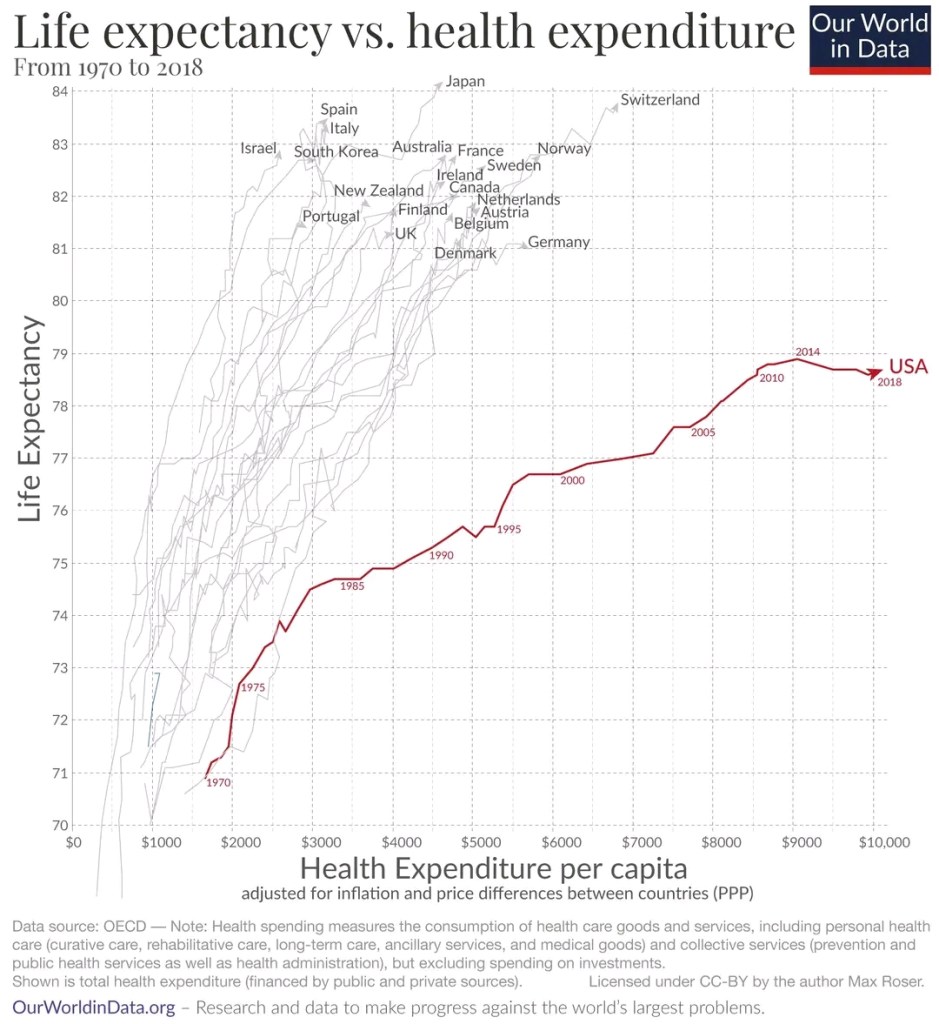
Relatively speaking, I simply no longer find much to admire in my home country. I did as a child but that admiration is long gone. There is no need to list all of our failings, they are legion and include deficiencies in health care access, environmental slackness, hyper-inequality in income and wealth, and an embarrasing level of gun related carnage. To focus, let us take one widely used metric of national health and well-being … life expectancy or LE. Basically, how long can we expect to live? In case you are wondering, I should have ‘kicked the bucket’ two or three years ago. Yikes … How did that happen?
If anything, this measure is a proxy for all kinds of dimensions associated with quality of life and national policies. As such, it is an excellent social indicator or statistic that goes far toward how we are doing as a nation, and how well we are taking care select societal subgroups like minorities and the vulnerable (old and young). Moreover, many factors go into determing LE, most of which are amenable to policy influences such as ease and affordability of health care and violence prevention. Perhaps the modal genetic makeup of a population seems impervious to control, yet even that variable can be influenced by immigration and emigration policies over the longer run. Even better, LE does not depend on self-reported status. Officials usually know when a person is dead or not though many an observor has concluded that I ‘bought the farm’ years ago. I should get off the couch more and move to indicate continued life.
But here’s the thing. During the Covid Pandemic, LE fell in the U.S. by some two years, the biggest drop in this measure since the Second World War. Of course, that was during a global crisis so such a dip was experienced in most countries with reliable data. Nothing to raise an eyebrow there. But in those wealthy nations that might serve as our peers, their dips were somewhat less extreme and they bounced back when Covid abated. The U.S. LE number has remained flat after the Covid peak while others have seen their LE figure begin to climb again in positive directions. Something insidious is going on here, another example of negative American exceptionalism.
Currently, the LE number here has been between 76 and 77 years (a number I have already passed as noted.) In all the nations we often use as references, the figures range from the low to the high 80s. Japan leads the pack with a figure approaching 90 years (should I start learning Japanese?). One estimate suggests that between 1980 and 2019 (before the pandemic), the U.S. had some 11 million excessive or amenable deaths assuming that we could have extended our life expectancy to match that of our peers. Another way of looking at it is to suggest that each early death truncates life by some 7 or 8 year (the difference between our mean death age and that of comparison jurisdictions), pushing the loss to some 77 to 88 million lost years of life. Whether they would be quality years is another matter altogether.
All this is no surprise. A National Research Council study from a decade ago reported that the gap in survival rates and in health outcomes between the U.S. and its peer nations started on divergent paths in the 1950s and that has remained a pervasive trend. In the early 1950s, the U.S. ranked 12th in LE. By 1968, it had fallen to 29th. By 2019, we ranked 40th among populous countries, lower than Lebanon and Albania. ALBANIA? Hetrogeneity is part of the problem here, not only in demographics but in policy regimes. The data clealry show that even people in their primes die earlier when they live in states dominated politically by conservatives. I will state the obvious … policies matter and conservatism kills! I might point out that this was an era where countries strengthened their safety nets with many adopting universal health care regimes.
Then, during the pandemic, we managed to kill off our citizens at a higher rate than others, a tragedy oft associated with resistance to masking and vaccination opportunities and with a struggling health care system that was unprepared and disorganized. Political confusion and unthinkable disinformation from mostly conservative sources also played a part along with embarrassing levels of inequality that leave too many vulnerable. Poverty stricken neighborhoods are not healthy places to live and we have some of the worst among wealthy nations.
Shockingly, our increasing mortality rates are even found among those in their midlife years (21-64). While we traditionally have lagged behind others in preventing post-natal deaths (we rank in the middle of the pack and after most rich nations), those in the prime of life are dying off faster than they should be. Epidemiologists look to rampant substance abuse and suicide to explain some of this. These are endemic to the widespead anxieties and despair felt by too many here (we don’t rank at all high on national happiness scales). Poor lifestyle choices contribute to high levels of cardio-metabolic diseases to be sure. But racism, disgraceful levels of societal inequality, and the fact that America has become a freaking free-fire zone adds to our woes here.
I must pause to note that Canadian officials recently issued a warning to their citizens intending to visit the U.S. They are concerned about the higher risks of their tourists becoming a gun fatality since similar levels of violence do not exist in their home country. They suggest Iraq, Somalia, and Afghanistan as safer alternatives. Okay, that part is a joke but not the warning, which I see as a sign we are descending into banana republic status.
The sad part of all this is that the gap between us and our peers can be diminished. It is amenable to correction through common sense public policies. What if we finally got around to passing even minimally sensible gun and firearm regulations? Perhaps we could cut into our rate of one or more mass shootings per-day. What if we had more preventative public health policies and better approaches to nutrition. Have you ever compared what we serve our kids at school versus what they get in other nations (pizza and burghers versus healthy alternatives)? What if we adopted the policy that exists in EVERY OTHER FREAKING RICH NATION of guaranteeing accessible health care to all. What if we started to ratchet back on the factors that result in unacceptable levels of inequality and poverty by strengthening labor market protections (e.g., raising the minimum wage), enhancing the social saftey net, and reintroducing a progressive tax structure. Much more might be said and none of these basic measures are secrets by any stretch of the imagination.
It has never ceased to amaze me that we can be mezmerized as a nation about the murder of one person, perhaps following the news or trial on that case for months. Yet, tens of thousands die annually in ways subject to policy amelioration and we simply yawn with indifference. How freaking sad!
American exceptionalism my ass.
NOTE: I’m reposting two of my favorite graphs below!

 Tom's Musings
One response to “American Exceptionalism Strikes Again.”
Sorely tempted to pop-off on the implications of the second chart, but won’t. Also tempted to point out that conservatives ask for money, liberals just steal it from you, but I won’t; that would be neither proper or absolutely correct. America today is sick. We were sick in the 60s, but there was promise from a socially aware youth. Unfortunately many of those youth did not deliver on promise and themselves raised a generation far far out of touch with reality and decency. Allus a thought-provoking read.
LikeLike