How many forks along the road of life do we confront? Do we think hard about each one, calculating the cost-benefits of every binary (or more complicated) choice confronted? Do we then fret and worry that a wrong decision had been made, that we had taken the poorer path and had forfeited some better alternative? Do we even have a freaking idea where we are going?
Not having any children of my own, which I’ve discussed earlier, my conclusions about how people confront life comes from the students I taught and my own pathetic existence. I could add that my close friends have helped but I don’t have any, other than the good people that ‘rent-a-friend’ sends over from time to time. No, my information sources remain sparse.
My students at the University of Wisconsin encompassed the period from the 1980s to early in this century. While I taught undergrad classes, my better sources of data came from the Social Work graduate students I taught in the 2nd year Practicum course for those interested in doing Policy work as a career. This course was small, roughly 8 to 15 students, and I had them for two whole semesters. From many conversations with them over the years, I absorbed the unpleasant truth that their world increasingly was dominated by anxiety and uncertainty. Many were in deep debt and worried about their futures. They focused much on job prospects and the bleak options they felt were in front of them. Many struck me as desperate.
I don’t blame them for this somewhat myopic and dismal perspective on their futures … this obsession with securing professional and financial success. The adult world they faced was far different from what I confronted in the 1960s when I was coming of age. In the most general sense, options for them seemed to be narrowing while the climb to financial security appeared to be a more difficult ascent. You needed more credentials, and of the correct kind, just to get into the ground floor while the stairway up was steep and filled with competitors. In the 1960s, a plurality of college age resondents said that developing a sound philosophy of life was extremely important to them. A generation or two later, securing financial security had risen to the top.
We all knew that inequality in both outcomes and opportuities became more pronounced in recent decades. In 1979, less than 10 percent of all income went to the top one-percent of families. That figure doubled in the years after Reagan took office and would continue to rise until it approached 25 percent. Such unequal outcomes had last been seen just before the great crash of 1929. This trend represents a tectonic change and a radical shift in the distribution of society’s goodies. A few were getting a lot while the rest of us were left scrambling for crumbs.
It was so different when I was in college. Sure, the competition was tough, it always is. At the same time, the prospects before us seemed open and unlimited. I became a Psychology major at Clark University mostly because it was the best department in the University. The American Psychological Association (APA) had been founded there and this was the place Sigmund Freud came to give his only lectures in America. After all, I had no idea what I wanted to do when I grew up. In truth, the thought of being a counselor of some sort repelled me … listening to other people bitch all day! I’d probably whack them after a half hour session and tell them to ‘suck it up.’
I might have been thinking about an academic career. That prospect dimmed quickly enough. Academic Psychology was abandoned after I spent a summer doing research on a National Science Foundation grant for promising young scholars. (How in the world was I chosen?) At the end of that summer, I realized I had to kill all my rodent subjects, one of whom peed right into my face as I jabbed a needle into his stomach. Thus ended my career as a research psychologist.
I did get as far as asking my advisor where I might consider going for a graduate degree. He didn’t blink as he rattled off Harvard, Yale, and Stanford. I almost laughed in his face. I was still a working class kid wondering how they had not yet discovered I was a fraud and kicked me out of Clark. It was not until many years later when I realized my colleagues were from these very institutions that I finally realized my advisor was not on drugs.
ME CONTEMPLATING MY FUTURE IN 1966!
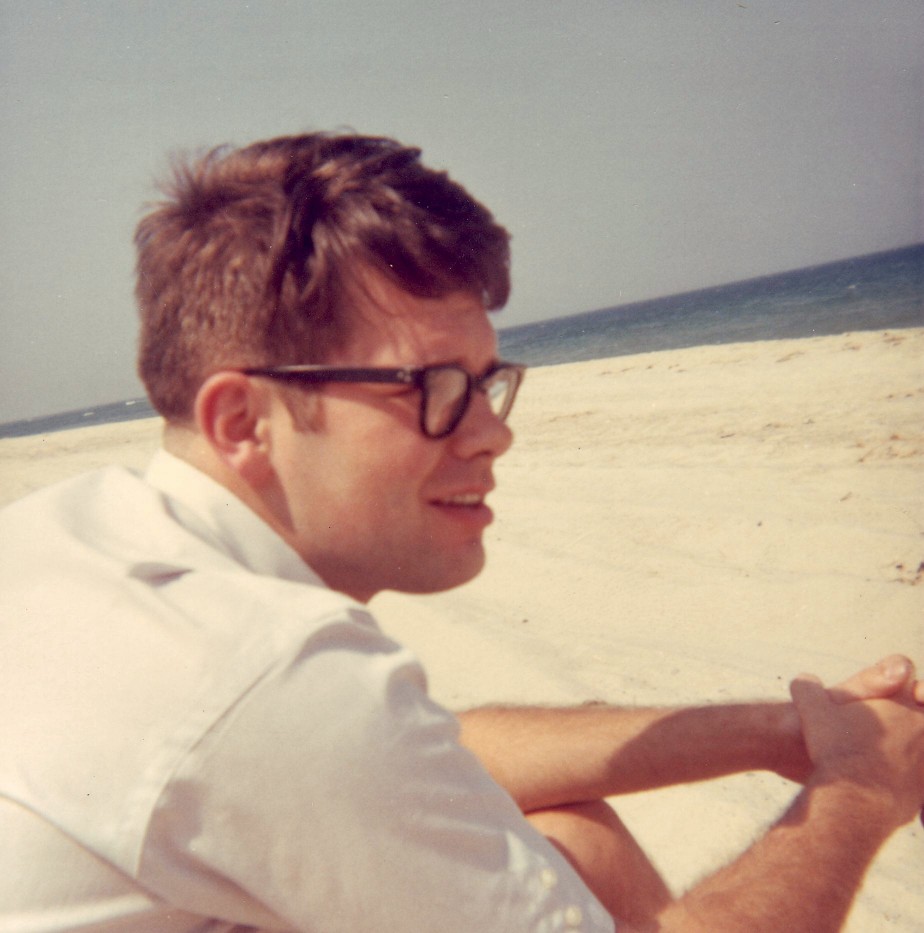
When I drifted out of college, I went the Peace Corps direction. I had been atrracted to that ever since Kennedy announced it in 1961. It fit my do-gooder sensibilities and appeared likely to be one hell of an experience. It was, though, a much more challenging trial than I had anticipated. Today, students might worry that two years out of their lives would put them behind in the competition up the ladder of success. How would potential employers look upon this kind of escapade? Perhaps some would see it in a positive light but could one take the chance. My sense is that, for recent generations of young people, every decision is approached in light of future payoffs.
Such considerations never entered my mind. I took courses in school because they interested me. I went the Corps route because it intrigued me. After India, I wandered back into graduate school in Urban Affairs at the University of Wiscosnin-Milwaukee since it spoke to my desire to help save society and I had heard about it while training there. That it might embellish my credentials was of secondary importance. In my world, one had faith in the future and that things would work out … somehow.
I remember once, when I was involved in the anti-war movement, a young man (though older than me) from my old neighborhood suggested that my activities might threaten my future plans. A file in some government agency might torpedo what little chance I had in life. He had recently joined the FBI and he was sincere in his comments. I thought on his advice for a moment and rejected it out of hand. I could not turn my back on what I believed for mere expediency. Perhaps more importantly, I never believed my future was in doubt or that I would find something ineresting to do. Even if he were correct, I was determined to do the right thing, not the safe thing. You could think like that back then.
For me, in the end, meandering through life worked out fine. Go fgure! After India, I returned to Milwaukee for a masters degree mostly because, as I mentioned, I had heard good things about the Urban Affairs program when I trained for the Peace Corps there. Good enough I thought. I was into social problems and this degree sounded vague enough to keep all my options open. Really, if I had studied accounting I would likely have to be an accountant. That sounded like prison to me. Shoot me now.
I had a great time in Milwaukee but that eventually ended, as all good times do. For the first time, I thought about gettng a real job, as much as the prospect pained me. I looked around for something to do in a desultory fashion when a professor I had worked with asked me to join him on a trip to Madison. He was working with with some State officials on a long forgotten project. During lunch, the topic of my unemployment came up and one official suggested I consider State Service. I immediately lied and said that had always been my dream while wondering silently what the hell State Service might entail. Before heading back to Milwaukee he secured some paperwork for me to fill out, which I did and sent back. Then I immediately put that incident out of my mind.
Then, my aimless life took another turn. This professor called one evening and said I had a job interview the next day in Madison. ‘What job?’ I asked but all he had was a building, a room number, and a time. I trekked down to the Capital City, found the room and walked in. It was as civil service interview panel for the position of Research Analyst-Social Services. Well, I thought, This should be quick since I knew little about research and less about social services. But, with very modest expectations, I tried to enjoy the experience before heading back to Beer City while hoping to forget all about what I considered a wasted day.
Sometime later, I get another call. I have an actual job interview with the hiring supervisor in the Department of Health and Social Services. It turned out I had made it to the 3rd position in the hiring queue after another candidate dropped out (only the top 3 could be interviewed for the position). I went through this next step again assuming one of the two more qualified individuals would get the position. Then, mirabili dictu, I got a call and was offered this real job. The hiring supoervisor said she found the 2nd candidate better than the 1st and I was better than the other two. I told her it was a damn good thing she did not get to the next person on the list. Go figure!
I enjoyed life as as a State employee, this was back in the days when they were valued and Wisconsin was doing exciting things. Then, after about four years, lightening struck again. My supervisor told me to work with a Social Work Professor on a Research Grant he was preparing, a grant application to a federal agency that had to have the support of the state agency. Why not! I helped him out and forgot about it once my collaborative work was complete. Once again, I get a call. This academic said he got the grant and would I consider moving to the University to help him run this large and very complicated project. Giving up a civil servic eposition was risky. So I gave this matter great thought, about six seconds, before saying … sure, why not!
Now I’m at the university but as low as you can go. But I figure, this is better than working for a living. As the project was winding down, I realized I needed the ‘union card’ (a Ph.D.) to have any career here. So, I started in the doctoral program in Social Welfare (while working under some of the best poverty researchers in the country). I was a terrible student since I spent little time at it. With my state contacts, I was able to forge critical linkages between the scholars at the University’s Institute for Research on Poverty (IRP) and the agencies responsible for social programs and welfare. I was busy working on the hot topics of the day when I should have been studying. Still, this state-university marriage was a natural match that paid dividends for many years on both sides.
Other idiosyncratic choices came about. One day, the Institute Director sent out a memo asking if anyone wanted to spend time working in the Office of the Assistant Secretary of Planning and Evaluation (ASPE). This entity did overall planning for the U.S. Department of Health and Human Services (DHHS) and aslo provided IRP with much of its federal funding as the designated site for poverty related research. I crumpled the memo up and threw it in the wastebasket. But I kept thinking about it during the day. This was at the beginning of Clinton’s administration and welfare reform would be high on the agenda. So, I retrieved the crumpled paper, and brought it home to discuss with my spouse. What would she think if I spent a year in D.C.? (She was Deputy Director of the state Court System by this time and would stay in Madison.) Her only response was to take out my suitcases and start packing for me. Hmmm?
By the time I returned, I was well established in Washington as a policy guru, I was in a leadership position at the Institute for Research on Poverty, I was a popuular teacher, and I was in demand to give talks and to consult with states and local around the country on welfare and human services issues. In short, I was what was called a ‘player.’ Somehow, without any plan whatsoever, and with zero direction in life, I wound up enjoying a rewarding career. Again, if you read my book titled A Wayward Academic: Reflections from the policy trenches, you will see how the substance of my career was dictated by random phone calls.
My wife had a similar life trajectory. While she was a more diligent student than I (we met while I was in m Master’s program), she also had no direction as to a career. Yet, once in State Service (she started as a limited term employee heading a research project), she quickly rose through the ranks in several agencies to end up as Deputy Director of the Wisconsin Supreme Court. Only then did she take a sabbatical and go back for her Law Degree. As my cousin’s spouse always said, ‘is this a great country or what.’
By this time, you are asleep or asking what my point might be. As my late wife and I came of age, it seemed as if the world was open before us. The American dream, if you will, remained alive and well. You could work your way through school without help from wealthy parents (she also came from a family of modest means). You didn’t have to start worrying about which courses to take in grammar school. You didn’t need to do all kind sof extra activities and grind away in AP classes on the chance of making it to an Ivy League school. You were not a failure if you got a B in a class. If you were smart and imaginitive and a risk taker in my day, opportunities seemed to present themselves to you.
Bottom line, I feel so lucky to have lived when I did. In college (and in my masters program), I spent countless hours debating with my peers about the issues of the day. Sure, I also did just enough in my classes to keep future options open but that is not where my real education was obtained. It was in the crucible of argument and the confronting of the issues of the day … war and peace, civil rights, social opportunites for all. That is where I learned how to think things through and sort out complex issues. When I was in my doctoral program I learned more from staffing a legislatively mandated welfare study than from my classes (in which I had several incompletes at one point).
My cognitive abilities were sharpened in these continuing debates about real world issues. My enduring values were perfected as I tried to work on actual policy conundrums, not going through the usual lock-step process expected on students. It was there that my liberal education became a reality, not liberal in any political sense, but in the pursuit of a free inquiry to determine what constitutes a just society and a fruitful future in life. Hell, when I was on the MSW admissions committee in the School of Social Work, I realized my college GPA wasn’t good enough to get past the Committee on which I now served.
I feel sad kids today. With all the goodies now being distributed to the favored few, the rest of them must scramble for what is left. Even so, I watch Republicans in Wisconsin and elsewhere (Florida) try to turn our colleges into high level technical skills. They wish to destroy the kind of free an unfettered inquiry that directs minds toward creative ends. They fear that thinking students will not buy what they are peddling. My neighbor, whose father was a professor, told me he once asked an iconic scholar at UW what the benefit of a liberal arts education might be. The scholar’s response stayed with him all these years … ‘so it will be harder to fool you.’
I hope they never succeed in destroying a place of free inquiry like the University of Wisconsin. I had it so good.
 Tom's Musings